
The accounting and finance industry will continue to grow and be in demand as the years go by. Since businesses from all types of industries are required to keep a public record of their accounts, there will always be a requirement for professionals who are qualified in the field of accounting and finance. In this article, we will learn about the top 17 accounting courses in India.
Choosing the Best Professional Accounting Courses in India for 2026
The Indian accounting industry offers a wide spectrum of professional certifications that are crucial for aspiring finance professionals to secure high-growth career opportunities in major domestic and global firms.
- Chartered Accounting Courses: Chartered Accounting Courses in India remain the nation’s most prestigious local qualification, deeply focusing on domestic taxation, auditing, and Indian legal frameworks.
- ACCA Accounting Course: ACCA Accounting Courses offer outstanding global recognition across numerous countries, providing excellent career opportunities in multinational corporations worldwide for finance professionals.
- US CMA Accounting Course: US CMA Accounting Courses specialise in strategic management and financial decision-making, allowing quick completion of the two-part exam within a focused six-to-nine-month period.
- US CPA Accounting Courses: US CPA Accounting Courses are internationally respected, ensuring high demand and premium roles within major multinational firms due to their emphasis on US accounting standards.
- Top Accounting Courses Salary: The starting salary for top Accounting Courses professionals is projected to be between six and eight Lakhs per annum in 2026, offering strong financial stability.
- Specialised Accounting Courses: Specialised Accounting Courses, like the Certified Financial Planner credential, train experts in comprehensive wealth management and personal investment strategy across all markets.
Which of these 17 courses pays the most? Speak to our experts
 Find Your Best Fit
Why Choose an Accounting Course in India?
The accounting and finance industry will continue to grow and be in demand as the years go by. Since businesses from all types of industries are required to keep a public record of their accounts, there will always be a requirement for professionals who are qualified in the field of accounting and finance. In this article we will learn about the top 13 accounting courses in India.
People regard it as one of the most prestigious and well-paid professions in the world. Every business relies on accounting, so professionals must gain expert knowledge, which they can acquire through various accounting courses in India. These courses cover topics such as accounting concepts, law and regulation, financial accounting, and more.
So, if you want to work in this ever-expanding field, it would be quite helpful to take a professional accounting course that brings you a blend of theoretical and experiential learning. This article includes a list of the top 13 accounting courses in India, from which you can choose one or multiple courses to develop your accounting knowledge and skills.
What is Accounting?
Accounting is the systematic process of recording, evaluating, analysing, and reporting financial transactions of a business or individual. It provides vital information that helps stakeholders like investors, management, regulators, and policymakers make informed decisions. Accounting ensures financial transparency, tracks performance, and supports effective budgeting and forecasting.
Why Pursue an Accounting Course in India?
1. High Demand for Accountants
With India’s growing economy and expanding corporate sector, skilled accountants are consistently in high demand. Skilled financial professionals play a crucial role in organisations of all sizes, from startups to multinational corporations—by managing finances, ensuring compliance, and shaping business strategy.
2. Diverse Career Opportunities
Accounting provides paths to multiple career paths, including auditing, taxation, financial analysis, forensic accounting, and consultancy. Professionals can work across industries such as banking, insurance, real estate, technology, and government sectors.
3. Professional Credibility and Recognition
A formal accounting qualification enhances your credibility in the job market. CA, CPA, or ACCA certifications demonstrate expertise and commitment, making you a trusted financial advisor and boosting your professional reputation.
4. Financial Stability and Growth
Accounting careers offer excellent salary prospects and opportunities for career growth. As you gain experience and earn professional certifications, you can expect higher positions, increased responsibilities, and attractive financial rewards.
Top 17 Accounting Courses in India
1. Chartered Accountancy (CA)
Course Details: Chartered Accountancy (CA) is a prestigious professional certification recognised globally, designed for individuals aiming to become experts in accounting, auditing, taxation, and financial management.
Eligibility: To enrol in the CA program, candidates must have completed their 12th grade or equivalent qualification in any stream from a recognised board. The CA course is structured in three levels:
- CA Foundation: Open to students who have completed their 12th grade.
- CA Intermediate: Requires completion of the CA Foundation or a graduation degree for direct entry.
- CA Final: Requires successful completion of the CA Intermediate.
Duration: The CA course duration varies depending on the student’s progression through the three levels and completion of the required articleship. On average, the course takes around 4.5 to 5 years to complete.
Scope: CAs can work in diverse roles, from financial management to auditing and advisory services, and have opportunities to work in both the private and public sectors.
Jobs and Salary: The starting salary for a newly qualified CA in India typically ranges from INR 6 to 8 LPA, with potential for significant growth based on experience, expertise, and the employing organisation.
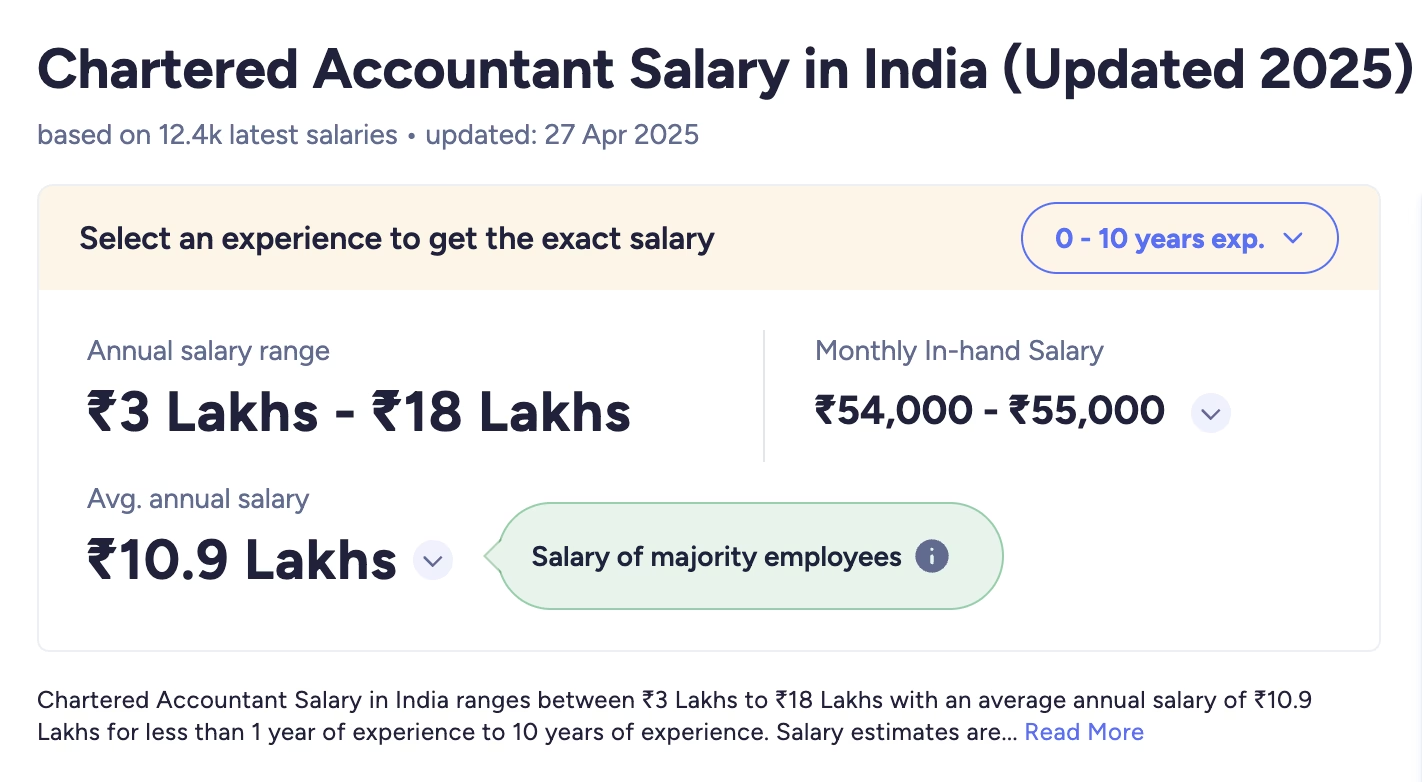
Source of Reference for Chartered Accountant Salary in India – AmbitionBox.
2. Association of Chartered Certified Accountants(ACCA)
The ACCA qualification is a wonderful way to start a career in accounting and finance because it is a globally recognised course with industry-relevant content. It consists of three levels and requires extensive practice and training to complete. Online coaching institutions like Zell Education can help you complete the ACCA course with flying colours.
Eligibility: Candidate must be at least 18 years old and pass the 10+2 examination with a minimum of 65% in Mathematics, Accounts, and English, as well as at least 50% in other subjects.
Scope: ACCA offers a variety of job options both globally and in India. With major firms and MNCs, an ACCA-certified individual can work as an accountant, financial planner, or management consultant.
Jobs and Salary: After completing the ACCA course, the salary ranges from INR 6 to 8 lpa, depending on the profile.
Job profiles that an ACCA professional can work in:
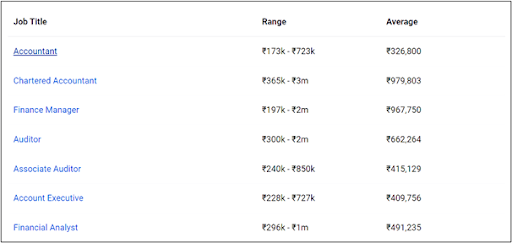
Source of Reference for Job Profiles an ACCA Professional Can Work: PayScale
3. Certified Management Accountant (US CMA)
One of the most popular international certification programs for accountants is the Certified Management Accountant (US CMA). The course duration is anywhere from 6 months to 4 years.
Eligibility: A student in their first year of college can also appear for these examinations. However, for the completion of this course, and to achieve your CMA certification, you do need to complete your graduation.
Scope: The CMA is internationally recognised and well-known for its work prospects on a global scale in the field of management accounting.
Jobs and Salary: The average salary is around INR 7 lpa and candidates can work in various financial institutions, banks, auditing firms, etc.
Job profiles a US CMA can choose to work in:
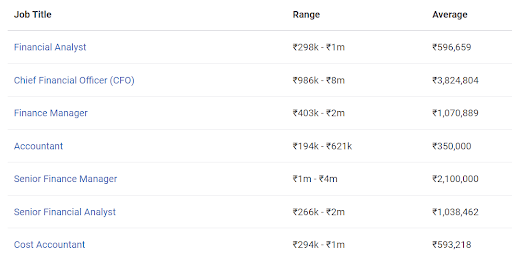
Source of Reference for Job Profiles: A US CMA can choose to work: PayScale
Join 10,000+ students who transformed their careers with us
 Compare All Courses
4. US Certified Public Accountant Course (US CPA)
The US CPA license is awarded by The American Institute of Certified Public Accountants (AICPA), which is a US-based accounting body. The course covers accounting topics such as laws, taxes, and principles, among others. The US CPA license qualifies you as an accounting specialist and opens up a world of possibilities.
Eligibility: To be able to give the US CPA exam, a candidate must have 120 credits, whereas, for the licensee, you need 150 credits. In India, the most qualifications that make you eligible for the US CPA Exam.
- Exam – Graduation + 1 year of Post Graduation (120 credits)
- Licensee – Graduation + post-graduation (150 credits)
Scope: It is an internationally recognised exam, so it opens a wide range of job opportunities in top MNCs and businesses, where candidates can work as accountants, public accountants, and cost accountants.
Jobs and Salaries: When working for businesses like EY, Deloitte, KPMG, PwC, and others in India, US CPA salaries range from INR 6 to 8 lpa.
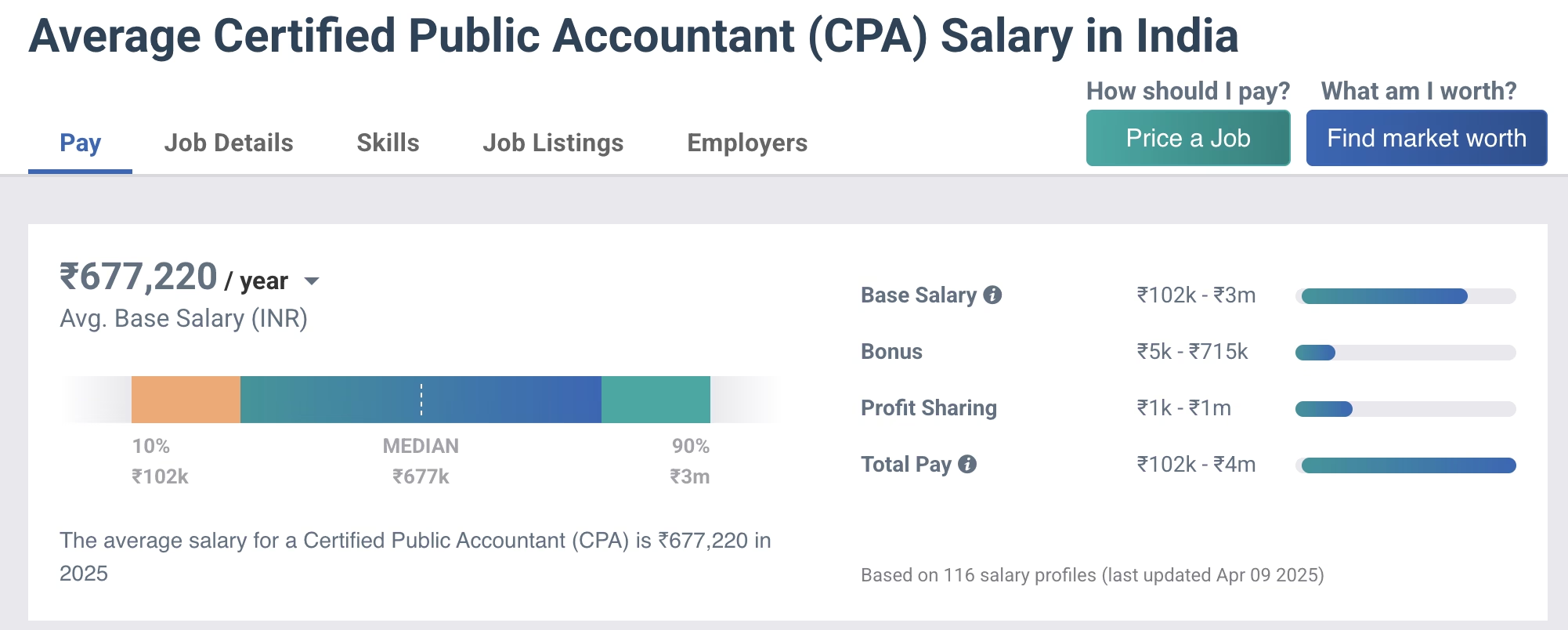
Source of Reference for Average CPA Salary in India: PayScale
5. Certified Financial Planner (CFP)
Certified Financial Planner (CFP) Course Details: This course is ideal for individuals interested in comprehensive financial planning, including investment, insurance, retirement, tax, and estate planning.
Eligibility: To enrol in the CFP program, a candidate must have a bachelor’s degree from a credible college or university. Additionally, candidates must complete specific financial planning education programs approved by the CFP Board and have three years of full-time professional experience in financial planning or a related field.
Scope: The CFP certification opens doors to a wide range of career opportunities in various sectors, including banking, investment firms, insurance companies, and financial planning firms.
Jobs and Salary: Job roles for CFPs include Financial Planner, Investment Advisor, Wealth Manager, and Estate Planner. The average starting salary for a CFP in India ranges from INR 4 to 6 LPA, and with experience, it can rise significantly, often reaching INR 15 to 25 LPA or higher.
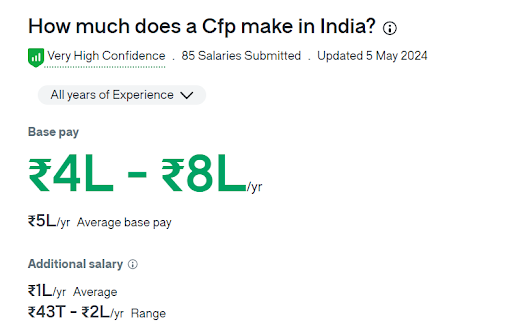
Source of Reference for Average CFP Salary in India: Glassdoor
6. Company Secretary (CS) Course Details
The Company Secretary (CS) certification is a professional course that prepares individuals for the role of a company secretary, which involves ensuring a company’s compliance with legal and regulatory requirements and managing corporate governance.
Eligibility: To enrol in the CS program, candidates must have completed their 12th or equivalent qualification in any stream from a recognised school or board. Graduates from any discipline can also pursue the CS course.
Scope: The CS certification opens up opportunities in various sectors, including corporate houses, financial institutions, government organisations, and regulatory bodies. A certified company secretary can work in roles that involve corporate law advisory, corporate governance, compliance management, and secretarial audit.
Jobs and Salary: CS professionals are in demand across many industries. Job roles include Company Secretary, Legal Advisor, Corporate Planner, and Compliance Officer. Reputed companies such as Reliance, TCS, Infosys, and various law firms actively seek CS-certified professionals. The starting salary for a CS in India ranges from INR 4 to 6 lpa, and with experience, it can increase significantly, often reaching INR 12 to 20 lpa or higher.
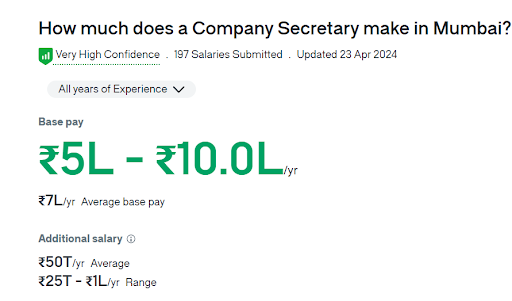
Source of Reference for Average CS Salary in India: Glassdoor
Hiring Companies: Top companies and organisations hiring CS professionals include Reliance Industries, Tata Consultancy Services (TCS), Infosys, Wipro, and various multinational corporations and law firms. These companies value the legal and compliance expertise that CS professionals bring to the table.
7. B.Com in Accounting and Finance
Bachelor of Commerce (B.Com) in Accounting and Finance is a three-year undergraduate program. It is a course that covers the essentials of accounting and financial management.
Eligibility: The only requirement for B.Com is 12th or equivalent qualification in any stream from a recognised school and board with a minimum score of 50%.
Scope: As every firm needs someone to deal with accounting, this course allows you to work in any field. As a result, you can work in a range of sectors and open many doors. A student can pursue M.Com and MBA degrees after finishing B.Com to gain additional management abilities and advance their career.
Jobs and Salary: B.Com Accounting and Finance graduates have a wide range of job options in India, as they are often in demand by SBI, KPMG, and EY, among others, for job roles such as accounting managers, auditing assistants, etc. Depending on the position, company, college, and skills, the starting salary of a B.Com graduate can fall anywhere between the range of INR 2 to 4 lpa.
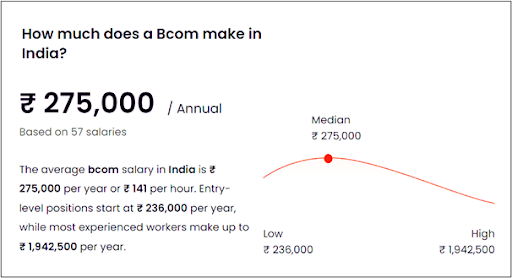
Source of Reference for Average B.Com Salary in India: Talent
8. Cost Management Accounting Course
It is a three-level course that is conducted by the Institute of Cost Accountants of India (ICAI). To work as a cost accountant, candidates must pass all the exams that test one’s accounting skills.
Eligibility: An applicant must pass their class 12th exams with at least a 50% score from a recognised board.
Scope: After completing the CMA course, you can work in consulting businesses, financial institutions, research organisations, government regulatory agencies, and more.
Jobs and Salary: The average starting salary of a cost accountant in India is anywhere between INR 5 and 9 lpa.
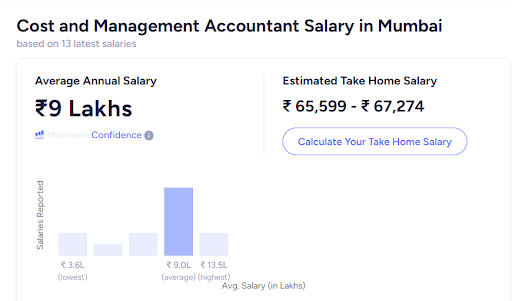
Source of Reference for Average CMA Salary in India: Payscale
9. M.Com in Accounting and Finance
The Master of Commerce (M.Com) in Accounting and Finance program is a two-year postgraduate study in accounting and finance. It is a higher degree of systematic study focusing on specialised finance and accounting subjects such as financial accounting, cost accounting, and so on.
Eligibility: Anyone with a BCom, BBA, BCA, or another accounting bachelor’s degree can apply for the MCom program after meeting the cut-off score requirement of the institution.
Scope: It can assist you to enhance your accounting and finance career and move you to a senior position within the company. An MCom degree can help you gain professional communication, management, and leadership skills to pace up your career with a good position and package.
Jobs and Salary: An M.Com degree can help you get a job as an assistant accounting manager, finance consultant, or cost accountant, among other positions. The remuneration ranges from INR 4 to 6 lpa.
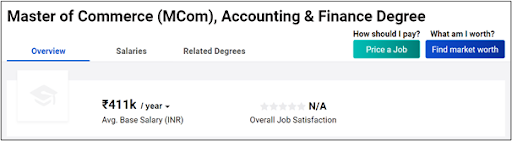
Source of Reference for Average M.Com Salary in India: Payscale
10. Certified Information Systems Auditor (CISA)
The Certified Information Systems Auditor (CISA) certification is a globally recognised qualification for professionals who audit, control, monitor, and assess information technology and business systems.
Eligibility: To pursue the CISA certification, candidates should have a minimum of five years of professional work experience in information systems auditing, control, or security. Waivers of up to three years are available for certain qualifications and degrees, such as a university degree or a master’s degree in IT.
Scope: The CISA certification equips professionals with the skills to manage vulnerabilities, ensure compliance, and institute controls within enterprises.
This certification is ideal for individuals seeking careers in IT auditing, security management, risk management, and governance. CISA-certified professionals can work in various sectors, including finance, healthcare, government, and technology.
Jobs and Salary: CISA-certified professionals have a wide range of job opportunities, including roles such as IT Auditor, Information Security Manager, IT Compliance Manager, and Risk Analyst. Prominent companies like Deloitte, PwC, EY, KPMG, and various government agencies actively seek CISA-certified professionals.
The starting salary for a CISA in India typically ranges from INR 6 to 12 lpa, and with experience, it can significantly increase to INR 15 to 30 lpa or higher.
Hiring Companies: Top companies and organisations hiring CISA-certified professionals include Deloitte, PricewaterhouseCoopers (PwC), Ernst & Young (EY), KPMG, IBM, and various multinational corporations and government bodies. These companies value the expertise in IT audit and security that CISA-certified professionals bring to their organisations.
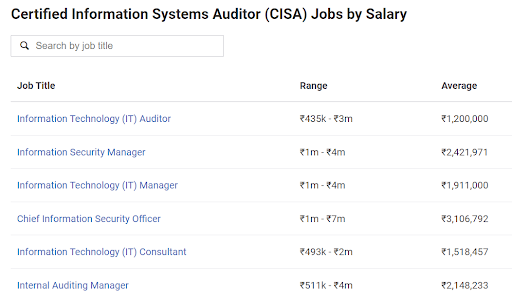
Source of Reference for Average CISA Salary in India: Payscale
11. Diploma in Accounting and Finance
A Diploma in Accounting and Finance is a specialised program designed to provide students with a strong foundation in accounting principles and financial management. This course is ideal for individuals looking to gain practical knowledge and skills for a career in the financial sector.
Eligibility: To enrol in a Diploma in Accounting and Finance, candidates typically need to have completed their 12th grade or an equivalent qualification in any stream from a recognised school or board. Some institutions may require a minimum score of 50% in the qualifying examination.
Scope: The diploma course prepares students for various roles in the accounting and finance sector. It opens up opportunities in multiple industries, including banking, corporate finance, investment, and consultancy.
Jobs and Salary: They are in demand by companies like SBI, KPMG, and EY for positions such as accounting assistants, auditing assistants, financial analysts, and tax consultants. Depending on the job role, company, and individual skills, the starting salary for diploma holders can range from INR 2 to 4 lpa.
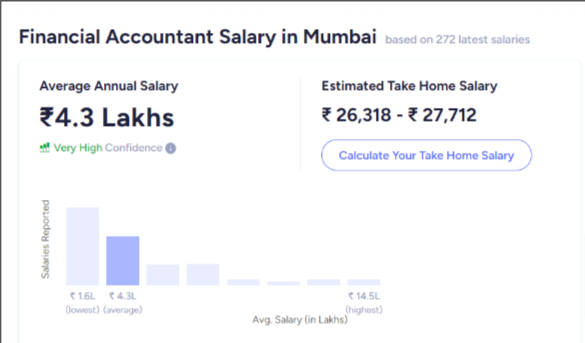
Source of Reference for Average Diploma in Accounting and Finance Salary in India: Payscale
Hiring Companies:
Companies that frequently hire diploma holders in accounting and finance include State Bank of India (SBI), KPMG, Ernst & Young (EY), PricewaterhouseCoopers (PwC), and various multinational corporations and financial institutions.
Such companies value the practical knowledge and skills that graduates bring to their organisations, making this diploma a valuable stepping stone in the financial sector.
12. Diploma in IFRS
This is a three-month program that can be completed concurrently with other accounting certifications. It equips the students with an in-depth knowledge of the International Financial Reporting Standards (IFRS).
Eligibility:
To qualify for this Diploma course, you need to meet one of the following criteria –
- Two years of relevant accounting experience and a relevant law degree
- Two years of relevant accounting experience and a certificate in International Financial Reporting
- Three years of relevant accounting experience
Scope: As this may be done while seeking another qualification or employment, it can help you achieve a wide range of opportunities from all over the world.
Jobs and Salary: After specialising in this field and gaining industry experience of 6 to 8 years, your earning potential can rise to INR 8 to 10 lpa or above.
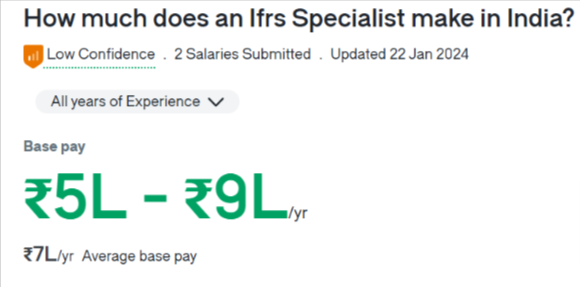
Source of Reference for Average Diploma in IFRS Salary in India: Glassdoor
13. Financial Modelling
A bachelor’s degree in Financial Modelling could take around 3 to 4 years, whereas a diploma course will take around 1 to 2 years, and if you happen to choose a short-term online course, then expect a learning journey as short as 2 weeks. Here are some of the major concepts you’ll be learning if you combine your CFA degree with a Financial Modeling course.
Eligibility: Since the Financial Modelling Course can be pursued either as an undergraduate degree, postgraduate degree, diploma degree, or short-term certificate course, the eligibility criteria for each of them differ.
Here are the course-wise eligibility criteria to help you prepare better for Financial Modelling courses.
- Undergraduate: 10+2 From a recognized university
- Postgraduate: Bachelor’s Degree From a Recognised University
- Certificate: 10+2 From a recognized university
- Diploma: 10+2 From a recognized university
Scope: Financial modelling plays a significant part in running a successful business with the right decision-making processes. The process of financial modelling consists of forecasting a company’s financial performance by considering factors like demand, supply, pricing, operational cost, past revenue, customer behaviour, etc., and then combining it with the calculations of the effect.
Financial modelling typically considers variables like the company’s past performance, growth, and risk assumptions to estimate its valuation or compare it with industry peers.
Jobs and salary: Pursuing a course in financial modelling equips you with the skills required for entry-level jobs in Financial Planning and Analysis, Equity Research, Investment Banking, Credit Research, and many more.
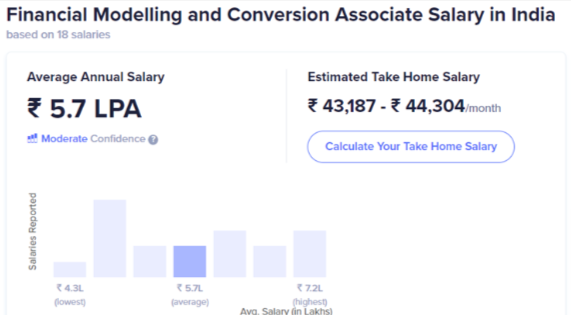
Source of Reference for Average Conversion Associate Salary in India: Payscale
14. Chartered Financial Analyst (CFA)
The Chartered Financial Analyst (CFA) program is a globally recognised credential offered by the CFA Institute (USA). It focuses on investment management, financial analysis, and portfolio management, making it ideal for those aiming for careers in banking, investment, and finance. The course covers topics like ethical standards, financial reporting, economics, and portfolio management.
Eligibility: Candidates must have a bachelor’s degree (or be in the final year of the bachelor’s program) or have a combination of work experience and education totalling four years to enrol for the CFA course.
Scope: A CFA charter opens doors to a wide range of finance-related careers, including investment banking, asset management, portfolio management, and risk analysis. It is highly valued by top financial firms worldwide.
Jobs and Salary: CFA charterholders are hired by companies like JP Morgan, Goldman Sachs, Morgan Stanley, and BlackRock. They can work as financial analysts, investment managers, portfolio managers, and risk analysts. The starting salary for a CFA Level 1 candidate typically ranges from INR 6 to 10 lpa, and it can rise significantly to INR 20 to 40 lpa with experience and completion of higher CFA levels.
15. Certified Fraud Examiner (CFE)
The Certified Fraud Examiner (CFE) certification is awarded by the Association of Certified Fraud Examiners (ACFE) and specialises in fraud prevention, detection, and investigation. It is globally recognised and highly regarded in industries requiring strong risk management and compliance.
Eligibility: Candidates should have a bachelor’s degree and two years of professional experience related to fraud detection or prevention. They must also be an associate member of ACFE.
Scope: A CFE certification permits professionals to work in roles related to forensic accounting, internal auditing, fraud risk consulting, and corporate compliance across sectors like banking, insurance, and corporate governance.
Jobs and Salary: Certified Fraud Examiners are often employed by companies like Deloitte, EY, PwC, KPMG, and government agencies. Common roles include fraud analyst, forensic accountant, and compliance officer. The starting salary for a CFE professional in India generally ranges from INR 6 to 10 lpa, with senior professionals earning upwards of INR 15 to 25 lpa.
16. Tally ERP 9 Training Course
Tally ERP 9 is one of India’s most popular accounting software solutions, widely used by businesses for financial management. A Tally course equips students with practical skills in managing financial transactions, GST compliance, inventory, and payroll.
Eligibility: To enrol in a Tally ERP 9 course, candidates typically need to have completed their 12th grade or an equivalent qualification. Basic knowledge of accounting principles is an added advantage.
Scope: Tally ERP 9 certification is beneficial for candidates seeking entry-level accounting roles or for those aiming to manage small business finances. It can also act as a stepping stone for individuals planning to obtain further certifications in accounting and finance.
Jobs and Salary: Tally-certified professionals are in demand by companies like Infosys, Accenture, and HDFC Bank for roles like accounts executive, data entry operator, and junior accountant. The starting salary ranges from INR 2 to 4 lpa, depending on the job role, skills, and organisation.
17. MBA in Accounting and Finance
An MBA with a specialisation in Accounting and Finance is a postgraduate degree designed to prepare students for leadership roles in financial management, investment banking, consulting, and corporate finance.
Eligibility: Candidates must hold a bachelor’s degree with at least 50% marks from a recognised university. They also need to qualify in entrance exams like CAT, MAT, XAT, or GMAT, depending on the institution’s admission requirements.
Scope: An MBA in Accounting and Finance helps students gain advanced skills in strategic management, corporate finance, international finance, financial modelling, and taxation. Graduates can work in senior positions across industries such as banking, consulting, investment, and insurance.
Jobs and Salary: Top companies like Goldman Sachs, Deloitte, ICICI Bank, and EY hire MBA graduates for roles like financial analyst, investment banker, finance manager, and business consultant. The average starting salary for MBA graduates ranges from INR 7 to 12 lpa, and it can rise significantly to INR 20 lpa or more with experience and expertise.
How to Choose the Right Accounting Course for You?
Identify Your Career Goals
Begin by assessing where you see yourself professionally in the next five to ten years. Whether you aspire to work in auditing, investment banking, or management accounting, your career goals will help determine the most suitable course.
Evaluate the Course Content
Thoroughly review the syllabus and curriculum of different accounting courses. Choose a course that offers thorough coverage of subjects aligned with your interests and the skills currently demanded in the job market.
Consider the Global and Local Recognition
Depending on your personal and professional duties, you can choose between full-time, part-time, or online courses. Many accounting courses now offer flexible learning modes that allow you to balance work and study effectively.
Assess the Time and Financial Investment
Consider how much time and money you are willing to invest. Some courses, like CA or CFA, require several years of study and significant financial resources, while others, like Tally certifications, can be completed in a few months.
Analyze Job Market Demand
Research the current demand for professionals in your chosen field. Look for industries or roles where accountants are highly sought after, and select a course that equips you with skills relevant to those opportunities.
Consider Flexibility and Learning Mode
Depending on your personal and professional commitments, choose between full-time, part-time, or online courses. Many accounting courses now offer flexible learning modes that allow you to balance work and study effectively.
Future Outlook of Accounting Careers in India
Increased Demand for Specialised Skills
As businesses grow more complex, there is an increasing need for accountants with specialised skills in areas like forensic accounting, financial analytics, taxation, and risk management.
Impact of Automation and Artificial Intelligence
Technological advancements are automating routine accounting tasks. As a result, future accountants must develop expertise in data analytics, AI-driven software, and strategic financial planning to stay relevant.
Emergence of New Roles
New roles such as sustainability accounting, financial data analysis, and regulatory reporting are emerging. Accountants who adapt to these evolving roles will find themselves at the forefront of the profession.
Globalisation of Accounting Standards
With globalisation, there is a move toward harmonised accounting standards like IFRS. Accountants familiar with international practices will be better positioned to work with multinational firms and global markets.
Growth of the Startup Ecosystem
India’s booming startup ecosystem demands accountants who can manage fundraising, compliance, and financial strategy. This creates exciting opportunities for finance professionals in dynamic, fast-paced environments.
Opportunities in Public and Government Sectors
Public sector undertakings (PSUs), government departments, and regulatory bodies like the RBI and SEBI also require skilled accountants. These sectors offer stable careers with opportunities to contribute to nation-building initiatives.
Final Thoughts
If you are planning to pursue a career in Accounting and Finance, there are numerous pathways that you can take. If you are interested in any of these courses or are looking for some guidance about your career, you can check out the courses at Zell Education and reach out to us for any queries.
FAQs on Accounting Courses in India
What are the best accounting courses in India for growth?
The most respected are CA, CPA, and ACCA. CA is essential for Indian practice, while CPA and ACCA offer better global mobility and Big 4 job potential. It depends on your career geography!
Which accounting course offers the highest salary package initially?
Globally recognised courses like CPA and CFA generally command the highest starting salaries (₹8–12 LPA) in MNCs. Zell Education focuses on securing these top-tier placements for its students.
Which accounting course can be done after 12th commerce?
CA Foundation and ACCA (Knowledge Level) are the most popular options right after 12th grade. You can also start a B.Com or BBA, which provides the necessary foundation for further certifications.
Which accounting course is short-term but highly valued?
The US CMA is highly valued and quick, often completed in 6–9 months. This is ideal for graduates who want a fast-track route into a management accounting career.
Which accounting qualification is recognised internationally by MNCs?
ACCA and US CPA are widely accepted in over 180 countries and highly valued by Multinational Corporations (MNCs) and international Big 4 firms operating in India.
What course is best for specialising in Taxation and Auditing?
Chartered Accountancy (CA) is the most comprehensive qualification for expertise in Indian tax laws, financial auditing, and corporate compliance within the country.
Where can I get the best coaching for global certifications?
Look for institutes with high pass rates, expert faculty, and placement support. Zell Education is known for providing structured mentorship and resources for ACCA and CPA candidates in India.
Is it really possible to learn accounting in just 3 months?
You can learn accounting fundamentals and basic concepts in 3 months with dedication. Think bookkeeping, financial statement basics, and perhaps some software like Tally.

Current Role
Co-Founder & CEO at Zell Education
Education
- ACCA – Association of Chartered Certified Accountants, Finance (2011 – 2014)
- Bachelor of Commerce (BCom), Financial Markets from H.R. College Of Commerce & Economics (2010 – 2013)
Location
Mumbai, India
Expertise
ACCA Certified
Why Zell?
- • Largest Provider for Global F&A Courses
- • 4.6 Google Review Rating
- • 1000+ Students placed Annually
- • 500+ Active Hiring Partners
- • Placement Opportunities at the Big 4
- • 100+ Global & Indian Rank Holders
- • 100+ Faculty Network
Speak to A Career Counselor
Zell's 10th Anniversary Offer - Avail a 10% Scholarship