
Key Takeaways
- ACCA SBL stands for ‘Strategic Business Leader’.
- The ACCA Strategic Business Leader (SBL) paper is at the Strategic Professional Level.
- The SBL curriculum focuses on strategic benefits, risks, and ethical implications.
Comprehensive Guide: ACCA SBL Study Guide
- What is the ACCA SBL exam?
The strategic business leader assesses the application of leadership, strategy, governance and professional skills.
- What is the ACCA SBL Syllabus?
The syllabus covers strategy, leadership, governance, risk, technology and ethics.
- What is the SBL exam format?
The SBL exam is a single paper, built around an integrated case study.
- How many marks are in SBL Professional Skills?
Twenty marks are given for communication, analysis, scepticism and evaluation.
- How many marks are in SBL Technical Marks?
Technical marks constitute 80% of the total score for your exam and are designed to test your core knowledge of the syllabus.
- What is the best SBL exam strategy?
Regular practice of case studies would significantly enhance your time management and professional judgement.
Ready to Pass ACCA SBL on Your First Attempt?
 Connect with Mentor
What Is ACCA SBL?
ACCA SBL, or the ACCA Strategic Business Leader, is the final case study exam in the Strategic Professional level. It is a measure of how future finance leaders apply knowledge from a boardroom perspective to solve complex business challenges.
The paper does not test isolated concepts but rather executive judgement, strategic thinking, communication skills and decision-making skills expected of a senior consultant or business leader.
How SBL Replaced P1 and P3
The SBL full form is Strategic Business Leader, a paper designed to combine the former P1 and P3 exams into one integrated business simulation. Students exploring what ACCA is today should understand that ACCA now emphasises practical decision-making, leadership, and commercial awareness.
This approach is more aligned with workplace expectations and helps develop skills which are in-demand by employers in multiple industries around the globe.
Key Facts at a Glance (Duration, Marks, Pass Rate)
The table below gives a summary of the key facts about this ACCA exam, including the mandatory pre-seen.
| Metric | Details |
| Exam Duration | 3 hours 15 minutes |
| Total Marks | 100 marks |
| Technical Marks | 80 marks |
| Professional Skills Marks | 20 marks |
| Pass Mark | 50% |
| Average Global Pass Rate | Approximately 50% |
| Pre-Seen Material | Mandatory and released before the exam |
Source for SBL exam details: ACCA Global/SBL Guidance
ACCA SBL Syllabus: Core Areas Explained
The ACCA SBL syllabus mirrors how real organisations operate, progressing from internal leadership responsibilities to external strategic decisions. Its structure is practical and logical and designed to help students develop business judgement required for senior management and advisory roles.
Leadership, Governance and Ethics
- Understand stakeholder analysis and how competing interests influence corporate decisions.
- Apply agency theory to evaluate relationships between shareholders, management, and governance structures.
- Assess corporate social responsibility (CSR) initiatives and their strategic implications.
- Evaluate professional ethical frameworks, fiduciary duty, and board composition requirements when advising organisations effectively.
Strategy, Innovation and Digital Transformation
- Evaluate strategic choices that strengthen competitive positioning within evolving global markets.
- Analyse competitive disruptions and responses driven by changing customer expectations.
- Assess how big data supports informed decision-making and organisational performance improvements.
- Examine e-business infrastructure, disruptive technology, and cloud solutions driving transformation.
- Recognise digital transformation trends frequently tested across recent examination sessions.
Risk Management, Control and Technology
- Apply structured risk assessment and monitoring processes to identify emerging risks.
- Apply risk mitigation matrices to effectively reduce operational and strategic threats.
- Evaluate internal control systems that support governance, compliance and accountability.
- Evaluate cybersecurity policies that protect enterprise assets, information and stakeholder interests.
- Balance entrepreneurial growth opportunities with responsible risk management recommendations professionally.
Learn How Top Students Clear ACCA SBL Successfully
 Enquire Now
ACCA SBL Exam Format and Mark Allocation
The ACCA SBL exam is not a calculation paper in the traditional sense but tests professional judgement, communication and decision-making. Success is not only about technical knowledge but also about how well you analyse situations, structure responses and communicate recommendations in realistic business contexts.
80 Technical Marks vs 20 Professional Skills Marks
Understanding the marking structure helps students prioritise preparation effectively today.
| Component | Marks | Assessment Focus |
| Technical Marks | 80 | Demonstrate appropriate syllabus knowledge and business application |
| Professional Skills Marks | 20 | Evaluate communication, analysis, scepticism, judgement, and commercial awareness |
| Pass Mark | 50 | Combined score from both assessment components |
| Exam | 100 | Real-world business decision-making and recommendations |
Exam Session Dates and Pre-Seen Release Timeline
This ACCA exam is conducted through quarterly sessions, with official pre-seen material released exactly two weeks prior to the examination date.
| Item | Timeline | Student Action |
| ACCA exam Sessions | March, June, September, December | Plan preparation around quarterly sessions. |
| Pre-Seen Material Release | Two weeks prior to exam date | Download and review immediately. |
| Preparation Tip | Before release day | Mark calendars early to avoid missing this critical update. |
How to Use the ACCA SBL Pre-Seen Material
The pre-seen dossier is your biggest advantage before exam day. Following this ACCA guide approach helps you understand the business environment early, reducing reading pressure and decision-making panic inside the ACCA examination centre while creating stronger links between case facts and strategic analysis.
Step 1 – Understand the Business Context, Not Memorise It
Treat the case study company as a real organisation requiring your advice. Focus on understanding its market position, industry competition, revenue sources, growth opportunities, and operational constraints. Read the dossier like a newly appointed management consultant assessing business realities rather than memorising isolated facts, figures, or details.
Step 2 – Identify Recurring Themes and Connect Them to Syllabus Areas
Ignore specific facts and look for common problems businesses face in the story. The operational weaknesses, governance issues, technology limitations or stakeholder conflicts are often directly linked with the ACCA SBL syllabus topics. Instead of focusing on one issue, highlight these red flags and think about their larger strategic implications.
Step 3 – Apply the Frameworks to the Case Company
Apply the case company directly to frameworks like SWOT analysis, PESTEL, and Porter’s Five Forces. Use them to develop thinking about business realities and strategic choices. Do not memorise model definitions for exam use; successful answers tailor framework insights to the organisation’s specific circumstances and challenges.
How to Score Professional Skills Marks
ACCA SBL rewards candidates who demonstrate professional judgement and stakeholder-focused communication throughout their answers. These marks often separate a disappointing 48-mark result from a confident 65-mark pass by proving you can think, evaluate, and communicate like a business leader.
The Five Professional Skills and What the Examiner Looks For
Examiners reward candidates who tailor communication style to the audience and context.
| Professional Skill | What It Means | What the Examiner Looks For |
| Commercial Acumen | Practical business awareness | Realistic recommendations linked to business outcomes |
| Skepticism | Questioning assumptions and data | Identification of risks, gaps, or unsupported claims |
| Analysis | Investigating trends and issues | Logical examination of causes and consequences |
| Evaluation | Weighing advantages and disadvantages | Balanced judgments supported by evidence |
| Communication | Presenting information clearly | Appropriate tone, structure, and audience focus |
Match your writing style to the requested format, whether it is a board memo, report, email, letter or press release.
Answer Structure Template That Earns Professional Marks
A structured presentation improves readability and immediately creates a more professional impression for examiners.
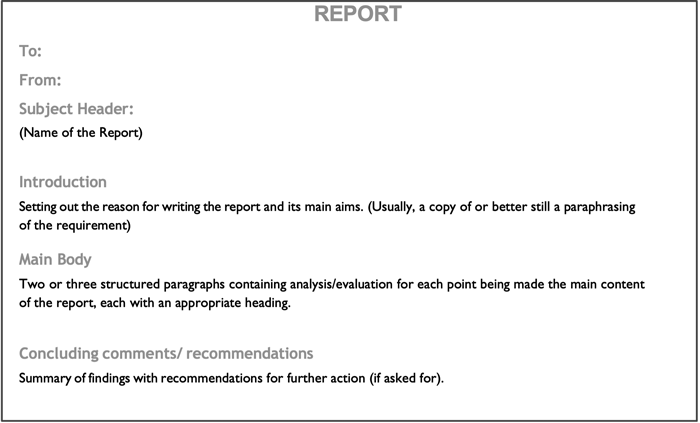
Reports
The following is a sample structure template for reports
Presentation Slides
The following is a sample structure template for presentation slide headers. 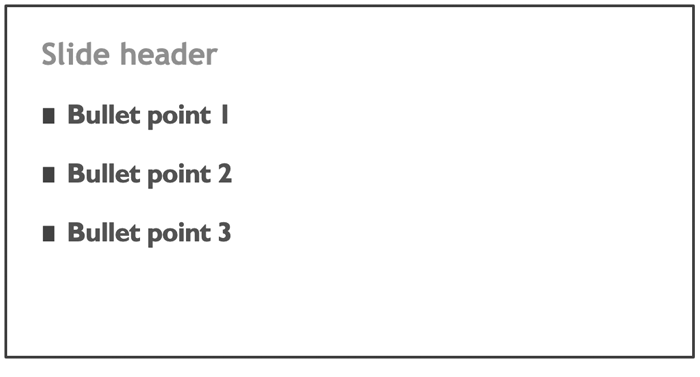
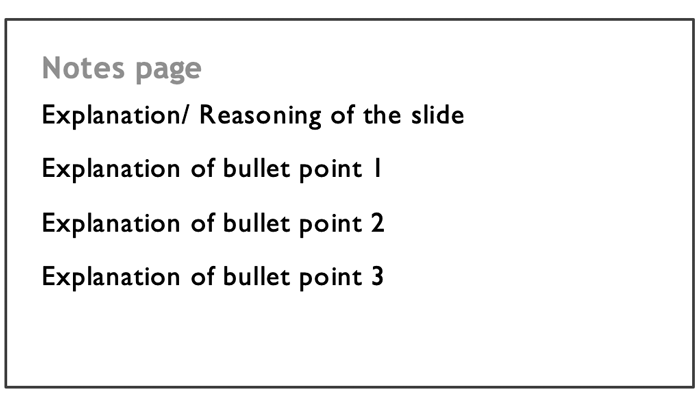
Notes Page
The following is a sample structure template for a notes page.
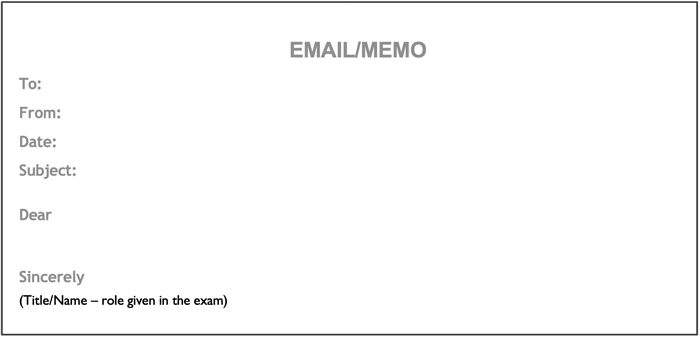
Email/Memo
The following is a sample structure template for an email/memo.
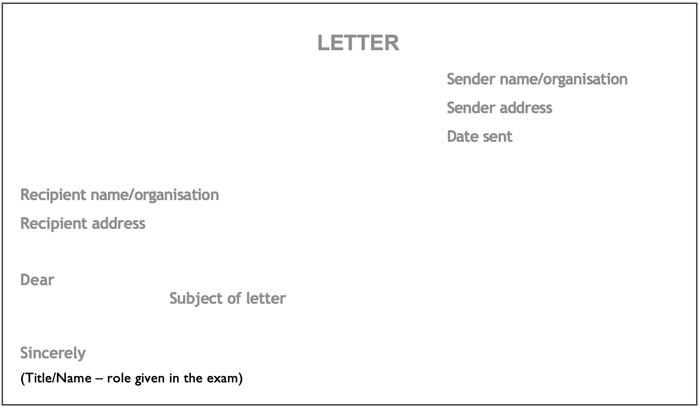
Letter
The following is a sample structure template for a letter.
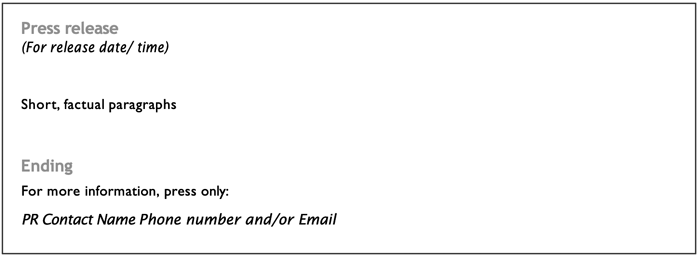
Press Release
The following is a sample structure template for a press release.
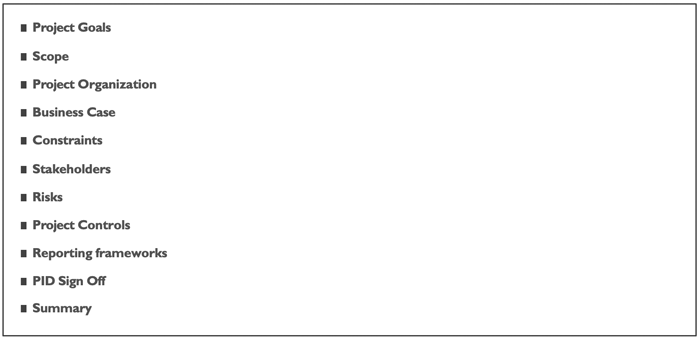
Project Initiation Document (PID)
The following is a sample structure template for a PID.
Source for ACCA SBL answer structure: ACCA Global/Exam Support Resources
ACCA SBL Study Plan: Phase-by-Phase Breakdown
A structured preparation journey makes success far more achievable. Follow this phased approach to progress smoothly from foundational understanding to advanced application and finally reach peak exam readiness with confidence and clarity.
Phase 1 – Develop Knowledge Framework
- In this ACCA course module be sure to spend your first few weeks laying down a good conceptual foundation.
- Learn the fundamentals of business strategy, governance structures, internal auditors, and measuring financial risks.
- Don’t take too much time taking notes, but try to understand.
Zell Education is one such high-quality learning platform that can help you grasp concepts faster and prepare you for your career in the global landscape.
Phase 2 – Application of Case Study & Practice Questions
- Learn the fundamentals and then move into application.
- Try the past exam questions in relaxed conditions on the ACCA global practice platform.
- Before talking about solutions, focus on applying concepts to real business situations.
Always answer your own answer first, and then study examiner reports carefully to understand common mistakes and improve professional judgement.
Phase 3 – Mock Exams and Practice of Exam Technique
- For the final stage of preparation, complete at least two full-length ACCA SBL mock exams under strict 3-hour 15-minute conditions.
- Make every session like the real exam to build stamina and manage time better.
This is the phase where you should never skip pre-seen analysis, as mock performance will often show weaknesses in your preparation that need to be fixed immediately.
Best Study Materials for ACCA SBL: BPP vs Kaplan
Both publishers are excellent choices for preparation. Select the resource matching your learning preferences and combine it with this comprehensive ACCA guide strategy.
| Feature | BPP | Kaplan |
| Learning Style | Detailed and technical | Clear and accessible |
| Content Depth | Extensive coverage | Focused coverage |
| Explanations | In-depth analysis | Simplified explanations |
| Layout | Information-rich | Student-friendly |
| Question Practice | Comprehensive | Structured and practical |
| Best For | Detail-oriented learners | Visual and concise learners |
| Overall Verdict | Excellent preparation resource | Excellent preparation resource |
Top Reasons Why SBL Questions Are Answered Poorly
Ensure that knowledge is not blindly dumped and every piece of content used in the answer is linked to the scenario provided.
- Prioritise answers while managing the time during the examination and divide your time accordingly on the basis of requirements.
- Answer according to the requirement and write about the role mentioned for which you have been asked to prepare.
- By following the above-mentioned guidelines, your chances of getting high grades in the ACCA SBL examination will definitely be improved.
Conclusion
The Strategic Business Leader paper, abbreviated as SBL, is a major milestone in becoming a future-ready business leader. This is a practical ACCA course for students who are considering ACCA and looking up professional qualifications. It develops strategic thinking, commercial awareness and decision-making skills in the workplace that are highly valued by employers across a range of industries.
It’s about consistent preparation, sharp exam technique and expert tuition. Ready to fast-track your journey? Connect with Zell Education for certified mentorship, personalised mock feedback, and complete preparation support aligned with ACCA global standards to help you move confidently toward long-term career success and leadership opportunities.
FAQ on ACCA SBL
Is ACCA SBL Harder Than Other Strategic Professional Papers?
ACCA SBL is challenging due to its integrated, case-study-based assessment approach.
What Is the Pass Rate for ACCA SBL?
ACCA SBL typically records one of the highest (48% to 53%) strategic professional pass rates.
How Many Hours of Study Does ACCA SBL Require?
Most students require 120–180 study hours to prepare effectively for SBL.
Can I Pass ACCA SBL Through Self-Study?
Yes, disciplined self-study with practice and exam technique can be sufficient.
When Is the Pre-Seen Material Released?
The pre-seen material is usually released approximately two weeks before exams.
What Happens If I Fail ACCA SBL?
You can retake ACCA SBL in a future session without restrictions.

Current Role
Co-Founder & CEO at Zell Education
Education
- ACCA – Association of Chartered Certified Accountants, Finance (2011 – 2014)
- Bachelor of Commerce (BCom), Financial Markets from H.R. College Of Commerce & Economics (2010 – 2013)
Location
Mumbai, India
Expertise
ACCA Certified
Why Zell?
- • Largest Provider for Global F&A Courses
- • 4.6 Google Review Rating
- • 1000+ Global Placement Partners
- • Placement Opportunities at the Big 4
- • 100+ Global & Indian Rank Holders
- • 100+ Faculty Network
- • 10,000+ Students Placed
Speak to A Career Counselor

Professionally reviewed by Harshit Morparia, ACCA & Executive at Ernst & Young
Zell's 10th Anniversary Offer - Avail a 10% Scholarship