
Key Takeaways:
- ACCA certification has excellent demand internationally for jobs in accounting via ACCA Global, while CFA is more suited for finance jobs and investment banking.
- ACCA or CFA will depend on your career aspiration, where ACCA is for a steady career in accounting and CFA is better for a fast-growing career in finance.
- ACCA eligibility criteria that students can enrol in after clear grade 10 make it more approachable than CFA, which is based on graduation and better suited for Finance Professionals.
Comprehensive Summary on ACCA vs CFA:
- What career paths are they suitable for? It really depends on which career paths you wish to undertake after achieving the necessary qualification.
- Details of ACCA: The ACCA is a global organisation which has created a qualification for accountants. The abbreviation stands for The Association of Chartered Certified Accountants.
- Eligibility for ACCA or CFA: The age range at which you can commence studies towards the ACCA is as young as 12, whereas to achieve a CFA requires a minimum level of an undergraduate degree before you can begin your studies.
- Cash Compensation: In India, ACCAs typically earn ₹6-15 lakh per year, and CFA holders make upwards of ₹8-25 lakh based on their level of expertise or what sort of job title they hold.
- Job Availability: Both ACCA and CFA hold jobs in accounting and finance (and have multiple job opportunities worldwide and in India).
- Deciding Between ACCA and CFA for Your Career: The best way to determine whether you want to pursue the ACCA or CFA qualifications will be based on what type of job role you want to work in, either accounting or a finance job, to achieve financial wealth.
At first, it can seem difficult to determine which to choose: ACCA or CFA? Both are respected qualifications in finance that have an international presence; however, they lead to two very different paths in terms of the types of jobs that you will perform.
If you have been asking: What is ACCA? How does ACCA compare with CFA? Which qualification provides better earning potential, growth prospects, and scope? This blog will provide you with clarity.
Talk to an Expert About ACCA & CFA Today
 Call Now
 Key Factors to Consider When Comparing ACCA vs CFA
You should consider the following points before deciding between ACCA and CFA certifications.
- Career goals: accounting or investment finance
- Duration of program & difficulty level
- Potential salary for ACCA and CFA
- Global recognition by organizations
- Eligibility requirements
- Job opportunities available to you in India and outside of India
Overview: ACCA vs CFA at a Glance
The overview of ACCA vs CFA is the following:
| Feature | ACCA | CFA |
| ACCA Full Form | Association of Chartered Certified Accountants | Chartered Financial Analyst |
| Focus Area | Accounting, auditing, taxation | Investment, finance, portfolio management |
| Difficulty | Moderate to High | High |
| Levels | 3 levels (13 exams) | 3 levels |
| Duration | 1.5 to 3 years | 2 to 3 years |
| Global Body | ACCA Global | CFA Institute |
| Eligibility | Cleared grade 10 | Graduation required |
| Career Path | Accountant, Auditor | Investment Banker, Analyst |
| Salary Range | INR 6–15 LPA | INR 8–25 LPA |
What is ACCA?
The ACCA is an international accounting body that represents chartered and certified accountants.
The certification provided by ACCA is one of the premier accounting certifications in the world that focuses on all of the disciplines of accounting (Accounting, Auditing, Tax, and Financial Management).
- This qualification has recognition in over 180 different countries.
- Extraordinarily good qualifications for a career in accountancy and finance.
- Admissions are continually sought after by all of the “Big 4” accounting firms.
Who is ACCA Best For?
ACCA is ideal for:
- Those aiming for global accounting roles
- Candidates targeting Big 4 firms
- Students interested in accounting and finance
- Commerce students after 12th
What is CFA?
What is CFA? CFA is Chartered Financial Analyst designation is a global certification in the fields of investment management, financial analysis and portfolio management.
The CFA Program is offered through the CFA Institute, has a strong reputation among finance and investment banking organisations, and is considered to have a tremendous track record of providing high salaries.
Regarding who the CFA designation is best for:
- Individuals who work in the stock market
- Financial analysts who are focused on data
- Someone interested in the finance field
- Someone who is trying to get into investment banking
Breaking Down the Differences: ACCA vs CFA
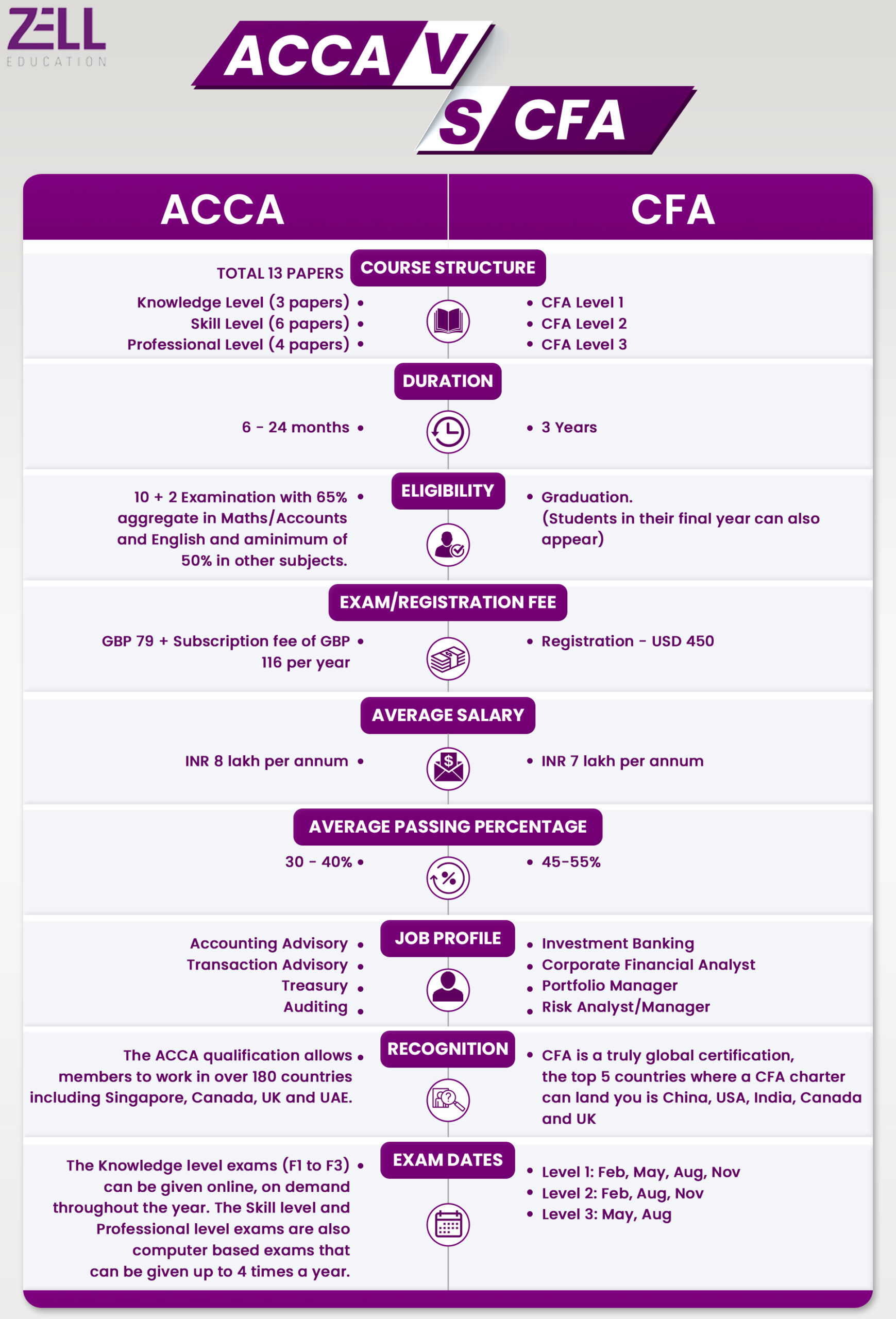
The ACCA certification program is dedicated to all aspects of accounting, auditing, and taxation.
Whereas CFA focuses on Investment Management, Financial Services and Portfolio Management careers.
- Acca is best suited for commerce graduates from 12th grade onwards; however, CFA requires completion of a college/university degree before enrolment.
- CFA typically provides higher compensation than the average ACCA; however, ACCA offers more job opportunities across multiple industries than does the CFA designation.
ACCA vs CFA Detailed Comparison Table
| Factor | ACCA | CFA | What This Means for You |
| Focus Area | Accounting, audit, taxation | Investment, finance, portfolio management | Choose ACCA if you like accounting; choose CFA for finance roles |
| Global Recognition | Recognised in 180+ countries via ACCA Global | Highly valued in the global finance industry | Both are global, but CFA is stronger in investment banking |
| Duration | 1.5 to 3 years | 2–3 years | ACCA is faster to complete |
| Eligibility | After 10th (ACCA eligibility is flexible) | Graduation required | ACCA gives an early-career start |
| Exam Structure | 13 exams across 3 levels | 3 levels | ACCA has more exams; CFA has deeper analysis |
| Regional Demand | UK, India, Europe | USA, global finance hubs | Choose based on where you want to work |
| Difficulty Level | Moderate to high | High | CFA is generally tougher due to analytical depth |
| Exam Pass Rate | 40–50% | 20–25% | CFA is more competitive |
| Professional Experience | 3 years required | 4 years required | Both require work experience for certification |
| Study Style | Structured (ACCA Global resources) | Self-study + coaching | CFA needs more independent study discipline |
| CPE Requirement | Required | Required | Continuous learning needed in both |
| Specializations | Audit, tax, accounting | Portfolio management, equity research | Career direction differs significantly |
| Job Roles | Accountant, auditor, tax consultant | Investment banker, analyst, portfolio manager | Roles are completely different |
| Networking | Strong global accounting network | Strong finance & investment network | Both offer valuable global exposure |
Course Structure
ACCA: 13 ACCA papers are broken down into three levels: Applied Knowledge, Applied Skills, and Strategic Professional. It spans a broad area of topics on financial and management accounting, taxation, and audit, hence giving the candidate an overall and comprehensive overview of the different aspects of accountancy and finance.
CFA: The CFA program is divided into three levels concerning financial analysis and investment management. It emphasises investment tools, asset valuation, portfolio management, and ethical standards, everything that a finance professional could want in their life.
Global Recognition
ACCA: ACCA certification has recognition in over 180 different countries and is greatly preferred by employers because of its wholesome approach to accounting and financial management. It appeals to careers in accounting, finance, and audit in most industries around the world.
CFA: The CFA certification is the flagship of investment management, and it has an enormous regard among finance professionals worldwide. It proves to be exceedingly helpful in getting senior-level jobs in investment banking, portfolio management, and financial analysis; it has high recognition across more than 160 countries.
Scope of ACCA vs CFA
The major difference between the scope of ACCA vs CFA is the sector or industry they are involved with. The ACCA-qualified professionals are engaged with the finance and accounting sectors, while CFA-qualified professionals are engaged in investment banking sectors. If you are interested in financial accounting, you can opt for ACCA. However, if you are interested in investment and portfolio management, you can shift towards CFA.
Exam Format
ACCA has 13 exams in 3 levels:
- Applied Knowledge: 3 papers (BT, MA, FA) – 2-hour online MCQs anytime.
- Applied Skills: 6 papers (LW, PM, TX, FR, AA, FM) – 3-hour mixed questions quarterly.
- Strategic Professional: 4 papers (SBL, SBR + 2 options) – 3-4 case studies quarterly.
CFA has 3 levels:
- Level I: Two 2+ hour sessions, 180 MCQs on basics/ethics. 4 times/year.
- Level II: Two 88-min sessions, 88-item sets on valuation. 3 times/year.
- Level III: AM essays + PM item sets on portfolios. 3 times/year.
Salary
Generally, the salary of a CFA is more than that of an ACCA. However, the salary of a professional is largely dependent upon work experience, location, companies, and other additional qualifications.
Entry-level salaries
- ACCA: Freshers with an ACCA certification can expect a starting salary of around INR 4 to 8 lakhs per year.
- CFA: The starting salary for a CFA in India is typically around INR 4–10 lakhs per year.
Mid-career salaries
- ACCA: Mid-career ACCA professionals can earn around INR 8–20 lakhs per year
- CFA: Mid-career CFA professionals can earn around INR 12–30+ lakhs per year
Senior-level salaries
- ACCA: Senior ACCA professionals can earn around INR to 35 lakhs or more per year
- CFA: Senior CFA professionals can earn around INR 25 to 50 lakhs or more per year
Source for ACCA salaries and CFA salaries – Glassdoor
Chat on WhatsApp for ACCA & CFA Details
 Get Instant Help
ACCA vs CFA Career Opportunities
When the choice must be made between ACCA vs CFA, it should be realised that the difference lies in career choice. Both ACCA and CFA have excellent job prospects, but they cater to different niches in the financial domain. You should pick the one that aligns with your career aspirations the best.
ACCA Job Opportunities
- Auditor
- Tax consultant
- Financial accountant
- Risk manager
CFA Job Opportunities
- Equity research analyst
- Financial analyst
- Investment banker
- Portfolio manager
Which Qualification Gives Faster Entry into the Job Market?
- ACCA → Faster entry (can start early)
- CFA → Slower but higher-paying roles
Choosing Between CFA and ACCA
Choosing between CFA and ACCA requires considering your long-term career goals and what particular aspect of finance or accounts you want to specialise in. Both come with their distinctive advantages and open up different career paths.
What Are the Benefits of Studying ACCA?
- From the completion of 12th grade
- Globally work as an accountant
- Demand is high at Big Four firms
- Good prospects of salary growth over a period of time
What Are the Benefits of Studying CFA?
- Can invest all over the world
- High demand for CFAs in financial markets
- High-salaried financial career opportunities can be reached
Can You Pursue Both ACCA and CFA Together?
Yes, but it’s challenging.
- ACCA + CFA = Powerful combo
- Best for advanced finance + accounting careers
ACCA vs CFA Cost Implications
The cost implications for ACCA vs CFA are the following:
| Cost Factor | ACCA | CFA |
| Total Cost | INR 3.5 to 5.5 Lakh | INR 3.5 to 4.5 Lakh |
| Coaching | Optional | Often required |
| ROI | High | Very High |
ACCA vs CFA Salary Comparison in India
ACCA salary vs CFA salary comparisons in India are the following:
| Experience | ACCA Salary | CFA Salary |
| Fresher | INR 4 to 8 LPA | INR 4 to 10 LPA |
| 3–5 Years | INR 8 to 20 LPA | INR 12 to 30 LPA |
| 5–10 Years | INR 12 to 25+ LPA | INR 20 to 45+ LPA |
Role-wise Salary Breakdown: ACCA vs CFA in India
| Role | ACCA Salary | CFA Salary |
| Auditor | INR 4 to 9 LPA | — |
| Accountant | INR 6 to 10 LPA | — |
| Financial Analyst | INR 5 to 12 LPA | INR 15 to 30 LPA |
| Investment Banker | — | INR 15 to 50+ LPA |
CA vs CFA vs ACCA: Who Earns More?
| Course | Salary Range |
| CA | Certified CAs Earn a CTC Range of INR 6 to 14 LPA |
| ACCA | Certified ACCAs Earn a CTC Range of INR 6 to 15 LPA |
| CFA | Certified CFAs Earn a CTC Range of INR 8 to 25 LPA |
Who Do Big 4 Firms Prefer — ACCA or CFA?
For firms that are at the forefront, such as the Big 4, i.e., Deloitte, PwC, EY and KPMG, it is role-specific, not qualification-specific.
Why Big 4 Firms Prefer ACCA Candidates
Because of the nature of their main services, accounting and auditing, large SUR firms have many ACCA candidates working for them. Several reasons make ACCA candidates so attractive to such businesses.
Candidates are recognised worldwide, which makes them appealing to multinational companies. They possess good knowledge of accounting and tax standards, are trained in audit and compliance and are well placed for many roles, including the following:
- Auditor.
- Tax Consultant.
- Financial Accountant.
Why Big 4 Firms Prefer CFA Candidates
It’s common for practitioners in big accounting firms to recruit CFAs to particular finance functions. Reasons CFA candidates are recruited include the following:
- Analysis and valuation skills for investment.
- Understanding investment and the market world.
Appropriate positions:
- Financial Analyst
- Valuation Analyst
- Corporate finance advisor
Rising Demand for CFA and ACCA Certification in India
As the country aligns with international economic standards and as financial markets evolve, there is a growing demand for ACCA and CFA certifications in India. Businesses and financial institutions have an ever-increasing need for professionals who have expertise with international standards. CFA and ACCA provide excellent training and global recognition, both of which can help with career progression in the finance and accounting professions and offer some very good job opportunities domestically and internationally.
CFA and ACCA Difficulty: Challenges and Solutions
CFA and ACCA are two of the most prestigious certifications. CFA concentrates on investment management and needs strong analytical skills along with the ability to grasp complex notions of finance.
Challenges
- CFA → Low pass rate
- ACCA → Multiple exams
Solutions
- Consistent study plan
- Mock tests
- Coaching support
Conclusion
ACCA or CFA, which one is better? The right qualifications for ACCA and CFA will depend on a definitive career vision and focused niche areas of finance or accounting. Both come with some unique advantages; ACCA is suitable for making an all-around accounting and finance qualification with global acceptance, which most importantly proves to be versatile in application in diverse industries.
CFA is the gold standard for investment professionals and is, without a doubt, comprehensive in its focus on knowledge and competencies in the field of investment management and financial analysis.
FAQs on ACCA vs CFA
Is the CFA exam difficult?
The CFA (Chartered Financial Analyst) exam is difficult, as it has a difficult level of passage with around 20-25% pass rates.
CFA vs. ACCA: which is better?
ACCA is best suited for someone wishing to pursue an accounting career, while CFA is the best choice for someone wishing to work in the finance industry.
Do you think ACCA is going to be harder than CFA?
No, the CFA is usually more challenging than the ACCA exam.
Do you get ACCA exemptions from taking the CFA?
There are no exemptions available to you through the CFA that you could get, and vice versa.
How does ACCA certification differ from a traditional degree in Accounting?
Usually, ACCA is much more practical and recognised around the globe than an Accounting Degree from an accredited institution.
Can I do CFA after obtaining an ACCA qualification?
Yes, many people choose to pursue a CFA after obtaining their ACCA qualifications.
Can you pursue CFA and ACCA at the same time?
Yes, however, you will need good time management skills to do this.
Between CFA and ACCA, which provides a better opportunity for careers in India?
They are both valuable in their own way, as both produce candidates with solid credentials and career advancement potential. Generally, CFA candidates have an edge in that they tend to earn higher salaries.
Is ACCA or CFA more cost-effective?
In terms of cost, the ACCA is cheaper than the CFA.
Which of ACCA/CFA has more job options internationally?
Both ACCA and CFA have international opportunities, but ACCA has more opportunities for people in an accounting role compared to CFA International.

Current Role
Co-Founder & CEO at Zell Education
Education
- ACCA – Association of Chartered Certified Accountants, Finance (2011 – 2014)
- Bachelor of Commerce (BCom), Financial Markets from H.R. College Of Commerce & Economics (2010 – 2013)
Location
Mumbai, India
Expertise
ACCA Certified
Why Zell?
- • Largest Provider for Global F&A Courses
- • 4.6 Google Review Rating
- • 1000+ Global Placement Partners
- • Placement Opportunities at the Big 4
- • 100+ Global & Indian Rank Holders
- • 100+ Faculty Network
- • 10,000+ Students Placed
Speak to A Career Counselor

Professionally reviewed by Harshit Morparia, ACCA & Executive at Ernst & Young
Zell's 10th Anniversary Offer - Avail a 10% Scholarship