
This is a comprehensive guide to the MBA in investment banking course, which includes eligibility, syllabus, course duration, career scope, and salary for both Indian and international students. You will also learn how this MBA course compares to other finance courses, such as the CFA and FRM, to help you place this course in the context of other finance courses.
Comprehensive Guide on ‘MBA in Investment Banking’
MBA in Investment Banking
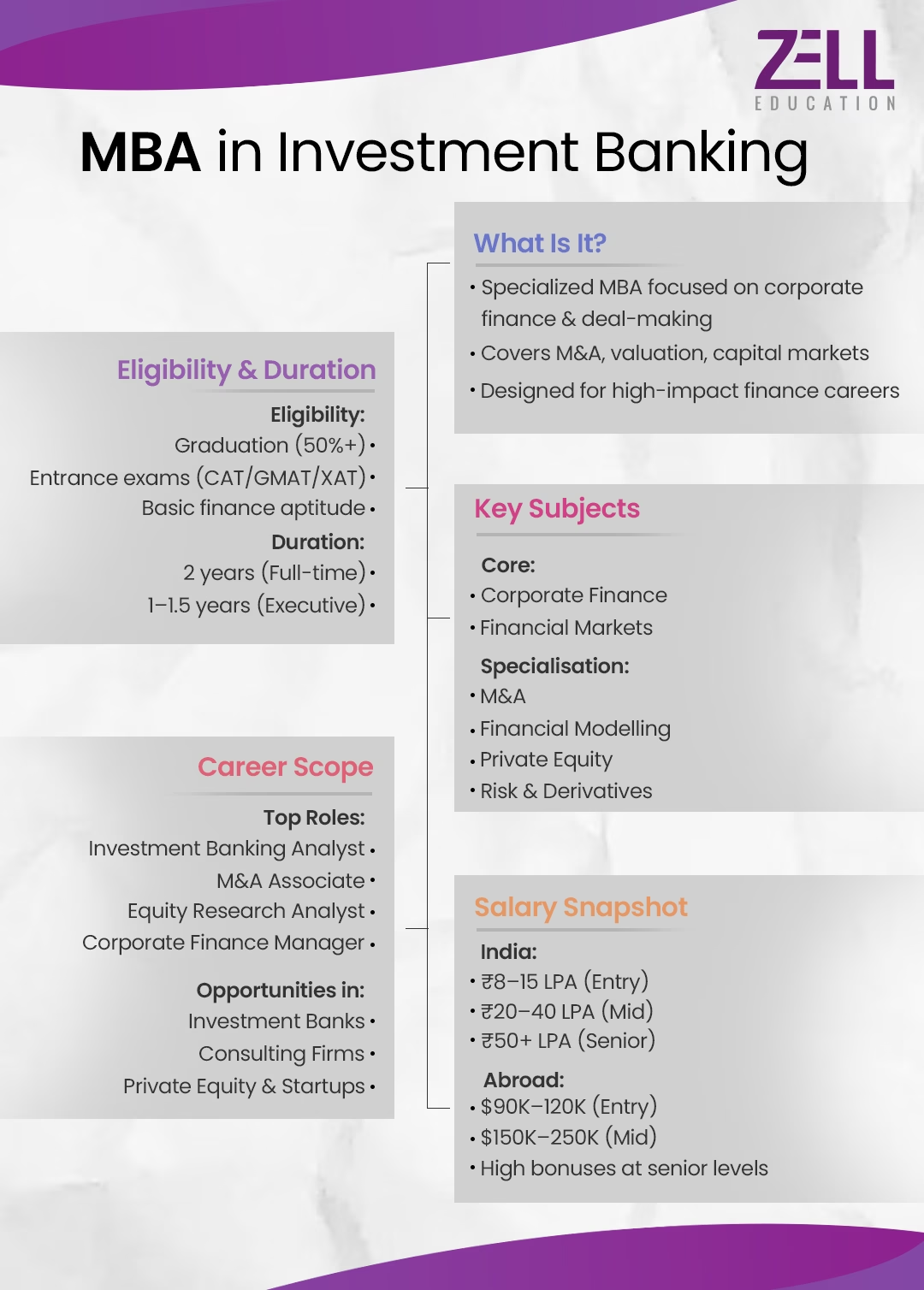
MBA in investment banking is a specialised management program designed to build careers in corporate finance, capital markets, and advisory roles.
Eligibility Criteria
Admission eligibility depends on graduation, entrance exams, and basic finance aptitude.
Investment Banking Syllabus
The syllabus for the course includes valuation, financial modelling, mergers and acquisitions, and capital markets.
Career Scope
The career prospects for those who pursue the course are high. They can find employment in investment banking, consulting, private equity, and corporate finance.
Salary Potential
Investment banker MBA salary increases significantly with experience, role, and geography.
Career Value
An MBA in investment banking offers strong long-term returns for those targeting high-impact finance roles.
Most finance enthusiasts reach a stage where they need more than the security of an entry-level job. They need to be involved in transactions that are worth billions of dollars and be involved in financial decision-making for large corporations. It is at such a point that the need for an MBA in investment banking often comes into consideration, not just as a degree programme, but more so as a passport to one of the most sought-after and rewarding careers in finance.
Before going through the trouble and expense of such a programme, however, it is necessary to understand what such a programme really entails.
What Is MBA in Investment Banking?
The MBA in investment banking is a postgraduate management programme designed to provide advanced training in corporate finance, capital markets, and strategic advisory services. It equips the student for roles such as fundraising, mergers and acquisitions, valuation, and financial restructuring.
To be precise, MBA full form in banking stands for Master of Business Administration, and investment banking refers to a specialised course of study in finance. Unlike other MBA programmes, which are more generalised, this course is more analytical.
What Is the MBA in Investment Banking Eligibility Criteria?
The eligibility criteria for an MBA in Investment Banking may vary from college to college; however, the basic requirements remain more or less the same. Most colleges require the following for admission to the programme:
- A bachelor’s degree in any discipline
- Minimum aggregate marks (usually 50% or above)
- Valid entrance exam scores
- Basic understanding of finance and mathematics
Work experience is preferred but not mandatory for full-time programs.
What Is the MBA in Investment Banking Syllabus?
The investment banking syllabus is designed in a manner that combines management studies with finance concepts, with a high emphasis on deal-making skills, and real-world applications.
What Are the MBA in Investment Banking Core Subjects?
The core subjects aim at creating a solid foundation in finance concepts. The core subjects include:
- Financial Accounting and Reporting
- Corporate Finance
- Financial Markets and Institutions
- Business Economics
- Quantitative Methods for Finance
These core subjects form a major part of the investment banking course.
Hurry! Discover future earnings potential in investment banking!
 Get Full Salary Guide Today
What Are the MBA in Investment Banking Specialisation Subjects?
The subjects that are taught in the specialisation section of the investment banking course are many and include:
- Mergers and Acquisitions
- Equity and Debt Capital Markets
- Financial Modelling and Valuation
- Private Equity and Venture Capital
- Risk Management and Derivatives
The specialisation courses prepare students for roles in investment banking, particularly in the front-end functions.
What Is the MBA in Investment Banking Course Duration & Study Format?
The course duration and mode of study for the MBA in Investment Banking differ depending upon the course structure and candidate profile.
What Is the MBA in Investment Banking Duration?
Course duration for the MBA in Investment Banking:
- 2 years for full-time MBA programs
- 1–1.5 years for executive MBA formats
Accelerated and international programmes may vary in duration.
Full-Time vs Part-Time vs Executive MBA in Investment Banking
The three formats are applicable to different stages of one’s career:
- Full-time MBA: Ideal for freshers and early-career professionals
- Part-time MBA: Suitable for working professionals
- Executive MBA: Suitable for experienced professionals who want to rise to leadership positions
The choice of format for an MBA in investment banking is based on career goals and work experience.
What Is the MBA in Investment Banking Career Scope?
The career scope for an MBA in investment banking is wide and applicable globally. The career options for an MBA in investment banking graduate include various roles within the finance industry, consulting, and corporate strategy.
What Are the MBA in Investment Banking Job Roles?
The job roles for an MBA in investment banking include:
- Investment Banking Analyst
- Associate – Mergers & Acquisitions
- Equity Research Analyst
- Corporate Finance Manager
- Private Equity Associate
These roles demand strong financial modelling and strategic thinking.
What Is the MBA in Investment Banking Career Scope in India?
The career scope for an MBA in investment banking in India is based on:
- Growing startup ecosystem
- M&A activity
- Capital market expansion
The job roles for an MBA graduate include investment banks, the Big 4, and corporate houses.
What Is the MBA in Investment Banking Career Scope Abroad?
The career scope for an MBA in investment banking abroad, especially for the US, UK, and Middle East, includes:
- Investment banking roles offer higher exposure
- Deal sizes are larger
- Global mobility is better
The job roles for an MBA graduate are highly competitive and lucrative.
What Is the MBA in Investment Banking Salary?
The salary is an important factor for an MBA graduate in investment banking. The salary for an MBA graduate in investment banking is high.
MBA in Investment Banking Salary in India
In India:
- Entry-level salary ranges from ₹8–15 LPA
- Mid-level professionals earn ₹20–40 LPA
- Senior roles go beyond ₹50 LPA
MBA in Investment Banking Salary Abroad
Abroad, investment banker MBA salary is significantly higher:
- Entry-level: USD 90,000–120,000
- Mid-level: USD 150,000–250,000
- Senior professionals can also receive bonuses that are higher than their base pay
MBA in Investment Banking Salary by Experience Level
The salary grows rapidly.
- 0–2 years: Analyst roles
- 3–6 years: Associate roles
- 7+ years: VP, Director, Partner
Experience directly impacts compensation.
Launch a high-stakes career with premium finance certification!
 Start Path to Zell Now
Who Are the Top Recruiters for MBA in Investment Banking?
Top recruiters include:
- Global investment banks: Goldman Sachs, J.P. Morgan, Morgan Stanley, Bank of America, Citi, Barclays, UBS, Deutsche Bank, HSBC
- Consulting firms: McKinsey & Company, Boston Consulting Group, Bain & Company, Accenture Strategy, EY-Parthenon, Deloitte
- Private equity & Venture Capital firms: Blackstone, KKR, Apollo Global Management, Carlyle Group, Sequoia Capital, General Atlantic
- Corporate finance divisions: Moelis & Company, Lazard, Evercore, Rothschild & Co, Avendus Capital, Houlihan Lokey
The reputation of the organisation and the skill set of the student are important factors that determine recruitment for an MBA in investment banking.
How Does an MBA in Investment Banking Compare with Other Finance Courses?
The following table shows comparison between MBA in investment banking and other financial courses:
| Criteria | MBA in Investment Banking | MBA Finance | CFA | FRM |
| Focus | Deal-making & advisory | Broad finance | Investment analysis | Risk management |
| Duration | 2 years | 2 years | 2–4 years | 1–2 years |
| Practical Exposure | High | Moderate | Moderate | Low |
| Career Roles | IB, PE, M&A | Finance roles | Asset management | Risk roles |
MBA in Investment Banking vs MBA Finance
The key difference between an MBA in investment banking and an MBA in finance is that an MBA in finance is a general course that covers corporate finance, financial management, taxation, analytics, and banking operations. The course is flexible and can be chosen by those who are interested in working in the finance industry.
On the other hand, an MBA in investment banking is a specialised course that focuses on deal-making, mergers and acquisitions, valuation, and capital markets. The course can be chosen by those who are interested in working in investment banking, private equity, and corporate advisory roles.
MBA in Investment Banking vs CFA
The CFA is a professional certification that is focused on investment analysis, equity research, portfolio management, and asset valuation. It is theory-intensive and is most appropriate for roles in asset management, mutual funds, and investment analysis.
To know more about CFA also read What is CFA? Full Form, Meaning and Course details 2026
An MBA in investment banking, on the other hand, is a professional degree that is focused on practical experience in financial deals such as IPOs, mergers and acquisitions, and fundraising. While one enhances their analytical skills through the CFA, an MBA in investment banking equips one with skills that make them fit for client-facing roles in investment banks and financial advisory firms.
MBA in Investment Banking vs FRM
The FRM is a globally recognised professional certification that is focused on risk management. It covers market risks, credit risks, operational risks, and compliance. It is most appropriate for professionals who prefer analytical roles in banks and financial institutions.
To know more about FRM also read What is FRM? Full Form, Course Details & Fees
An MBA in investment banking, on the other hand, is focused on growth-orientated financial activities such as valuation, capital structuring, and financial advisory. While one is expected to manage risks in roles in financial analysis and banking, investment banking is focused on creating deals and growing businesses and is most appropriate for professionals seeking financial decision-making roles.
Is MBA in Investment Banking Worth It?
For individuals seeking an MBA in investment banking, it is worth it for those individuals who perform well in fast-paced and dynamic environments and have analytical and strategic skills. It is worth it for those individuals seeking a rapid growth curve and exposure to global financial centres. It is not worth it for individuals seeking a passive experience and easy routes to success.
While it is true that an MBA in investment banking is worth it for individuals seeking rapid growth and exposure, it is important to note that it is not an easy route, and one is expected to put in long hours and have competition and upskilling as part of their experience.
Conclusion
An MBA in investment banking is a career accelerant for those aspiring to be at the centre of financial decision-making across the globe. From the investment banking course material to the salary packages of investment bankers, the course, along with an MBA in Finance certification, comes with its own challenges and rewards. The real key to success lies in choosing the right institution, preparing for the competition, and understanding the realities of the role.
FAQs on MBA in Investment Banking
What is the eligibility for MBA in investment banking?
Graduation with minimum required marks and valid entrance exam scores are mandatory.
Which entrance exams are required for MBA in investment banking?
CAT, GMAT, XAT, and other institute-specific exams are commonly accepted.
What is the syllabus of MBA in investment banking?
The syllabus includes corporate finance, valuation, M&A, and capital markets.
What is the career scope after MBA in investment banking?
Graduates can work in investment banks, consulting firms, PE funds, and corporates.
What salary can I expect after MBA in investment banking in India?
The Investment banker MBA salary in India typically starts from ₹8–15 LPA and grows rapidly with experience.

Current Role
Co-Founder & CEO at Zell Education
Education
- ACCA – Association of Chartered Certified Accountants, Finance (2011 – 2014)
- Bachelor of Commerce (BCom), Financial Markets from H.R. College Of Commerce & Economics (2010 – 2013)
Location
Mumbai, India
Expertise
ACCA Certified
Why Zell?
- • Largest Provider for Global F&A Courses
- • 4.6 Google Review Rating
- • 1000+ Students placed Annually
- • 500+ Active Hiring Partners
- • Placement Opportunities at the Big 4
- • 100+ Global & Indian Rank Holders
- • 100+ Faculty Network
Speak to A Career Counselor
Zell's 10th Anniversary Offer - Avail a 10% Scholarship