
The Financial Risk Manager (FRM) designation operates as an internationally accepted certification which recognises risk specialists. The certification verifies professionals’ abilities to handle financial risks through their evaluation of market and credit and operational risk domains, which leads to in-demand employment opportunities at major international banking institutions.
Comprehensive Summary on ‘What is FRM’?
- FRM Full Form: FRM stands for Financial Risk Manager, a globally recognised professional qualification awarded by the Global Association of Risk Professionals (GARP).
- FRM Duration: The course typically takes 12 to 18 months to complete.
- FRM Eligibility: There are no formal eligibility requirements, but a clearing grade in 12th is recommended.
- FRM Course Structure: The FRM program is divided into two parts, Part I and Part II. You must pass Part I before you can take Part II.
- FRM Course Fees: The overall cost is around ₹2–3 lakhs, including registration, exam, tuition, and subscription fees.
- FRM Jobs: 36,000+ jobs are available for an FRM candidate across India.
- FRM Average Salary: FRM professionals in India can expect an average salary between ₹8 and ₹15 LPA, depending on experience and the specific risk domain.
- FRM Class Schedule (Zell): Zell Education offers flexible weekend batches (EMIs start at ₹6,167 per month).
Is FRM right for you? Call now for a 2026 FRM Eligibility Check
 Talk to an Advisor
Introduction and Overview of FRM
Thinking about what it takes to be an elite risk management professional? Introducing the FRM certification, this qualification is a globally recognised badge of expertise in the world of finance. But before learning about the certification, let’s learn about the meaning of FRM.
- FRM helps you climb the corporate ladder in banking, finance, or investment.
- The FRM credential puts you on a course to master the art of risk management.
In this article, we will walk you through
- What is FRM?
- What is the full form of FRM?
- FRM course details
- Its pros and cons
- The FRM exam procedure
- FRM levels
- Financial Risk Manager salary
- FRM in banking
- And Financial Risk Management certification in detail.
As the field of finance evolves at a fast pace, so do careers in finance. One such profession that’s gaining popularity among the others is Financial Risk Management. After the pandemic, it became essential for several companies to risk-proof their financial management.
To do that, it is necessary to have an in-house expert who can analyse all the financial statements of the company and understand the impending risk factors that can be eliminated. FRM is a niche profession to be in and brings exciting challenges for those who possess an interest in this field. Every MNC, fast-growing start-up, and HNI is now sensing the need to hire a Financial Risk Manager.
What is FRM?
We’ll discuss what FRM is, FRM full form, FRM course details, eligibility, pros and cons, the FRM exam procedure, FRM levels, the Financial Risk Manager salary, FRM in banking, and Financial Risk Management certification. They are all discussed at length.
- FRM full form – Financial Risk Manager (FRM), is a professional certification awarded by the Global Association of Risk Professionals (GARP). Experts recognise it worldwide as the standard of expertise in financial risk management.
- The Financial Risk Management certification is for people who want to build careers in risk-related fields. This includes areas like market risk, credit risk, operational risk, and investment management.
- The FRM certification is highly regarded within the financial industry. The course is often sought by professionals working in banking, asset management, insurance, consulting, and regulatory agencies.
If you are interested in taking up this course, then here’s everything you need to know about this course.
Watch the Video on “What is FRM?”
FRM Course Details
Now, what is the meaning of FRM? FRM stands for Financial Risk Manager. A professional designation provided by the Global Association of Risk Professionals to individuals showing expertise in handling financial risk.
The program is divided into two parts:
- Part I FRM: Part 1 of FRM teaches you the tools to analyse the topics in Part 2. This section covers the essentials. You will focus on quantitative analysis, risk management principles, financial markets, and valuation models.
- Part II FRM: And now you put all these tools you have learnt to work. This part teaches real-world applications with market, credit, and operational risk, even the newest trends in financial markets.
You can complete the FRM syllabus within a year, but generally, it takes 1.5 to 2 years to finish. The exams are now conducted three times a year, in May, August, and November, providing candidates with more flexibility to plan their studies at various locations around the world.
| Differentiators | Financial Risk Management |
| Organising Body | GARP: Global Association of Risk Professionals |
| Course Duration | 1 to 2 years |
| Difficulty Level (passing percentage) | 45% for Part I and 63% for Part II |
| Eligibility Criteria | An undergraduate in the final year of their degree can also apply for the FRM course. However, you need to clear your part 1 to appear for the part two examinations. Within the 5 years of your learning journey, you must also have 2 years of relevant work experience. |
| Career Scope | Job profiles you can explore
|
| Top Hiring Firms |
|
FRM Curriculum Updates: What is New for 2026?
The 2026 FRM curriculum emphasises real-world application because it teaches students to model practical risks through actual risk assessment work instead of teaching them theoretical concepts.
- The 62 existing chapters of Part I maintain their original structure but now require students to demonstrate advanced “calculative” skills needed for Quantitative Analysis.
- Part II has undergone a significant transformation with 12 new chapters and a total of 107 readings which show essential new financial themes through their coverage of Artificial Intelligence in Capital Markets and Private Credit and Tokenisation and the new 2026 financial environment.
If you are interested in taking up this course, then here’s everything you need to know about this course.
Watch the video on “What is FRM?”
FRM Course Eligibility
There aren’t any strict requirements for joining the FRM program! While it does help to have a background in finance, economics, or mathematics. Anyone interested in risk management can enrol.
You can appear in the Part 1 exam as early as in the 1st year of your college. However, to obtain a certificate, you need to complete both parts of the exam within 4 years of applying for Part 1. Along with having a minimum of two years of relevant work experience to earn the highly respected FRM title.
Advantages vs. Disadvantages of FRM
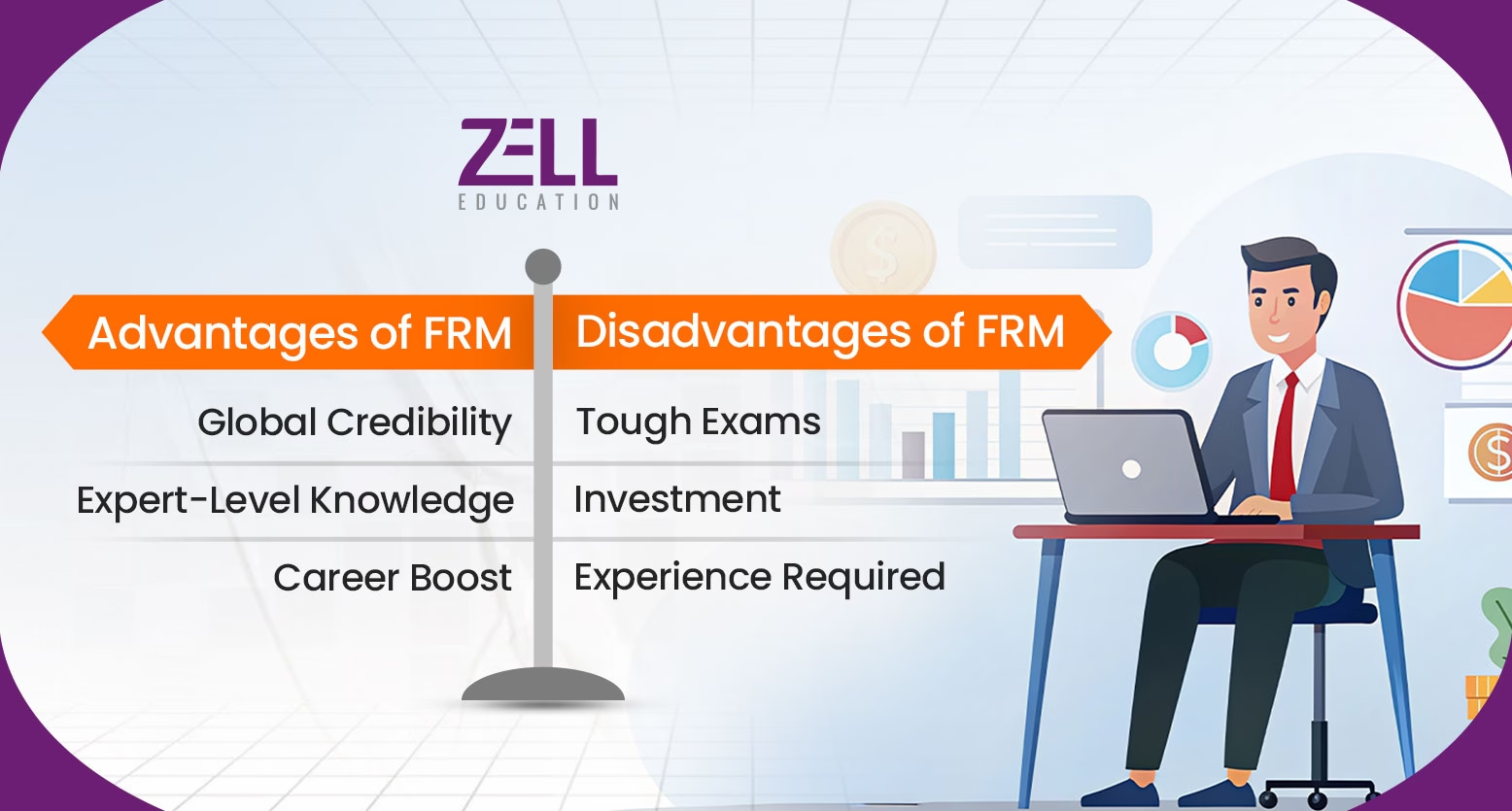
FRM offers global prestige and high-salary potential in risk management. However, it requires intense dedication to master complex quantitative concepts and demands significant study hours to clear its two rigorous levels.
Advantages of FRM
Some pros of doing FRM are mentioned below:
- Global Credibility: It is like having a golden ticket for any risk management job around the world.
- Expert-Level Knowledge: You will gain specialised knowledge that many industries need. This is especially true in banking, insurance, and investment.
- Career Boost: Generally, holders of the FRM qualification progress career-wise at faster rates and usually command higher salaries.
Disadvantages of FRM
Some cons of doing FRM are mentioned below:
- Tough Exams: The exams are manageable but not simple. They require careful preparation and study time.
- Investment: Be it time or money, the preparation involved for FRM is not cheap.
- Experience Required: If you are a fresher, needing two years of work experience may feel like a setback.
So, is FRM certification the correct option for you? Is risk management something that interests you? Financial Risk Management might be the career stimulus you are looking for!
Chat now to unlock an exclusive discount on FRM coaching
 Chat on WhatsApp
FRM Exam Pattern
The process of FRM certification includes passing two sequential exams: FRM Part 1 and FRM Part 2. These exams have been specifically designed to test the candidate’s knowledge and understanding of concepts, techniques, and tools about financial risk management.
- FRM Part 1: This part provides the candidate with the foundation necessary in risk management, consisting of four major topics: Foundations of Risk Management, Quantitative Analysis, Financial Markets and Products, and Valuation and Risk Models.
The part 1 paper brings one hundred multiple-choice questions, and it is held in May and November. The duration of the exam is four hours.
- FRM Part 2: FRM Part 2 expands on topics introduced in Part 1 and goes on to discuss the actual implementation of risk management strategies. Market Risk Measurement and Management, Credit Risk Measurement and Management, Operational Risk and Resiliency, Liquidity and Treasury Risk Measurement and Management, and Risk Management and Investment Management will be discussed.
The format of this test for Part 2 comprises 80 multiple-choice questions, and the dates of examination for both parts are the same.
What does the FRM Syllabus Include?
The syllabus is discussed in detail below; please note that the weightage of each subject in percentage is written beside their name in brackets.
FRM Part 1
- Foundations of Risk Management (20%): Understand the concept of risk, the role of the risk manager, corporate governance, and the foundations of financial risk management techniques.
- Quantitative Analysis (20%): Probability theory, statistics, time series analysis, and regression analysis are major areas within the domain of risk management.
- Financial Markets and Products (30%): Encompasses the diverse financial markets, including equities, fixed income, derivatives, and foreign exchange.
- Valuation and Risk Models (30%): Covers linear and non-linear option pricing models, fixed income valuation, an introduction to various valuation techniques, and an understanding of key risk models like VaR (Value-at-Risk) and Expected Shortfall.
FRM Part 2
- Market Risk Measurement and Management (20%): This will take an in-depth view of how to measure and manage market risks.
- Credit Risk Measurement and Management (20%): The risk associated with credit exposure assessment and management.
- Operational Risk and Resiliency (20%): It deals with the process of operational risk management and business continuity.
- Liquidity and Treasury Risk Measurement and Management (15%): This section deals with the risks associated with liquidity and treasury management.
- Risk Management and Investment Management (15%): It deals with integrating risk management practices under investment management.
- Current Issues in Financial Markets (10%): Promotes reviewing recent trends, including Climate Risk (ESG), Artificial Intelligence in Risk Management, and digital asset volatility.
What is the Cost of Pursuing FRM?
The cost of pursuing an FRM certification includes registration fees, examination fees, and probable coaching fees. Here’s a breakdown:
FRM Fees for New Candidates
- Enrolment Fee: The first time you enrol for the FRM Program, you will have to pay a one-time enrolment fee of USD 400. The amount is not refundable.
- Examination Fee: The exam fees depend on when you register.
- Early Registration: USD 700 per part
- Standard Registration: USD 900 per part
FRM Fees for Repeat Candidates
Candidates who are returning for a repeat attempt or to take the second part do not have to pay the enrolment fee again. Only the examination fee has to be paid, which remains the same as the above-mentioned, i.e., USD 600–800, depending on the period of registration.
FRM Average Coaching Fee
Though not compulsory, most candidates go for coaching classes to be properly trained for the examinations. On average, FRM coaching classes are going to cost between INR 30,000 and INR 60,000 for each part. The factors that influence the price of coaching include the type of institute one is getting coaching from, the mode of learning, that is, online or offline, and the comprehensiveness of the study materials provided.
Though not compulsory, most candidates go for coaching classes to be properly trained for the examinations. On average, FRM coaching classes are going to cost between INR 30,000 and INR 60,000 for each part. The factors that influence the price of coaching include the type of institute one is getting coaching from, the mode of learning, that is, online or offline, and the comprehensiveness of the study materials provided.
FRM Coaching Fees: Online vs Offline Comparison
The average coaching charge for FRM online and offline classes is listed below:
- Online Coaching: Starting from INR 9000
- Classroom Coaching: Starting from INR 30,000
FRM Career Scope in India & Abroad
Attainment of the Financial Risk Manager certification leads to the opening of a host of career opportunities within India and abroad. With financial systems getting increasingly complex, demand for skilled professionals in risk management is soaring all across the globe.
Career Opportunities in India
Within India, FRMs are highly in demand. Key locations would be financial centres like Mumbai, Delhi, Bangalore, and Hyderabad. Some of the important roles are
- Risk Manager: Mitigate financial risks in the BFSI sectors.
- Credit Risk Analyst: Assess creditworthiness and manage lending risk.
- Market Risk Analyst: Analyse and manage market risks like stock price fluctuations and interest rate fluctuations.
- Operational Risk Manager: Identify and mitigate the risks arising out of internal processes and external events.
- Investment Risk Manager: Manage risks in investment portfolios.
From ICICI Bank and HDFC Bank to Kotak Mahindra Bank and Axis Bank, almost all leading banks in the country and international banks with operations in India, like Citi and HSBC, look for FRMs amongst other qualifications. Even consulting firms like Deloitte, KPMG, EY, and PwC consider FRM as one of the more important qualifications.
Career Opportunities Aboard
This qualification is considered very prestigious and well-compensated abroad, especially in New York, London, Hong Kong, Singapore, and Dubai. One can find employment in the following areas:
- CRO: Chief Risk Officer; oversees all risk management efforts at an executive level.
- Quantitative Risk Analyst: Develop mathematical modelling to assess and manage risk.
- Portfolio Manager: Balance risk-return in investment portfolios.
- Treasury Manager: Manage liquidity and financial risk for corporations.
- Global Risk Analyst: Manage regional risks for global companies.
These FRMs are also wanted by top global banks: JPMorgan Chase, Goldman Sachs, Morgan Stanley, and such financial firms as BlackRock and Vanguard. The FRM designation is also highly regarded by multinational companies like General Electric, IBM, and Microsoft.
What is the FRM Salary in India?
Financial Risk Manager Salary in India differ based on various factors, including experience, location, and the size of the organisation. The average salary for an entry-level position as a financial risk manager is between INR 600,000 and INR 15,00,000.
]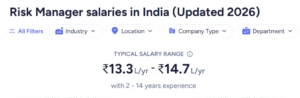
Source for Average Annual FRM Salary in India – AmbitionBox
An FRM certification opens the door to many top jobs and offers high salaries. Salaries for FRM-certified professionals differ significantly from country to country, based on demand in a given financial market. Here is a brief overview of what you can expect as a professional in the FRM field in different countries.
| Countries | Average Salary of a Financial Risk Manager |
| USA | $110,000 to $150,000 |
| UK | £75,000 to £80,000 |
| Canada | CAD 120,000 to CAD 125,000 |
| UAE | AED 60,000 to 63,000 |
| Australia | AUD 145,000 to 150,000 |
Source for FRM Salary Abroad – Indeed
FRM Scholarships
Scholarships are available only to students and faculty at schools that are part of GARP’s Academic Partner Program. The program administrator at partner institutions can nominate up to six students and one faculty member each year.
These nominees will receive a scholarship to cover the registration fees for the FRM Part I Exam. This scholarship supports education in risk management. It provides financial aid to deserving candidates who excel academically.
FRM and Other Certifications
The following table showcases information about other certifications along with FRM:
| Certification | Focus Area | Course Structure | Duration |
| FRM | Financial Risk Management | Two parts: Part I (100 questions), and Part II (80 questions) | 1-2 years |
| CFA | Investment Management | Three levels cover ethics, portfolio management, etc. | 2-4 years |
| CMA | Management Accounting | Two parts: financial planning, analysis, and control | 6-12 months per part |
| CAIA | Alternative Investments | Two levels focusing on hedge funds, private equity | 1-2 years |
Employment Benefits of Earning the FRM Certification
The following are some of the benefits of earning the FRM certification:
- Career Advancement: Acquiring the FRM qualification maximises the opportunity for advancement in risk management areas, thus providing a high-value position in any organisation.
- Higher Salary Potential: The salary for FRM-qualified experts is normally higher as compared to non-qualified counterparts. The finance sector highly regards the relevance of the FRM qualification.
- Global Recognition: The FRM qualification offers global recognition, which makes work opportunities easier across various financial sectors worldwide.
- Proof of Skills: FRM certification shows that a person understands risk management principles. This boosts employers’ confidence in these workers.
- Opportunity to Network: You gain access to a world network of finance professionals by joining GARP. Opening doors to further collaborations and job opportunities.
- Portability: The skills are transferable in many variants of the field, including banking, investment management, and consulting, thus offering flexibility in careers.
Conclusion
The Financial Risk Manager certification can be a career game-changer in finance. The course teaches you the ability to steer through complex financial risks. You will be an instrumental element in organisations. Whether you are starting in risk management or trying to get to the top of the business world around the world. The FRM certification avails the credibility and expertise needed to make a statement in the fiercely competitive job market.
If you love running financial risks or would like to further your career in finance, the FRM will be the right credential for you. It opens doors to some exciting and lucrative career opportunities worldwide. Enrol in Zell Education’s FRM program today!
FAQs on Financial Risk Management (FRM)
What does the Financial Risk Manager (FRM) designation actually involve?
It’s a globally recognised certification that proves your expertise in managing financial risks, awarded by GARP.
What exactly does an FRM professional do on a day-to-day basis?
They assess and mitigate market, credit, and operational risks to protect a company’s financial stability and value.
How many distinct papers or exams are there in the FRM program?
The certification consists of two separate, mandatory exams: FRM Part I (Foundations) and Part II (Application).
Is the FRM curriculum very math heavy, focusing on complex quantitative analysis?
Yes, a strong understanding of statistical and quantitative models is critical, especially in Part I of the FRM.
Who is actually eligible for FRM exams, is a specific degree required?
You don’t need any prior educational requirements to register, but Zell Education advises a strong finance background for the FRM.
Is the FRM exam generally considered very difficult to pass?
With historically low pass rates, yes, the FRM is challenging. Focused coaching from Zell Education can boost your success.
How many hours to pass FRM Part I and Part II should I plan to study?
GARP suggests allocating at least 275 hours of dedicated study time for each part of the demanding FRM exam.
How many years to complete FRM do most people typically take?
Most candidates complete both exams in 1 to 2 years; you must pass Part II within four years of passing Part I.
What is a realistic average FRM salary in India for an experienced professional?
A mid-to-senior level FRM salary in India typically ranges from ₹12 Lakhs to ₹30 Lakhs per annum, depending on the role.
Who are the major firms that hire FRM professionals in India?
Banks, consulting firms like Deloitte and KPMG, and insurance companies actively hire FRM professionals for risk roles.
Is taking the FRM better than CFA (Chartered Financial Analyst)?
FRM is superior for a risk management career; CFA is broader for investment. Zell Education can help you pick the right fit.
What is the total cost of FRM certification including all fees in India?
The total cost of FRM can range from approximately ₹1,20,000 to ₹2,00,000, not including study materials from providers like Zell Education.

Current Role
Co-Founder & CEO at Zell Education
Education
- ACCA – Association of Chartered Certified Accountants, Finance (2011 – 2014)
- Bachelor of Commerce (BCom), Financial Markets from H.R. College Of Commerce & Economics (2010 – 2013)
Location
Mumbai, India
Expertise
ACCA Certified
Why Zell?
- • Largest Provider for Global F&A Courses
- • 4.6 Google Review Rating
- • 1000+ Students placed Annually
- • 500+ Active Hiring Partners
- • Placement Opportunities at the Big 4
- • 100+ Global & Indian Rank Holders
- • 100+ Faculty Network
Speak to A Career Counselor
Zell's 10th Anniversary Offer - Avail a 10% Scholarship