
There are a multitude of opportunities for candidates who want to build a career after BFM. For example, banking, finance, and investment, all of which can lead to highly rewarding careers. Graduates with the appropriate amount of training, education, and/or credentialing will have access to a multitude of great-paying careers and job prospects within the realm of BFM within India.
Comprehensive Summary for Career After BFM:
- Value of BFM: BFM (Bachelor’s degree programme in Financial Markets) is an excellent programme for people who want to build their financial career over the long term. It provides extensive knowledge of the various types of financial markets, investment instruments, and market practices.
- Career opportunities/roles after BFM: Career options after obtaining your BFM may include finance, banking, investment, corporate finance and risk management. BFM provides many different types of jobs, enabling graduates from this programme to find a job in many industries.
- Higher Education and Certifications: Some examples of advanced degrees that are beneficial to graduates of BFM include an MBA in finance, CFA, US CMA, FRM, and ACCA, among others. These advanced degrees and certifications can expand the BFM curriculum beyond the BFM’s core curriculum and provide you with access to careers around the world.
- Salary Growth and Income Potential: BFM graduates typically earn starting salaries between INR 4 lakhs to 20 lakhs per year. After graduation, a BFM graduate’s salary increases based on work experience, the addition of an advanced degree, and the acquisition of professional certifications.
- Growth of the Career Scope for BFM in India: The career after BFM for graduates in India is expanding and will be driven by private companies, multinational corporations, financial institutions, and government agencies.
- Essential Skills for Career Success after BFM: To be successful in a career after BFM, you should have a strong understanding of technical finance concepts, an ability to think analytically, and effective communication skills.
Want better roles after BFM? upgrade with ACCA Course
 Enrol in ACCA
Career after BFM (Bachelor’s degree in Financial Markets), you may feel overwhelmed with the numerous possible career choices available to you. There are many opportunities in the areas of finance, banking, investment banking, corporate finance, and others. Many BFM graduates have questions about what BFM stands for. What type of BFM jobs do I qualify for? What is the average salary for someone with a BFM degree? And finally, what will my long-term job opportunities look like as a BFM graduate?
This article addresses all of these questions and many more in an organized format that is easy to read and understand. It will assist you in making an informed decision, whether you want to immediately begin seeking a position or if you are considering pursuing graduate studies after completing your BFM programme.
What Is BFM (Bachelor of Financial Markets)?
To understand a what is BFM, it is also necessary to understand the meaning of BFM as well as what the BFM programme prepares the student for.
Bachelor of Financial Markets (BFM) is an undergraduate three-year degree programme geared toward financial markets, investment, banking, accounting, risk management, and corporate finance. BFM’s focus is on specialised knowledge of how financial systems actually function in the real world, compared to a general commerce programme.
The curriculum consists of the following subjects:
- Financial Accounting
- Equity and Debt Markets
- Derivatives and Risk Management
- Corporate Finance
- Economics and Business Statistics
- Portfolio Management
The BFM curriculum has been developed to be very industry-specific and give the student a very solid foundation for the graduate to begin their career immediately upon graduation and also to allow the graduate to be well prepared to sit for professional certifications upon entering the workforce.
Don’t miss your ACCA breakthrough; seats are filling fast in premium batches!
 Plan Your Career
Career Options After BFM
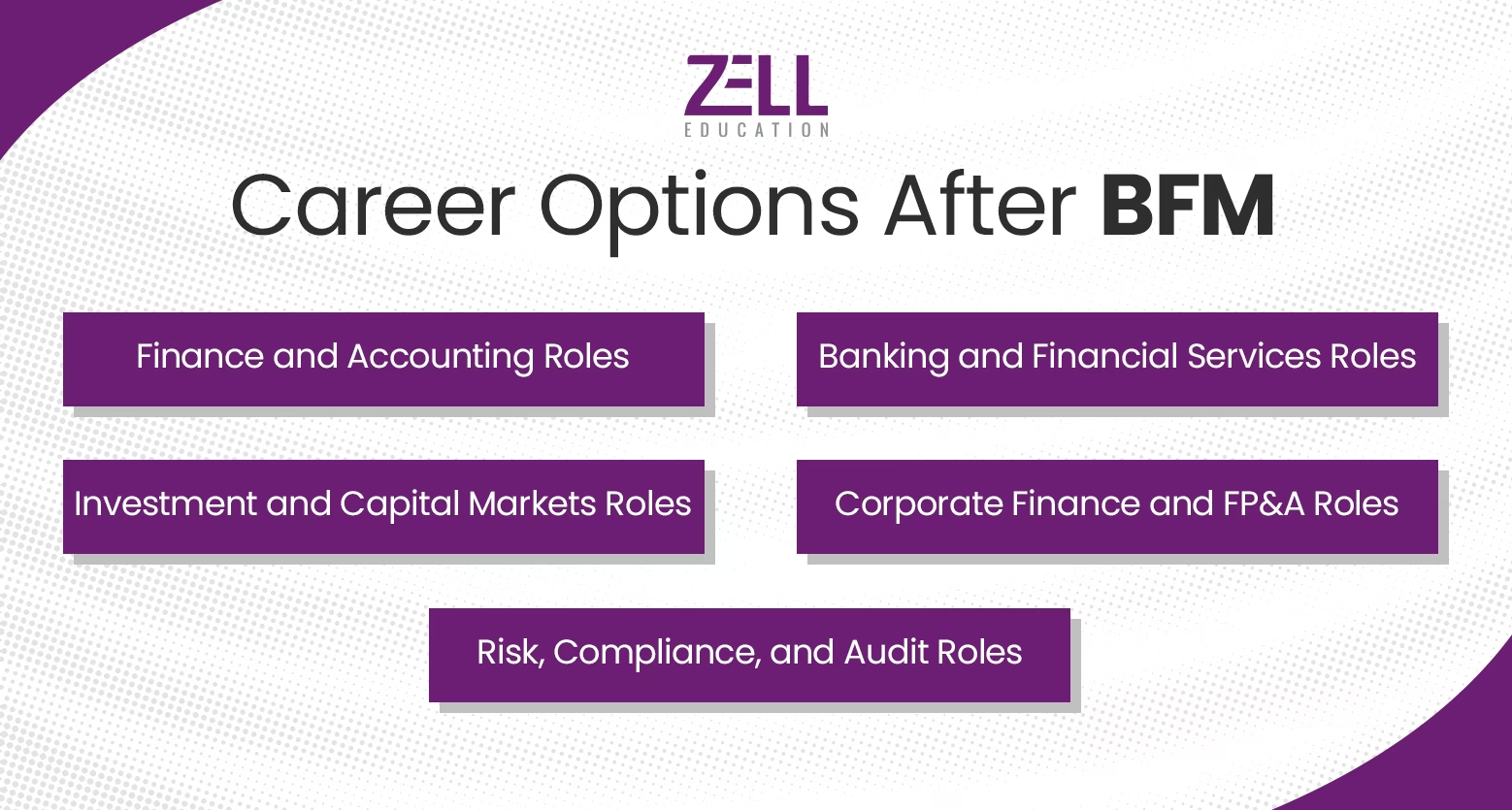
Career opportunities after graduation with a BFM can be very broad or varied, depending on interests, capabilities, and future aspirations.
1. Finance / Accounting
Many students who obtain a Bachelor of Finance and Management degree will begin their career within the finance or accounting field. Finance/accounting positions involve providing assistance to companies by providing financial reports or being involved in developing a company’s financial budget or assisting with the analysis of their results and internal controls.
The most frequently filled entry-level positions for an individual graduating with a Bachelor of Finance and Management are typically junior accountant, finance executive, and audit assistant.
2. Banking / Financial Services
Career options within the banking and financial services sector are one of the more popular career paths for students graduating from the Bachelor of Finance and Management programme. Private Banking, Non-Banking Financial Companies (NBFCs), and Financial Institutions employ BFM graduates for positions that provide both a customer-facing role and/or a back-end operational role.
- The type of entry-level jobs that BFM graduates typically pursue are as relationship managers, credit analysts, and Banking Operations executives.
- Having worked in these types of entry-level positions will give BFM graduates a better understanding of lending, customer management, and compliance issues.
3. Investment and Capital Market Careers
If you’re passionate about stocks and investments, Investment and Capital Market Careers are a great source of opportunities to get started in the finance industry.
- BFM graduates have the academic background necessary to work in the Capital Markets as they have taken classes related to, but not limited to, equities, derivatives, and mutual funds.
- Working at broking firms, Asset Management companies, and Research houses provides other professionals the opportunity to analyse the Capital Markets and make investment decisions based upon available data.
4. Corporate Finance and FP&A Careers
Corporate Finance Careers involve the management of a company’s finances and forecasting for the future. Additionally, it is a rapidly growing area of the Corporate Finance segment and provides BFM Graduates the opportunity to work closely with Senior Management.
- The typical duties of Corporate Finance include: preparing Budgets, Financial Analysis & Variance Tracking, and preparing Financial Models.
- These types of positions are perfect for students who possess strong analytical skills.
5. Risk Management, Compliance, and Audit Careers
The growth of stricter regulations within the Finance Industry has increased the number of opportunities for BFM Graduates to establish a career in risk management and compliance.
There are a variety of positions available for professionals, including but not limited to:
- Risk Analysis
- Internal Audit
- Regulatory Compliance within Banks and Corporations.
Risk Management, Compliance, and Audit positions focus on identifying the risks of Financial Losses to an organisation, ensuring compliance with its financial policies and procedures, and protecting a company from Financial Losses.
Best Job Roles After BFM
The BFM position can be a variety of types depending on the focus of the position and what industry experience the person has had.
1. Financial Analyst
The financial analyst will analyze, compile, and create a variety of financial reports to assist in the decision-making process. This position is typically one of the most sought-after following a BFM degree and also the most satisfying. Many Corporate & Consulting companies have a high demand for this position.
2. Investment Banking Analyst
The Investment Banking Analysts play an important role in helping companies conduct M&A (Merger & Acquisition) and Capital Raising activities. This position is extremely competitive, but it can provide an excellent opportunity for learning and growth for those who are committed to building a successful financial career.
3. Equity Research Analyst
Equity Research Analysts will research and evaluate companies and the industries in which they operate, and then provide a level of recommendation for Investments in those companies, as well as provide investors with insight into longer-term investment strategies. This position is ideal for those interested in Capital Market Investments and Long-Term Investments.
4. Relationship Manager
The Relationship Manager position is one that generally works directly with the customer or client in a bank and/or wealth management. In order to be successful as a Relationship Manager, one will need to have good communication skills along with a solid understanding of financial concepts and markets.
5. Risk Analyst
A risk analyst is a professional who identifies and evaluates the potential for financial losses resulting from lending, investment, and operational activities. This type of position is highly sought after in many financial institutions, including banks and other types of financial institutions.
6. Analyst of Operations
An operations analyst is focused on process improvement, ensuring compliance with regulations and standards, and performing analytical reporting. This role is prevalent in banks, Knowledge Process Outsourcing (KPO) organisations, and other types of financial service providers.
Higher Studies After BFM
Many students pursue degree-level education to attain degrees and provide them with higher levels of potential for future career opportunities in the areas of finance, business, and accounting.
1. Master of Business Administration degree with a Finance concentration
A Master of Business Administration (MBA) degree with a Finance concentration will assist students in transitioning into a leadership- or management-type position. An MBA degree in Finance has opened new opportunities for those interested in Corporate Finance, Investment Banking, Consulting and Strategy.
2. Chartered Financial Analyst designation (CFA)
CFA is considered one of the most prestigious designations that an investment or finance professional can achieve and will allow for more international career opportunities and better compensation rates.
3. U.S. Certified Management Accountant (CMA) designation
A U.S. CMA designation is ideal for students who want careers in corporate finance and/or work internationally and want to continue their education in management accounting.
4. Financial Risk Manager (FRM) designation
The Financial Risk Manager (FRM) designation is a great choice for individuals who want to focus on a career in risk management, banking and/or financial analytics. It is a highly sought-after designation for those working in Financial Institutions.
5. Association of Chartered Certified Accountants (ACCA)
The CPA and ACCA are recognised worldwide as the leading qualifications for an international accounting career. A CPA or ACCA is suitable for students who want to work in Accounting and/or Finance Worldwide.
6. Master’s in Finance or Economics
Students who have obtained a Master’s degree in Finance or Economics can further their understanding of a specific area of study and will complete their education with a mission of becoming a researcher with analytical skills.
Professional Certifications After BFM
Certifications increase the marketability of a BFM.
- CFA: The CFA programme builds expertise in investment analysis, portfolio management, and ethics, making the CFA designation a key requirement for positions in asset management and equity research.
- US CMA: The US CMA certification enhances the financial management, budgeting, and strategic planning skills of a candidate, making the CMA credential ideal for jobs in corporate finance.
- FRM: The FRM certification is targeted toward students aspiring to work in financial risk management and treasury operations, as well as compliance.
- CFP: The CFP certification focuses specifically on financial planning, wealth management, and advisory services.
- NISM Certifications: NISM certifications are entry-level credentials for stock and mutual fund sales personnel in India.
Salary Scope After BFM
Entry-Level Salary After BFM
Entry-level BFM graduates who move into the fields of investment banking, consultancy, or multinationals generally receive much higher compensation packages compared to entry-level positions in the fields of accounting and operations.
- Any recent graduate or other prospective BFM job candidate in India should gain a full understanding of the current BFM salary market before determining their career direction.
- The average starting BFM salary for someone who just graduated with a BFM degree is around INR 4 lakhs to 8 lakhs per annum. The specific amount will vary depending on the type of role and the level of experience within particular industries.
Mid-Career Salary Growth
After about 3-5 years of work experience in fields where a BFM graduate is employed in either analytical or heavily finance-oriented positions, the typical BFM salary ranges are INR 8 Lakhs to 20 Lakhs per annum.
Salary After Higher Studies and Certifications
In the event of completing a master’s in business administration, a chartered financial analyst or a certified management accountant certification, or obtaining a financial risk manager designation, the majority of BFM graduates report that their BFM salary increases drastically, often starting around INR 25 – 50 LPA and above.
Source: Payscale
Salary Comparison by Industry
Investment banking, consulting, and MNC roles typically offer higher BFM salary in India as compared to entry-level accounting or operations roles.
Career Scope After BFM in India
With the growth of the financial markets in India, many career opportunities exist for BFM graduates today.
1. In the Private Sector
Several organisations, including private sector banks and NBFCs, as well as fintech and other corporate organisations, are now looking to hire BFM graduates in a variety of roles that they can supply.
2. In Multinational Corporations (MNCs) and International Firms
Global consulting firms, the Big 4, and international banks present tremendous opportunities for BFM graduates, especially those who are also certified professionals.
3. Government and PSU Opportunities
BFM graduates can also explore government exams, PSU roles, and regulatory bodies such as SEBI and the RBI.
Skills Required to Build a Strong Career After BFM
Technical and financial skills are very important to an individual’s success in Business Finance Management (BFM).
- The technical and financial skills required for BFM include strong knowledge of accounting, financial modeling, and valuation for most BFM job titles.
- The BFM job profession offers many roles through data analysis, logical thinking, and quantitative ability.
- In addition to technical and quantitative skills, soft skills and communication skills are critical for career advancement; the ability to effectively communicate with clients, work as part of a team, and present ideas effectively are facets of the BFM job role.
How to Choose the Right Career Path After BFM
The career path selected following completion of a Bachelor of Finance and Management will largely be based upon the individual student’s interests, strengths and long-term goals. For example, if a student is interested in working in investment banking or capital markets, he or she may elect to pursue the CFA designation or an equities analyst position.
Conversely, if a student is more interested in corporate management, his or her decision may line up with pursuing an MBA or US CMA credential.
In addition to students conducting self-assessments, obtaining internship experiences and having professional mentors, there are many other factors influencing an individual’s ability to make informed career decisions.
Launch your ACCA journey today before the next batch closes forever?
Conclusion
A BFM degree may lead to a number of different career paths in finance, banking, investing and corporate sectors. Having the right combination of skills, training and experience will give you a solid foundation from which to develop your career. There are many options available to pursue a career in BFM employment, certification or education, and the future will be very bright for those who choose to take the career path of BFM jobs in India and internationally.
FAQs on Career After BFM
What are the best career options after BFM?
Careers for those who hold a degree in Banking and Financial Management (BFM) are many, including positions such as Financial Analyst, Equity Research Analyst, Investment Banking Analyst, Relationship Manager, and Risk Analyst. All these careers will offer excellent growth and exposure to many new things, as well as the potential for long-term security.
Is BFM a good degree for finance careers?
BFM does indeed provide an excellent foundation for anyone looking to have a successful career in Finance. With its focus on providing in-depth knowledge and understanding of the Financial Markets, as well as Investments and Corporate Finance, BFM will give those with the degree a strong advantage when competing for jobs in Banks, Investment Companies, Corporations, and the Financial Services industry.
What is the average salary after BFM in India?
The average starting salary for BFM graduates in India is around INR 4 to 8 LPA. After gaining experience and/or obtaining one of the certifications or credentials mentioned above, your salary will most likely increase significantly within a Career in Banking/Finance.
Which course is best after BFM?
The course that BFM graduates should take after graduation will depend on their respective career goals, but the most common courses taken by BFM graduates are an MBA in Finance, Certified Financial Analyst (CFA), U.S. Certified Management Accountant (US CMA), Financial Risk Manager (FRM), and Certified Chartered Accountant (ACCA).

Current Role
Co-Founder & CEO at Zell Education
Education
- ACCA – Association of Chartered Certified Accountants, Finance (2011 – 2014)
- Bachelor of Commerce (BCom), Financial Markets from H.R. College Of Commerce & Economics (2010 – 2013)
Location
Mumbai, India
Expertise
ACCA Certified
Why Zell?
- • Largest Provider for Global F&A Courses
- • 4.6 Google Review Rating
- • 1000+ Students placed Annually
- • 500+ Active Hiring Partners
- • Placement Opportunities at the Big 4
- • 100+ Global & Indian Rank Holders
- • 100+ Faculty Network
Speak to A Career Counselor
Zell's 10th Anniversary Offer - Avail a 10% Scholarship