
The CPA Skill Assessment reflects the shift to an advisory/analytic and technology-orientated CPA profession by showing a trend toward the majority of high-value CPA skills now include Strategic Reporting, Risk Management, and Business Advisory because of the growing amount of automation to eliminate routine tasks.
Comprehensive Summary of CPA Skill Assessment 2026:
- Changing The Demand For CPA Skills: The assessment of CPA skills as of 2026 demonstrates that there has been a hindrance in CPA skills by moving toward advising/recommendation vs routine accounting through the utilization of high-end CPA skills related to analytics and technology that are integrated into Business decisions directly.
- Impact of AI and Automation Utilisation: Through the use of AI, the value of transaction-based accounting has significantly decreased, and the use of Advanced CPA skills is more prevalent in the workplace than any manual accounting task.
- The Top CPA Skill Set of 2026: Advanced financial reporting, Audit Analytics, Strategic Tax Planning, Risk Management, ERP (Enterprise Resource Planning) system usage, and Data/Fact-Based forecasting.
- Declining Areas Of Employment Opportunity For CPAs: Basic Bookkeeping, Manual Reconciliations, and Data Entry: As both Automation Technologies and the standardisation of business processes have occurred, the salaries associated with these areas have decreased.
- The Strategy For Career Success For CPAs: There are two aspects of successful CPA Skill Assessment Outcomes; the first aspect is the utilization of CPA Skills related to Analytics, Advisory Services, and Technology Skills, and the second aspect is to develop Industry Specific Specialization and to continue to learn.
- High Salary Positions For CPAs: Advisory, Senior Leadership in Audit, Risk, among Other Functions, and Chief Financial Officer Roles (CFO) offer the highest salary for CPAs possessing strong CPA Certification along with business-focused CPA Skills.
Ready to future proof your CPA career with the right skills?
 Get Started Now
The accounting profession is experiencing one of the greatest changes to occur in the history of accounting. The CPA skill assessments of professionals are the primary focus for employers; the combination of soft skills with CPA certification is no longer enough to satisfy the employer’s needs.
Most employers have recognised that CPA professionals have much more to offer an organisation than just the title of CPA. Employers need to assess the CPA professional’s skill set to determine if the professional has the technical knowledge, competency in technology, and understanding of business processes necessary to excel in their role as a CPA.
This guide outlines the most important CPA skills in 2026, and then guides CPAs to ensure continued relevance and value and the ability to command high levels of compensation in a rapidly evolving environment.
Why CPA Skill Premiums Are Changing in 2026
Accountants have acted as compliance guardians; accountants have historically been viewed as being involved with the management and preparation of reports, accounting reports, and auditing financial statements.
But, as we enter 2026, the definition of what is CPA is changing. The basis by which employers differentiate between average CPA positions and those of premium, high-paying positions is based on CPA skill assessment.
- Employers are no longer interested in merely understanding the role of a CPA.
- They want to understand how CPAs add value to the overall business picture through the provision of sound advice.
- Therefore, there is an increasing effort to evaluate CPA skills, recognise CPA contributions, and compensate CPAs fairly in all types of organisations.
Impact of AI and Automation on Accounting Roles
Automation has significantly transformed the accounting workflow, making many hours of work translate into just seconds when using automation tools. Tasks such as account reconciliation can now be accomplished at lightning speed using artificial intelligence to quickly identify errors or inconsistencies. The accounting profession’s criteria for assessing CPA skills have evolved due to this major technology change.
- Today, employers place more emphasis on how CPAs will manage AI-generated outcomes than simply on executing a task.
- Those CPAs who can apply judgment in the evaluation of an AI-generated report or use their expertise to analyse insights and incorporate scepticism will see a higher salary premium.
Don’t miss your CPA breakthrough; seats are filling fast in premium batches!
 Find Out More
Shift from Compliance to Advisory-Driven Finance
While compliance has always been essential, its importance is diminished in the current environment, where businesses want their CPAs to function as Strategic Advisors to Business Management.
- Financial Information is to be used to help provide insights into areas of Growth, Investment, and Long-Term Planning.
- Modern CPAs are evaluated on how well they convert numerical data into Strategic Solutions.
- The Driving Force behind Advisory-based Finance is a deeper Commercial Understanding, as well as Industry Understanding, and Forward-thinking Analysis.
- This Evolution is the primary reason why the PA Skills Assessment Focuses on Advisory Exposure and Consulting Capability.
Rising Regulatory and Risk Complexity
As globalisation increases, the demand for compliance with multiple layers of legislation, corporate governance, and tax jurisdictions continues to grow and will require more sophisticated knowledge and experience than ever before.
Today’s successful CPA (Certified Public Accountant) must be able to evaluate risks, interpret regulations and design internal controls to protect their clients’ businesses from non-compliance. Companies are willing to pay more for CPAs who can manage this complexity and therefore increase client value.
Demand for Business-Facing CPAs
Currently, organisations are looking for CPAs who will participate at the executive level. Finance professionals are expected to interact with executives, investors, and operational staff.
- The need to be able to communicate on behalf of a company has caused CPA skill assessment models to be revamped.
- Communicative ability, presentation skills, and influence are no longer considered extra skills for a CPA; they are now core CPA skills.
- Individuals with strong technical knowledge combined with a strong business acumen will earn better compensation and more senior-level positions.
Top CPA Skills That Will Be Paid a Premium in 2026
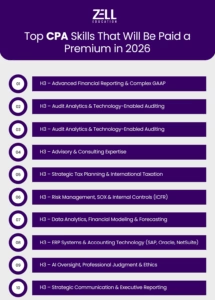
The future will be most advantageous for individual CPAs with ever-evolving skill sets. Listed below are the Top CPA Skills that generate the greatest salary premium when evaluated using contemporary CPA Skill Evaluation Methods.
Advanced Financial Reporting & Complex GAAP
Due to new Accounting Standards, Financial Reporting has become an increasingly challenging task for CPAs to perform.
Many of the more challenging Financial Reporting issues that CPAs must be able to manage include the Revenue Recognition Criteria, the Lease Accounting criteria, and the Consolidation criteria. CPA candidates with advanced levels of GAAP interpretation skills can command higher salaries and are considered very valuable across the Accounting profession.
- CPAs that can successfully navigate a complex economic environment will be able to build and maintain investor confidence as well as ensure regulatory compliance with specific regulations.
- The Advanced Financial Reporting & Complex GAAP CPA Skill remains one of the essential CPA Skills required for all CPA candidates to hold as they progress into Senior and Leadership Roles.
Audit Analytics & Technology-Enabled Auditing
Auditing has shifted from using checklists to being driven by data. Analytics, visualisation, and continuous monitoring systems now support data-driven audits.
- The assessment of the skills of CPAs focuses on how well they can use technology to assist in identifying areas of risk and/or identifying anomalies.
- Technology-assisted audit skills will reduce overall failure rates during audits while at the same time increasing efficiencies.
- Using technology, CPAs who perform audits have a distinct advantage over other professions.
Advisory & Consulting Expertise
Advisory services have emerged as one of the fastest-growing areas in the accounting profession, as clients now seek not only reports but also insightful data.
- An advisory skill set of a CPA includes the ability to diagnose a business’s issues, design solutions, and implement them strategically.
- This type of professional can assist organisations in improving performance and adapting to new environments.
- By providing advisory expertise, CPA certification holders significantly increase their earning power.
Strategic Tax Planning & International Taxation
The function of tax has progressed away from being purely compliance-focused to becoming a more strategic focus or function. The nature of the global enterprise and multinational operations requires a higher level of understanding of international tax structures and transfer pricing.
- By having CPAs who are knowledgeable about elements of strategic tax planning, organisations can take advantage of the law to legally optimise their tax position.
- This knowledge is even more valuable for larger and more complex global enterprises.
- In 2026, tax professionals with strategic knowledge will have a commanding premium value.
Risk Management, SOX & Internal Controls (ICFR)
Corporate Governance is now centred on the assessment of Risk Management practices. The scope of Internal Controls has expanded due to an increase in Regulator oversight.
- CPAs are now assigning a higher value to Individuals who possess skills related to the design, development, evaluation, and improvement of control frameworks.
- The knowledge and experience gained through a Working Knowledge of SOX and ICFR will help protect Organisations from both Financial and Reputational Loss.
- This is a key skill for individuals in Leadership Roles for Risk Management and Compliance.
Data Analytics, Financial Modeling & Forecasting
Modern finance relies on data to drive decisions. CPAs develop skills that will allow them to successfully analyse large datasets and also create predictive models, which will allow them to stand out.
- Forecasting and financial modelling help organisations plan for what’s to come, turning CPAs into strategic partners instead of just reporting the past.
- These two skills represent the top CPA qualifications globally and are highly sought after.
ERP Systems & Accounting Technology (SAP, Oracle, NetSuite)
Organisations are dependent on integrated financial systems and no longer have the ability to avoid using ERP technology.
- Mastery of ERP systems like SAP, Oracle, or NetSuite allows CPAs to integrate financial processes with IT and improve both data accuracy and system utilisation.
- CPA certifications will continue to grow in value with the increasing importance of CPA fluency in the use of technology
AI Oversight, Professional Judgment & Ethics
AI processes numeric and text data; it cannot use ethical judgment in addition to providing validation of its output and compliance with regulations. CPAs must validate outputs as well as ensure compliance.
- The current CPA skill assessment will require CPAs to manage AI systems while adhering to ethical standards. This skill protects organisations from the risks associated with automating their businesses.
- Professionalism is an important characteristic of trust to clients and employees, and ethical leadership defines successful CPAs.
Professional Communication & Executive Reporting
While numbers are an important part of the decision-making process for CPAs, CPAs must clearly communicate their findings to the stakeholders involved.
- The process of effective executive reporting requires a storytelling technique that utilizes both visual elements and the ability to influence others.
- This CPA skill enables CPAs to create a sense of urgency regarding financial insights.
- CPAs with a high level of communication skills are often paid top dollar for their expertise in this area.
Don’t miss your CPA breakthrough; seats are filling fast in premium batches!
CPA Skills with Declining Salary Premium
The decline of certain CPA Competency Areas will occur as Automation becomes increasingly integrated into accounting practice. The following are key areas in which Automation is expected to replace many traditional CPA skills:
1. Transactions Accounting & Bookkeeping
Routine Accounts/Bookkeeping functions, such as Posting data, maintaining Basic Ledger, will require Minimal human interaction due to Automation.
As a result of this shift, these Competency Areas will fall to the bottom of CPA skill assessment models and consequently will not be highly valued.
2. Manual Reconciliations and Compliance
Automation has replaced the reliance on Manual processes for Normal Compliance Activities, and thus demand for CPAs performing manual Compliance will be greatly reduced.
The value of Manual Compliance has dropped significantly because of Automation.
3. Data-Entry Accounting Roles
The role of Data Entry is no longer representative of professional CPA practice. Most Data-Entry Accounting roles are completed by Office Outsourcing or Automated systems.
How CPAs Can Position Themselves for High-Paying Roles in 2026
In 2026, CPAs need to proactively develop their skills to become successful. To do this, CPAs must align their growth strategies with the current market needs.
1. Upskilling in Analytics, Advisory, and Technology
CPAs must continue learning throughout their careers by continually investing in analytics tools, advisory frameworks, and accounting technology. These new skill sets will ultimately result in more positive CPA skill assessment results and increased earning potential.
2. Building Industry and Domain Specialisation
CPAs who specialise in industries will have greater differentiation from their competition. Having expertise in a specific industry allows CPAs to make more informed decisions, which also improves the quality of the advice they provide to clients.
Specialisation also results in an increase in the CPA’s perceived credibility and earning potential.
3. Combining CPA with Complementary Certifications
By obtaining CPA certification as well as credentials such as CMA, CFA, or Data Analytics certifications, CPAs can distinguish themselves and increase their marketability.
High-Paying CPA Career Paths in 2026
In 2026, the high-paying CPA jobs will lead to great career paths.
- Advisory and Consulting Roles: People who work in advisory roles help make strategic decisions and changes. These jobs pay well and let you move up in your career.
- Leadership in Risk Management and Audit: Leadership within Audit and Risk Management requires sound judgement and the ability to make informed decisions using a modern risk management model and monitoring systems. A career in audit and risk provides respect and financial rewards.
- Corporate Finance, CPA, CFO Roles: A CPA with a solid career plan and exceptional knowledge of the Financial Path will be promoted to an executive role. This is the pinnacle of CPA career advancement.
Launch your CPA journey today before the next batch closes forever?
Conclusion
In 2026, what it means to be a CPA has changed dramatically since the days of merely passing the CPA exam. Becoming successful as a CPA will require continual testing of CPA skills, increased adaptability, and strategic learning of what the Top CPA skills are to become bolstered within the rapidly changing financial World.
FAQs on CPA Skill Assessment
Which CPA skills will be most in demand in 2026?
According to the CPA 2026 Skills Assessment Study, there is an increase in demand for advisory expertise, advanced financial reporting, data analytics, and technology-enabled auditing. The combination of business-facing CPA capabilities along with sound ethics and judgment will yield the greatest value over time for CPA professionals.
Will AI reduce salaries for CPAs?
AI will not reduce skilled CPA salaries; rather, the CPA Skills Assessment identifies those CPA Professionals who possess the ability to oversee AI, exercise Professional Judgment, and provide insight. While many routine CPAs will gradually decline, the advanced CPA competency areas will continue to garner higher salaries.
Which CPA roles will pay the highest salaries in the future?
The highest-rewarding career paths include advisory and consulting, senior management in audit and risk areas, and on the CFO track; while these have the most lucrative salary potential, they require significant advanced CPA Skills combined with Strategic Thinking, a deep understanding of the Business, as well as the CPA designation.
Are audit skills still valuable for CPAs in 2026?
Yes, an audit has value when paired with technology and analytics. Modern CPA(Australia) Skills Assessment emphasizes technology-enabled auditing and risk-based analysis over traditional manual auditing processes.
How can CPAs future-proof their careers?
To safeguard their careers in the future, CPAs should consider developing their analytics, advisory, and technology capabilities. Developing an Industry area of Specialization and possessing supporting credentials in addition to the CPA designation will ultimately add tremendous value and growth potential to CPAs on a long-term basis.

Current Role
Co-Founder & CEO at Zell Education
Education
- ACCA – Association of Chartered Certified Accountants, Finance (2011 – 2014)
- Bachelor of Commerce (BCom), Financial Markets from H.R. College Of Commerce & Economics (2010 – 2013)
Location
Mumbai, India
Expertise
ACCA Certified
Why Zell?
- • Largest Provider for Global F&A Courses
- • 4.6 Google Review Rating
- • 1000+ Global Placement Partners
- • Placement Opportunities at the Big 4
- • 100+ Global & Indian Rank Holders
- • 100+ Faculty Network
- • 10,000+ Students Placed
Speak to A Career Counselor
Zell's 10th Anniversary Offer - Avail a 10% Scholarship