
Automating routine accounting services, CPAs have developed their capabilities to become mindful advisors. Therefore, CPAs will need the ability to leverage the CPA AI skillset as well as include data analysis, the use of automated programming, and applying AI insights for their continued professional development as a mindful advisor.
Comprehensive Summary for CPA AI Skillset:
- Shift from Execution to Analytical Roles: In the new age of CPA work, the basic function of the CPA has changed from manual execution of tasks to performing analysis and providing recommendations based on data.
- Additional Required Skills for CPAs: To be effective in their new role, CPAs must learn about AI literacy, Data Visualization, and Financial Forecasting. Adding these skills will allow CPAs to remain competitive in today’s world.
- Emerging Trends in CPA Career Opportunities: As a result of Technology, the CPA profession is experiencing growth within the advisory function. In addition, it is predicted that the trend of increasing demand for CPA services in Risk Management, Financial Planning & Analysis will continue to grow.
- The Future of CPA Certification: It continues to be important for CPA certification to remain relevant. Therefore, CPAs who upgrade their top CPA skills and become knowledgeable about Technology will have them to Lead the Future of Accounting and the CPA.
- Enhanced Skillset: The CPA profession has progressed from executing manual procedures to utilising the analytical capabilities provided by technological advances made possible through technological advancement.
- AI (Artificial Intelligence) and Automation of Accountant Tasks: In our world today, many businesses have taken advantage of the development of AI (Artificial Intelligence) and therefore have taken a proactive approach by incorporating AI technology into their Accounting, Audit and Tax Function processes using automated processes.
Want to understand the CPA AI skillset for future success?
 Begin Your Journey
Automation, machine learning, and advanced data analytics have created a new normal for CPAs with the launch of a CPA AI Skill Set. This evolution is not intended to replace CPAs; rather, it aims to redefine what CPAs bring to the table. With today’s economy being driven by technology, CPAs are no longer just number crunchers; they are now strategic advisors, data interpreters, and “tech-savvy” business partners who assist businesses in making better decisions.
For students and young professionals considering a career as a CPA or contemplating CPA certification, understanding the shift in how accountants will interact with clients and the world is crucial for their plans.
The businesses of the future will be those that blend strong accounting fundamentals with the analytical capabilities provided by advanced technology. This article will provide insight into the changing landscape of top CPA skills, including the most important skills needed to thrive in an age of AI, and how this evolution will affect your career trajectory and your long-term options.
The Traditional CPA Skillset: What Is Changing
To grasp the future, we should first understand the origins of CPAs and the need for them to change with the times.
1. Core Accounting, Audit, and Compliance Skills
Traditionally, you were trained as a CPA to understand all aspects of financial accounting, auditing standards, taxation, and regulatory compliance. These four basic areas provided the foundation upon which your CPA training was built. The highest level of skill you could develop as a CPA was through accuracy, attention to detail, and familiarity with accounting regulations.
While these skills are still necessary to perform well as an accountant today, they are no longer sufficient by themselves for you to be competitive in a rapidly changing financial world.
2. Manual and Rule-Based Processes
Historically, many of the tasks undertaken by a CPA consisted of entering data manually, reconciling accounts, maintaining ledgers, and performing checks based on a series of rules. In these situations, human input was required for a large number of tasks. Therefore, the use of human effort in these situations resulted in an increased risk of mistakes and required a significant investment in time.
Although this process was effective in the past, it would have difficulty scaling to accommodate increased amounts of data and complex business structures as they have been developed over the years.
3. Tasks Increasingly Automated by AI
With advancements in artificial intelligence technology, there are now computer-based systems available that can automatically process invoices (i.e., routing them to the right accounts), match transactions, and identify anomalies in their data, all while producing reports faster and more accurately than manual systems.
Because these processes are now automated, CPA roles at the entry level have changed, resulting in the shift of professional activity away from execution-based responsibilities.
Still waiting while AI skills are becoming essential for CPAs?
 Get Started Now
Role of AI and Automation in Accounting
Artificial Intelligence (AI) is now part of how accountants work.
1. AI-Powered Accounting and Audit Tools
AI will allow an accountant to quickly find answers based on analysis of large amounts of data and flag inconsistencies in real time, with AI having an impact on the assessment of audit risk by providing the opportunity to utilise all available data vs. a smaller sampling.
AI-powered tools allow CPAs to spend more time on interpretation than on verification.
2. Robotic Process Automation (RPA) in Finance
Robotic Process Automation (RPA) is designed to help automate repetitive finance activities such as making journal entries and reconciling accounts, with report generation performed by ‘bots’ which continuously run without tiring and produce results quickly and consistently from the input provided.
This allows CPAs to concentrate more on analyses and advisory functions, as automated repetitive finance activities allow for more time available.
3. Automation in Tax, Audit, and Reporting
Tax preparation software now utilises AI to assist with identifying deductions, assessing compliance risk, and updating the compliance process for changes to policies. Financial reporting automation tools also use AI to automate the consolidation of data and the production of standardised disclosures.
How AI Is Redefining the CPA Skillset
AI integration has fundamentally changed what it means to be a Certified Public Accountant (CPA).
1. Shift from Execution to Analysis
CPAs now are expected to analyse the output generated from the multiple Artificial Intelligence systems rather than performing the tasks manually, and this requires CPAs to have strong critical thinking skills to develop the right questions.
The CPA has a skill set that is primarily focused on deriving insights and not executing tasks for the organisation.
2. Data Analytics and Insight Generation
CPAs must be able to assess financial and non-financial data to identify patterns and risks as well as opportunities for the organisation. With the use of Data Analytics, a CPA can assist with making the best decision across all areas of a company and is not limited to only the finance department.
3. Technology and Systems Proficiency
Knowing how to use an Accounting Application, an ERP system, various types of AI tools, and Analytics tools is now a necessary skill for the CPA. Although the CPA is not required to be a computer programmer, the CPA must have a good understanding of how the systems operate and how to perform their functions effectively.
4. Enhanced Professional Judgment
AI can analyse and process data, yet AI is not equipped to replace the professional judgement of the CPA. CPAs must assess the accuracy and relevance of AI-generated information, as well as take into consideration the context for their advice, and provide ethical guidance to clients and other stakeholders.
New Skills CPAs Must Develop
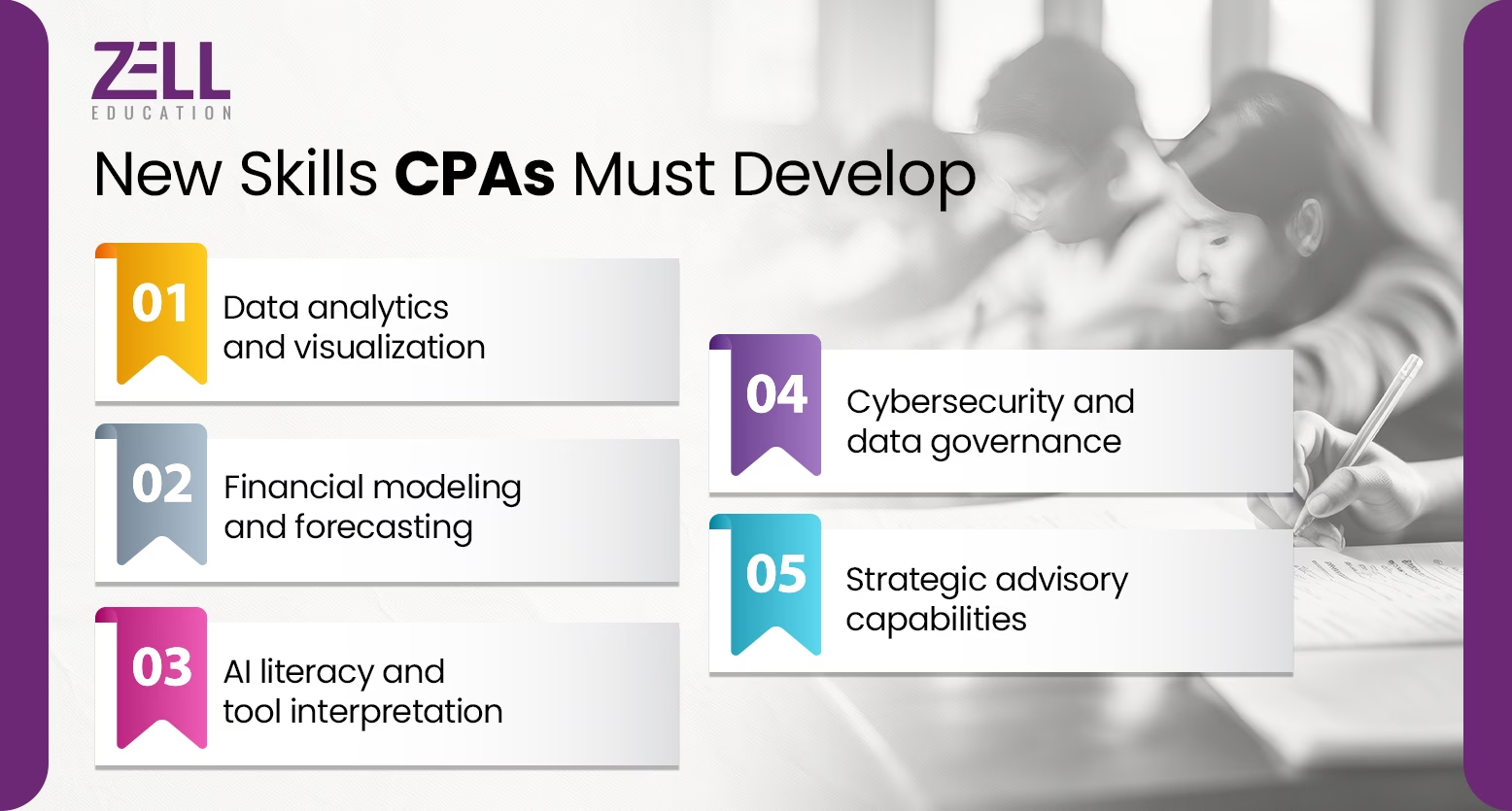
As a result of the dynamic nature of today’s market, CPAs must expand their expertise beyond what is CPA in traditional accounting practices.
1. Data Analytics and Visualisation
- The development of Dashboards and other visual tools allows for the rapid communication of both data and insight to enable decision-makers to understand complex concepts in the financial world much more easily.
- Additionally, through the use of Data Visualisation, CPAs will be better able to influence and communicate with their clients.
2. Financial Modelling and Forecasting
- AI has improved the accuracy of forecasting; CPAs must continue to possess the skills necessary to develop Financial Models and to assess the outputs, as well as to further evaluate the assumptions associated with the Model Design.
- Financial Modelling will provide valuable input for Future Planning and Investment Decisions.
3. Advisory and Leadership
Financial data continues to be digitally converted, CPAs will need to know how to properly protect this information and also to understand the purpose of Data Governance, Access Control, and Cyber Security, as these will all be critical areas of focus for CPAs who practise in sectors that require compliance.
4. Strategic Advisory Capability
CPAs must evolve to not just being Accounting Professionals but must evolve to becoming Strategic Partners to their clients by providing advice on subjects such as Cost Efficiency, Risk Mitigation and Performance Improvement, etc.
Impact on CPA Career Paths
CPAs’ evolving AI skills impact all types of careers.
1. Move Toward Advisory and Consulting Roles
As CPAs begin to shift into roles that are more advisory, consultative, or strategic, more employers value analytical skills, communication competencies, and knowledge of the business world than they have in previous years.
Because of the increased ability for advisory and consulting work, many CPAs may see those areas as having a greater potential for upward movement and development into leadership positions.
2. Growing Demand in FP&A and Risk Management
Estimates suggest that FP&A and Risk Management continue to be in growing demand. CPAs with analytical and predictive capabilities in FP&A and Risk Management will be heavily sought after as an effect of AI.
While AI will provide greater capabilities within these functions, the requirement for experience and knowledge will continue beyond what AI provides.
3. Decline of Transactional Accounting Roles
Automation is causing the decline of transactional roles focused on data entry and processing. Therefore, entry-level professionals need to add at least some upskilling during their early career to remain competitive.
Will AI Replace CPAs?
Students seeking information on CPA and those attempting to earn CPA Certification frequently voice this concern.
Automated Processes vs Human Judgement
AI technology is better than hearing lots of data through computers; AI lacks the ability to think like a human (i.e., no ability to use creativity or ethical reasoning). As such, CPAs possess a scrutiny of data and a contextual understanding that cannot be equalled or recreated by machines.
AI assists CPAs but does not replace the CPA’s role.
Ethical Oversight and Regulatory Responsibility
CPAs are responsible for establishing ethical standards, ensuring compliance with regulations, and being transparent to their clients. All of these functions require the ability to hold someone accountable in a professional manner through the use of professional judgement, which AI does not possess.
Future of the CPA Profession
The accounting profession is steadily evolving, rather than disappearing.
Long-Term Development of CPA Functions
In the coming years a CPA will find himself/herself at the intersection of finance and technology and will be an important player in developing business strategy.
- In addition to the accounting function, CPAs will guide businesses as leaders and advisors.
- Success in this new era will depend on CPAs’ ability to develop their CPA AI competencies.
Importance of Lifelong Learning and Continuous Growth
Lifelong learning is essential. CPAs cannot afford to fall behind as technology continues to evolve and change and the laws and regulations governing accounting continue to change.
Continuous Upskilling provides CPAs with the necessary resiliency to succeed over the long term.
Want to Pursue ACCA Accounting Career?
Talk to Our Expert Today
Conclusion
The accounting industry is experiencing major changes like never before because of AI and automated systems. However, these new technologies have created new avenues for growth and impact. The new CPA is not just a financial statement preparer; he/she is a financial strategist, data analyst, interpreter and tech-savvy business professional.
It is critical for all future accountants to obtain and develop the CPA skill set related to the use of artificial intelligence (AI) and other data analytics procedures.
This would enable CPAs to provide their traditional accounting functions along with the added value of interpreted data and creative solutions.
FAQs on CPA AI Skillset
How is AI changing the CPA profession?
Automation of the routine accounting and audit functions by artificial intelligence (AI) is changing the way Certified Public Accountants (CPAs) work and influencing the CPA’s new skill set to include a greater emphasis on the analysis of data and on providing insight and making strategic business decisions and to be more impactful.
Will AI replace CPAs in the future?
Artificial intelligence will not take the place of CPAs, but it is changing the way that CPAs do their jobs. While automation helps CPAs with repetitive tasks, CPAs perform the tasks with their professional judgment and ethics, and they apply their compliance expertise. In the AI-driven finance sector, the CPA certification will still be a highly valued asset.
What skills should CPAs learn to stay relevant?
To adapt to the CPA’s evolving skill set for IA, CPAs must focus on expanding their knowledge of data analytics, developing an understanding of AI, and acquiring financial forecasting capabilities. A CPA’s knowledge of technology and cybersecurity will also be critical.
How is AI used in accounting and auditing today?
AI is being utilised by CPA firms for the automated processing of invoices, performing reconciliations on customer accounts, and generating financial reports. In providing audit services, CPAs are using AI to review very large amounts of data to identify patterns and anomalies that may indicate a risk.
Is CPA still a good career in the age of automation?
Yes, CPA is still a viable career path in this age of automation. CPA firms are increasingly looking to hire CPAs that have a broad skill set in CPA matters and who also possess knowledge of AI. The CPA profession is evolving toward providing advisory and strategic services to their clients, and the potential for CPA opportunities will continue to grow.

Current Role
Co-Founder & CEO at Zell Education
Education
- ACCA – Association of Chartered Certified Accountants, Finance (2011 – 2014)
- Bachelor of Commerce (BCom), Financial Markets from H.R. College Of Commerce & Economics (2010 – 2013)
Location
Mumbai, India
Expertise
ACCA Certified
Why Zell?
- • Largest Provider for Global F&A Courses
- • 4.6 Google Review Rating
- • 1000+ Students placed Annually
- • 500+ Active Hiring Partners
- • Placement Opportunities at the Big 4
- • 100+ Global & Indian Rank Holders
- • 100+ Faculty Network
Speak to A Career Counselor
Zell's 10th Anniversary Offer - Avail a 10% Scholarship