
Key Takeaways
- What is the future of ACCA? The ACCA’s future is bright on a global level due to its popularity, the high demand of employers, and the development of finance professions.
- The ACCA future in India is ensured by investments of multinationals, the development of shared service centres, and finance transformations.
- Despite the current economic uncertainties and advancements in AI, the ACCA future is still gaining momentum due to increasing demands for strategic finance specialists who are able to work with business decision-makers.
Comprehensive Summary on ‘ACCA Future’
Is ACCA recession-proof?
Yes. The ACCA future will stay safe since there will be constant needs of organisations for professionals with skills in accounting, compliance, auditing, and financial planning.
What is ACCA, and why is it relevant?
Those interested in the question What is ACCA?, should know that it is an internationally acknowledged certification which develops skills in finance, business, and strategic management.
How does ACCA in India compare globally?
The future of ACCA in India grows together with an increased demand for professionals in the field of finance with international certificates.
Is ACCA future-proof despite AI?
The ACCA’s future is quite promising due to the increasing demand of employers for professionals with skills in making strategic decisions and giving business advisory services.
How does ACCA salary grow during a recession?
ACCA salary growth is rather favourable since such specialists can help companies survive financially.
How do ACCA changes support careers?
The most recent changes in ACCA focus on technology, sustainability, analytics, and leadership skills.
Discover How ACCA Can Help You Build a Recession-Resilient Career
 Start Your ACCA Journey

What Is ACCA and Why Are People Worried About Its Future?
Talk of what lies ahead for ACCA usually flares up when the global economy experiences moments of instability, recessionary fears, or fast-paced technological developments. One of the most frequently asked questions by students considering joining the ACCA course would be whether this qualification would be relevant in the rapidly changing world.
ACCA is an abbreviation of the Association of Chartered Certified Accountants. It is a well-known professional certification in the areas of finance and accounting. The ACCA course helps the candidates build their knowledge and skills in various crucial domains such as accounting, auditing, taxation, financial management, and business leadership as well as acquire a solid understanding of critical soft skills. With the help of this course, the candidates develop a wealth of practical skills and knowledge that help them perform effectively in different financial and managerial positions.
While ACCA has already earned itself a great reputation, fears related to its future are associated with three major aspects:
- Economic recessions and hiring slowdowns.
- Automation and artificial intelligence.
- Increasing competition among finance professionals.
However, taking a more general view of the situation in the finance sector allows putting the future relevance of ACCA into perspective and highlighting a stable career prospect despite the temporary fears.
Prepare for the Future With ACCA and Stay Ahead of Market Changes
 Talk to ACCA Experts
Does Recession Actually Hurt ACCA Professionals?
It is generally believed that all professions suffer from recessions in a similar way. In fact, finance and accounting demonstrate different behaviour in times of economic downturn. Organisations depend highly on finance professionals during those tough times, making the career of ACCA-qualified professionals quite stable in comparison to others.
What History Tells Us About Finance Careers in a Downturn
Historical economic downturns reveal a consistent pattern.
During recessions, companies require professionals to:
- Manage cash flow.
- Reduce operational risks.
- Strengthen financial controls.
- Improve budgeting processes.
- Ensure regulatory compliance.
Hence, accountants and finance professionals usually stay in high demand regardless of the decreased rate of hiring in other fields.
Examples of historical trends show how the demand for finance professionals grows during recessions, including for positions of financial analysts and others.
- Financial analysts.
- Auditors.
- Risk managers.
- Management accountants.
- Internal control specialists.
This historical evidence supports a positive outlook for the ACCA future.
Why Accounting Is Counter-Cyclical: The Numbers Case
Accounting is considered to be a counter-cyclical area since demand for accounting services stays high or increases when the economy suffers from downturns.
Reasons include:
- Companies need accurate financial reporting.
- Regulators require compliance.
- Investors demand transparency.
- Businesses require restructuring support.
- Cost management becomes a priority.
All these aspects ensure the stability of ACCA scope in tough economic times.
What Are the 5 Reasons ACCA Is Recession-Proof?
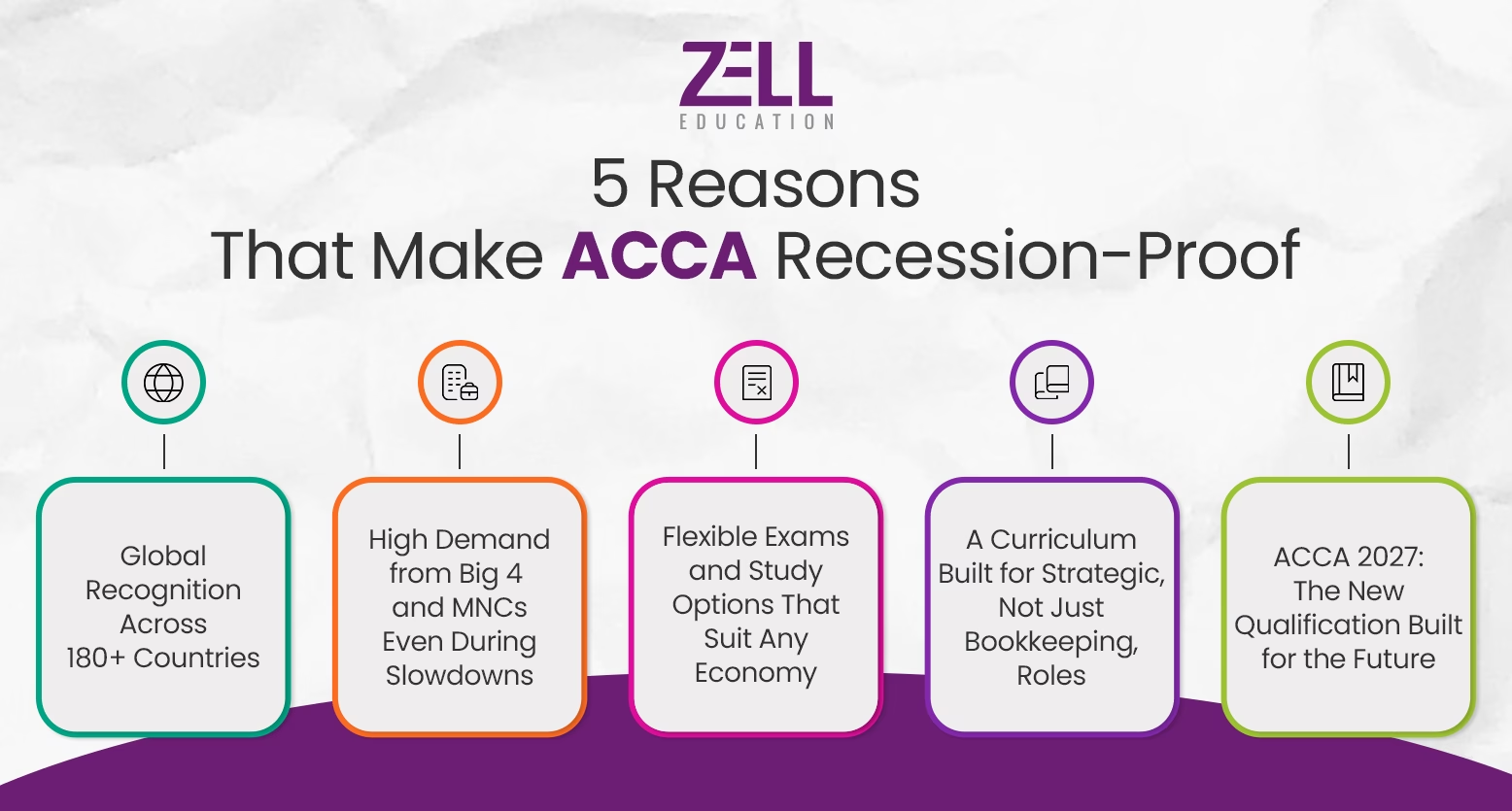
Several factors contribute to the strength of the ACCA future despite changing economic conditions.
Global Recognition Across 180+ Countries
One of the biggest advantages of ACCA is its international recognition.
Benefits include:
- Career mobility.
- Global employment opportunities.
- Cross-border finance roles.
- International employer acceptance.
The influence of Acca global recognition helps professionals access opportunities across multiple markets.
High Demand from Big 4 and MNCs Even During Slowdowns
Large organisations continue hiring finance professionals during recessions.
Employers include:
- Audit firms.
- Consulting firms.
- Banks.
- Technology companies.
- Manufacturing corporations.
Many multinational companies prioritise financial governance and compliance, supporting the long-term ACCA future.
Flexible Exams and Study Options That Suit Any Economy
The ACCA qualification offers flexibility that appeals to students and working professionals.
Advantages include:
- Remote learning options.
- Self-paced study.
- Global exam availability.
- Flexible examination schedules.
Such an extent of flexibility allows overcoming obstacles in times of economic uncertainty and volatility.
A Curriculum Built for Strategic, Not Just Bookkeeping, Roles
Finance professionals of today have to do more than just work on accounting matters.
The ACCA subjects covers:
- Strategic business leadership.
- Risk management.
- Financial strategy.
- Corporate governance.
- Performance management.
This strategic focus strengthens the ACCA scope in future and differentiates ACCA professionals from purely transactional accounting roles.
ACCA 2027: The New Qualification Built for the Future
Recent ACCA changes demonstrate a commitment to future-ready skills.
Key focus areas include:
- Sustainability reporting.
- Digital transformation.
- Business analytics.
- Ethical leadership.
- Emerging technologies.
These developments reinforce confidence in the long-term ACCA future.
What About AI? Is Automation a Bigger Threat Than Recession?
Artificial intelligence has become one of the key topics discussed within ACCA’s future trends. Even though AI systems have the capability to perform plenty of repetitive operations in accounting, they are unlikely to fully substitute other functions performed by finance specialists.
Tasks AI can automate:
- Data entry.
- Basic reconciliations.
- Routine reporting.
- Transaction processing.
Tasks requiring human expertise:
- Strategic decision-making.
- Risk assessment.
- Financial planning.
- Leadership.
- Client advisory services.
Thus, the future finance specialist will probably cooperate with the AI system rather than compete with it. With time, the ACCA journey will focus more on the development of advisory skills that are hard to be automated.
What Are ACCA Salary and Career Prospects During a Recession?
Career stability is one of the most important factors that determine the perception of ACCA’s future. However, qualified finance professionals usually have good employment perspectives even during periods of economic slowdown.
Entry-Level vs. Senior ACCA Roles: Who Is More Recession-Proof?
Different experience levels affect how people feel about recession.
| Role Level | Recession Impact | Demand Outlook |
| Entry-Level | Moderate | Stable |
| Mid-Level | Low | Strong |
| Senior-Level | Very Low | Strong |
| Leadership Roles | Very Low | High |
Senior employees benefit from higher levels of job security in times of recession due to their special knowledge that is needed by companies in these periods. The salary range of an ACCA may differ depending on many factors, such as geography, sector, and level of experience.
| Experience | Estimated Salary Range |
| Fresher | ₹5–8 LPA |
| 2–5 Years | ₹8–15 LPA |
| 5–10 Years | ₹15–30 LPA |
| Senior Leadership | ₹30 LPA+ |
Long-term growth of ACCA salary levels will positively influence perception of the qualification.
Is Pursuing ACCA Worth the Cost During an Economic Slowdown?
Uncertain economic times usually make students more conservative in their education investments. Assessing the ACCA future prospect, one needs to look at costs and benefits from it.
Potential benefits include the following:
- Global recognition.
- Higher earning potential.
- Career flexibility.
- Leadership opportunities.
- International mobility.
Potential considerations include:
- Examination fees.
- Study material costs.
- Time commitment.
- Practical experience requirements.
For those who plan to build a career in finance, the investment into such a qualification looks promising from a long-term perspective. And the increasing ACCA future in India will make such investment even more justified.
ACCA vs. CA During a Recession: Which Is the Smarter Bet?
In times of economic uncertainty and when we have a recession, the issue of which is the better choice, ACCA or CA, emerges. Both ACCA and CA offer lucrative career paths for professionals, but what separates the two is the area they cover and global recognition.
| Criteria | ACCA | CA |
| Recognition | Global | Primarily India |
| Career Mobility | High | Moderate |
| Exam Flexibility | High | Moderate |
| International Opportunities | Extensive | Limited |
| MNC Demand | Strong | Strong |
| Strategic Focus | High | Moderate |
Choose ACCA if you:
- Want international opportunities.
- Prefer flexible learning.
- Plan to work with multinational companies.
- Value global mobility.
Choose CA if you:
- Focus on Indian regulations.
- Prefer traditional chartered accountancy roles.
- Intend to build a domestic practice.
The expanding ACCA future in India makes ACCA increasingly competitive against traditional alternatives.
Conclusion
The arguments presented above prove that the future of ACCA looks promising despite the recession, disruptive technologies, and changing market conditions. While economic downturns will certainly affect the hiring process at some point, companies will still need finance professionals who can help them to properly manage risks, improve performance, comply with regulations, and make decisions that will benefit the business.
India is one of those countries where the future looks bright for ACCA because of the rapid development of multinational companies, the creation of global capability centres, consultancy firms, and other financial institutions. In addition, the recognition abroad, flexibility in terms of education, and updating of the curriculum in order to prepare candidates for future challenges allow ACCA to remain an appealing certification.
Even though artificial intelligence is expected to revolutionise some processes, it will increase productivity rather than replace specialists. Therefore, the future of ACCA looks bright and adaptable to changing conditions. The career prospects of ACCA seem promising and versatile if we talk about the needs of modern businesses. For those students who want to have a successful career in finance and high salaries, ACCA certification remains a good choice regardless of economic conditions.
FAQs on ACCA Future
Will ACCA survive the recession?
Yes, the ACCA future remains strong because organisations continue to require accounting, compliance, audit, and financial management expertise during economic downturns.
Is ACCA a recession-proof qualification?
No qualification can be entirely recession-proof; however, ACCA is considered relatively resilient, as the requirement of finance and accounting professionals always persists regardless of the economic situation.
What is the future of ACCA in India?
The future of ACCA in India looks promising. There are always chances for ACCA professionals with multinational companies and global capability centres constantly growing their finance departments.
Will AI replace ACCA professionals?
Artificial intelligence is believed to take care of automated and routine processes; however, strategic finance management, advisory roles, leadership, and decision-making are not going to be replaced.
Is ACCA worth it in 2026 during economic uncertainty?
Even in economically unstable situations in 2026, the value of ACCA as a qualification will be evident for people who want to make a career in finance and accounting.
What is the ACCA 2027 qualification change?
The ACCA 2027 revision highlights sustainability, digital competencies, analytics, and future-orientated business skills as more important than they used to be.
ACCA vs CA — which is better during a recession?
It all depends on your personal preferences and plans. The main difference between ACCA and CA is in the fact that ACCA provides more flexibility and global opportunities.

Current Role
Co-Founder & CEO at Zell Education
Education
- ACCA – Association of Chartered Certified Accountants, Finance (2011 – 2014)
- Bachelor of Commerce (BCom), Financial Markets from H.R. College Of Commerce & Economics (2010 – 2013)
Location
Mumbai, India
Expertise
ACCA Certified
Why Zell?
- • Largest Provider for Global F&A Courses
- • 4.6 Google Review Rating
- • 1000+ Students placed Annually
- • 500+ Active Hiring Partners
- • Placement Opportunities at the Big 4
- • 100+ Global & Indian Rank Holders
- • 100+ Faculty Network
Speak to A Career Counselor

Professionally reviewed by Harshit Morparia, ACCA & Executive at Ernst & Young
Zell's 10th Anniversary Offer - Avail a 10% Scholarship