
This complete blog for the ACCA in 2026 will answer all your questions about what the ACCA qualification encompasses and how it can benefit you globally. Having an ACCA qualification will provide many opportunities for career development in finance.
Comprehensive Summary of How ACCA Qualification Works:
- What Is ACCA?: The ACCA full form is Association of Chartered Certified Accountants (ACCA) Qualification is a globally recognized Accounting Qualification for finance careers across the globe.
- Worldwide Recognition: By earning ACCA Global Certification, you will have access to international job opportunities in Accounting, Auditing, and Finance across 180-plus countries.
- Course Structure: There are three different levels of qualifications to obtain the ACCA qualification: Applied Knowledge Level, Applied Skills Level, and Strategic Professional Level. In total, the program has thirteen exams.
- Eligibility and Exemptions: After completing their 12th Class or Graduate level education, students can start their education for the ACCA qualification.
- Exams, Fees, and Duration: The examinations for the ACCA qualification have a flexible exam schedule. The total cost of the ACCA qualification is approximately ₹2.5 lakh – 4 lakh rupees. Approximately 1.5 to 3 years will be needed to complete the ACCA qualification program.
- Career Development and Salary: Individuals that complete an ACCA qualification can earn a salary comparable to others that work for top global companies for positions in India or abroad.
ACCA certification is a leading finance certification recognised globally. Many wonder how the ACCA qualification works and what it takes to complete it. First, you must meet the ACCA qualification requirements. Usually, you need a school or college background in maths or business. The ACCA course is split into different ACCA levels.
It starts with Applied Knowledge, then moves to Applied Skills, and ends with Strategic Professional. Each ACCA level has exams you need to pass. Practical experience is part of the journey. You need 36 months of relevant work experience. The Ethics and Professional Skills module also plays a key role.
The ACCA course is flexible. You can study while working or alongside other courses. Once done, the ACCA qualification opens doors in accounting, finance, and management around the globe. Knowing how the ACCA qualification works helps you plan better and reach your career goals.
Unlock Your Course Today
What Makes ACCA a Global Qualification
ACCA full form is the Association of Chartered Certified Accountants. The ACCA qualification is recognised worldwide in finance and accounting.
- It is a flexible ACCA course suitable for students and working professionals. The ACCA levels start from Applied Knowledge and go up to Strategic Professional.
- Each ACCA level tests practical skills and theoretical knowledge. The ACCA course combines exams, ethics, and real work experience.
- Completing ACCA opens doors to careers in accounting, auditing, and finance globally. It allows professionals to work in multiple industries and countries.
- What is ACCA? It is a pathway to becoming a certified finance expert. The ACCA qualification is valued for its professional standards and credibility.
How ACCA Compares to CA, CFA, and CPA
Here’s a comparison of ACCA vs. other credentials:
- CA (Chartered Accountant). Very popular credential in India but not as widely recognized globally.
- CFA (Chartered Financial Analyst). Focuses on investment and finance but provides no accounting credential.
- CPA (Certified Public Accountant). Focused on the United States and will enhance your ability to get an accounting job in the United States only.
- ACCA Global. Best credential for those interested in performing accounting, auditing and finance work internationally.
If your ultimate goal is to work out-of-country and/or for an international company, then ACCA is the obvious choice.
ACCA Qualification Requirements: Who Can Apply?
The ACCA qualification has flexible entry criteria, allowing students to be accepted to study ACCA.
- Have completed Class 12 (preferably Commerce)
- Are graduates (any degree, e.g. B.Com, BBA, etc.)
- Have completed CA Inter or other equivalent professional course or degree
If your background is not in Commerce, you can still begin studying ACCA with foundation-level exams. This makes the ACCA qualification accessible to a wide range of students.
Overview of the ACCA Course Structure
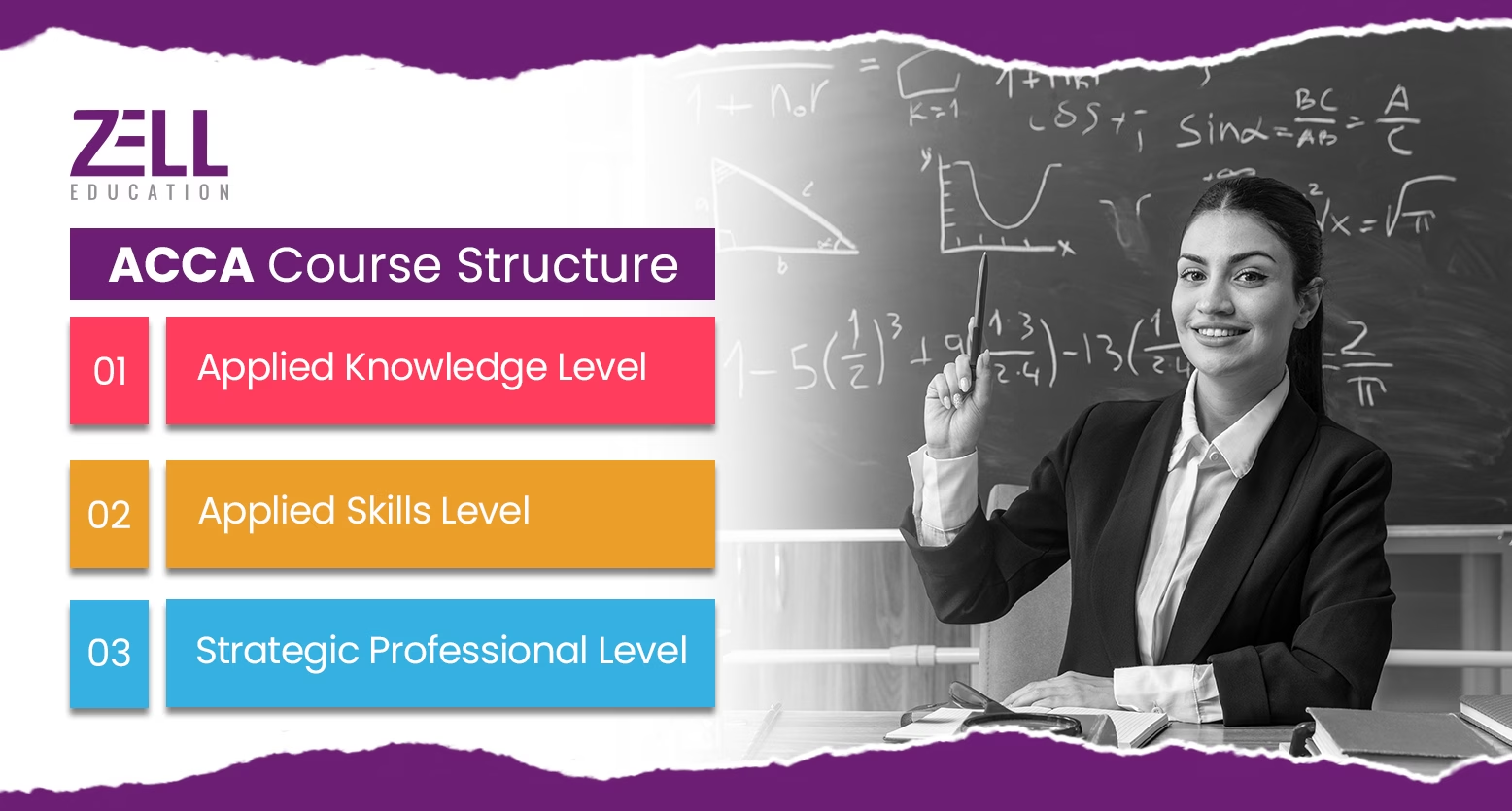
- The ACCA course is built to give strong skills in finance and accounting. Many wonder how the ACCA qualification works.
- It has three main ACCA qualification levels. The first is Applied Knowledge. This covers basics like accounting, business, and management.
- You will go through the applied skills stage of the ACCA Qualification. You will study important parts of finances (taxes, business laws, proper reporting of numbers, etc.).
- There are exams at each level of ACCA qualifications that you must pass to earn your ACCA Qualification. Additionally, practical experience is an important component of your ACCA qualification.
- You can study for your ACCA qualification online, in a classroom, or using a combination of both. You will also take a module on ethics and professionalism.
- By understanding how the process of getting an ACCA Qualification works, you will be able to effectively plan to study, and advancing in your career after obtaining an ACCA Qualification will allow you to work anywhere in the world in the field of finance and accounting.
Source of Information for ACCA Course Structure – ACCA Global
Applied Knowledge Level
The Applied Knowledge level is the first stage of the ACCA course. It focuses on the basics of accounting and business. You learn to understand financial statements and simple business reports. This level is ideal if you are new to finance and accounting. For example, you could prepare a small shop’s income statement or balance sheet.
The exams are simple and help you practise real-life tasks. Many students enjoy this level because it builds confidence. It also lays a strong foundation for the next stage, Applied Skills.
- Papers: Business and Technology (AB), Management Accounting (MA), Financial Accounting (FA)
- These papers help you understand how businesses operate and how financial data is used.
Applied Skills Level
The Applied Skills level is the second step in the ACCA course. It goes deeper than the basics. You study areas like taxation, financial reporting, audit, and management accounting. You pick up stuff like business law and keeping track of how a business is doing. It’s not all theory; you actually get to have a go at it.
One day you might work out the tax for a little café; another day you might spot mistakes in someone’s accounts. The exams are there to see if you can actually use what you’ve learnt, not just remember it.
This stage helps you make decisions based on numbers. It also prepares you for the Strategic Professional level. Many students enjoy seeing how what they learn works in real life.
- Papers: Corporate and Business Law (LW), Performance Management (PM), Taxation (TX), Financial Reporting (FR), Audit and Assurance (AA), Financial Management (FM)
- Here, you learn practical concepts like taxation, auditing, and financial reporting.
Strategic Professional Level
ACCA’s Strategic Professional level is the last stage, where you learn about leadership, strategy, and difficult topics in finance. Students will learn more complex topics than they did in previous phases, including advanced auditing, risk management, and business analysis.
The exams test your ability to apply practical reasoning and make decisions. In addition, you will begin to work with real businesses at this level. For example, once you become a Strategic Professional student, you could provide advice to a business to help it improve its financial performance.
- The Strategic Professional level represents the culmination of everything you have learned in earlier phases of the ACCA course.
- You also have to complete the ACCA Ethics and Professional Skills module.
- You will take required exams related to Strategic Business Leadership (SBL) and Strategic Business Reporting (SBR).
- These modules assess your ability to resolve problems involving real businesses.
You will also take 2 elective exams from among the subjects Advanced Financial Management, Advanced Performance Management, Advanced Taxation or Advanced Audit and Assurance. You will select your elective exams based on your specific job objectives.
Got Questions Regarding How the ACCA Qualification Works?
Click Here for a Free Counselling Session
ACCA Exam Windows, Format, and Fees
Before commencing the ACCA qualification, it is essential to be aware of the exam schedule and associated costs.
When are the ACCA Examinations Conducted?
- Examinations for ACCA will take place in March, June, September and December.
- This allows you the ability to plan your studies with the flexibility of your own pace.
How much will ACCA cost? (Registration Fee, Subscription Fees & Exam Fees)
The expense of obtaining an ACCA certification consists of:
- Registration fee (one-time)
- Annual subscription fee
- Testing fees (by paper)
In most cases, the total amount may range from ₹250,000 to ₹400,000 depending upon exemptions and coaching received. Although it may seem like a large expense, the worldwide possibilities for employment opportunities will make the investment worthwhile.
ACCA Exemptions: Can You Skip Papers?
ACCA qualifications offer many advantages. The biggest is exemptions from some exams (or papers) if you are a B.Com graduate, a CA Inter student, or any other Finance-related graduate.
Exemptions for B.Com, CA Inter, and Other Graduates
- A B.Com. graduate will get some exemption from papers
- A CA Inter student could receive multiple exemptions
- Graduates with other finance degrees may also qualify for exemptions
The fast completion of the ACCA qualification and lower costs are two big benefits of obtaining exemptions.
Practical Experience Requirement (PER)
PER is all about learning while you work. You do it alongside the ACCA levels. You get to see how finance and accounting work in real life. Most days, you’re helping out with small tasks, looking at numbers, or supporting the team in simple ways.
Someone at work checks in with you and gives tips as needed. Many students say this part makes the ACCA course click and feel real. You pick up skills without even noticing, just by doing the work. It helps you understand how each ACCA qualification level fits into actual jobs.
Many feel more confident tackling real finance roles after this stage.
PER is also a key part of meeting the ACCA qualification requirements. Finishing it is necessary to complete the ACCA qualification and start applying your learning in the real world.
Source on Information on Practical Experience Requirement (PER) – ACCA Global/PER
Why Work Experience Matters in ACCA
Work experience is an important part of the ACCA journey. It is one of the main ACCA qualification requirements. You’ll see how finance works in real life, not just in books. Each ACCA qualification level teaches the theory, but it’s the on-the-job stuff that really makes it click. You’ll try things, make a few mistakes, and slowly get the hang of it.
It also helps you develop confidence in real situations. Supervisors give guidance and feedback along the way. Many students say it makes studying much more meaningful.
Work experience gives you a clearer idea of your strengths and interests. It also prepares you for senior roles after completing the ACCA course. Knowing how the ACCA qualification works in practice makes the whole journey easier.
How to Log Your Experience Using the MyExperience Tool
MyExperience is a tool provided by the ACCA to support you in recording your work experience, providing a record of your achievements (and surname), and tracking your progress. As you use the tool, you create a structured and transparent process for recording your practical experience.
Ethics and Professional Skills Module
The Ethics and Professional Skills module forms part of your ACCA course and has an important component to help you to understand how to behave in a professional manner and develop yourself and the skills necessary to work ethically and professionally through your career. You learn about honesty, responsibility, and decision-making. The module shows you what real finance work is like. It also explains why ethics are important in everyday business decisions.
Many students say it makes the ACCA course more practical. Knowing how the ACCA qualification works is easier when you understand professional behaviour. This module gives you skills that last throughout your career.
Duration and Flexibility of ACCA
- The ACCA course usually takes three to four years, but it depends on you. You can study full-time or fit it around a job.
- Exams happen several times a year, so you can pick what works best. The ACCA levels can be taken in an order that suits you once the basics are done.
- You can study online, in a classroom, or a mix of both. Some students take breaks between levels to focus on work or personal life.
- You can take the ACCA course at your own pace and fit it around whatever else you’ve got going on. You gain work experience while studying, which makes learning feel real.
- Study hours can be adjusted around your daily routine. You kind of study when it fits your schedule, around work or life stuff, so it doesn’t feel like too much at once.
Typical ACCA Journey: Year-by-Year Timeline
- Year 1: Applied Knowledge + start Applied Skills
- Year 2: Complete Applied Skills
- Year 3: Strategic Professional level + PER
On average, students complete ACCA in 1.5 to 3 years.
Career Opportunities After ACCA
When you finish ACCA, you’ll probably start in accounts, dealing with numbers most days. After a bit, some people move into corporate finance, helping with budgets or just seeing how the company runs stuff.
- Advisory work is also common, guiding small businesses or startups. Management accounting is a good option if you like checking costs and giving suggestions.
- Taxation work is there too, helping clients sort out taxes and plan ahead. Internal audit or risk roles let you see how companies keep things on track.
- Banks and investment firms often look for ACCA-qualified people. Over time, you could aim for bigger roles like finance manager or even CFO.
- ACCA is recognised globally, so working abroad is an option too. Some mix ACCA with other certificates to focus on areas like strategy or forensic accounting.
ACCA Salary Expectations in India and Abroad
With experience, salaries increase significantly.
- India: INR 4 LPA to 8 LPA,
- Abroad: Approx. $30,000–$50,000+ or more depending on location
Source of Salary: Glassdoor
Conclusion: How ACCA Builds Global Finance Careers
ACCA isn’t just about passing exams. It’s about actually understanding how finance works in real life. When you get a sense of how the ACCA qualification works, it makes sense why so many companies value it. From the first levels you start learning things you can actually use: accounting, business, finance, and stuff that clicks once you see it in action.
As you go along, you also get some real work experience. That’s where it starts to feel real. You’ll try things at work and sometimes mess up, but that’s how you learn. Slowly, you start getting the hang of it. The ethics module is handy because it shows how to deal with tricky situations without panicking. By the time you finish, you’ll feel ready for different kinds of jobs.
FAQs on How the ACCA Qualification Works
How does the ACCA qualification system work?
It’s a mix of exams, practical work experience and an ethics module that together prepare you for real finance roles.
What are the 3 levels of ACCA?
You start with Applied Knowledge, move to Applied Skills and finish with Strategic Professional, which feels closer to real business work.
How long does it take to complete ACCA?
Most people take around three to four years, but it depends on how fast you study or if you’re working alongside it.
Do I need work experience to become ACCA qualified?
Yes, you need some hands-on experience, as it helps you apply what you’ve learnt and is part of the final qualification process.
Is it possible to receive exemptions from ACCA?
You can receive exemptions if you have completed prior studies, such as a Bachelor of Commerce, or have completed your CA Intermediate examinations.
What is the ACCA Ethics and Professional Skills Module?
The Ethics and Professional Skills module is a module designed to help with developing both your ethical and communication professional skills.
What is the average cost to complete your ACCA program in India?
You should expect to pay anywhere between INR 3 lakh to 5.5 lakh depending on what all services you request.
Is ACCA accepted in India?
Yes, ACCA is widely recognized and accepted, particularly among the large Multinational Corporations globally and in India.

Current Role
Co-Founder & CEO at Zell Education
Education
- ACCA – Association of Chartered Certified Accountants, Finance (2011 – 2014)
- Bachelor of Commerce (BCom), Financial Markets from H.R. College Of Commerce & Economics (2010 – 2013)
Location
Mumbai, India
Expertise
ACCA Certified
Why Zell?
- • Largest Provider for Global F&A Courses
- • 4.6 Google Review Rating
- • 1000+ Students placed Annually
- • 500+ Active Hiring Partners
- • Placement Opportunities at the Big 4
- • 100+ Global & Indian Rank Holders
- • 100+ Faculty Network
Speak to A Career Counselor

Professionally reviewed by Harshit Morparia, ACCA & Executive at Ernst & Young
Zell's 10th Anniversary Offer - Avail a 10% Scholarship