
Key Takeaways
- The full form of PER is Practical Experience Requirement.
- To qualify for ACCA membership, you must complete the PER.
- The duration of ACCA PER is 36 months or 3 years of work experience.
Comprehensive Summary: ACCA PER
- What are ACCA PER requirements?: ACCA PER requires candidates to complete relevant work experience and performance objectives.
- How much is the practical experience requirement?: Students must achieve 36 months of supervised experience in relevant accounting roles.
- What are ACCA Performance Objectives?: ACCA PER includes essential objectives demonstrating professional competence and workplace skills.
- Who can review the practical experience requirement?: A qualified supervisor must review, verify, and sign off PER achievements.
- Why is PER important for ACCA membership?: Completing PER is mandatory before becoming a full ACCA member.
- What are the benefits of PER?: ACCA PER strengthens practical expertise, improving employability and long-term career progression.
In this blog, we will be able to know why work experience is necessary to complete the ACCA qualification, various ways of completing the ACCA Practical Experience Requirement, and how Zell Education can help you get the required work experience.
Learn How to Complete ACCA PER the Right Way
 Book Free Counselling
What Is the ACCA Practical Experience Requirement (PER)?
The ACCA qualification is among the most preferred and globally valued qualifications for accountants, leading their profession in financial accountancy practice. It doesn’t just prepare one for brilliant work in corporate finance and accountancy at all; again, acquiring this qualifies a person at large for way more than just scoring the ACCA examinations.
Where ACCA exemption could be quite valuable, another critical complementary factor toward acquisition of your advanced ACCA qualified degree would remain the PER (Practical Experience Requirement) ACCA. ACCA PER ensures that the candidates get theoretical knowledge and, at the same time, work experience in accounting and finance fields.
| PER Component | What It Means | How It Is Verified |
| 36 Months Experience | 3 years supervised work in accounting/finance role | Supervisor confirms relevant period in MyExperience |
| 5 Essential Objectives | Ethics, professionalism, leadership, governance, stakeholder management | Supervisor reviews & signs off 200–500 word statements |
| 4 Technical Objectives | Management accounting, audit, taxation, financial reporting, advisory | Supervisor approves achievement via myACCA online portal |
| MyExperience Record | Online log updating progress, roles, employer, supervisor details | Submitted digitally through myACCA account for supervisor approval |
Source for PER details: ACCA Global/Practical Experience
Why Is Work Experience for ACCA Degrees Important?
Work experience is crucial for an ACCA qualification because it is mandatory to complete the 36-month Practical Experience Requirement (PER) to become a full member. It bridges the gap between textbook theory and real-world finance so that you become a competent, job-ready professional.
How Important is Practical Experience to the ACCA Qualification?
The ACCA qualification covers both theoretical and practical views. The ACCA exams prove that you have mastered the theory of accounting but the ACCA Practical Experience Requirement will ensure that you have the practical skills and experience to back up that knowledge.
| Practical Experience Area | Skills Developed | Importance in ACCA Qualification | Career Benefit |
| Financial Reporting | Financial statement preparation | Supports ACCA technical knowledge | Better reporting roles |
| Audit & Assurance | Risk assessment and auditing | Meets PER competency requirements | Audit career opportunities |
| Taxation | Tax compliance and planning | Applies ACCA tax concepts practically | Tax advisory roles |
| Management Accounting | Budgeting and cost analysis | Strengthens decision-making skills | FP&A and finance positions |
| Financial Management | Investment and financing decisions | Enhances strategic understanding | Corporate finance careers |
| Internal Controls | Compliance and governance | Develops professional judgment | Risk management roles |
| Business Analysis | Data interpretation and insights | Supports strategic business leadership | Consulting opportunities |
| Stakeholder Communication | Professional communication skills | Required for workplace effectiveness | Leadership readiness |
| Team Collaboration | Cross-functional teamwork | Builds professional competencies | Improved career progression |
| Ethical Decision-Making | Professional ethics application | Supports ACCA ethics requirements | Strong professional reputation |
| Performance Evaluation | KPI monitoring and analysis | Links theory to business outcomes | Management roles |
| Project Participation | Planning and execution skills | Demonstrates practical competence | Enhanced employability |
For full details on selecting and tracking your objectives, refer to the ACCA Completing Your PER Guide.
ACCA practical experience is quite important because one gets the avenue to apply what he or she has learned in a professional setting. This practical experience will prepare you for the demands of the accounting profession, but it will also instil confidence in your ability to make sound decisions, communicate effectively, and contribute to business success.
Why Is the ACCA Practical Experience Requirement (PER) Crucial for Career Growth?
The ACCA PER is an integral part of your journey to becoming a fully qualified ACCA member. It provides the opportunity to work in various areas of accounting and finance and thus exposes you to different industries and roles. Completion of your ACCA practical experience makes you distinctive in the job market, too, as it shows the employers that you are in possession of the essential skills required for the profession.
Also, achieving the ACCA Practical Experience Requirement provides greater subject options and enhances the prospects of career enhancement and career development within the profession.
Get Expert Support for Your ACCA Practical Experience Requirement
 Explore ACCA Program
How Can I Gain ACCA Practical Experience?
To gain your ACCA Practical Experience Requirement (PER), you must complete 36 months of relevant finance/accounting work, achieve 9 performance objectives, and have your experience signed off by a qualified supervisor. You can build this experience through full-time roles, part-time jobs, internships, or voluntary work.
Where Can You Gain Practical Experience for ACCA?
ACCA’s Practical Experience Requirement can be achieved through many avenues in the field of professionalism. You may have already secured an opportunity to work for an organisation or a firm offering you ACCA work experience, where you may receive work exposure to practical areas of financial accounting, management accounting, taxation, audit, and business advisory services. Many of the ACCA course providers extend their facilities toward finding job placements for you in your pursuit of fulfilling the requirements for your ACCA practical experience.
Besides that, some organisations happen to have ACCA-pre-approved employers, offering attachments that are specifically tailored to aid one in meeting the ACCA PER; this would mean that once one starts working with such companies, the practical experience will immediately start counting while trying to meet the requirements for the ACCA qualification.
Can You Gain ACCA Practical Experience through Internships?
ACCA practical experience is also useful when it is earned through internships. Many firms, but mainly those dealing in the fields of finance and accounting, provide internship opportunities for students studying for the qualification.
Most of these internships are organised in such a way that students get real work experience in auditing, tax planning, financial reporting, and management accounting. The reason being, internships not only avail you of the required experience in ACCA but also build your connections within the industry that will eventually help you land permanent positions once your studies are complete.
Specifications for ACCA’s Practical Experience Requirements (PER)
The ACCA Practical Experience Requirement (PER) mandates that you complete 36 months of relevant accounting/finance work and achieve nine specific performance objectives (five Essentials and four Technical). You must also have your experience signed off by an IFAC-qualified practical experience supervisor.
What Is the Minimum Duration for the ACCA Practical Experience Requirement?
The minimum work experience for the ACCA PER (Practical Experience Requirement) is 36 months, which is three years. Any work experience should be within your work context or relevant to the practical application of accountancy and/or finance. You will be expected, throughout this time, to work in various roles that will help you develop the key skills required for the accounting profession.
What Does the ACCA PER Include?
The ACCA PER prescribes activities in both the development of technical skills and ethical awareness. It covers areas like financial reporting, budgeting, and internal controls so that you will be equipped to handle various aspects of accounting work.
| ACCA PER Component | Requirement |
| Practical Experience | 36 months of relevant work experience |
| Performance Objectives | 9 objectives (5 Essential + 4 Technical) |
| Essential Objectives | Ethics, communication, leadership, governance |
| Technical Objectives | Chosen based on role and career path |
| Mentor/Supervisor Sign-Off | Approved by a Practical Experience Supervisor |
| Ethics Requirement | Complete ACCA Ethics and Professional Skills Module |
Considering the completion of the qualification, ACCA requires that you provide evidence of work experience through their system to confirm you have met the criteria. This means documenting your activities and showing how they align with ACCA’s key competencies and technical areas.
Are 36 Months Enough for PER?
The big question at this stage usually is whether 36 months of work satisfy the ACCA Practical Experience Requirement. As a matter of fact, yes, it does, provided one has 36 months’ worth of work, usually related to anything that may portray the demonstration of skill and competence of the standard expected from the ACCA Global.
However, the efficiency with which you can complete your ACCA work experience would depend on the nature of your job, the type of exposure you receive to various accounting operations, and how actively you pursue opportunities at the workplace for learning.
Types of Work Experience that Can Be Included in ACCA Work Experience
What Kind of Work Experience Can Count Towards ACCA PER?
Not all work experience will qualify for the ACCA Practical Experience Requirement. For your experience to count, it needs to meet certain criteria as set out by ACCA Association of Chartered Certified Accountants. The work should be in direct relation to accounting, finance, or business management and hence can be included. Examples of typical work that would normally qualify include the following:
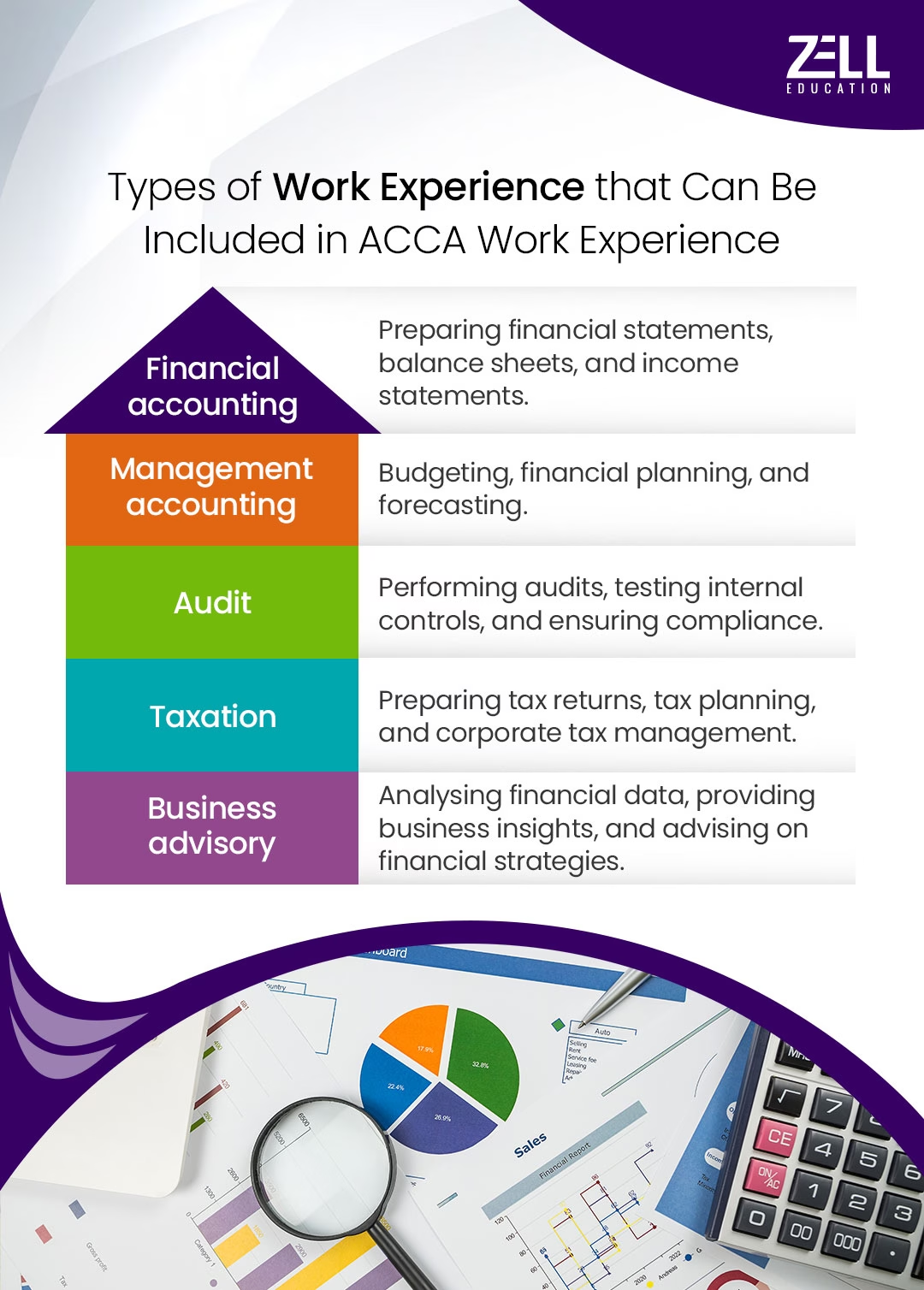
- Financial accounting: Preparing financial statements, balance sheets, and income statements.
- Management accounting: Budgeting, financial planning, and forecasting.
- Audit: Performing audits, testing internal controls, and ensuring compliance.
- Taxation: Preparing tax returns, tax planning, and corporate tax management.
- Business advisory: Analysing financial data, providing business insights, and advising on financial strategies.
How Can You Make Sure Your Work Experience Aligns with ACCA Requirements?
This will ensure that your working experience meets the standards of practical experience put forth by ACCA. You would have to engage your employer and a mentor at work closely to ensure exposure to various areas of experience in accounting as required by this body. You will record the tasks you perform that link with two key competencies specified by the ACCA syllabus for the ACCA qualification. Review with an ACCA-approved mentor and mentor on the progress you are making while trying to eventually meet these specific requirements.
What Are the Essential Skills Required for Practical Experience Requirements (PER)?
These skills are necessary for achieving the ACCA Practical Experience Requirement in the following:
- Core Skills and Expertise: Proficiency in accounting, financial reporting, budgeting, and taxation.
- Ethical awareness: Realisation and adherence to professional ethics in accounting.
- Communication skills: The ability to present financial data in a clear manner and explain it to non-financial stakeholders.
- Problem-solving: The extent to which one can show one’s capability of analysing and resolving financial problems.
- Leadership skills: managing teams, making decisions, and taking responsibility for financial outcomes.
How Do You Gain These Skills?
You develop these through your everyday work and with the help of your practising mentors and colleagues. Your employer should provide opportunities for you to take on progressively challenging tasks that help you build these competencies. Many candidates also look for additional training or learning opportunities to further develop these essential skills during their ACCA studies.
How Zell Can Help You
At Zell Education, we are committed to seeing you through your ACCA qualification successfully. We will support you through your ACCA journey with a range of services that include finding you ACCA work experience placements. Zell has a network of ACCA-approved employers that have opportunities for students to gain valuable experience in accounting and finance roles. Through our placements, you can get the work experience you need to satisfy the ACCA Practical Experience Requirement while learning from industry professionals.
Zell Education works closely with employers in the accounting and finance sectors to help students secure internships, apprenticeships, and full-time positions that align with their ACCA studies and ACCA practical experience needs. Our experienced team will guide you through the process of finding a placement that fits your career goals and ensures you meet the ACCA PER.
Conclusion
The ACCA Practical Experience Requirement is an integral part of the ACCA certification that provides an assurance that you obtain relevant work experience to complement your academic studies. It gives you an opportunity to professionally develop the skills, knowledge, and ethical understanding required for a successful career in accountancy.
ACCA work experience is not only a requirement but also one great opportunity to put into practice what you have learned and increase your career prospects. The required support to do so, however, only ace providers like Zell Education can ensure that you get hold of quality ACCA practical experience and complete your qualification with total confidence.
FAQs on ACCA PER
What counts as practical experience for ACCA?
Relevant accounting, finance, audit, taxation, or business roles count as ACCA practical experience.
What does ACCA PER mean?
ACCA PER stands for Practical Experience Requirement needed for ACCA membership.
What is the salary of an ACCA professional during practical experience?
ACCA trainees typically earn between ₹3–8 LPA during practical experience periods.
Is work experience necessary for ACCA?
Work experience is required to become an ACCA member, not to study.
How can I get ACCA practical experience?
You can gain ACCA practical experience through relevant finance and accounting roles.
What are the minimum requirements to study ACCA?
Students need a 10+2 qualification or FIA route with required marks or equivalent eligibility criteria.
Can I use freelance or part-time work to complete ACCA PER?
Yes, qualifying freelance or part-time roles may count toward ACCA PER.
What happens if I do not complete PER after passing all ACCA exams?
You cannot obtain ACCA membership until all PER requirements are completed.
How do I find an ACCA Approved Employer in India?
Search ACCA’s Approved Employer directory or explore major finance employers.
Is ACCA PER changing in 2027?
No official ACCA announcement currently confirms any PER changes for 2027.

Current Role
Co-Founder & CEO at Zell Education
Education
- ACCA – Association of Chartered Certified Accountants, Finance (2011 – 2014)
- Bachelor of Commerce (BCom), Financial Markets from H.R. College Of Commerce & Economics (2010 – 2013)
Location
Mumbai, India
Expertise
ACCA Certified
Why Zell?
- • Largest Provider for Global F&A Courses
- • 4.6 Google Review Rating
- • 1000+ Global Placement Partners
- • Placement Opportunities at the Big 4
- • 100+ Global & Indian Rank Holders
- • 100+ Faculty Network
- • 10,000+ Students Placed
Speak to A Career Counselor

Professionally reviewed by Harshit Morparia, ACCA & Executive at Ernst & Young
Zell's 10th Anniversary Offer - Avail a 10% Scholarship