
Many investment bankers choose to complete the CFA after MBA in order to gain comprehensive financial acumen and switch from general to specialised financial jobs. It is an improvement in both strategic and skill-based dimensions.
What Makes MBA and CFA a Powerful Combo in the Finance Industry?
MBA and CFA provide value in combination because these not only provide management acumen, but they are also highly technical in nature regarding the financial aspects. It has been realised by many professionals in their banking careers that it is easy to enter banking with an MBA, whereas the CFA course provides in-depth knowledge to grow in banking.
For instance, a person could land an initial job in corporate finance or investment banking after pursuing an MBA, yet once they require training in handling valuation models, equity analysis, or risk management, they realise there is some gap in their mastery. Consequently, they end up looking for answers to questions such as whether one can do CFA after MBA, with concern for its typical duration after MBA.
Why this combination works so well
- MBA teaches strategy, communication, and leadership
- CFA builds technical depth and analytical strength
- Investment banks value professionals who can do both
- The combination strengthens credibility, especially in global markets
- It aligns with long-term objectives such as transitioning into asset management, private equity, or portfolio careers.
Talking about CFA vs MBA, these two aren’t competing courses; rather, they complement each other.
Curious About Why Some Investment Bankers Choose CFA After MBA?
How Is an MBA a Gateway to Investment Banking?
Pursuing an MBA guarantees a job in investment banking, either through placement, internship, or network contacts. Most of the elite MBA courses have close affiliations with investment banks, thus ensuring easy entry for new graduates into these institutions.
MBAs are usually recruited for roles in Mergers & Acquisitions, Corporate Finance, Investment Banking Division (IBD), Equity Capital Markets (ECM), or Debt Capital Markets (DCM). These functions rely on communication skills, which are honed during an MBA.
But once MBA pass-outs start work in these capacities, they realise that these functions, too, require financial model development, valuation, and market acumen for success to be achieved. It’s at this point that they understand the need for CFA after MBA.
Strategic Thinking and Leadership Skills
MBA courses are geared towards improving leadership, decision-making, and strategic thinking, all crucial elements in investment banking. MBA coursework includes:
- Strategic management
- Negotiation and communication
- Corporate finance
- Business analytics
- Leadership and organisational behaviour
These attributes make job seekers thrive in stressful, interaction-based jobs. Still, many opt to undertake CFA duration after MBA because there is growing demand for strategic insight, in addition to expertise in high-level banking functions, which CFA comprehensively enhances.
MBA Placements and Corporate Exposure
Amongst the most important plus points for pursuing an MBA before obtaining CFA certification is to have the opportunity to gain experience in real-world business environments. MBA applications are benefited by:
- Campus recruitment from major finance companies
- Summer internships which frequently lead to full-time jobs
- Case competitions in M&A, investments, and corporate finance
- Direct access to alumni working in global banks
This direct interaction with the finance world gives MBA graduates an advantage, but it shows them soon enough how much financial acumen investment bankers require. It is at this point that most professionals in business administration start looking for information on what is CFA in relation to whether there is a “CFA course” for their profession.
How Does CFA Offer a Deeper Dive Into Financial Expertise?
CFA is renowned for imparting in-depth professional-level information in investment analysis, financial markets, portfolio management, and ethics, which have utmost applicability to investment banking. It is for these reasons that CFA after MBA is in high demand, even for those already employed in finance. It is because the CFA curriculum bridges any gaps in analysis not filled in MBA courses.
CFA adds value in:
- Valuation and financial modelling
- Equity and fixed-income analysis
- Risk management
- Portfolio theory
- Derivatives, alternatives, and structured products
Another reason why MBA pass-outs opt for the CFA certification is due to its international regard, which adds to their credentials.
Strengthening Technical Knowledge & Analysis Skills
CFA is regarded as one of the most difficult technically in finance. The CFA curriculum covers:
- Financial reporting and analysis
- Discounted cash flow valuation models
- Credit and debt valuation
- Quantitative techniques
- Market behaviour and trading concepts
- Professional ethics and global standards
MBA pass-outs realise that CFA fills gaps in their knowledge, which is necessary while working on investment models, equity reports, or risk strategies. Hence, CFA after MBA is extremely advantageous for professionals.
Source of information for How Does CFA Offer a Deeper Dive Into Financial Expertise: CFA Program Overview by CFA Institute.
CFA’s Value in Portfolio Management and Valuation
CFA is particularly appreciated in contexts such as investment decision-making, asset valuation, and portfolio management. MBA courses would discuss such issues, whereas the CFA curriculum explores areas several levels further. CFA is highly useful for professionals interested in:
- Asset management
- Hedge funds
- Wealth management
- Equity research
- Valuation and advisory services
It is crucial to understand the structure of the CFA course for MBA graduates to plan on incorporating CFA in their schedules.
Why Do MBA Graduates Pursue CFA Later?
MBA pass-outs opt for CFA later because they understand that holding an MBA might not be sufficient for pursuing their technical, analysis, or investment-based careers. In simple terms:
- MBA gives a strong entry
- CFA gives long-term professional strength
All these elements lead to finance professionals with well-rounded expertise in areas like leadership and investment analysis.
To Move from Generalist to Specialist Roles
A lot of MBA graduates begin with general management functions; however, they end up in finance-specific functions, which demand CFA-level proficiency. These could include:
- Equity research analyst
- Risk analyst
- Valuation specialist
- Investment strategist
- Portfolio manager
For these roles, the understanding from CFA is much more in-depth than what’s usually provided in an MBA. It is why many delve into CFA duration after MBA to schedule their CFA certification process while pursuing their full-time job.
To Stand Out in Competitive Finance Careers
Just like other industries, acquiring a CFA vs MBA could provide finance professionals with a competitive edge in the job market. Candidates with each type of qualification usually have these benefits:
- Higher salary packages
- Faster promotions
- Better global mobility
- More credibility with clients and employers
It’s for these reasons why CFA vs MBA isn’t an either/or consideration, because together it’s presumably the best route.
How Does CFA Add Career Value to an MBA Profile?
Adding to the MBA resume, CFA offers its depth, integrity, and in-depth analysis in financial roles. Investment banks and asset management firms require professionals to have management expertise along with market know-how.
Enhanced Credibility in Global Markets
Global recognition by CFA is one reason why professionals choose to pursue it after acquiring an MBA. With CFA, professionals can work across:
- North America
- Europe
- Middle East
- Southeast Asia
- Australia
This global mobility is truly an asset, given that careers in investment banking commonly extend into several markets. MBA graduates, intending to expand their horizons globally, opt for CFA after MBA to improve their overall global outlook.
Broader Opportunities in Asset Management & Research
CFA offers other opportunities which an MBA maybe doesn’t, especially in areas like investments or research-based roles. These include:
- Buy-side analyst roles
- Sell-side research positions
- Fund management
- ESG and sustainability investing
- Investment advisory

- Wealth management
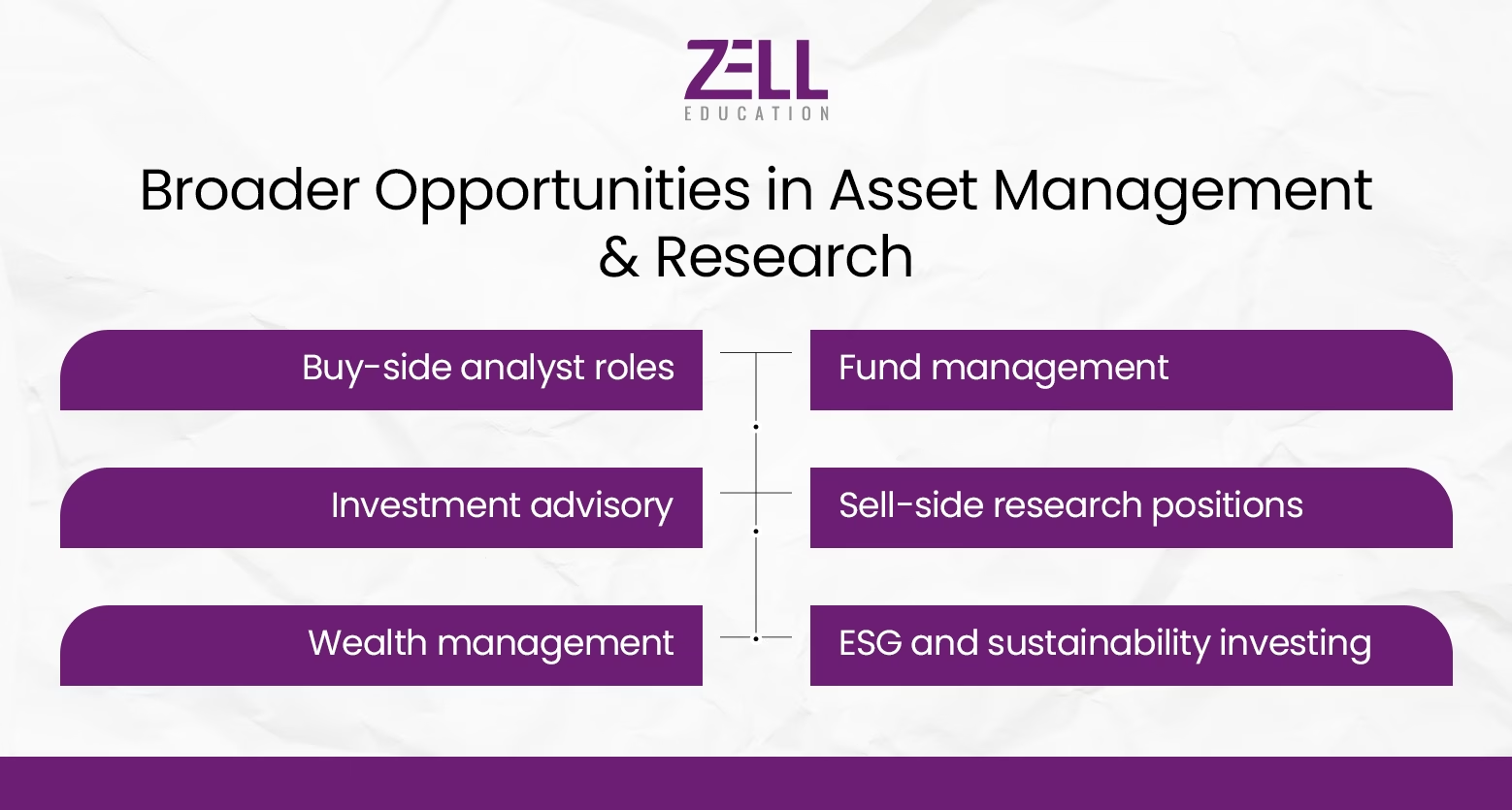
CFA increases an MBA graduate’s integrity in these areas, given that its curriculum is specifically aligned with their everyday tasks. For professionals looking into transitions, studies on ‘Can I do CFA after MBA?’ or ‘CFA duration after MBA’ would assist them in mapping their skill development process.
Want to Pursue CFA Finance Career?
Book Your Free Counselling Session Today
Conclusion: Why Combining MBA and CFA Leads to Long-Term Growth
Both CFA vs MBA together create an optimal combination with regard to strategic thinking, management, and financial acumen. MBA assists professionals in getting into investment banking, whereas CFA hones their analytical acumen with in-depth finance knowledge.
Well, for those interested in knowing whether CFA after MBA is worth investing in, my answer is affirmative. It aids in improving international mobility and unlocking professional opportunities, as well as increasing job security. It is imperative to have some comprehension regarding the CFA course structure and CFA duration after MBA.
MBA creates the basics. CFA constructs the expertise. These skill areas, together, create a dynamite finance career.
FAQs on Why Some Investment Bankers Choose CFA After MBA
Should MBA graduates pursue CFA?
Yes, MBA graduates have something to gain from pursuing CFA programmes, given that such programmes improve finance acumen and job opportunities in investment banking and research analysis.
How does CFA help after completing an MBA?
CFA offers value in areas such as analysis acumen, valuation proficiency, market savvy, and global recognition, which increase competitiveness in finance careers.
Do investment bankers do CFA after MBA?
Yes, many investment bankers choose to pursue CFA after MBA in order to have more in-depth financial knowledge, especially in markets, research, and asset management.
Is it worth doing CFA after MBA in finance?
Yes, CFA after MBA is highly valued, especially for those seeking long-term growth, in-depth knowledge, and international opportunities in senior finance roles.

Current Role
Co-Founder & CEO at Zell Education
Education
- ACCA – Association of Chartered Certified Accountants, Finance (2011 – 2014)
- Bachelor of Commerce (BCom), Financial Markets from H.R. College Of Commerce & Economics (2010 – 2013)
Location
Mumbai, India
Expertise
ACCA Certified
Why Zell?
- • Largest Provider for Global F&A Courses
- • 4.6 Google Review Rating
- • 1000+ Global Placement Partners
- • Placement Opportunities at the Big 4
- • 100+ Global & Indian Rank Holders
- • 100+ Faculty Network
- • 10,000+ Students Placed
Speak to A Career Counselor
Zell's 10th Anniversary Offer - Avail a 10% Scholarship