
What is GAAP? Its purpose is in managing what is reported in business financial statements and producing consistency from business to business. It explains the key principles, applications, contrasts with IFRS, and common limitations.
In finance and reporting, knowing what is GAAP is essential. GAAP meaning provides a foundation for financial transparency and consistent accounting across the United States. It provides methodology guidelines for accounting information (i.e., costs and revenue tracking or financial statement preparation) to ensure consistency, accuracy, and clarity for all stakeholders.
When we think about GAAP, there is a level of trust and credibility that is incorporated into the use of the GAAP framework. All investors, lenders, regulators, auditors, and the company’s own management rely on the principles of GAAP.
By following GAAP, companies can sustainably communicate their financial standing so that comparative and analytical evaluation can occur, consequently providing some level of choice by users of the information.
Importance of GAAP in Financial Reporting
It is important to grasp the meaning of GAAP and the importance it plays. Primarily, it is meant to outline accounting principles and promote trustworthy financial statements. Here are some of the key reasons GAAP is important to a business.
1. Allows for Consistency and Comparability
A key benefit of following GAAP accounting principles is that it makes it easy to compare financial statements. All stakeholders can compare businesses easily, meet to determine performance trends, and evaluate potential financial viability when everyone is following their own specific set of general accounting principles.
2. Improves Transparency and Accuracy
Part of understanding what is GAAP is understanding how it enhances financial transparency. The rules require that businesses report their substantial assets, liabilities, revenues, and expenses in an accurate way. Less misinformation can be generated by accuracy, and it helps all stakeholders to trust what is demonstrated in the financial statements.
3. Builds Investor and Lender Confidence
GAAP-compliant financial statements are used by investors, banks, analysts, and credit agencies to evaluate an organisation’s actual financial situation. GAAP presents standardisation and transparency in financial reporting, building trust among stakeholders.
4. Supports Auditing and Regulatory Compliance
GAAP is used by external auditors to assess the completeness, accuracy, and fairness of financial statements. There are many government, regulatory and grant organisations that require adherence to GAAP.
Curious About What Is GAAP?
Core GAAP Principles
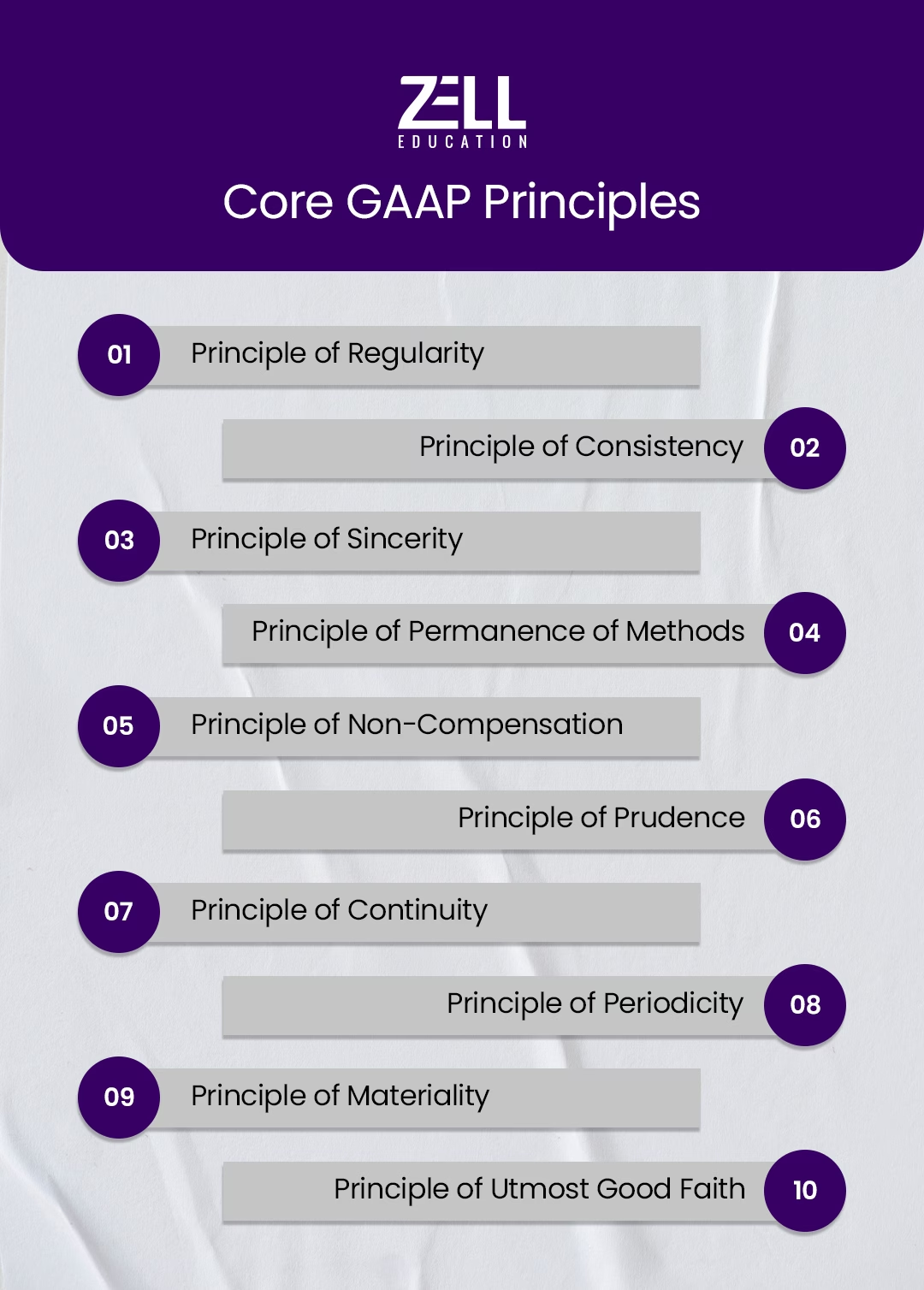
There are 10 primary or foundational GAAP accounting principles that are the DNA of generally accepted accounting principles and govern how businesses recognise revenue, assign value to assets, record expenses, and maintain transparency.
The following core GAAP principles are:
1. Principle of Regularity
The principle of regularity ensures businesses follow established general accounting principles in preparing financial statements. It promotes discipline and consistency in implementation and fulfilling GAAP requirements.
2. Principle of Consistency
Once a company selects an accounting practice under GAAP accounting, it must consistently apply that practice each reporting period. This consistency is crucial to allow investors to compare performance across time periods easily.
3. Principle of Sincerity
This principle speaks to honesty. Under generally accepted accounting principles, accountants are required to represent the company’s financial position fairly and honestly, even if the results aren’t positive.
4. Principle of Permanence of Methods
The principle of permanence of methods assists the long-term comparability of information. Businesses are required to maintain the same accounting methodology unless a justified reason is given or adequately disclosed.
5. Principle of Non-Compensation
Organisations cannot disguise losses by offsetting them with gains. Under GAAP accounting guidelines, clarity must be maintained in reporting both positive and negative financial items.
6. Principle of Prudence
This conservatism ensures that financial performance is not overstated. Under GAAP, companies must avoid the inflation of profits or asset values and instead expense or recognise liabilities when they are expected to occur.
7. Principle of Continuity
The principle assumes that the business will continue to operate in the near future. The existence of continuity assumes valuations, depreciation, and asset categories as defined by general accounting principles.
8. Principle of Periodicity
This rule requires all financial activities to be accounted for within a certain time period (monthly, quarterly, and annually). This limits the nature of financial reporting and is a means of transparency in GAAP-based reporting.
9. Principle of Materiality
Reporting practices require that all relevant information that could have determined a stakeholder’s decision must be disclosed. Reporting may include small details if they are material in context.
10. Principle of Utmost Good Faith
This principle defines honesty at the highest conceivable level. It requires integrity in all transaction recordings, maintaining documentation, and presenting financial statements.
Source for Core GAAP Principles – Wikipedia/GAAP US.
Applications of GAAP in Business
To understand GAAP (Generally Accepted Accounting Principles), it is useful to observe it being applied in real-world businesses. GAAP is not just a theoretical concept; it impacts everyday financial decisions, transactions, and planning.
Here are some examples of where businesses apply GAAP:
1. Financial Statement Preparation
The organisation prepares income statements, balance sheets, cash flow statements, and equity statements based on GAAP with the aim of clarity, accuracy, and consistency in their financial reporting.
2. Auditing & Compliance
Auditors evaluate whether the company is adhering to GAAP. Compliance shows you are accountable and responsible and builds confidence with lenders, investors, and regulators.
3. Internal Decision-Making
Companies rely on GAAP accounting for reliable financial information that informs long-term decisions, ranging from budgeting, forecasting, and assessing risk.
4. Mergers & Acquisitions Reporting
In acquisitions, companies need audited or reviewed GAAP-compliant valuations, allowing buyers (or investors) to understand actual financial performance, liabilities, goodwill, and future earnings potential.
5. Investor Communication
Companies apply generally accepted accounting principles to create financial statements that help investors from around the world analyse the growth, profitability, and financial stability of the company.
6. GAAP vs. Non-GAAP Reporting
Certain companies issue adjusted, or non-GAAP, metrics (for example, adjusted EBITDA); however, GAAP accounting must remain the fundamental accounting baseline. Non-GAAP accounting must always be a bridge back to GAAP accounting to not mislead analysts.
GAAP Financial Statements
GAAP financial statements aim to accurately depict a company’s financial performance. Anyone who finds out what GAAP is should be familiar with how these statements operate.
1. The Income Statement
The income statement provides a report of revenue, expenses, and net profit for a period of time. This report relies on rules surrounding revenue recognition and expense matching to provide accuracy.
2. The Balance Sheet
The balance sheet reports assets, liabilities, and equity on a date. GAAP accounting principles determine how items are reported and valued, thereby causing consistency between companies.
3. The Cash Flow
The cash flow statement accounts for cash inflows and outflows while itemising activity from operating, investing, and financing. The cash flow statement provides transparency into liquidity and financial sustainability.
4. Statement of Retained Earnings
The statement of retained earnings provides a report of how retained earnings change over time. In terms of GAAP accounting, as it relates to the balance sheet and retained earnings, it reports net income, dividend payments, and any adjustments that occurred, which are adjustments to the closing balance of shareholder equity.
GAAP vs IFRS: Understanding the Key Differences
As you learn what is GAAP, it’s helpful to learn how GAAP compares with the International Financial Reporting Standards (IFRS). While the two frameworks aim to enhance financial transparency, there are differences in structure and reporting.
| Parameter | GAAP (U.S.) | IFRS (International) |
| Framework Style | Rules-based with thorough instructions. | Principles-based with wide concepts. |
| Inventory Valuation | Allows LIFO and FIFO. | LIFO is not allowed; only FIFO and weighted average are. |
| Impairment Testing | Two-step impairment test. | One-step impairment test. |
| Primary Region Used | United States | Over 140+ countries globally |
| Reversal of Impairment | Most reversals are not allowed. | Reversals are allowed under some conditions. |
| Fair Value Usage | Limited use in some areas. | Greater reliance on fair value measurement. |
| Development Costs | Expensed immediately | Can be capitalised if criteria are met. |
| Flexibility | Less flexible due to strict rules. | More flexible due to an interpretation-based approach. |
Why These Differences Matter
Gaining awareness of these differences assists students, professionals, and business owners in bringing value into their interpretation of financial statements prepared by companies that conduct business in multiple regions. When someone asks what is GAAP, one response includes that GAAP establishes the consistency of reporting in the U.S., while IFRS emphasises the importance of international comparability.
Limitations of GAAP
While GAAP is very credible, understanding what GAAP is also includes understanding its limitations.
1. Complexity
Many GAAP accounting principles are detailed and likely require some professional expertise. This can create difficulty for small businesses that do not rely on, or do not have, professional accounting help.
2. Less Flexible Than IFRS
GAAP is a rules-driven accounting and, therefore, a less flexible accounting standard for unique or modern financial transactions. It makes IFRS a more applicable routine in certain industries.
3. Variations Across Industries
Industries like not-for-profits, insurance and government organisations are required to follow modified versions of GAAP. This can cause ambiguity and inconsistencies.
Source for Limitations of GAAP – Indeed/Career Development/GAAP.
Want to Pursue IFRS Finance Career?
Book Your Free Counselling Session Today
Conclusion
Understanding GAAP is indispensable in accounting, finance, and business decision-making. It was based on the most rigorous general accounting principles and standardized rules of GAAP, which make financial reporting transparent, comparable, and valuable.
Most importantly, although GAAP is a guideline for companies, it is a protection for investors, regulators, and the overall economy. Generally accepted accounting principles still remain important in today’s ever-evolving reporting environment, and gaining an ACCA certification further strengthens your understanding of these principles and enhances your credibility in the global accounting field.
FAQs on What Is GAAP
What is GAAP?
GAAP refers to Generally Accepted Accounting Principles. It is a set of rules that help financial statements be consistent, reliable and comparable across companies.
Why is GAAP important in accounting?
GAAP helps with transparency, improves investor confidence, and creates accuracy in financial reporting by following standardised GAAP accounting principles.
What are the 10 basic GAAP principles?
The ten basic GAAP principles are regularity, consistency, sincerity, prudence, materiality, continuity, periodicity, non-compensation, permanence of methods, and utmost good faith.
How does GAAP differ from IFRS?
GAAP is more rule-based, while IFRS is more principle-based and flexible. There are also differences in accounting, such as with inventory or methods of impairment.
Who sets GAAP standards?
The Financial Accounting Standards Board (FASB) is responsible for developing and updating GAAP accounting principles in the United States.
Is GAAP mandatory for all companies?
Public companies are required to follow GAAP; GAAP may also be used by private firms for the needs of lenders, investors or a regulatory requirement.

Current Role
Co-Founder & CEO at Zell Education
Education
- ACCA – Association of Chartered Certified Accountants, Finance (2011 – 2014)
- Bachelor of Commerce (BCom), Financial Markets from H.R. College Of Commerce & Economics (2010 – 2013)
Location
Mumbai, India
Expertise
ACCA Certified
Why Zell?
- • Largest Provider for Global F&A Courses
- • 4.6 Google Review Rating
- • 1000+ Global Placement Partners
- • Placement Opportunities at the Big 4
- • 100+ Global & Indian Rank Holders
- • 100+ Faculty Network
- • 10,000+ Students Placed
Speak to A Career Counselor
Zell's 10th Anniversary Offer - Avail a 10% Scholarship