
Key Takeaways
What is actuarial science?
- Actuarial science is the study of using math, stats, and money rules to figure out future risks.
- They help companies guess how much money they might lose in the future.
- This helps businesses set safe prices and keep enough cash on hand.
Comprehensive Summary: What Is Actuarial Science
- Actuarial Science: Actuarial science applies mathematics and statistics to assess financial risks.
- Actuarial Risk Management: Actuarial risk management helps organisations measure and manage financial uncertainty.
- Actuarial Career: Actuarial careers span insurance, consulting, pensions, investments, and financial services.
- Actuarial Exams: Actuarial exams develop technical knowledge required for professional actuarial qualifications.
- Actuarial Skills: Actuarial professionals require analytical, mathematical, problem-solving, and communication skills.
- Actuarial Science Applications: Actuarial science supports insurance pricing, financial planning, pensions, and risk assessment.
Is Actuarial Science a Better Fit for You Than Other Finance Qualifications?
 Speak to Finance Expert
Actuarial science is the application of mathematical, statistical, and financial theory to measure, analyse, and manage risks. Actuarial science plays a significant role in insurance, finance, pensions, and elsewhere, and it offers high-paying international career opportunities.
What Does Actuarial Science Involve?
Actuarial science involves applying mathematical, statistical, and economic techniques in order to evaluate and manage monetary risks. Actuaries are professionals who are schooled in actuarial science and who use data modelling techniques in order to evaluate probabilities of future events as well as their resultant monetary impact.
Actuarial science’s very purpose is financial unpredictability management. The science assists organisations in developing policy and planning that makes them more prepared to deal with adverse events. From calculating insurance fees to scrutinising pension funds, actuarial science makes financial viability more of a certainty.
What actuarial science actually does is answer the question of how companies prepare for uncertainty. It is not simply computation; it is decision-making based upon predictions of what is to come.
Why Is Actuarial Science Considered Important?
Actuarial science lies at the foundation of risk management in this uncertain world. Not a single financial decision, whether in setting the cost of health insurance or retirement planning, lacks uncertainty. Actuarial professionals bring predictability and order to such decisions.
Importance of actuarial science:
- Accurate Risk Assessment: Helps businesses quantify financial risks.
- Efficient Resource Allocation: Allows firms to allocate reserves based on potential liabilities.
- Compliance and Regulation: Ensures companies meet legal solvency requirements.
- Strategic Planning: Aids long-term forecasting and planning.
In the absence of actuarial science, companies would be making behind-the-scenes choices by estimation. It is also pivotal in crafting products based on customers’ needs and verifying organisations’ financial viability.
What Is the Scope of Actuarial Science?
The actuarial science scope is wider now than it has ever been. Previously, it was limited to life insurance and pensions, but now actuaries are involved in banks, investment firms, hospitals, climate risk, and even in sporting statistics.
The arrival of data analytics and machine learning has also deepened actuarial science’s reach. Actuaries in current times now work alongside data scientists to develop AI-driven models of risk.
What Are the Career Opportunities in India and Abroad?
In India, there is a growing need for actuaries because of IRDAI’s rules, whereby actuarial involvement is a must in the case of most insurance products.
Top roles in India:
- Life and Health Insurance Actuary
- Pricing Analyst
- Pension Fund Actuary
- Credit Risk Analyst
- Reinsurance Specialist
Internationally, actuarial science scope spans across:
- Multinational banks
- Reinsurance giants like Swiss Re and Munich Re
- Government departments (e.g., NHS in the UK)
- Startups needing data risk modeling
The nations, like the US, UK, Canada, UAE, and Australia, continuously hire actuaries, especially professionals who are globally qualified, like SOA, CAS, or IFoA
How Promising Is the Future of Actuarial Careers?
The future actuarial science scope is exceedingly strong. In a world that is data-driven and risk-sensitive, there is a growing need for individuals who are capable of taking complex data and forecasting risk.
Emerging fields for actuaries:
- Climate Risk Modeling
- Cybersecurity Insurance
- AI and Predictive Analytics
- Healthcare Analytics
The World Economic Forum names actuarial science as a “future-proof” career, as automation will not replace actuaries.
Curious About What Is Actuarial Science?
What Skills Are Required to Become an Actuary?
An actuarial career is a successful career that involves mastering both technical and soft Actuarial science skills. The knowledge of actuarial science in papers, internships, and careers helps in succeeding.
Which Technical Skills Should Aspiring Actuaries Learn?
Must-have technical skills:
- Statistics & Probability: The foundation of actuarial modelling.
- Financial Mathematics: For Pricing, Reserving, and Capital Modelling.
- Excel and VBA: Crucial for data manipulation.
- R and Python: Becoming increasingly central to modern actuarial practice.
- SQL & Data Visualisation: For data retrieval and interpretation.
These are examined in a vast majority of actuarial science exams and are also critical in the everyday work actuaries do in practice.
What Soft Skills Do Actuaries Need?
Even brilliant technical minds require soft skills in order to succeed. They assist actuaries in communicating abstract ideas and in interacting.
Essential soft skills:
- Critical Thinking: For innovative problem-solving.
- Communication: Explaining technical data to non-technical stakeholders.
- Ethical Judgement: Maintaining professionalism in sensitive financial matters.
- Time Management: Balancing exam prep with work or academics.
- Teamwork: Working in cross-functional and global teams.
What Are the Exams and Qualifications in Actuarial Science?
One must pass a group of challenging actuarial science exams that are administered by accredited organisations in order to become a certified actuary. The exams test a blend of mathematical, statistical, and financial knowledge.
What Are the Common Exam Pathways?
Popular qualification routes:
- Institute of Actuaries of India (IAI): For Indian students
- IFoA (UK): Global recognition, preferred in Europe and Asia
- SOA/CAS (USA): Best for North America-focused careers
The patterns of the exams of both institutes are varied, yet there is similar content regarding core principles, modelling, and specialisation.
What Are the Different Levels of Actuarial Exams?
The actuarial science exam levels usually map to three stages:
- Foundation (Core Principles): CS1, CS2, CM1, CM2
- Application (Core Practices): CP1, CP2, CP3
- Specialization (Advanced Modules): SP1–SP9, SA1–SA7
Generally, it will take 10–15 exams in 6–10 years to become qualified, depending upon your consistency and speed.
What Is the Salary of an Actuary?
One of such professions’ attractions is its high-earning actuarial science salary, both in India and globally. Actuaries will always feature among the highest-earning finance careers.
What Is the Starting Salary of an Actuary in India?
In India, actuarial science salary offerings at entry-level in actuarial science are competitive:
- ₹4–₹5 LPA with 2–4 cleared exams
- ₹15–₹20 LPA with 5+ exams and internship experience
Source for Indian Actuary Salary Figures – Institute of Actuaries of India
PwC, Aon, and Max Life are companies that offer good choices such as accelerated promotions and exam bonuses.
What Are the Global Salary Trends for Actuaries?
Global salary benchmarks:
- US: $75,000–$140,000/year for mid-level actuaries
- UK: £40,000–£90,000 depending on experience
- Canada & Australia: Comparable with steady growth
Source for Global Actuary Salary figures – US Bureau of Labour Statistics
Salaries usually rise substantially after qualification. In line with expert knowledge in such fields as data science or reinsurance, actuaries can receive high-level remunerations.
Which Factors Influence Actuary Salaries?
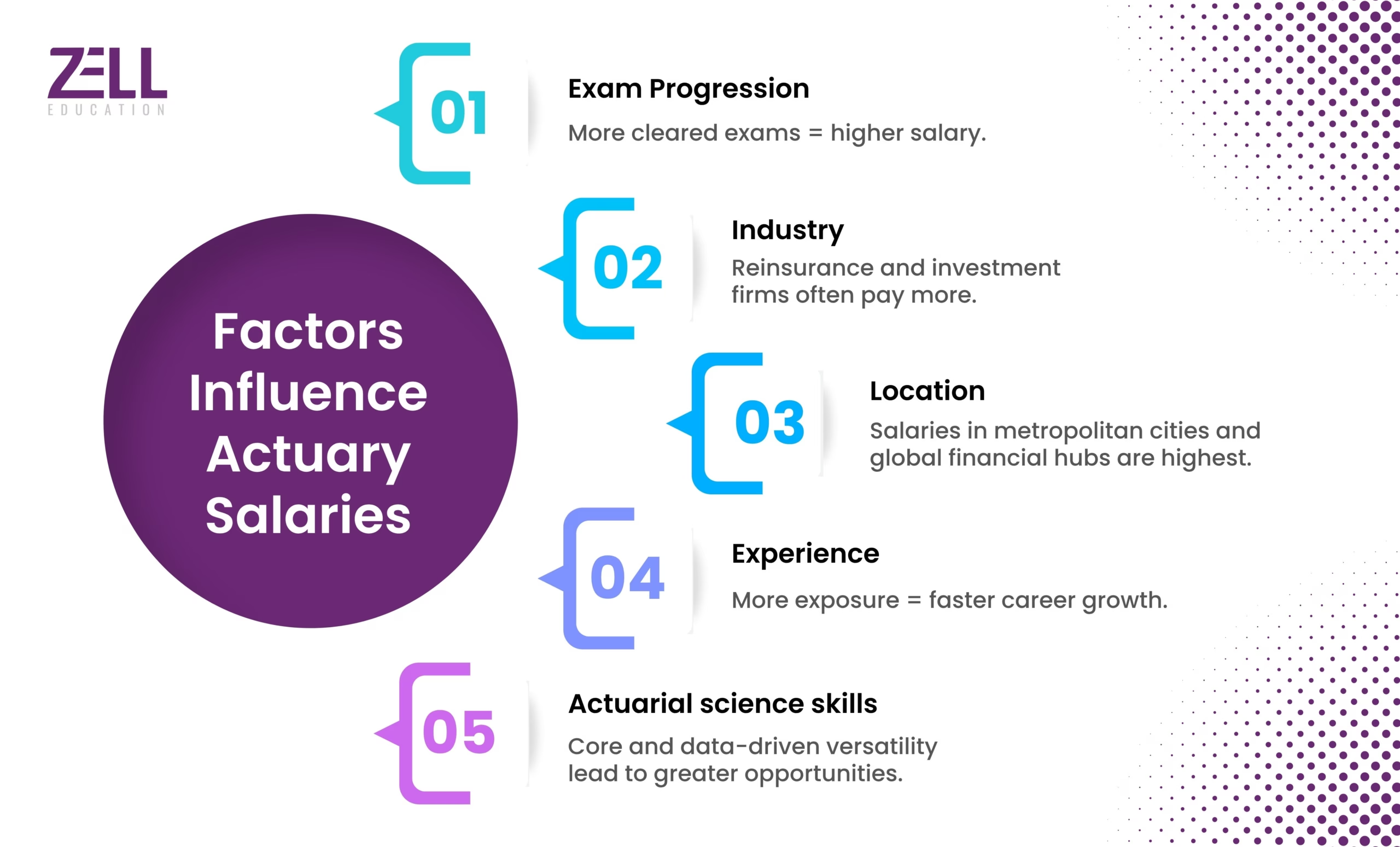
Actuarial science salary levels depend on several variables:
- Exam Progression: More cleared exams = higher salary.
- Industry: Reinsurance and investment firms often pay more.
- Location: Salaries in metropolitan cities and global financial hubs are highest.
- Experience: More exposure = faster career growth.
- Actuarial science skills: Core and data-driven versatility lead to greater opportunities.
What Are the Key Challenges in Pursuing Actuarial Science?
While it has rewards, actuarial science is challenging. The students should be in it for the long term.
Key challenges:
- Difficult Exams: High failure rate; requires consistent study.
- Time Pressure: The work and exam preparations become challenging to handle.
- Lack of Clarity: Inadequate guidance at school in India.
- Limited Colleges: Few institutions offer full-time actuarial courses.
But with proper drive and good mentorship (such as that of Zell Education), such issues can be addressed.
What Are the Final Thoughts on Choosing Actuarial Science?
Actuarial science is not for everyone, yet it’s a very rewarding career opportunity for numbers, analysis, and risk management enthusiasts. The actuarial science scope is growing in every sector, compensation is good, and there is always a perennial increase in global market demand for professional actuaries.
If you are someone who enjoys applying logic and data to real-world problems, actuarial science or CFA certification could be your perfect career. Zell Education offers expert mentorship and tutorials, conducted by professionals, to help you at each stage of your actuarial or CFA career, from past papers to placements.
Want to Pursue Finance and Accounting Career?
To Book Your Free Counselling Session
FAQs on What Is Actuarial Science
Is actuarial science a good career option in India?
In fact, it’s a very fulfilling profession in India with growing prospects in insurance, finance, and consulting.
How many years does it take to become an actuary?
Typically, 6-10 years, depending on test progress and full- or part-time study opportunities.
What is the minimum qualification to start actuarial science?
The candidate should be a 12th pass with mathematics as a subject. A commerce background is preferred.
How much can an actuary earn internationally?
Around the world, actuaries receive anywhere in the range of $75,000-$150,000 annually.

Current Role
Co-Founder & CEO at Zell Education
Education
- ACCA – Association of Chartered Certified Accountants, Finance (2011 – 2014)
- Bachelor of Commerce (BCom), Financial Markets from H.R. College Of Commerce & Economics (2010 – 2013)
Location
Mumbai, India
Expertise
ACCA Certified
Why Zell?
- • Largest Provider for Global F&A Courses
- • 4.6 Google Review Rating
- • 1000+ Students placed Annually
- • 500+ Active Hiring Partners
- • Placement Opportunities at the Big 4
- • 100+ Global & Indian Rank Holders
- • 100+ Faculty Network
Speak to A Career Counselor
Zell's 10th Anniversary Offer - Avail a 10% Scholarship