
Picking between MBA Finance vs CFA is one of the most common forks in a finance career, and there’s no single right answer for everyone. This guide breaks down cost, duration, salary, and job roles side by side so you can match the path to your own goals rather than someone else’s.
Key Takeaways
- What is the core MBA Finance vs CFA difference?
An MBA in Finance is a broad, 2-year management degree, while CFA is a self-paced, three-level investment certification.
- Which costs less, CFA or MBA?
CFA typically costs ₹2 to ₹5 lakh in India including coaching, while an MBA can run ₹10 to ₹30 lakh at a reputed college.
- Which is better, CFA or MBA, for a starting salary?
A Tier-1 MBA usually edges out CFA at the entry stage, but the gap narrows fast once a charterholder gains a few years of experience.
- Is CFA harder than an MBA?
Yes, CFA pass rates sit around 39 to 50% per level according to CFA Institute, which makes it more academically demanding than most MBA coursework.
- Should you do CFA after MBA or before?
Many candidates start CFA Level 1 during their final MBA year or right after, so the two credentials build on each other instead of competing.
- Can you do both CFA and MBA?
Yes, and a growing number of finance professionals in India now hold both, since the combination covers technical depth and leadership range together.
Comprehensive Guide on MBA Finance vs CFA
- What is the MBA Finance vs CFA overview in one line?
Choosing between an MBA in Finance and the CFA charter mainly comes down to whether you want broad management training or deep investment expertise.
- What gives the CFA certification its value?
The CFA certification is issued by CFA Institute and is recognised in more than 160 countries for investment and portfolio-focused roles.
- What does an MBA Finance career scope actually cover?
An MBA in Finance opens doors into corporate finance, consulting, and leadership tracks across almost any industry, not just financial services.
- How do CFA vs MBA costs compare in India?
CFA is the cheaper route by a wide margin, since total charter costs in India usually stay under ₹5 lakh against ₹10 to ₹30 lakh for an MBA.
- Who earns more, CFA vs MBA, in India?
Entry-level MBA graduates from top colleges tend to out-earn fresh CFA candidates, but experienced charterholders in portfolio and research roles often close that gap by mid-career.
- How should you actually make the MBA Finance vs CFA decision?
The right pick depends on whether your five-year goal looks more like managing a business function or managing an investment portfolio.
Confused Between MBA in Finance and CFA?
 Speak to Our Experts Today
Consider an example of a recent graduate who has received two emails in his mailbox. The first one invites him to join the programme and earn an MBA in finance at one of the leading business schools. The second email is used as a notice for the registration for the Level I CFA exam. Either path to a finance career, MBA or CFA, opens great perspectives with great earning potential and many other advantages, though choosing one option over another may not be easy. It reflects the dilemma of a great number of people as they decide what will help them build a career: an MBA in finance vs CFA?
Which Is Better? MBA vs CFA
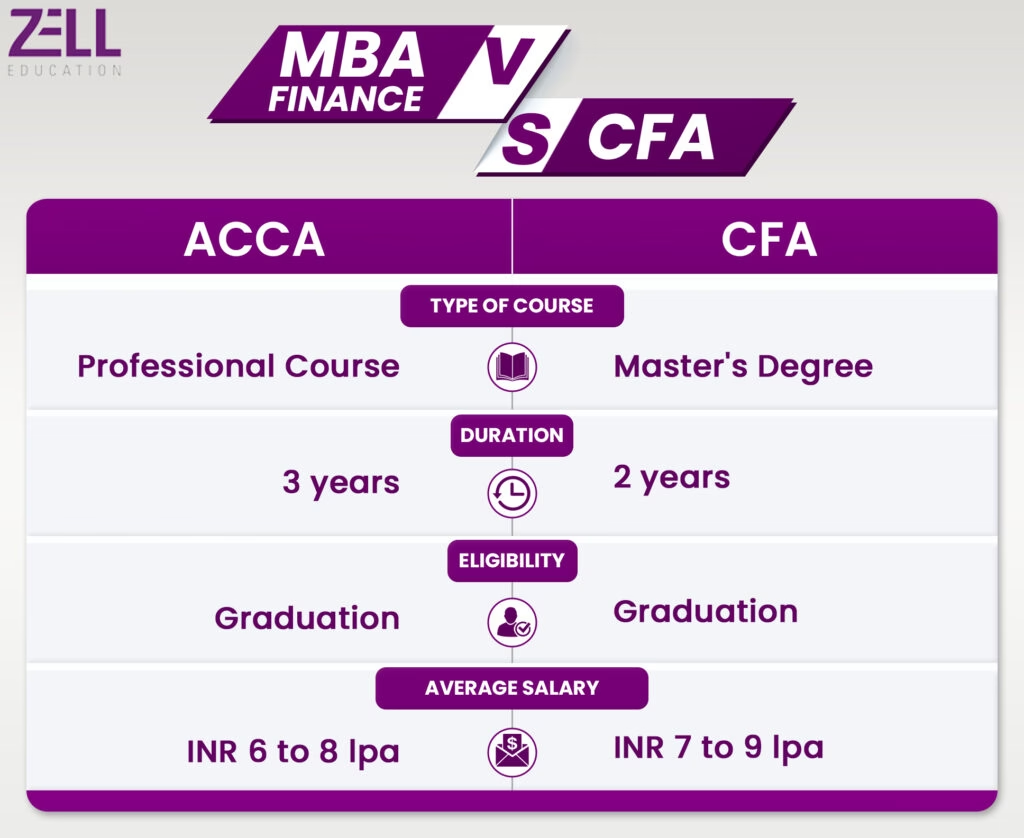
The comparison between an MBA in Finance and CFA certification has become quite common since 2026 as far as changes in the finance sector made these programmes highly relevant.
- Companies now demand:
- Strategic thinking (MBA)
- Technical expertise (CFA)
- The development of fintech and analytics increased the popularity of both options.
- The choice between these programmes depends on personal preferences and priorities.
What is MBA in Finance?
An MBA in Finance is a two-year postgraduate management degree with a finance specialisation, covering corporate finance, financial markets, strategy, and leadership.
- Full-time, classroom-based program at most Indian business schools
- Combines finance electives with general management subjects like marketing, HR, and operations
- Leads to roles in banking, consulting, corporate finance, and strategy
What is CFA?
CFA stands for Chartered Financial Analyst, a self-paced professional certification built around investment analysis, portfolio management, and ethics.
- Three sequential exam levels, no fixed classroom requirement
- Deep focus on equity, fixed income, derivatives, and portfolio construction
- Leads to roles in asset management, equity research, and risk analysis; you can read more on what is CFA if you’re starting from scratch
Key Differences at a Glance
| Criteria | MBA in Finance | CFA |
| Format | Full-time classroom degree | Self-paced certification |
| Focus | Broad management + finance | Deep investment analysis |
| Duration | 2 years | 2 to 4 years |
| Cost in India | ₹10 to ₹30 lakh | ₹2 to ₹5 lakh |
| Best suited for | Leadership, strategy, consulting | Research, portfolio management, risk |
Source for comparative program data: CFA Institute and business school placement reports.
Eligibility and Entry Requirements
Getting into each program looks quite different, and that’s worth knowing before you commit time to either one.
MBA in Finance: Who Can Apply?
Most Indian B-schools ask for a bachelor’s degree in any discipline plus a competitive entrance score.
- Bachelor’s degree with a minimum aggregate, usually 50% or higher
- Entrance exams like CAT, XAT, GMAT, or NMAT depending on the college
- Work experience is optional for most full-time programs, though it helps for executive MBAs
CFA: Who Can Apply?
CFA has a lighter entry bar but a much heavier exam load once you’re registered.
- A bachelor’s degree, or being in the final year of one, to sit for Level 1
- No mandatory finance background, though it helps
- 4,000 hours of relevant work experience over a minimum of 36 months, completed before you can claim the charter, per CFA Institute’s official requirements
Curriculum and What You Actually Learn
The day-to-day learning experience is where MBA Finance vs CFA diverge the most, since one is broad and the other is narrow but deep.
MBA Finance Curriculum
MBA Finance programs mix core management subjects with finance-specific electives over four semesters.
- Core: accounting, economics, marketing, operations, HR, strategy
- Finance electives: corporate finance, financial markets, M&A, valuation
- Capstone projects, internships, and case-study-heavy pedagogy
CFA Curriculum: Level by Level
The CFA syllabus builds in a strict sequence, and each level tests a different layer of investment knowledge.
- Level 1: Foundational concepts across ethics, quantitative methods, economics, and financial statement analysis
- Level 2: Asset valuation and applying Level 1 concepts to real scenarios
- Level 3: Portfolio management and wealth planning, with a written-response component
Fintech and AI Coverage in 2026
Both programs have started weaving in tech-driven finance topics, though neither treats it as a full specialisation yet.
- CFA’s curriculum now touches AI and big data applications in investment analysis
- Several MBA programs have added standalone fintech or analytics electives
- Neither replaces the need for hands-on tool skills like Python or Excel modelling, which is worth building separately
Duration, Cost, and ROI Compared
When considering the return on investment of the programme, we need to discuss its main components: cost, duration, and difficulty.
- MBA = High cost, structured learning
- CFA = Low cost, self-paced, high rigor
How Long Does Each Take?
- MBA: 2-year full-time program
- CFA: 2 – 4 years (self-paced, 3 levels)
The CFA or MBA decision depends on your time flexibility.
Total Cost Comparison
- MBA: ₹10 – 30 lakhs (India)
- CFA: ₹2 – 4 lakhs total
How Should You Budget for Prep Materials and Coaching?
- MBA: Included in tuition
- CFA: Additional ₹50,000 – ₹1 lakh for coaching
Total expenses are lower for a CFA when compared between CFA vs MBA programme. Which is better CFA vs MBA comes down to whether you can manage the tough exam pressure.
Long-Term ROI: What the Data Says
- MBA ROI tends to show up early, through a strong starting salary at Tier-1 colleges
- CFA ROI builds more gradually, since the real pay jump happens after the full charter and a few years of experience
- On a pure cost-to-eventual-salary basis, CFA often shows the stronger long-term ROI simply because the upfront spend is so much lower
Need Help Choosing MBA in Finance or CFA?
 Chat With Us on WhatsApp Now
Career Paths and Job Roles
The MBA Finance vs CFA comparison becomes a lot more concrete once you look at where each one actually leads.
Top Careers After MBA Finance
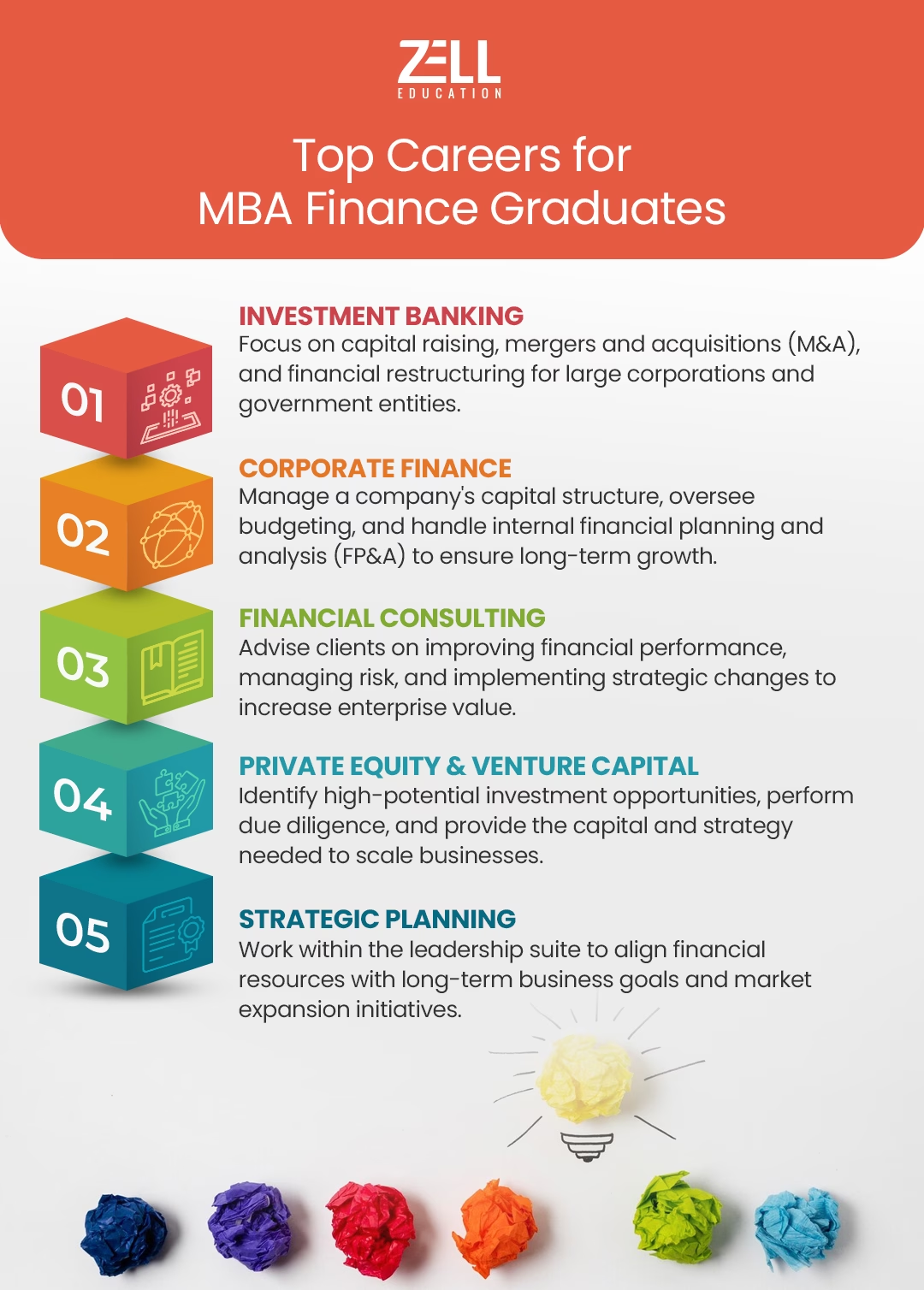
MBA graduates land in a wide spread of functions, not just finance-specific ones.
- Corporate finance
- Management consulting
- Investment banking
- Business strategy
Top Careers After CFA
CFA charterholders move into roles that sit closer to markets and money management directly.
- Equity research
- Portfolio management
- Risk and credit analysis
- Asset management
Which Employers Hire MBA vs CFA?
- MBA-heavy recruiters: McKinsey, BCG, Bain, most large consulting and corporate finance teams
- CFA-heavy recruiters: HDFC AMC, ICICI Prudential AMC, SBI Mutual Fund, and global names like BlackRock and Goldman Sachs for research and asset-management desks
Both credentials open doors at big banks, so the real difference is which desk you end up on once you’re inside.
Salary Comparison: MBA Finance vs CFA
Pay is often the deciding factor when people ask which is better CFA or MBA, and the honest answer is that it depends heavily on stage of career.
Entry-Level Salaries in India and Globally
| Stage | MBA Finance | CFA |
| India, entry-level | ₹6 to ₹12 lakh at most colleges, ₹15 to ₹35 lakh at Tier-1 schools | ₹5 to ₹8 lakh (Level 1/2 candidates) |
| USA, entry-level | $90,000 to $150,000 | $80,000 to $140,000 |
| UK, entry-level | £50,000 to £120,000 | £45,000 to £110,000 |
Sources: Glassdoor India
Senior-Level and Long-Term Earnings
- New CFA charterholders with around six years of experience average ₹28.6 lakh a year in India, per CFA Institute’s own impact study
- Senior charterholders in portfolio management or VP roles often reach ₹30 to ₹50 lakh, and total pay at top funds can cross ₹1 crore with bonus
- MBA graduates from Tier-1 colleges in leadership tracks can also cross ₹50 lakh within 8 to 10 years, particularly in consulting and corporate strategy
The gap between MBA Finance vs CFA earnings narrows considerably by the 8 to 10 year mark, especially for charterholders who move into portfolio management or CIO-track roles.
Networking and Career Mobility
Career growth isn’t only about the credential itself; who you know matters just as much, and the two programs build very different networks.
MBA: The Alumni Network Advantage
- Strong, tightly-knit alumni bodies, especially at IIMs and other Tier-1 schools
- Alumni networks often double as informal recruiting pipelines
- Useful well beyond finance, since MBA networks span every industry
CFA: CFA Institute Societies
- Local CFA Society chapters in most major Indian cities host regular networking events
- Global membership connects charterholders across 160+ countries
- The network skews heavily toward investment professionals rather than generalists
Career Flexibility: Which Gives More Options?
MBA generally offers wider industry flexibility since it isn’t tied to finance alone, while CFA offers deeper mobility within finance itself, including across countries, without needing to explain the qualification to a new employer.
Which Is Harder: MBA or CFA?
If sheer difficulty is your deciding factor, CFA usually wins that comparison by a clear margin.
CFA Pass Rates and Exam Difficulty
- Level 1 pass rates have run around 39 to 45% through 2026 exam windows
- Level 2 sits around 42 to 43%, and Level 3 around 50%, based on CFA Institute’s published results
- Passing all three levels back to back is genuinely rare; most candidates take multiple attempts at some stage
MBA Academic Rigor
- Entrance exams like CAT and GMAT are highly competitive to get in
- Once enrolled, coursework is demanding but graded on a curve, and dropout or failure rates are low
- The harder part of an MBA is usually getting admitted, not finishing it
Put simply, the CFA exam sequence is the tougher academic filter once you’re actually in the program, while the MBA is tougher to get into in the first place.
Cost vs Value in the Indian Context
For Indian students on a tighter budget, CFA usually delivers a better cost-to-career-outcome ratio, while MBA delivers better value specifically when it comes from a Tier-1 college with strong placements.
MBA Finance vs CFA: How to Decide
Rather than treating this as an either-or contest, it helps to map the decision to your actual goal.
- Choose MBA in Finance if you want broad career mobility, leadership roles, and a strong alumni network, and you can afford the higher upfront cost
- Choose CFA if you want deep investment expertise, lower cost, and global recognition in markets-facing roles
- Consider both if your long-term goal is a senior leadership role within asset management or investment research, where the combination compounds
Whichever way you lean, the decision should follow your target job function first, and the credential second, not the other way around.
FAQs on MBA Finance vs CFA
Which is more valued by top-tier investment banks?
Investment banks generally prefer MBA for front-office and client-facing roles, and CFA for research and analysis roles.
Is the CFA harder than an MBA?
Yes, CFA’s pass rates of roughly 39 to 50% per level make it harder to clear than most MBA coursework.
Can I pursue CFA while doing a full-time MBA?
Yes, many students study for CFA Level 1 or 2 alongside their MBA to strengthen their finance profile.
Does CFA Level 1 help in MBA admissions?
Yes, having cleared CFA Level 1 can strengthen a finance-focused MBA application.
Average salary of CFA vs MBA in India 2026?
CFA candidates typically start around ₹5 to ₹8 lakh, MBA graduates from Tier-1 colleges start around ₹15 to ₹35 lakh, and both converge higher with experience.
Is CFA recognised in India?
Yes, CFA is recognised across Indian asset managers, banks, and research firms, and it’s regulated globally by CFA Institute.
Which should I do first: CFA or MBA?
Most candidates start CFA Level 1 first since it’s cheaper to attempt early, then pursue an MBA once they have some work experience.
Is an MBA required for a CFA charterholder to get promoted?
No, an MBA isn’t required, though it can help charterholders move into broader leadership or general-management roles later on.

Current Role
Co-Founder & CEO at Zell Education
Education
- ACCA – Association of Chartered Certified Accountants, Finance (2011 – 2014)
- Bachelor of Commerce (BCom), Financial Markets from H.R. College Of Commerce & Economics (2010 – 2013)
Location
Mumbai, India
Expertise
ACCA Certified
Why Zell?
- • Largest Provider for Global F&A Courses
- • 4.6 Google Review Rating
- • 1000+ Students placed Annually
- • 500+ Active Hiring Partners
- • Placement Opportunities at the Big 4
- • 100+ Global & Indian Rank Holders
- • 100+ Faculty Network
Speak to A Career Counselor
Zell's 10th Anniversary Offer - Avail a 10% Scholarship