
This article is a critical analysis for those looking for a programme in finance as a well-planned course for an effective career. It begins by exploring if an MBA in finance is difficult, followed by a detailed course syllabus, subjects, and how to succeed.
Comprehensive Summary on ‘MBA in Finance’
- Is MBA in Finance Difficult: The process of obtaining an MBA degree in finance requires students to demonstrate their mastery of two distinct forms of educational material, which include quantitative and qualitative skills.
- MBA in Finance and Accounting: A combination of management and accounting skills is the primary objective of pursuing an MBA in finance and accounting, ensuring a high-paying job for those who pursue this course of study in a corporate environment.
- MBA Finance Syllabus: Students who understand the MBA finance syllabus for each semester can create their study plans and identify important study materials.
- MBA Finance Subjects: Students who understand essential MBA finance subjects, which include corporate finance and financial modeling and derivatives, can better predict their academic challenges.
- Is MBA Tough: The determination of MBA difficulty requires an assessment of learning progress, required study time, and necessary skills for finance students who come from diverse educational backgrounds.
- PGDIAF & Certification Integration: Pursuing a certification course, such as PGDIAF, helps a prospective student succeed in the global financial markets.
Introduction:
For those who are about to start their MBA in finance, it can feel like they are about to step into a whirlwind of numbers, markets, and complex decision-making scenarios. For some, the first week of classes can feel daunting, with the likes of Excel spreadsheets, financial ratios, investment simulations, and case studies becoming an integral part of their routine. While the situation can feel daunting, with the right mindset, students can conquer the most daunting challenges of an MBA in finance.
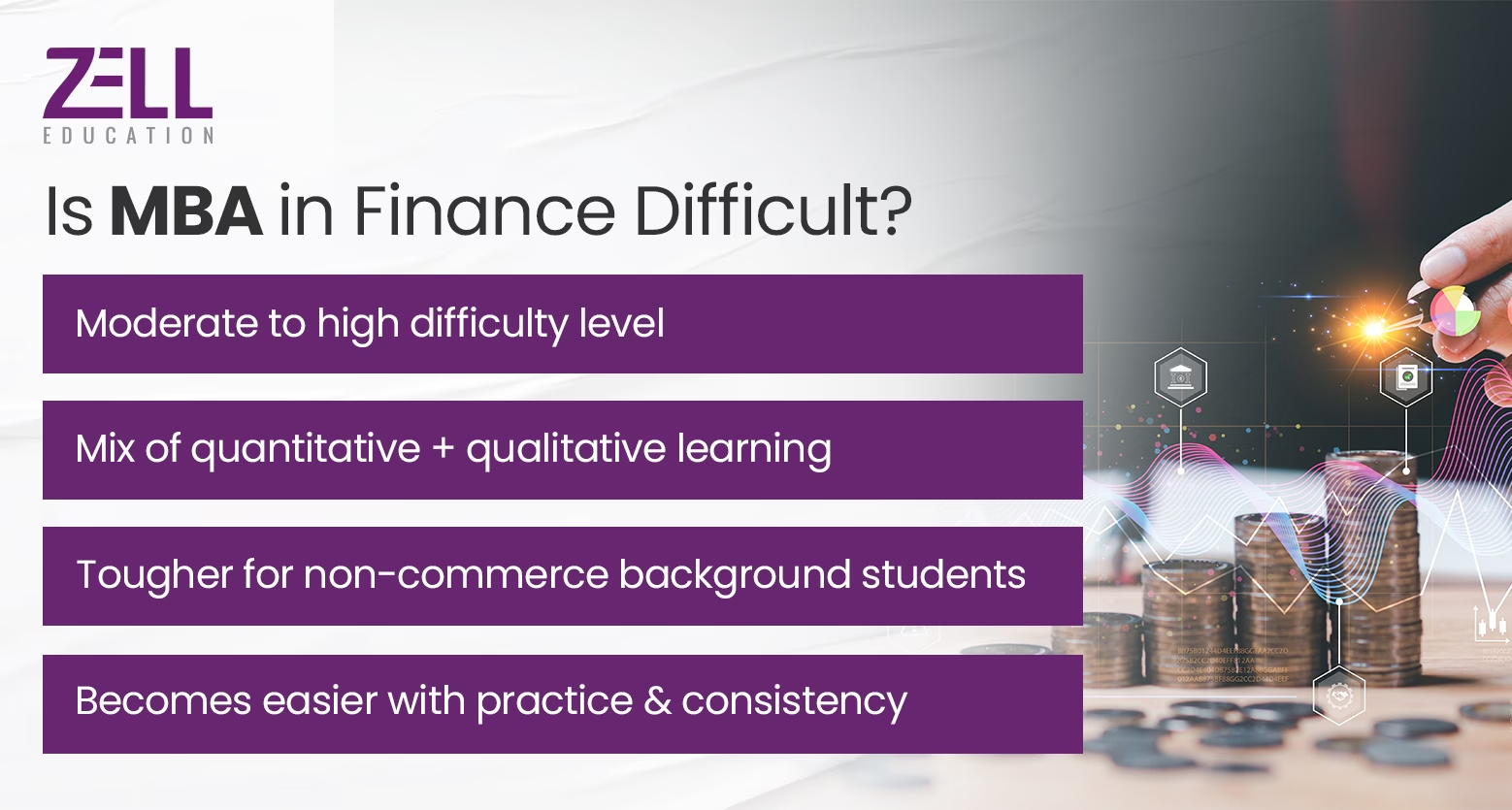
Is an MBA in finance hard? The reality for 2026 students
For those who aspire to an MBA in finance, the query, “Is an MBA in finance difficult?” is common, especially for those who are from a non-commerce background. The reality is
Decoding the Learning Curve: For Commerce vs. Non-Commerce Students
While students from a commerce background can adjust to an MBA in finance due to prior exposure to accounting, finance, and statistics, those from non-commerce backgrounds can expect a higher learning curve.
Quantitative vs. Qualitative Challenges: Is it all just math?
While there is a significant quantitative component to an MBA in finance, there is also a qualitative component such as business analysis, corporate strategy, and ethical decision-making, which are equally important.
The Impact of FinTech and AI on Course Difficulty
FinTech and AI have significantly influenced MBA courses, which can make them difficult in the short term but beneficial in the long term for investment banking, financial analysis, and financial consulting careers.
What are the core MBA finance subjects?
For those who are about to enroll in an MBA in finance, understanding what an MBA is and the MBA finance subjects is essential to mastering them efficiently. Here is the MBA finance syllabus for a semester-wise course:
| Year | Core Subjects | Electives |
| Year 1 | Managerial Accounting, Business Economics, Statistics for Business Decisions, Marketing Management | Leadership Skills, Organizational Behaviour |
| Year 2 | Corporate Finance, Investment Banking, Derivatives & Risk Management, Financial Modeling & Valuation | FinTech Applications, Sustainable Finance, Mergers & Acquisitions |
Year 1 – Building the Management Foundation
| Subject | Focus / Learning Outcomes |
Managerial Accounting & Business Economics |
Focuses on cost concepts, budgeting, and economic frameworks influencing corporate finance decisions. |
Statistics for Business Decisions |
Covers probability, regression, and data interpretation for practical financial analysis. |
Year 2 – Mastering Specialized Financial Tools
| Subject | Focus / Learning Outcomes |
Corporate Finance & Investment Banking |
Includes capital budgeting, mergers and acquisitions, and IPO valuation techniques. |
Derivatives and Risk Management |
Students learn hedging strategies, options, futures, and risk metrics. |
Financial Modeling and Valuation |
Hands-on Excel projects teach scenario analysis, discounted cash flow models, and portfolio valuation. |
What are MBA in Finance course requirements and eligibility?
In order to answer the question, “Is an MBA tough?” it is essential to know the course requirements and the eligibility criteria:
Academic Prerequisites and Entrance Exams (CAT, GMAT, GRE)
- Graduation from a recognized university
- Entrance exams like CAT, GMAT, or GRE
- Strong quantitative and analytical skills
Technical Skills: Why Excel is Your Best Friend
- Proficiency in Excel and financial software is crucial
- Ability to run simulations, build models, and perform scenario analysis
- Familiarity with tools like SPSS, R, or Python is advantageous
What is the career scope after an MBA in finance?
The finance industry provides extensive career opportunities because it offers work positions that pay high salaries.
- Investment Banking Analyst
- Corporate Finance Manager
- Risk Management Specialist
- Financial Analyst in consulting firms
- Roles in FinTech startups leveraging AI and analytics
Dual qualifications such as PGDIAF, CFA, and FRM add value to the MBA and make the student more employable in the international job market.
What are 5 expert tips to succeed in your finance MBA?
Succeeding in an MBA in finance and accounting requires a combination of strong fundamentals, practical exposure, market awareness, professional skill-building, and disciplined study habits. Here are five expert tips that can be followed to perform well in the finance MBA program:
-
Mastering the Fundamentals: Time Value of Money (TVM)
Understanding the time value of money, discounted cash flows, and capital budgeting is important for all finance students.
-
Networking and Internships: The “Hidden” Curriculum
Building a strong professional network through internships and live projects enhances practical understanding and job placement.
-
Staying Updated with Global Market Trends
People need to monitor stock markets together with macroeconomic indicators and regulatory updates because this practice enables them to connect classroom knowledge with actual life situations.
-
Leveraging FinTech Tools and Certifications (CFA, FRM)
Combining the MBA in Finance and Accounting with professional certification helps in developing analytical skills and career readiness.
-
Time Management and Consistent Practice
Balancing coursework, assignments, and exam preparation requires disciplined schedules and regular problem-solving practice.
Conclusion: Is the challenge worth the reward?
For students who think an MBA in finance is difficult, the answer is simple. The MBA in Finance is challenging if the student is not well prepared. However, the skills that the student learns in the finance MBA programme are worth the reward. The skills that the student learns in the finance MBA programme are highly valued in the job market and can get the student placed in high-paying jobs. With structured learning, practical exposure, and expert guidance, an MBA in finance can be both manageable and rewarding.
FAQs on Is an MBA in Finance Difficult
Is an MBA in finance difficult for students with a non-math background?
Non-math majors may find it slightly challenging but are equally capable of succeeding with proper practice and guidance in the fields of accounting, statistics, and finance models.
What are the hardest subjects in an MBA finance programme?
Derivatives, risk management, corporate finance, and finance models are considered to be the most challenging MBA finance subjects due to their technical depth.
Can I pursue an MBA in finance after a BA or BSc?
Yes, if you are able to meet the criteria set for the entrance exams (CAT/GMAT/GRE) and prepare for quantitative modules.
How much salary can I expect after completing an MBA in finance in India?
The salary would be anywhere between ₹6 and ₹12 LPA, but if you are already experienced in investment banking or corporate finance, the salary could be as high as ₹20 LPA.
Which is better: an MBA in finance or a CFA certification?
An MBA in Finance offers broad management skills, while a CFA focuses on investment analysis and portfolio management. Combining both is ideal for global finance careers.

Current Role
Co-Founder & CEO at Zell Education
Education
- ACCA – Association of Chartered Certified Accountants, Finance (2011 – 2014)
- Bachelor of Commerce (BCom), Financial Markets from H.R. College Of Commerce & Economics (2010 – 2013)
Location
Mumbai, India
Expertise
ACCA Certified
Why Zell?
- • Largest Provider for Global F&A Courses
- • 4.6 Google Review Rating
- • 1000+ Global Placement Partners
- • Placement Opportunities at the Big 4
- • 100+ Global & Indian Rank Holders
- • 100+ Faculty Network
- • 10,000+ Students Placed
Speak to A Career Counselor
Zell's 10th Anniversary Offer - Avail a 10% Scholarship