
Key Takeaways:
- ACCA AA emphasises more application-based learning. This allows students to prepare properly for the examination and their careers.
- Students who want to score high in AA need to know audit methods and audit risks.
- Students need to keep on reading previous test papers. This helps to have more self-confidence and quality answers.
- Good time management is very important for passing the ACCA AA exam.
Comprehensive Summary on ACCA Audit & Assurance:
- Apply and Develop Auditing Skills: the continuous ACCA Audit and Assurance study enables the students to enhance and apply their practical auditing knowledge as well as develop their professional judgment skills.
- Gain Foundation for Audit Papers: The course gives an excellent foundation to more challenging audit papers in the ACCA certification process.
- Focus on Alternative Aspects: Students should pay attention to internal controls, audit evidence, ethics, and auditing methods.
- Focus on Scenario-based Practice: To score well in the exam, focus on scenario-based practice.
- Work on Technical publications: Students should pay greater attention to examiner reports and technical publications, which explain the real expectations of the exam.
- Gain More Score: Students can score well if focused on careful preparation, editing, and presentation of responses.
When it comes to doing well on the exam at the ACCA Applied Skills level, the most important exam is the ACCA AA exam. The ACCA AA exam is formerly known as ACCA F8 and allows for the development of an audit mindset required for finance professionals who will ultimately receive an ACCA award.
Many students take this exam thinking that Audit and Assurance is completely theoretical in nature when, in fact, the ACCA Audit and Assurance exam still requires students to think like an auditor, apply auditing procedures to real-world business scenarios, and communicate their audit judgment appropriately.
The global pass rate for the ACCA AA exam remains consistently between 40 and 47%, indicating that having a solid foundation of technical knowledge is insufficient to pass the exam. This guide will provide you with everything you need to know about ACCA AA, including its syllabus areas, global pass rate, study techniques, examiner insight, and effective preparation methods.
Clear ACCA AA with a Smart Study Strategy
 Connect with us today
What Is ACCA Audit & Assurance (AA)?
The Audit and Assurance (AA) paper of the ACCA is an Applied Skills level subject in the ACCA qualification, which aims to provide you with an understanding of the different aspects of auditing and assurance.
It was previously known as ACCA F8. As part of the above aim, ACCA’s Audit and Assurance (AA) syllabus intends to help students achieve an understanding of:
- The process for planning audits and the assessment of audit risks
- Internal control systems
- The collection of audit evidence
- The procedures that are to be performed during an audit;
- Professional ethics
- The standards for audit reporting
- The International Standards on Auditing (ISAs)
If you’re asking, “What is ACCA?” it is the Association of Chartered Certified Accountants (ACCA), the world’s largest accounting body, providing professional qualifications to people wishing to pursue a career in either audit, tax, finance, consulting, or management accounting.
Why Is Audit & Assurance Important in the ACCA Qualification?
ACCA Audit and Assurance facilitates the development of practical professional competencies required to succeed in any area of Accounting.
Audit is vital to providing transparency of an organisation’s finances, strengthening corporate governance and establishing trust with all stakeholders. As a result, organisations require the expert input of an auditor in identifying, assessing and testing both risks and controls and providing verification of financial information.
When considered as a part of the complete ACCA qualification, the AA paper helps to develop skills such as the following:
- Professional scepticism
- Risk assessment
- Analytical skills
- Understanding of business
- Ethical decision-making
- Communication and reporting
Those pursuing a career in External Audit, Internal Audit, Advisory, Forensic Accounting, or Financial Reporting will all gain particular benefit from the successful completion of ACCA Certification.
Prepare Smarter for Your ACCA Exam
 Connect with Zell Experts
What Is the Structure and Content of the ACCA Audit & Assurance (AA) Paper?
The AA paper follows a computer-based examination format under the ACCA Applied Skills level.
Exam Structure and Format
The ACCA AA paper is part of the Applied Skills level of ACCA. The exam is usually 3 hours in duration and is computer‑based in jurisdictions.
- It includes a mixture of question types: scenario questions, objective test questions (OTQs), and constructed response/essay/case questions. Application of theory, use of audit and assurance standards, and a presentation that is clear are what you’re assessed on.
- Pass marks are typically 50/100 in most ACCA papers. The solution to tackling such paper structures lies in proper time planning per question.
Key Areas of the Syllabus
The ACCA audit and assurance syllabus (latest ACCA AA Study Guide) includes the following major areas:
| Syllabus Area | Topics Covered |
| Audit framework & regulation | Concept of audit and other assurance engagements; external audits; professional ethics; corporate governance. |
| Planning and risk assessment | Accepting audit engagements, understanding the entity & its environment, risk of material misstatement, laws, fraud, audit planning & documentation. |
| Internal control | Internal control systems, tests of control, the role of internal audit, and evaluation of controls; differences between external & internal audits. |
| Audit evidence | Assertions, sampling, substantive procedures; automated tools & techniques, work of others, and audit of specific items. |
| Review and reporting | Subsequent events; going concern; written representations; final review; independent auditor’s report. |
| Employability & technology skills | Ability to use audit software; digital working, technology in gathering evidence & reporting; good communications. |
Knowing these topics in and out, particularly auditing and assurance standards, is essential in passing the exam.
Types of Audit Opinions You Must Know
Students need to understand the types of audit opinions to score well in the AA paper, as the concept focuses on scenario-based questions. Some of the types are-
- Unmodified Opinion: This type is issued when there are no significant misstatements and financial accounts give a genuine and fair picture.
- Qualified Opinion: When there is a significant misrepresentation or inadequate audit proof, the problem is not widespread.
- Adverse Opinion: It is issued when financial statements are untrustworthy because of significant and widespread misstatements.
- Disclaimer Opinion: It is used when auditors are unable to gather enough proof, and the consequences could be significant and widespread.
What Are the ACCA AA Pass Rates and Difficulty Level?
As per the ACCA Global report, the March 2026 pass rate was 43% for the ACCA AA, but this pass rate was in the range of 35-57%. But still, the level of difficulty in the AA is quite high since it is very much practice-oriented and revolves around professional judgment.
Yet another factor causing such a great difficulty level is that the AA has scenario-based questions where the students will be put in a real-world situation. The student needs to recognise risks, audit procedures, plan and also make changes to financial statements.
Source: ACCA Global
What are the common challenges students face in ACCA Audit & Assurance?
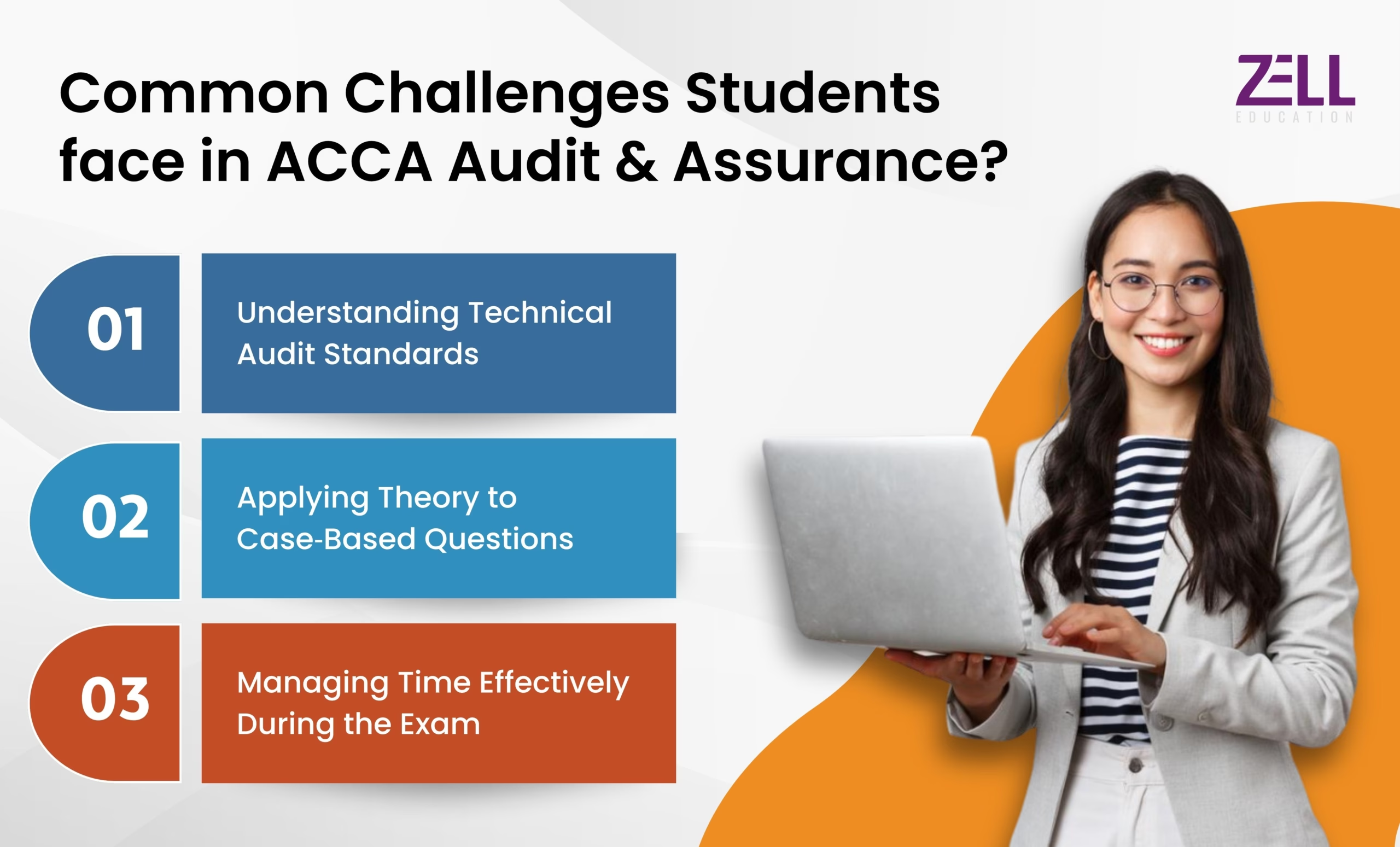
Understanding Technical Audit Standards
- Auditing and assurance standards like ISAs (International Standards on Auditing) are technical and precise. The students are generally unclear regarding how to apply ISA‑200, ISA‑315, ISA‑500, ISA‑505, ISA‑520 and so on in practical exam cases.
- In addition, students often mix up assurance engagements (possibly more informal) with statutory audits, one of the reasons behind the audit and assurance concept. An awareness of assurance vs. audit is critical.
Applying Theory to Case‑Based Questions
- Most students can recall definitions (“audit is …”, “assurance engagement is …”) but find it harder when asked to apply them in specific circumstances (scenario‑based questions).
- For instance, problem questions might be whether facts constitute a risk or whether internal controls are sufficient; you will need to apply theory (as applicable, including applicable auditing and assurance standards) to scenario facts.
Managing Time Effectively During the Exam
- Time management is typically underutilised. The students take too much time over a section or theory writing, so there is little time left over for scenario questions.
- ACCA and tutor reports show that time misallocation across questions means missing out on marks either in reporting sections or in scenario-based parts.
What Are the Best Study Strategies to Clear ACCA Audit & Assurance?
The best strategies to follow to clear the ACCA Audit & Assurance exam are:
Build a Strong Foundation in Audit Concepts
- Begin by learning what ACCA is and what the ACCA course entails for audit and assurance. Try to clearly differentiate assurance vs. audit and what lies in each.
- Ensure that you work extensively with auditing and assurance standards applicable to ACCA AA. Familiarise yourself with the ACCA subjects & study guide so that you are aware of examinable ISAs.
Practice Past Papers and Examiner Reports
- Practising past papers of AA exams under time pressure makes you familiar with the types of questions and improves speed.
- Examiner reports are especially valuable in highlighting frequent errors: omission of standard references, poor application of scenarios, and inadequate structuring of responses. Read about what people did wrong.
Focus on Audit Procedures and Real‑World Application
- Practice in writing audit procedures of different account areas (inventory, receivables, intangible assets, etc.), sampling, auditing estimates, reliance on external confirmations, etc.
- Practise real-world audit scenarios, like how you tackle fraud risk, how you evaluate internal control, and how you discuss going concern or subsequent events.
Master the Language of Auditing and Answer Writing
The use of effective auditing language along with professional answer-writing techniques in doing your ACCA AA exam will provide you with a greater level of clarity, quality and scoring potential.
- Use auditing action words like ‘inspect’, ‘observe’, ‘confirm’, ‘recalculate’ and ‘reperform’. Write specific audit procedures, not generic/standard procedures, for each situation.
- Use audit terminology directly applicable to the presented scenario.
- Have a clear structure of your answer, which will enable the examiner to read your paper more easily and quickly. Use terminology reflecting true auditing practices professionally.
How to Plan Your ACCA AA Study Schedule
A planned preparation programme will improve learning and revision consistency.
| Weeks 1-3 | Review your syllabus material
Become familiar with the ISA’s Understand the concepts of auditing |
| Week 4-6 | Complete topic-based exercises
Practice the audit procedures. |
| Week 7-8 | Full audit exam mocks
Read the examiner’s reports on the audit exam mocks Revision for weak areas. |
| Suggested study time is between 120 to 150 hours for effective preparation. | |
Which Study Resources Are Recommended for ACCA Audit & Assurance?
The study resources that are recommended for ACCA Audit & Assurance are the following:
ACCA Approved Study Texts
- Get the approved ACCA study guide of the current syllabus, Audit & Assurance. The books integrate auditing and assurance standards and uncover the difference between audit and assurance by ACCA.
- BPP and Kaplan are world-class publishers with clear content according to the ACCA syllabus.
Revision Kits and Mock Exams
- Revision kits/exam kits of ACCA consist of mock papers and examiner-style tests. Take them under time conditions.
- Practice papers help you to work through entire papers, time yourself under exam conditions, and apply theory to case scenarios.
Online Lectures and Tutor Guidance
- You can learn from lectures that are available for free online, like YouTube and OpenTuition. They will help you understand auditing and assurance standards that can sometimes be difficult.
- Your tutor will provide feedback too on things like your ability to apply the standards and how you answer questions, and they will also highlight pitfalls to watch for (e.g., ‘assurance’ versus ‘audit’ & weak identification of risks).
Technical Articles and Official Examiner Reports
- Technical Articles directly tell us what examiners are looking for in the exam answer.
- Official Examiner reports show exactly where students drop marks in the exam.
- These are invaluable to study before you do the exam.
What Exam Techniques Can Help You Succeed in Audit & Assurance?
The exam techniques that can help you succeed in audit and assurance are:
How to Approach Scenario‑Based Questions
- Start by carefully reading the scenario: identify stakeholders, context, risks, control environment, and financial reporting framework.
- Before writing, plan: set out what auditing and assurance standards apply, what risks should be covered, what audit work applies, and what is being reported.
Structuring Answers for Maximum Marks
- Employ headings/subheadings: e.g., “Assessment of Risk”, “Evaluation of Controls”, “Audit Evidence”, and “Reporting”. Assists in guiding your examiner
- Always tie your answer back to the situation; generic theory is penalised below applied theory. When citing auditing and assurance standards, try to cite them by name (e.g., ISA 315 Risk Assessment and ISA 500 Audit Evidence) and comment upon their requirements.
Avoiding Common Student Mistakes
- Mistake: describing assurance vs audit without showing awareness of the difference between audit and assurance or assurance and audit in a scenario-based situation.
- Mistake: omission of content in the syllabus, such as events following, going concern, written representations, or failure to disclose appropriately.
- Mistake: overloading of response with theory and forgetting time, such that all necessary questions are attempted.
ACCA AA Examiner Report Insights: What Markers Keep Penalising Session After Session
Multiple weaknesses have been highlighted throughout the examination feedback:
- Students use generic answers (i.e., they copy textbook theory without any relevance to the scenario).
- Procedures are not precise enough.
- There is a lack of professional language (i.e., technical language must still be used).
- Poor time management (i.e., an incomplete answer reduces the overall score).
All examiners will reward candidates for their ability to exercise their own professional judgment and apply it, not just for their ability to memorise.
ACCA AA Pre-Exam Preparation Checklist
Prior to your testing appointment:
- At least three to five practice tests should be done
- Obtain a copy of the ISA
- Practice updating audits
- Get a copy of your examiner’s report
- Improve your knowledge of terms used in the audit process
- Improve the speed at which you can type (CBEs).
- Sleep well the night before taking your test.
- Get your testing documents organised before the test day.
Conclusion
If you are going to pass ACCA Audit & Assurance, then your strategy should be a combination of understanding what the ACCA audit and assurance syllabus is, practising application, and tuning exam technique. Get deeply into auditing and assurance standards; keep in mind the difference between audit and assurance and assurance vs audit.
Develop a pattern of trying past papers, rewriting examiner reports, and practising full‑length papers under time pressures. Practise by using allowed materials and seek comments.
Through careful preparation, which combines strong theory, relevance to real life, time discipline, and sound exam hygiene (organisation, clarity, and proper referencing), passability in the AA paper is extremely achievable.
FAQs on ACCA AA Audit & Assurance
What is the ACCA Audit and Assurance pass rate?
According to official statistics, the average pass rate for ACCA Audit & Assurance has been between 43-47%, based on the performance of various cohorts throughout different sessions.
How many hours should I spend studying for Audit & Assurance?
Most candidates study for a minimum of 120-150 hours to prepare adequately for their ACCA Audit & Assurance examination.
What are some of the most frequent mistakes made by students taking the ACCA Audit and Assurance examinations?
The most frequent mistakes when sitting for the ACCA Audit and Assurance examination relate to providing generic responses, using insufficient detail in conducting an audit procedure, and demonstrating poor application of the scenario within the question.
What are the most important topics covered in the Audit and Assurance syllabus?
Some of the most important topics in the Audit and Assurance syllabus include audit risk, audit evidence, internal controls, substantive procedures, and audit reporting.
Should I take ACCA Audit and Assurance before or after completing Financial Reporting (FR)?
The majority of candidates will complete Financial Reporting (FR) before attempting the ACCA Audit and Assurance examination, as an understanding of financial statements better enables candidates to understand how to conduct an audit of such statements.
Is ACCA Audit and Assurance an application or a theory paper?
ACCA Audit and Assurance is mainly an application paper. Although you need to have sufficient knowledge on the topic, the ability to apply theoretical knowledge to practical situations will determine whether you successfully pass the ACCA Audit and Assurance examination.

Current Role
Co-Founder & CEO at Zell Education
Education
- ACCA – Association of Chartered Certified Accountants, Finance (2011 – 2014)
- Bachelor of Commerce (BCom), Financial Markets from H.R. College Of Commerce & Economics (2010 – 2013)
Location
Mumbai, India
Expertise
ACCA Certified
Why Zell?
- • Largest Provider for Global F&A Courses
- • 4.6 Google Review Rating
- • 1000+ Students placed Annually
- • 500+ Active Hiring Partners
- • Placement Opportunities at the Big 4
- • 100+ Global & Indian Rank Holders
- • 100+ Faculty Network
Speak to A Career Counselor

Professionally reviewed by Harshit Morparia, ACCA & Executive at Ernst & Young
Zell's 10th Anniversary Offer - Avail a 10% Scholarship