
The Audit and Assurance ACCA paper is an important part of the course that allows students to gain an in-depth understanding of the principles and practices followed by auditors in verifying financial statements and internal controls. The article offers an in-depth guide to the ACCA AA syllabus and examination format. It also allows students to gain an understanding of how the ACCA AA examination can help them attain the globally recognised ACCA certification successfully.
Comprehensive Guide on ‘ACCA Audit & Assurance (AA) Syllabus’
- Audit and Assurance ACCA: The ACCA paper provides students with an in-depth understanding of the principles and practices that auditors follow to verify financial statements and ensure overall compliance with globally recognised auditing practices.
- ACCA AA: The ACCA AA examination allows students to gain an in-depth understanding of the principles and practices followed by professional accountants in the field of assurance services.
- ACCA AA Syllabus: The ACCA AA syllabus allows students to gain an in-depth understanding of the principles and practices followed by professional accountants in the field of assurance services.
- ACCA Certification: The Audit and Assurance ACCA paper is an important part of the course that allows students to attain the globally recognised ACCA certification successfully.
- ACCA Global: The ACCA AA syllabus and examination format have been carefully designed by ACCA Global to help students attain an in-depth understanding of the principles and practices followed by professional firms in the modern world.
- What Is ACCA: Students who are pursuing Audit and Assurance as part of their ACCA certification course will gain a better understanding of what ACCA is and how it will help them in their career as a finance professional.
Confused about papers? Call our experts for a personalised plan
 Claim Free Session
Imagine you are going through a company’s financial statements and realise that a simple mistake could alter the entire financial landscape of a company. Every business relies on auditors who ensure that financial information is accurate, transparent, and reliable. This is exactly what is being tested in the Audit and Assurance ACCA paper.
Students who are pursuing their ACCA certification course will need to understand what is ACCA AA and how it will help them in their auditing career as a finance professional. The ACCA AA exam involves auditing frameworks, risk assessment, checking internal control systems, and verifying financial reports.
By taking Audit and Assurance in ACCA, students learn how to read financial reports, identify risks, and create accurate audit reports that comply with international accounting standards.
What Should Students Know to Master the ACCA AA (F8) Syllabus for 2026?
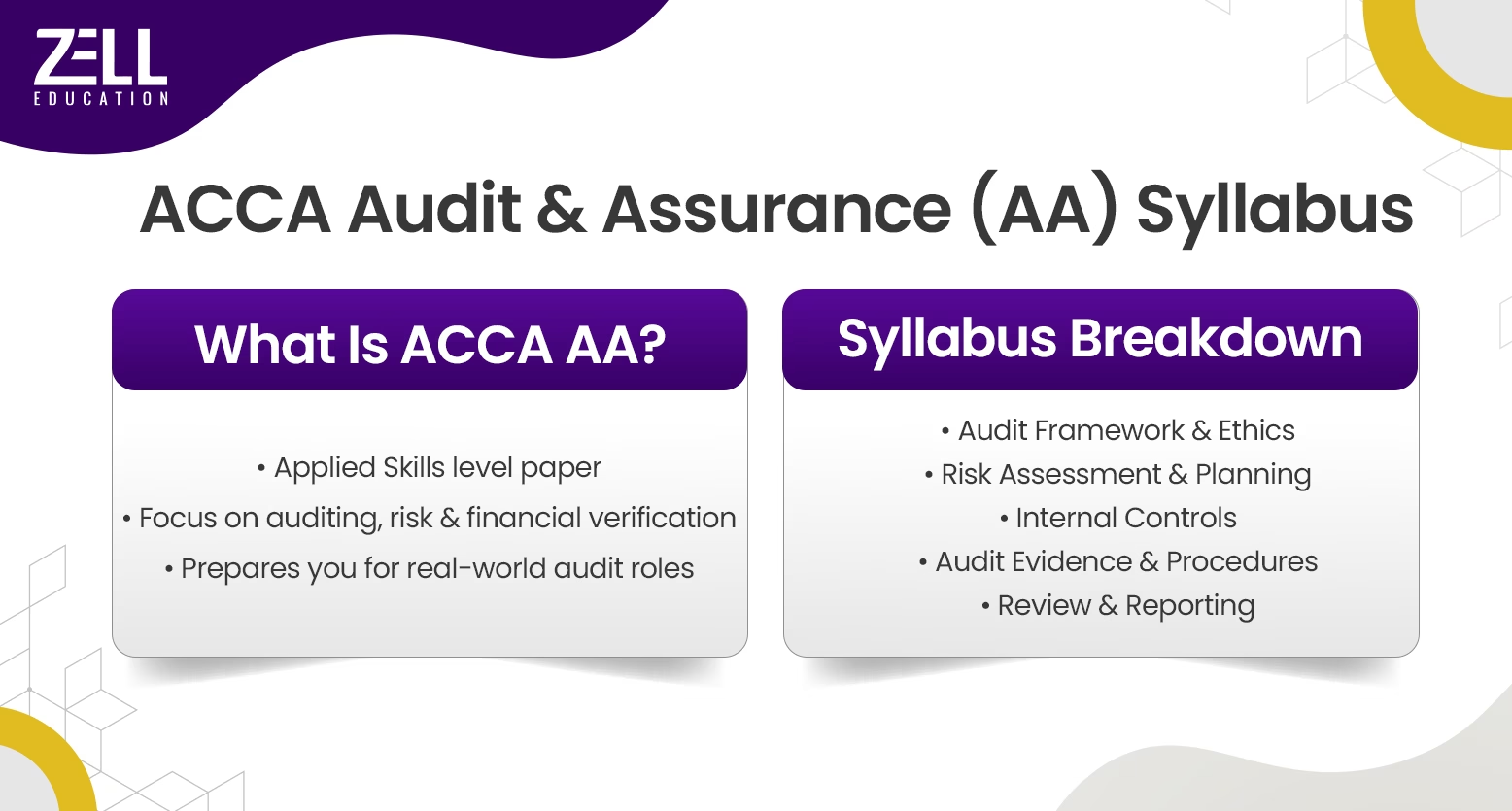
The ACCA Audit and Assurance paper is part of the Applied Skills level of ACCA exams. The ACCA AA syllabus is designed to ensure that students learn auditing principles that can be applied in real business situations. The main ACCA AA learning goals are:
- Understanding auditing frameworks and regulations
- Evaluating internal control systems
- Performing audit testing procedures
- Reporting audit findings professionally
Mastering the ACCA AA syllabus helps students move closer to completing the ACCA certification.
What Is the Detailed Breakdown of the ACCA AA Syllabus Areas?
The ACCA AA syllabus comprises five main sections that cover all aspects of the audit process. The sections ensure that students comprehend how an auditor plans and conducts an audit in a professional setting.
Section A: Audit Framework and Regulation
The Audit and Assurance ACCA syllabus starts by teaching students the importance of the regulatory environment and the concept of assurance. Students learn how auditors maintain independence and comply with professional standards.
The Concept of Assurance and External Audit
The ACCA AA syllabus starts by teaching students about the importance of assurance services provided by auditors. The key concepts include:
- Purpose of assurance engagements
- Role of external auditors
- Differences between audit and assurance services
- Importance of financial statement reliability
Corporate Governance and Professional Ethics (ACCA Code of Conduct)
Professional ethics play a major part in the Audit and Assurance ACCA exam. Key concepts include:
- Auditor independence
- Ethical threats and safeguards
- Corporate governance principles
- Responsibilities of auditors under the ACCA Global code of ethics
Section B: Planning and Risk Assessment
The ACCA AA syllabus has highlighted the importance of risk assessment. Auditors must be aware of the risks before planning the audit.
Assessing Audit Risk vs. Business Risk
The Audit and Assurance ACCA syllabus helps students differentiate between different kinds of risks. Key concepts include:
- Audit risk components
- Business risk evaluation
- Risk identification techniques
- Risk-based audit planning
Understanding the Entity and Its Environment
Auditors must be aware of the company they are auditing. Key concepts include:
- Industry analysis
- Business processes
- Internal systems
- External economic factors
Section C: Internal Control Systems
Auditors use internal control systems to prevent fraud and financial errors. The ACCA AA syllabus teaches students how to assess the effectiveness of internal control systems.
Evaluating Internal Controls and Identifying Deficiencies
Auditors are expected to understand the internal control procedures used by the organisation. The main processes involved are:
- Reviewing control design
- Identifying weaknesses
- Assessing control effectiveness
- Documenting deficiencies
Tests of Control and Communication to Management
Auditors are expected to use tests to determine whether the internal control procedures are working properly. The main processes involved are:
- Control testing methods
- Sampling techniques
- Documentation of findings
- Reporting issues to management
Section D: Audit Evidence and Procedures
Audit evidence is used as a source of information for the auditor’s conclusions. The ACCA AA syllabus focuses on the procedures used to obtain reliable evidence.
Financial Statement Assertions: The Key to Audit Testing
Assertions are used as a guide for the auditor to verify the financial statements. The main assertions are:
- Completeness
- Accuracy
- Valuation
- Existence
Substantive Procedures for Specific Financial Items
Auditors are expected to understand the procedures used to verify major financial statement items. The main areas tested are:
- Inventory verification
- Receivables confirmation
- Cash testing
- Fixed asset verification
Automated Tools and Techniques (Data Analytics in Audit)
Technology is changing the face of auditing. The main processes involved are:
- Data analytics tools
- Automated audit testing
- Digital audit evidence
- Technology-driven audit procedures
Section E: Review and Reporting
The last phase of the audit is the review of the results. This is where the ACCA AA syllabus places a great deal of importance on professional communication skills.
Subsequent Events and Going Concern Reviews
The auditor reviews the events that happen after the financial period. Some of the issues to be considered are:
- Subsequent events testing
- Going concern assessments
- Financial stability evaluation
- Disclosure requirements
Types of Audit Opinions and the Independent Auditor’s Report
The auditor provides an opinion on the financial statement. There are different types of opinions. They are:
- Unmodified opinion
- Qualified opinion
- Adverse opinion
- Disclaimer of opinion
Chat now to unlock a limited-time discount on ACCA fees
 Claim Your Discount
What Are the New Syllabus Changes for 2025–2026?
The ACCA AA syllabus has introduced updates to reflect evolving audit practices. These updates ensure students remain prepared for modern auditing challenges.
Impact of IFRS 18 on Financial Statement Disclosure Testing
The ACCA AA syllabus includes the incorporation of IFRS 18. This includes the following updates:
- Updated financial reporting standards
- Enhanced disclosure evaluation
- Improved audit documentation procedures
New Learning Outcomes: Sustainability Reporting and Digital Skills
The ACCA AA syllabus includes the incorporation of the latest developments. This includes the following updates:
- Sustainability reporting assurance
- ESG reporting verification
- Digital audit skills
- Data analytics integration
These updates align the ACCA AA exam with industry expectations.
What Is the ACCA AA Exam Format and Marks Distribution?
The ACCA exam under the Audit and Assurance ACCA follows a computer-based exam.
Total marks: 100
Passing marks: 50
Section A: Case-Based Objective Test Questions (30 Marks)
This section is for conceptual questions. The questions will be based on the theoretical knowledge of the ACCA AA syllabus. Question types include:
- Multiple-choice questions
- Scenario-based questions
- Short objective responses
Section B: Constructed Response Questions (70 Marks)
This section focuses on analytical skills .The questions will be based on the practical scenario that may arise in the course of the audit. The students will be required to:
- Analyze audit scenarios
- Identify risks
- Recommend audit procedures
How Should Students Structure a 30-Mark Integrated Scenario Answer?
A structured approach improves performance in the ACCA AA exam. Recommended strategy:
- Identify key audit risks
- Explain the issue clearly
- Suggest relevant audit procedures
- Present answers using bullet points
What Is the Proven Study Strategy to Pass ACCA AA on the First Attempt?
In order to pass the ACCA AA examination on the first attempt, the students will be required to have a good conceptual understanding. Students should focus on both theory and exam techniques.
How Can Students Transition from Financial Reporting (FR) to Audit (AA)?
The ACCA AA examination is based on the Financial Reporting examination. The students will find it easier to transition from the financial reporting examination to the audit and assurance examination.
- Reviewing financial statements
- Understanding accounting treatments
- Practicing scenario-based questions
Why Is the ACCA Practice Platform Important for CBE Success?
The ACCA practice platform is the official practice platform. The platform is important for the success of the students. The platform will allow the students to practise the examination in a simulated environment.
- Real exam interface practice
- Time management improvement
- Familiarity with exam format
- Exposure to realistic questions
Conclusion: Your Path to Becoming an Audit Professional
The Audit and Assurance ACCA paper is a significant subject for students who want to make a career in the auditing profession. By studying the ACCA AA course material, students will be able to understand how auditors measure financial risks, how they check the internal control environment, and how they verify the financial statements.
For all those who want to become an ACCA member, it is important to gain good knowledge in the subject of auditing. Understanding the meaning of ‘what is ACCA’ will help a student understand the value of ACCA papers like ACCA AA in gaining the required knowledge in the global accounting industry.
By studying the ACCA AA course material with consistent practice and a good understanding of the ACCA AA syllabus, a student will be able to pass the ACCA AA exam successfully.
FAQs on ACCA Audit & Assurance (AA) Syllabus
What are the most important chapters in the ACCA AA syllabus?
The most important chapters that a student should read for the ACCA AA exam are the chapters on audit risk assessment, internal controls, audit evidence, and audit reporting.
Is ACCA Audit and Assurance harder than Financial Reporting?
The ACCA Audit and Assurance exam is a challenging exam for students, as it has more analytical questions.
How many hours of study are required for the AA exam?
A student will need to prepare for 120 to 150 hours to master the ACCA AA syllabus.
Can I use a calculator in the ACCA AA exam?
Yes. A student can use a calculator for the ACCA AA exam.
What is the pass rate for ACCA Audit and Assurance in 2026?
The pass rate for the ACCA Audit and Assurance exam is between 35% and 45%.

Current Role
Co-Founder & CEO at Zell Education
Education
- ACCA – Association of Chartered Certified Accountants, Finance (2011 – 2014)
- Bachelor of Commerce (BCom), Financial Markets from H.R. College Of Commerce & Economics (2010 – 2013)
Location
Mumbai, India
Expertise
ACCA Certified
Why Zell?
- • Largest Provider for Global F&A Courses
- • 4.6 Google Review Rating
- • 1000+ Students placed Annually
- • 500+ Active Hiring Partners
- • Placement Opportunities at the Big 4
- • 100+ Global & Indian Rank Holders
- • 100+ Faculty Network
Speak to A Career Counselor

Professionally reviewed by Harshit Morparia, ACCA & Executive at Ernst & Young
Zell's 10th Anniversary Offer - Avail a 10% Scholarship