
FRM Banking vs Investment Banking are both distinct finance careers, but their primary objectives differ. FRM Banking focuses primarily on managing risk, complying with regulations, and maintaining a positive balance sheet, while investment banking provides a greater ability to generate revenues through a high volume of transactions.
Comprehensive Summary of FRM Banking vs Investment Banking:
- Understanding the financial risk management: FRM process for banks and other financial institutions is essential to understanding how banks and other financial institutions determine the best approach to controlling market risks, credit risks, and operational risks.
- Overview of an Investment Banking Career: The investment banking profession is mainly composed of providing advisory services related to mergers and acquisitions, as well as assisting companies in raising capital.
- Work Lifestyle Comparison: In comparison to investment banking, working as an FRM professional is characterised by: Structured work hours and analytical roles, whereas investment banking has long hours with heavily transaction-focused work (i.e., execution of deals), and there is a higher level of client interaction.
- Career Scope and Job Roles within FRM & Investment Banking: Individuals in the FRM world generally hold the role of a risk analyst or manager; investment banking professionals, however, typically progress from the analyst role up to the managing director role.
- Salary & Career Growth Comparison: Investment bankers typically earn higher salaries than FRM Banking professionals due to the fact that they receive bonuses as well, and az provides gradual and consistent salary growth, as well as more long-term job security.
- Selecting an Appropriate Career Path: If you are interested in a stable career focused on risk management, then FRM Banking would be a good career choice for you; if you are interested in quick advancement with significant reward potential, then investment banking would likely be a better career choice for you.
Waiting too long can cost your finance career growth now
 Enrol Now
If you’re interested in making a career in finance, your options can seem overwhelming. Consider the two paths available: one path is FRM Banking; it is based on risk management, stability, and regulatory approvals. The other path to finance is investment banking, which consists of high-stakes deals and the potential for large earnings at the end of your long workday.
To answer the questions “What is FRM?”, “What is FRM full form in Banking?”, and “Is Investment Banking a good career?”, you need to consider your personal goals. Understanding the meaning of FRM and comparing the career paths in FRM Banking and investment banking will boost your confidence in choosing the right finance career for you.
This article will compare FRM Banking and investment banking based on job responsibilities, salaries, education requirements, work environments, and available careers. By the end, you’ll have a clearer idea of which financial path suits you best.
What Is FRM Banking?
FRM Banking is a type of banking and finance career that specializes in the management of financial risk. Financial Risk Manager (FRM) is the full name of the FRM certification, and it is a highly respected global certification granted to individuals by the Global Association of Risk Professionals (GARP).
In other words, when we talk about FRM in banking, we refer to the process of determining, quantifying and managing the risks arising from:
- Market fluctuations
- Credit failures
- Liquidity shortages
- Operational issues
Individuals working with an FRM certification are responsible for maintaining the viability of banks through the management of financial uncertainties, regulatory updates, and economic collapses.
What Is Investment Banking?
Capital raising, M&A, and providing advice to businesses are all areas of focus in the field of investment banking. Investment banking professionals assist businesses in:
- Public offerings (IPOs)
- Debt and equity capital raising
- Mergers and acquisitions (M&A)
- Restructuring
It is common to associate an investment banker’s level of prestige, salary level and work environment as having hustle attributes. The traditional career path to becoming an investment banker typically starts at the analyst level, moving through the associate, vice president, and managing director levels.
If you are an aspiring investment banker and are questioning, ‘Is an investment banker’s career a good career? ‘, then yes, if you can handle working long hours, under pressure as well within a very competitive environment with defined performance metrics.
FRM Banking vs Investment Banking: Core Differences
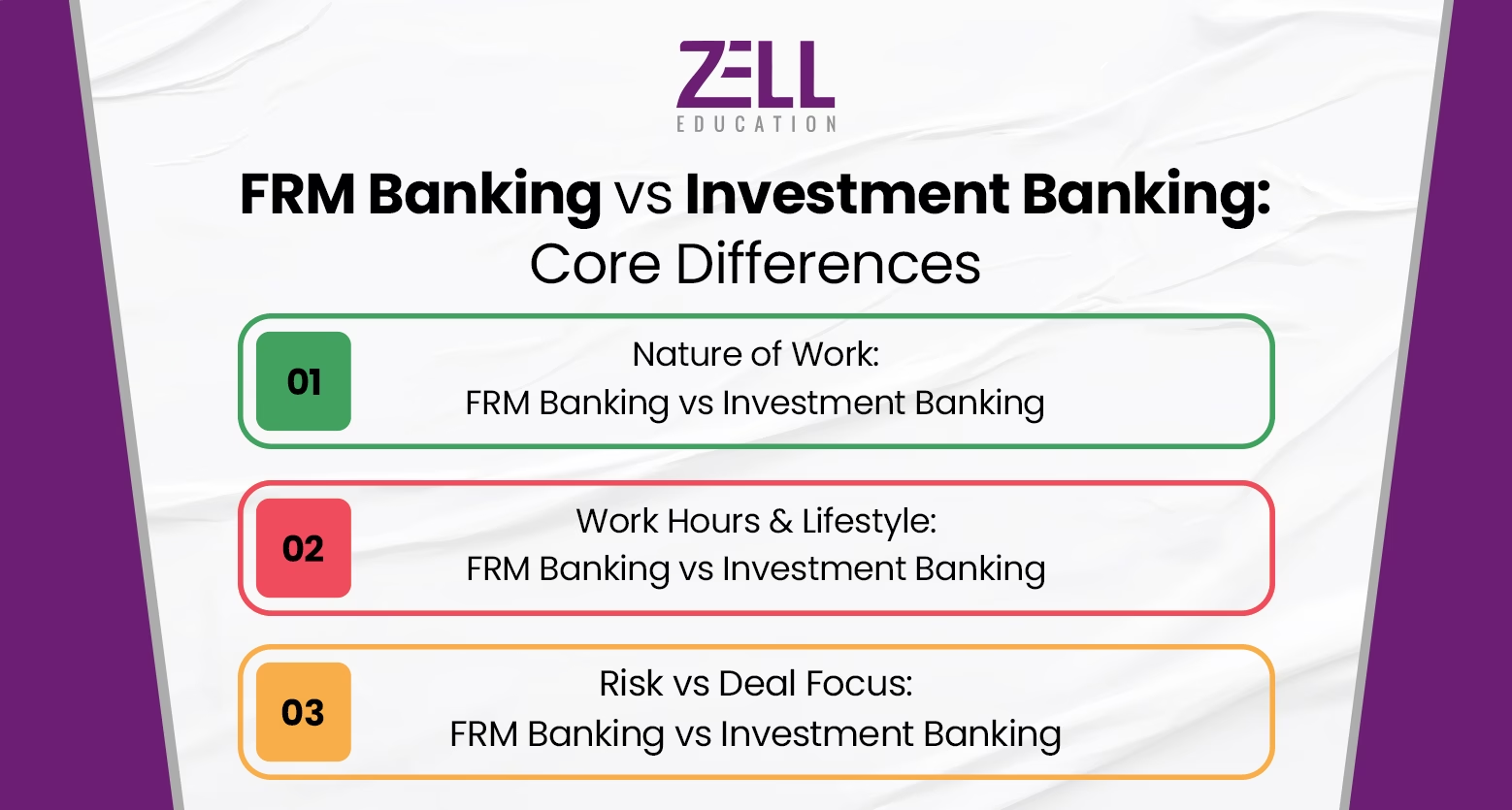
Nature of Work: FRM Banking vs Investment Banking
These two careers have vastly different roles based on their respective focuses and overall objectives.
- FRM Banking focuses primarily on internal operations, such as data analysis and portfolio review, while investment banking focuses on outward-facing operations, such as marketing and closing client transactions.
- While FRM Banking professionals play an important role in protecting investors from loss through assessment, they do not engage in revenue generation at this level of engagement.
Work Hours & Lifestyle: FRM Banking vs Investment Banking
Work-life balance is a major influence in terms of job selection.
- FRM Banks tend to have structured working hours based on regular office hours and a set schedule.
- In contrast, Investment Banks generally require lengthy working hours, long evenings, and weekend working hours.
Because of this, if adequate lifestyle stability is important to you, then typically FRM Bank positions are better suited for you than an Investment Banking position.
Risk vs Deal Focus: FRM Banking vs Investment Banking
In Comprehensive Risk Management Banking, all of the models, reports, and analyses have a focus on mitigating the likelihood of losses.
In such an environment, an investment banker is focusing on making as much money as possible through the execution of deals and will accept the existence of the unknowns that would potentially cause loss.
Want to understand FRM roles in banking and investments?
 Enquire Now
Career Scope in FRM Banking
FRM Banking Job Profiles
The Global Association of Risk Professionals (GARP), FRM certification allows numerous different fields and positions associated with risk management, including:
- Credit Risk Manager
- Risk Analyst
- Market Risk Specialist
- Operational Risk Manager
Additional Roles for Risk Consultants, like Asset Management Firms, Regulatory Bodies, and Banks.
FRM Banking Career Growth
Career Advancement in Finance Risk Management Banking. In finance risk management banking, it is a steady and structured path to advance from entry-level analyst to senior risk manager and eventually Chief Risk Officer (CRO).
This increasingly stringent environment of global regulation continues to add to the demand for finance risk management professionals.
Career Scope in Investment Banking
Investment Banking Job Profiles
The investment banking career path includes:
- Associate
- Vice President
- Director
- Analyst
- Managing Director
Each level in the investment banking career path comes with increasing responsibility, client exposure, and compensation.
Investment Banking Career Growth
Investment Banking is on a strong growth curve but remains an extremely competitive industry. The three primary factors for promotion in Investment Banking are performance, volume of deals done, and the relationships created with clients. It is common for Investment Bankers to leave the industry for Private Equity or Hedge Fund roles, but many also experience burnout.
FRM Banking vs Investment Banking Salaries
Entry-Level Salaries: FRM Banking vs Investment Banking
- Banks employing Financial Risk Managers will typically pay reasonable entry-level salaries at an average level.
- Investment banks offer higher entry-level positions and offer bonuses to help make up the difference.
- Investment banks compensate employees much more quickly in the early stages than banking jobs.
Mid-Level Salaries: FRM Banking vs Investment Banking
- As you progress in your career as a banking professional, you will generally see steady salary growth over time.
- In contrast, when you are an Investment Banker, you will see huge increases in your overall compensation if you happen to work on a successful deal.
Senior-Level Salaries: FRM Banking vs Investment Banking
- A Senior Investment Banker (Banking Sector Employee) earns much more than any other Senior Employee, but only a small percentage of Investment Bankers actually achieve this level of seniority.
- Senior Banking Professionals earn similar salaries, but there is much better opportunity and job security within a Banking Career versus an Investment Banking Career.
FRM Banking vs Investment Banking: Qualifications & Entry Requirements
FRM Certification Requirements
The FRM certification requires passing two rigorous exams covering:
- Quantitative analysis
- Financial market
- Credit and market risk
- Operational risk
Candidates often come from finance, engineering, or economics backgrounds.
Investment Banking Education & Skills
Investment banking typically requires:
- Strong financial modeling skills
- Valuation expertise
- Excellent communication abilities
Degrees from top universities and relevant internships play a major role in entry.
FRM Banking vs Investment Banking: Who Should Choose What?
Who Should Choose FRM Banking
Choose FRM banking if you:
- Enjoy analytics and problem-solving
- Prefer stability over volatility
- Want long-term career security
- Are interested in risk management and regulation
Who Should Choose Investment Banking
Investment banking is ideal if you:
- Seek rapid financial growth
- Enjoy negotiations and deal-making
- Thrive in high-pressure environments
- Are comfortable with long work hours
FRM Banking vs Investment Banking: Long-Term Career Stability
FRM banking provides greater long-term stability due to increasing regulatory oversight and global risk awareness. Investment banking remains profitable but is cyclical, heavily influenced by market conditions.
Conclusion: FRM Banking vs Investment Banking
Both FRM and investment banking are very successful; however, each emphasises different abilities and priorities.
The FRM career path in banking centers around analytical ability, as well as risk management, in a stable work environment and is therefore ideal for individuals who have interest or inclination towards this type of work. In contrast, investment banking is a much more competitive career path, emphasizing high salaries, dealing and networking opportunities, and fast-track promotions.
You can compare the FRM designation with investment banking and subsequently decide which is the best career path for your skills and lifestyle.
FAQs on FRM Banking vs Investment Banking
Which is better: investment banking or banking?
FRM is the more appropriate certification for people looking to work within banking as an FRM banker. This is due to the FRM certification emphasizing risk management, regulatory environment, and financial stability, which all fall under the umbrella of banking rather than investment banking, which places an emphasis on deal execution.
Can FRM professionals work in investment banking?
FRM professionals are able to work in investment banking, primarily within the risk, treasury, and compliance areas of those businesses. However, the majority of an investment banking career will be based on an individual’s ability to structure deals and value companies, whereas the majority of an FRM’s skill set will not come into play.
Which pays more: FRM banking or investment banking?
Although there is a higher average compensation for investment banking, especially at senior levels, due to bonus and deal commissions, the FRM career path offers a more stable and secure compensation model while still achieving competitive salaries.
What skills are needed for FRM banking roles?
The fundamental skills required for success as an FRM banker include risk analysis, quantitative modeling, regulations, financial data interpretation, and an understanding of Financial Markets from the FRM meaning, which represents Financial Risk Manager.
Is investment banking suitable for FRM holders?
For an FRM holder, an opportunity to work within investment banking will exist if they supplement their FRM education with financial model development and valuation skills. However, this path is better suited for risk-focused career paths rather than paths leading to an investment banker career path.

Current Role
Co-Founder & CEO at Zell Education
Education
- ACCA – Association of Chartered Certified Accountants, Finance (2011 – 2014)
- Bachelor of Commerce (BCom), Financial Markets from H.R. College Of Commerce & Economics (2010 – 2013)
Location
Mumbai, India
Expertise
ACCA Certified
Why Zell?
- • Largest Provider for Global F&A Courses
- • 4.6 Google Review Rating
- • 1000+ Students placed Annually
- • 500+ Active Hiring Partners
- • Placement Opportunities at the Big 4
- • 100+ Global & Indian Rank Holders
- • 100+ Faculty Network
Speak to A Career Counselor
Zell's 10th Anniversary Offer - Avail a 10% Scholarship