
Key Takeaways
- The FRS full form in finance is Financial Reporting Standards
- Accounting Research Bulletins (ARBs) were the first financial reporting standards.
- Currently, there are 2 major types of financial reporting standards: IFRS and GAAP
Comprehensive Summary: Financial Reporting Standards
- FRS Definition: FRS is a set of guidelines used when preparing financial statements throughout the world.
- IFRS: International financial reporting standards help achieve clarity, comparability and precision in international financial reporting.
- GAAP: GAAP consists of standardised accounting principles, commonly applied for financial reporting.
- Use of FRS: The use of reporting standards ensures the accuracy of the financial statements prepared.
- Legal Compliance: Organisations need to abide by reporting standards due to legal and auditing reasons.
- Advantages of FRS: One advantage of the reporting standards is the ability to compare firms internationally.
Learn IFRS, GAAP, and Compliance from Industry Experts
 Explore Finance Courses
What Are Financial Reporting Standards?
The financial reporting standards refer to the universally accepted standards of accounting. They can be compared to the set of universal standards used in various sports for fair comparison of teams and players regardless of their nationality.
While financial reporting standards differ from one region to another, financial analysts should have a good knowledge of what is IFRS standards and GAAP standards to be able to interpret financial statements objectively and without bias.
History and Evolution of Financial Reporting Standards
The journey toward globally accepted reporting practices developed gradually as businesses expanded beyond local markets. Growing investor participation and international trade increased the need for transparent, comparable financial information, driving the evolution of standardised reporting frameworks across different economies and industries.
Pre-20th Century Accounting Practices
- Accounting in its earlier days was influenced by local bookkeeping systems that included double entry accounting systems used by merchants. However, reporting techniques differed greatly among the regions.
- The challenges faced by companies and investors as they did business outside their region necessitated standardisation.
GAAP and the FASB: Development (1970s-1990s)
- As capital markets developed in the United States regulators and standards-setters observed the need for consistent financial reporting practices. Investor confidence became more important during periods of market instability.
- GAAP became a systematic structure that made it more transparent, more comparable and more credible in the financial ecosystem, thus helping businesses communicate the financial performance more reliably to the stakeholders.
Birth of IFRS and the IASB (2001–Present)
- Globalisation increased the demand for a common financial reporting language that could be understood across countries and industries. The IFRS full form is International Financial Reporting Standards, developed to improve consistency and transparency worldwide.
- Today, IFRS issued by the International Accounting Standards Board provide a globally recognised framework which aids organisations to present financial information using comparable principles and promotes greater confidence in international corporate finance and investment decisions.
Learn How IFRS and GAAP Shape Modern Financial Reporting
 Enquire Now
Types of Financial Reporting Standards
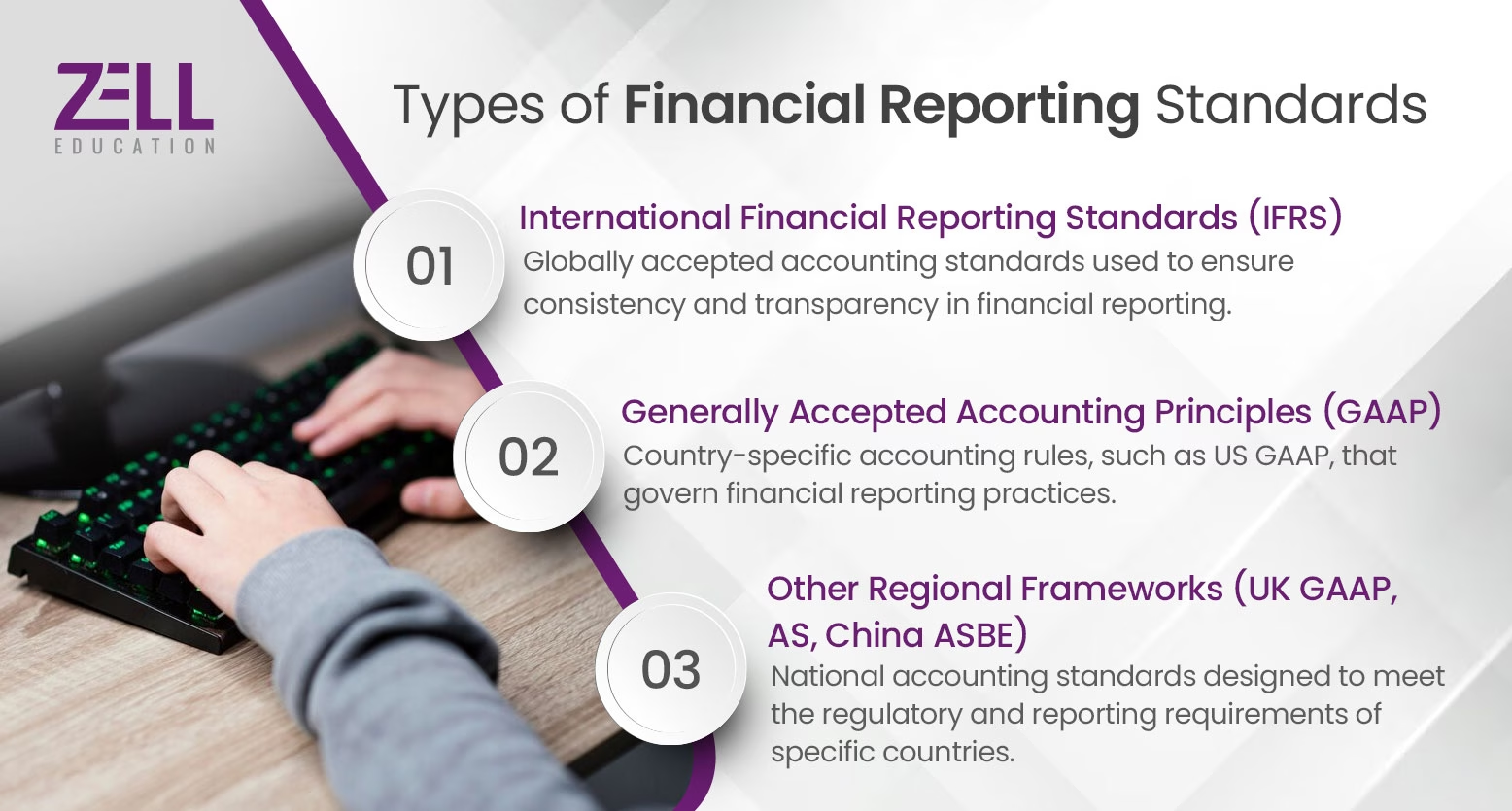
Financial reporting standards differ from jurisdiction to jurisdiction but most organisations use globally accepted frameworks supported by local regulations. Knowing these structures enables firms to keep consistency and transparency in their activities throughout the globe.
International Financial Reporting Standards (IFRS)
- What is IFRS? IFRS is the principles-based approach to financial accounting adopted by over 140 countries around the world.
- IFRS is founded on economic substance, transparency and professional judgement rather than a highly prescriptive approach.
- Increased consistency of IFRS accounting in different reporting environments for multinationals using IFRS methods.
Generally Accepted Accounting Principles (GAAP)
- What is GAAP? GAAP is a rules-based reporting of financial results and is the most commonly used framework among US companies.
- It is based on detailed standards, guidance and prescribed procedures to assure consistency in financial reporting.
- The framework is based on compliance, documentation and standardised treatment of various accounting transactions.
- Organisations following this approach benefit from clear reporting requirements that reduce interpretation differences during financial statement preparation.
Other Regional Frameworks (UK GAAP, AS, China ASBE)
Many countries have also developed regional financial reporting frameworks adapted to local regulatory requirements. India uses Ind AS, UK uses UK GAAP and China uses ASBE. These frameworks are generally consistent with international standards while responding to domestic reporting needs.
Knowing the regional systems is useful for those working in global outsourcing, consulting and multinational business environments.
IFRS vs. GAAP: The Key Differences Explained
The table below highlights the main differences between IFRS reporting and GAAP which affect the preparation of financial statements, valuation methods and accounting methods in organisations.
| Area | IFRS | GAAP |
| Basis | Principles-based approach | Rules-based approach |
| Inventory Valuation | LIFO not permitted | LIFO permitted |
| Asset Revaluation | Revaluation allowed | Revaluation generally prohibited |
| Development Costs | Capitalisation is permitted when criteria are met | Usually expensed |
| Statement Format | Greater presentation flexibility | Prescribed reporting structure |
| Professional Judgement | Higher reliance on judgment | Higher reliance on detailed guidance |
| Global Adoption | Used in 140+ countries | Primarily used in the United States |
Governing Bodies: Who Sets and Enforces Financial Reporting Standards?
Independent organisations must develop, update and oversee reporting frameworks as part of consistent global financial reporting standards. Each of the bodies has a different role in terms of transparency, compliance and accountability across the globe.
FASB – Financial Accounting Standards Board
The Financial Accounting Standards Board (FASB) is an independent private-sector organisation that establishes and updates accounting standards in the United States. Its guidance is the foundation of US GAAP and helps to ensure consistency in financial reporting. FASB’s primary focus is on public markets, investors and corporate financial transparency across the country.
International Accounting Standards Board (IASB)
The International Accounting Standards Board (IASB) is an independent organisation based in London that develops global accounting standards. Most international standards are IFRS issued by this board to improve consistency, transparency, and comparability across financial markets. Its influence extends across multiple continents, supporting investors, regulators, and businesses worldwide.
SEC – Securities and Exchange Commission
The US government regulator that enforces financial reporting requirements for publicly traded companies is the Securities and Exchange Commission (SEC). The SEC regulates compliance and enforcement. FASB establishes the accounting standards, and this differentiation helps to maintain investor confidence, market integrity and consistent reporting practices in public markets.”
Core Principles and Qualitative Characteristics
These characteristics form the foundation of global financial reporting standards and improve trust, transparency, and decision-making across financial markets worldwide.
- Relevance ensures financial information supports informed business and investment decisions effectively.
- Faithful representation requires information to be complete, accurate, neutral, and reliable.
- Comparability is the quality of information that makes it possible for users to compare and contrast items.
- Verifiability is when other parties can check independently using the same evidence and methods.
- Timeliness means financial data is available to users before the decisions lose their practical value.
- Understandability is the ability for the stakeholders to interpret and use the reports with confidence.
Why are Financial Reporting Standards Important?
Financial reporting standards ensure that companies receive tangible benefits in terms of increased financial accuracy and minimised operational risks.
- Investor Confidence: Accuracy in reporting allows investors to assess the performance of companies and allocate investments effectively.
- Global Market Access: Understanding the IFRS full form and its application supports cross-border fundraising and international market participation.
- Mergers and Acquisitions: Streamlined processes reduce uncertainties due to standardised accounting statements.
- Reduced Regulatory Risk: Regulations limit the chances of penalties, disputes regarding the reports, and any regulatory intervention.
- Higher Transparency: Disclosure fosters higher levels of transparency and good governance.
Accounting Principles Based on Types of Firms
The rules that govern compliance vary depending on various factors like size of firm, types of reports and disclosures required, and so forth. Large firms generally tend to have operations in more than one state.
Large companies often use complex IFRS accounting processes to maintain consistency across international operations and between subsidiaries. SMBs, on the other hand, tend to favour simplified frameworks such as IFRS for SMBs which reduce the complexity of reporting, costs of compliance and administrative burdens while still providing financial transparency and comparability.
Challenges Encountered in Implementing Financial Reporting Standards
There are a number of challenges that face companies adopting financial reporting standards including:
- Constantly changing regulations that need to be constantly monitored.
- High costs of implementation in relation to technological changes, audits and consultancy services.
- Difficulties for multinational companies due to different reporting standards across regions.
- Collecting and verifying data can be very labour intensive and expensive for a firm.
- Compliance becomes more difficult due to the global shortage of skilled accountants.
How to Achieve Compliance: A Step-by-Step Process
Achieving compliance becomes simpler when teams follow a structured workflow. By applying a consistent process, organisations can improve accuracy, reduce reporting risks, and maintain regulatory confidence over time.
Step 1: Choosing the Right Reporting Standard for Your Organisation
Decide which reporting standard is relevant to your business operations depending on where you are based geographically and the nature of your industry and regulatory obligations. Choose the right standard early because the decision will set the ground for financial reporting, disclosures, compliance and governance in the long term.
Step 2: Data Gathering and Validation
Start by gathering all the transaction documents, invoices, receipts, and journal entries. Financial data should be validated at the point of source, and errors rectified in order to enhance the accuracy of the reporting process.
Step 3: Preparation and Review of Financial Statements
Financial statements such as the balance sheets, income statements, and statement of cash flows are prepared using the right format. The preparation of financial statements should be done according to applicable accounting and financial standards like those prescribed in IFRS reporting standards and GAAP.
Step 4: Audit, Disclosures and Reporting
Present your documents to the external auditors for auditing and evaluation. Make necessary disclosures in your financial reports and present them to the respective regulatory authority or exchange or registry after being prepared.
Step 5: Keep Updated With Regulatory Changes
Do not consider compliance as a once-off duty but rather make it a continuous one and monitor changes that come from standards board and regulatory authorities.
Compliance Using Technology and Automation
In compliance, technology has changed compliance with the advent of cloud accounting, accounting automation, and the application of fintech. The current technologies make use of AI-powered algorithms in identifying discrepancies, improving reporting efficiency, and enhancing cloud compliance. This makes the task of managing huge data sets easy for the finance department.
Automation, in this context, does not mean the removal of professionals but rather makes them think intelligently and concentrate on analysis and reporting. According to ACCA Global, digital competence is essential for future-proofing a finance career.
The Future of Financial Reporting Standard
As global standards grow, professionals need training in both financial and non-financial reporting. Diploma in IFRS Course holders in finance can keep pace with the new reporting requirements and global compliance trends.
- The future of financial reporting standards is being shaped by ESG integration and sustainability disclosures.
- Investors, regulators and other stakeholders now expect organisations to report on environmental, social and governance performance, as well as financial performance.
- The change widens reporting beyond the usual accounting measures and promotes greater transparency.
Conclusion
Financial reporting frameworks promote transparency, consistency and trust in global business environments. Professionals who understand these standards are better able to support compliance, improve the quality of reporting and contribute to strategic decision making, An ACCA Global-aligned qualification can develop expertise and enhance long-term career prospects in finance and accounting.
To build a premium career, you need to gain globally recognised skills and master corporate reporting. Get practical reporting skills with the industry-approved Diploma in IFRS Course from Zell Education and align your professional growth with international standards and ACCA Global benchmarks today.
FAQs on Financial Reporting Standards
What are financial reporting standards?
Financial reporting standards are rules ensuring consistent, transparent, and comparable financial statements.
What is the difference between IFRS and GAAP?
IFRS are principle-based guidelines. GAAP is rules-based, more detailed guidelines.
Which countries use IFRS and which use GAAP?
The United States follows GAAP for the most part while most countries (140+) follow IFRS.
Who is responsible for setting financial reporting standards?
Standard-setting bodies establish financial reporting standards for their respective jurisdictions.
Are reporting standards mandatory for all businesses?
Requirements vary by country, company size, industry, and regulatory obligations.

Current Role
Co-Founder & CEO at Zell Education
Education
- ACCA – Association of Chartered Certified Accountants, Finance (2011 – 2014)
- Bachelor of Commerce (BCom), Financial Markets from H.R. College Of Commerce & Economics (2010 – 2013)
Location
Mumbai, India
Expertise
ACCA Certified
Why Zell?
- • Largest Provider for Global F&A Courses
- • 4.6 Google Review Rating
- • 1000+ Students placed Annually
- • 500+ Active Hiring Partners
- • Placement Opportunities at the Big 4
- • 100+ Global & Indian Rank Holders
- • 100+ Faculty Network
Speak to A Career Counselor
Zell's 10th Anniversary Offer - Avail a 10% Scholarship