
The day in a life of a CFA shows what finance professionals experience daily after earning the CFA certification. It covers market analysis, financial modeling, portfolio management, and client interactions. This helps students and aspiring charter holders see what the CFA work life is like and what challenges and opportunities it offers.
Day in the Life of a CFA Charter Holder : What to Expect
Imagine starting your morning scanning global markets while sipping your first coffee, preparing for client calls and analysing investment opportunities before the office even fills up. This is a typical day for many CFA charter holders, where every decision can impact portfolios and client trust.
Many finance students and young professionals usually ask about the day in a life of a CFA charter holder. Understanding the CFA work life can assist you to prepare for the challenges, responsibilities, and opportunities this career path offers. A CFA professional’s day is a mix of market analysis, financial modeling, client interactions, and strategy development. For anyone pursuing the CFA certification, it is important to visualise the routines and skills involved before committing to this journey.
Whether you are curious about how a portfolio manager spends their day or what tasks an equity research analyst handles, this guide will provide a detailed look at a CFA day in the life, including role-specific scenarios, key skills, work pressures, and lifestyle considerations. It will also give a clearer picture of what a day in a life of a CFA looks like for different roles in finance.
Who Is a CFA Charter Holder and Where Do They Work?
What it means to be a CFA Charter holder
A CFA charter holder is a finance professional who has completed the CFA certification. It means passing all three CFA exams, getting the required work experience, and following strict ethical rules. A CFA shows you really know about investment analysis, portfolio management, financial reporting, economics, and ethics. Being a CFA charter holder also proves you are trusted and respected worldwide. Employers rely on you to make smart financial decisions, advise clients, and manage tricky investments. For students wondering what is CFA, the course gives them real skills that directly apply to real-world finance roles. A day in a life of a CFA usually mirrors the concepts and skills learned during the certification process.
Common employers of CFA charter holders
People who hold a CFA license work in many different fields. Common jobs are:
- Investment banks – professionals advise on mergers, acquisitions, and capital raising.
- Asset management firms – manage investment portfolios for individual and institutional clients.
- Hedge funds – work on high-stakes trading and investment strategies.
- Corporate finance departments – handle budgets, forecasting, and strategic financial planning.
- Insurance companies – focus on risk management and investment portfolios.
- Consulting firms – advise businesses on valuation, investment, and risk strategies.
CFA careers are flexible, letting charter holders pick roles that match their skills and interests. This is why the CFA study routine can be challenging but also very rewarding. It also explains why students usually wonder what a day in a life of a CFA looks like in different companies.
Curious About A Day in the Life of a CFA Charterholder?
A Typical Workday of a CFA Charter Holder
Morning routine and market preparation
Most charter holders start their day early, usually before markets open. The morning routine usually includes:
- Reviewing overnight market news from global exchanges.
- Checking stock prices, bond yields, and commodity trends.
- Reading financial reports and economic updates to plan decisions for the day.
- Preparing for team meetings or client calls.
A disciplined morning sets the tone for the day, allowing professionals to anticipate market movements and make informed investment choices. For CFA students, mirroring this routine can be a helpful part of a CFA student’s daily routine. Understanding the morning habits gives insight into the day in the life of a CFA, particularly in fast-moving markets.
Core analytical work during the day
Once the market opens, most of a CFA day in life is spent on analysis. Key tasks include:
- Performing company valuations using discounted cash flows, multiples, and comparable analyses.
- Monitoring investment portfolios to ensure optimal performance.
- Conducting sector and industry research to spot trends and opportunities.
- Reviewing financial statements to detect anomalies or potential risks.
Strong analytical skills are critical in the CFA work life. Professionals spend hours interpreting numbers, evaluating investments, and supporting recommendations with robust data. Observing how they structure their day provides a real example of a day in a life of a CFA.
Meetings, collaboration, and communication
Collaboration is important in the day in a life of a CFA. Typical interactions involve:
- Team discussions on portfolio strategies and investment ideas.
- Presenting findings to senior management, boards, or clients.
- Coordinating with research analysts, portfolio managers, and risk teams.
- Negotiating deals or providing clear investment recommendations.
Effective communication is just as important as analytical skills. Explaining difficult financial information in simple terms ensures informed decision-making and client trust.
End-of-day reporting and reviews
A CFA charter holder’s day usually ends with:
- Writing a summary of market performance for the team or clients.
- Checking how investment portfolios are doing and making changes if needed.
- Reviewing regulatory compliance and ethical standards.
- Planning tasks for the next day based on market developments.
The evening routines of CFA professionals are essential for ensuring accuracy, compliance, and strategic planning. Understanding this can help students prepare their CFA study routine in a way that is in line with real-world expectations.
Role-Specific Day-in-the-Life Scenarios
Different CFA roles have unique daily responsibilities and routines.
Equity Research Analyst
An equity research analyst focuses on analysing companies and recommending investments. A typical day includes:
- Analysing company financial statements, earnings reports, and industry data.
- Building valuation models and predicting stock performance.
- Preparing detailed research reports for clients or management.
- Engaging in discussions with company management and industry experts.
This role reflects much of what is taught in the CFA study routine, translating academic knowledge into real investment decisions.
Portfolio Manager
Portfolio managers oversee portfolios and decide on asset allocation strategies. Daily activities usually include:
- Monitoring market trends and assessing portfolio performance.
- Adjusting investments based on client goals and risk tolerance.
- Reviewing analyst reports and research to inform decisions.
- Meeting clients to explain investment strategies and outcomes.
A portfolio manager’s CFA day is a mix of planning, talking to clients, and always looking at the market.
Investment Banking Professional
Investment bankers focus on mergers, acquisitions, and capital raising. Their daily work involves:
- Building detailed financial models to evaluate potential deals.
- Preparing pitch books and client presentations.
- Performing due diligence on companies and investment opportunities.
- Coordinating with legal, compliance, and operations teams.
The CFA work life in banking can be intense but offers experience to high-value transactions and strategic decision-making.
Risk Manager or Quant Analyst
Risk managers and quantitative analysts work to identify and mitigate financial risks. Tasks include:
- Developing and running models to assess market and credit risk.
- Stress-testing portfolios under different economic situations.
- Advising managers on potential experience and mitigation strategies.
- Monitoring regulatory changes and ensuring compliance.
This job uses the math and analysis skills taught in the CFA certification.
Corporate Finance or FP&A Professional
Corporate finance and FP&A professionals focus on internal business strategy and planning. Daily activities include:
- Preparing budgets and financial forecasts.
- Looking at results to find ways to save money.
- Collaborating with departments to improve financial processes.
- Supporting strategic decisions through detailed financial analysis.
For these roles, the day in a life of a CFA focuses on decision-making, reporting accuracy, and strategic insight.
Key Skills Used Daily by CFA charter holders
Financial analysis and valuation
Daily tasks usually revolve around:
- Checking financial statements and important numbers.
- Estimating the value of companies for investment decisions.
- Creating models to predict performance and help plan strategies.
These skills are central to any CFA work life role and are consistently applied across industries.
Quantitative and data skills
CFA professionals work with large datasets and complex calculations. This includes:
- Using number-based models to check for risks.
- Testing different situations and predicting outcomes.
- Using financial software to make analysis easier.
Mastering these skills is crucial for success in a CFA day in the life.
Ethics and compliance awareness
Ethics is an important pillar of the CFA certification. Professionals are expected to:
- Follow ethical standards in reporting and investment advice.
- Ensure transparency with clients and stakeholders.
- Maintain compliance with regulatory needs.
Adhering to ethics is critical across all roles in the CFA work life.
Communication and presentation
Explaining financial concepts to clients and teams is essential. Daily activities include:
- Preparing reports and presentations for clients or management.
- Presenting investment recommendations clearly and persuasively.
- Negotiating or advising on strategic financial decisions.
Good communication makes sure a smooth collaboration and successful outcomes in a day in a life of a CFA.
Work Hours, Pressure & Lifestyle
Typical working hours
Working hours depend on the role and organisation:
- Equity research and investment banking usually exceed twelve-hour days.
- Portfolio management and corporate finance usually involve nine to ten-hour days.
- Risk management and quantitative analysis can have structured hours but peak workload during market events.
Stress and deadlines
The CFA work life includes meeting deadlines, studying detailed data, and making important decisions. Good planning, prioritising tasks, and managing time well are key skills.
Work-life balance across roles
Work-life balance varies:
- Corporate finance roles tend to have more predictable hours.
- Investment banking and equity research can demand long days and flexible schedules.
- A portfolio manager’s schedule changes with market ups and downs.
Understanding this is important for students considering the CFA student daily routine and career path.
How the CFA Curriculum Applies to Daily Work
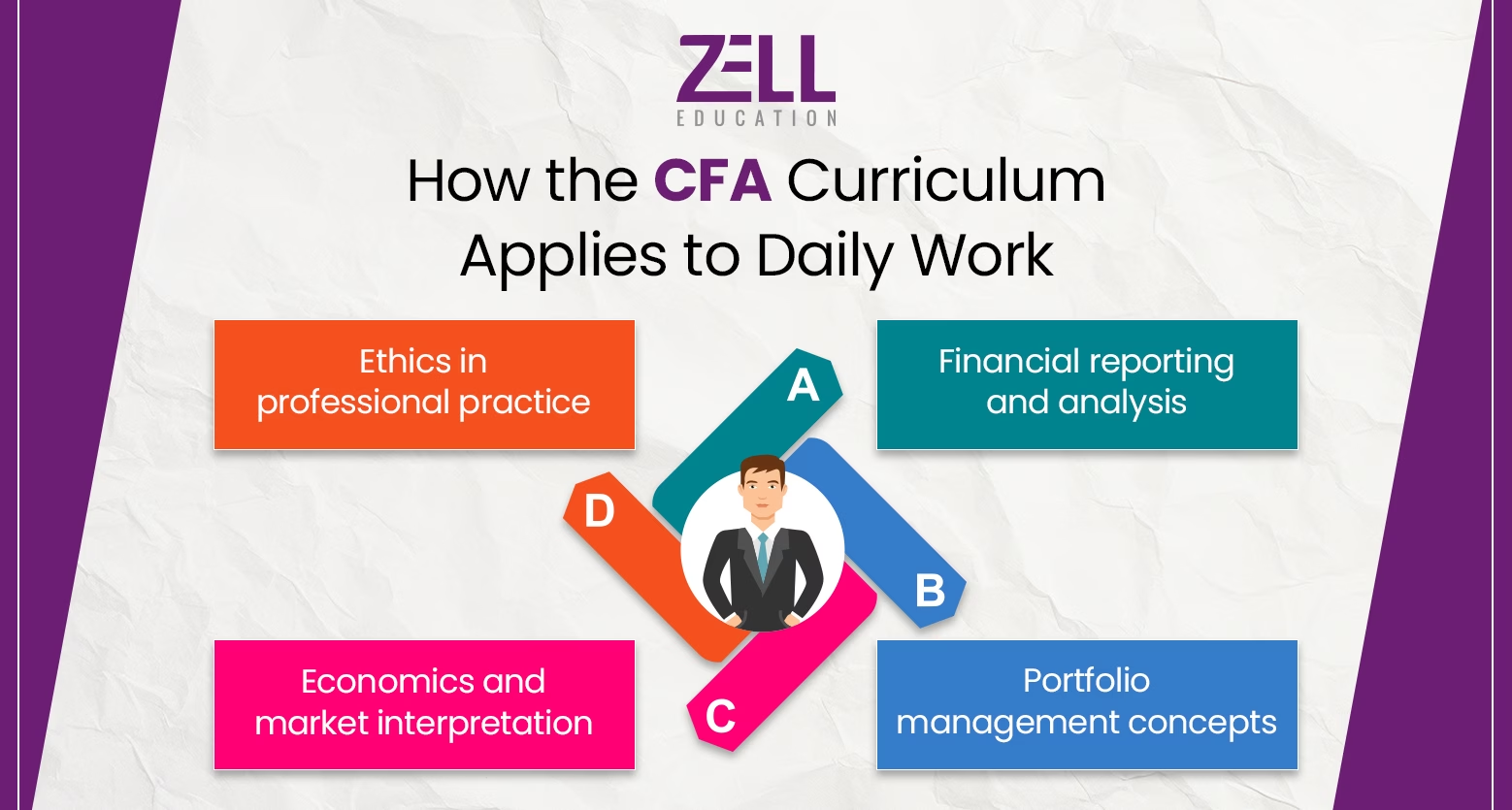
Financial reporting and analysis
Knowledge from the CFA certification course is applied in reviewing financial statements, understanding cash flows, and assessing company performance.
Portfolio management concepts
Skills such as asset allocation, risk-return trade-offs, and portfolio optimisation guide daily investment decisions.
Economics and market interpretation
Economics knowledge allows CFA professionals to understand market trends, forecast movements, and make informed investment recommendations.
Ethics in professional practice
Ethics training ensures professionals maintain integrity, build client trust, and follow regulations in their CFA work life.
Career Growth After Becoming a CFA Charter Holder
Early-career responsibilities
New charter holders usually start as analysts or associates. Responsibilities include research, reporting, financial modeling, and supporting senior professionals.
Mid to senior-level roles
Senior professionals guide teams, handle portfolios, and help make important business decisions. They focus on leadership, communication, and analytical skills.
Long-term career paths
Long-term, CFA charter holders may become senior portfolio managers, chief financial officers, or directors in corporate finance, risk management, or investment banking. The CFA day in the life evolves as responsibilities grow.
Is the CFA Lifestyle Right for You?
Who CFA suits best
The CFA student daily routine and the eventual day in a life of a CFA suits those who:
- Enjoy analysing data and financial statements.
- Thrive in challenging environments with responsibility.
- Want to work in global business with a chance to grow?
- Value ethics, skill, and trustworthiness.
Who should reconsider CFA
This path may not be ideal for those who:
- Choose jobs that are reliable and low-stress.
- Avoid continuous learning or tough exams.
- Have no interest in finance or investment roles.
Want to Pursue CFA Finance Career?
Book Your Free Counselling Session Today
Conclusion
A CFA’s day mixes analysing, planning, talking with others, and following ethics. It can be tough, but it helps you grow in your career, open global opportunities, and gain respect in the field. Understanding what a CFA does each day helps you prepare for the job. For students who use the CFA study method, learning is easier and more helpful when they see how it is done in real life.
FAQs on A Day in the Life of a CFA Charterholder
What does a CFA charter holder do daily?
On a daily basis, the work usually includes studying markets, doing research, building financial models, managing portfolios, preparing reports, and coordinating with the team.
How many hours does a CFA charter holder work?
Hours vary by role. Entry-level roles usually involve nine to ten-hour days. Banking and research roles may exceed twelve hours.
Is the CFA job role stressful?
Yes, due to deadlines, high-stakes decisions, and complex analysis. Time management and focus help manage stress.
Do CFA charter holders work in investment banking only?
No, they work across banking, asset management, corporate finance, risk management, and consulting.
Can CFA charter holders maintain work-life balance?
Work life balance really depends on the role. Corporate finance usually has more predictable hours, while banking and research roles can be more demanding.
How relevant is the CFA curriculum to real work?
Very relevant. Concepts from the CFA certification, such as financial analysis, portfolio management, and ethics, are used directly in everyday work.

Current Role
Co-Founder & CEO at Zell Education
Education
- ACCA – Association of Chartered Certified Accountants, Finance (2011 – 2014)
- Bachelor of Commerce (BCom), Financial Markets from H.R. College Of Commerce & Economics (2010 – 2013)
Location
Mumbai, India
Expertise
ACCA Certified
Why Zell?
- • Largest Provider for Global F&A Courses
- • 4.6 Google Review Rating
- • 1000+ Students placed Annually
- • 500+ Active Hiring Partners
- • Placement Opportunities at the Big 4
- • 100+ Global & Indian Rank Holders
- • 100+ Faculty Network
Speak to A Career Counselor
Zell's 10th Anniversary Offer - Avail a 10% Scholarship