
Key Takeaways:
- CFA Ethics forms the backbone of the CFA curriculum, and it deals with professional behavior and integrity as it applies to making sound decisions.
- What is CFA? CFA is a professional global certification that is a combination of knowledge and the practice of ethical standards in finance.
- The full form of CFA is Chartered Financial Analyst, and it represents technical skills along with the ability to follow ethical principles in the world of finance.
- Weightage for CFA Ethics is 10-20% for all the levels, and thus, it is considered to be one of the important scoring and decision-making sections in the CFA exam.
Comprehensive Summary on CFA Ethics:
- What is CFA & Full Form: The CFA full form means Chartered Financial Analyst, the internationally renowned designation, the convergence of financial acumen and ethics.
- Weightage on Syllabus: The CFA Ethics has a 10-20% weighting on the total syllabus in each level and could determine your pass through Ethics Adjustment.
- CFA Ethics Structure: The CFA Ethics structure consists of the Code of Ethics and the 7 Standards of Professional Conduct, and it guides our daily behaviour in the financial world.
- Examples: The application of CFA Ethics assists us in avoiding pitfalls like misrepresentation, insider trading, and conflicts of interest.
- Significance of CFA: The significance of CFA Ethics to a career is the confidence it builds, thus the credibility.
The CFA Institute has created the CFA Ethics to set forth guidelines for the ethical conduct of all CFA candidates and charterholders regarding their interaction with the financial market. If you want to prepare for the CFA Exam, you’ll want to make sure you know all about CFA Ethics.
While many candidates think that this part is not important, they don’t realise just how much of an effect it will have on them at their next level. In this blog, we will cover everything, from the full form of CFA and Ethical Framework to understanding the 7 Standards of Professional Conduct, to having real-world examples and successful studying strategies to get the highest scores possible on the exam.
What are CFA Ethics?
CFA ethics are the principles and standards laid down by the CFA Institute to guide both CFA Candidates and charterholders in their professional lives, thus ensuring integrity, transparency, and trust within the financial markets.
Key Highlights of CFA Ethics:
- Accounts for 15-20% weightage in the CFA exam
- The section covers the CFA Code of Ethics and the 7 Standards of Professional Conduct
- Applies to CFA Level I, II, and III examinations
- Has an effect on final grades as a result of the Ethics Adjustment
- An important prerequisite topic to become a credible finance professional
What is CFA?
What is CFA? The CFA full form is ‘Chartered Financial Analyst’. It is a recognized global professional designation in investment management concentrating on financial analysis, portfolio management, and ethical judgment through a 3-level CFA course.
The CFA credential represents the highest level of achievement in finance and is intended for professionals who work in all areas of finance, including
- Investment Banking
- Portfolio Management
- Equity Research
- Asset Management
The CFA program consists of three levels:
Level 1 – Foundations of Ethics and Basic Concepts
Level 2 – Applied Skills and Analytical Techniques
Level 3 – Portfolio Management and Decision-Making
Through all three levels, CFA Ethics is designated as one of the fundamental principles of CFA and demonstrates the importance of ethics to the CFA profession.
Why CFA Ethics Is the Most Important Topic in the CFA Course
The Ethical content has been examined at all Levels and forms a separate part of your Final Score for the vast majority of subjects.
Key Information:
- Important weightings for the Exam
- Real World Testing
- The ethics adjustment could be the difference between passing and failing
- Importance for your professional integrity
CFA Ethics Weightage Across Levels
The CFA Ethics across levels are mentioned below:
| CFA Level | Ethics Weightage | Focus Area |
| Level 1 | 15–20% | Basic understanding of standards |
| Level 2 | 10–15% | Application in scenarios |
| Level 3 | 10–15% | Case-based ethical decisions |
The Role of Ethics in the CFA Program
The minute you begin CFA Level 1, you realise the importance of ethics. Ethics is not just a set of rules; it is the performance of right action in the world of finance. Ethics of a CFA can help you be unbiased towards clients, work with integrity, and gain clients’ confidence.
The biggest benefit is that it applies to day-to-day activities and not just to the exams. Investing your time and learning ethics at the beginning of the CFA course truly benefits you for the entirety of your profession.
Purpose of the CFA Ethical Framework
The basic idea behind the CFA ethical framework is that it provides you with guidelines for how to behave when the situation is not black and white, to give you the framework you need to be doing what is appropriate in finance. It is not a checklist to get through but a reflection of your behaviour and the fact that you need to be someone who can be trusted.
- You must treat your client with diligence
- Be honest
- Manage conflicts of interest calmly and rationally
- Have a good and trusted reputation in finance
Importance in the Global Financial Industry
Trust is the fundamental basis of the finance industry. Unethical behaviour can undermine this trust, resulting in:
- Financial crisis
- Loss of investor confidence
- Regulatory penalties
CFA Charterholders’ Ethical Obligations
It is required that CFA charterholders follow the highest ethical standards, including:
- Place the interests of clients above their own
- Maintain the integrity of the financial markets
The main difference between someone with a CFA designation and someone who considers themselves an expert in the financial services industry is their commitment to ethical behaviour.
CFA Code of Ethics – Core Principles Explained
The CFA’s Ethical Code establishes rules for ethical behaviour. The code stipulates that all CFA members and their candidates must do the following:
- Act with integrity, competence, diligence, and respect
- Place the interest of their clients above their own interests
- Use independent judgment
- Support the integrity of capital markets
- Enhance and maintain their knowledge of the profession
These principles should guide each decision you make while you are taking the CFA program and after you have completed it.
Key Components of the CFA Code of Ethics
The purpose of the CFA Code of Ethics is to inspire financial professionals to make good choices about how they conduct themselves in their employment. To encourage fairness with clients, critical decision-making, and responsible behaviour in their everyday business dealings.
1. Professionalism
At CFA Level 1, professionalism relates to the way people act professionally in their work environment, including how they conduct themselves towards other individuals while maintaining general compliance with all applicable laws and regulations.
2. Integrity of Capital Markets
Capital markets should be transparent and free from any type of abuse. If an investor gets access to capital through insider trading or misleading information about a stock and subsequently profits from a rise in its price, then that investor has benefited from a corrupt violation of the law.
3. Duties to Clients
Obligations to a client are part of CFA Level I ethics, which essentially involve putting the client first, ensuring you communicate clearly with them, and protecting the information they provide.
4. Obligations to Employers
CFA Level I ethics also include obligations to your employer, which means being loyal and honest to your employer and keeping confidential information safe. CFA Level I ethics assists candidates with the understanding of how to appropriately manage both of these sets of obligations.
5. Investment Analysis and Recommendations
The portion of CFA Level I ethics is dedicated to ensuring that you are fair and impartial when evaluating any investment. It emphasizes that recommendations should be founded on empirical data rather than the individual’s or firm’s personal gain.
6. Conflicting Interests
Conflicts of interest are prevalent in finance, which is the reason CFA Level I ethics devotes a significant amount of its attention to the topic. The emphasis is placed on recognising the presence of a conflict as early as possible and on being open with respect to those conflicts.
The Seven Standards of Professional Conduct (With Examples)
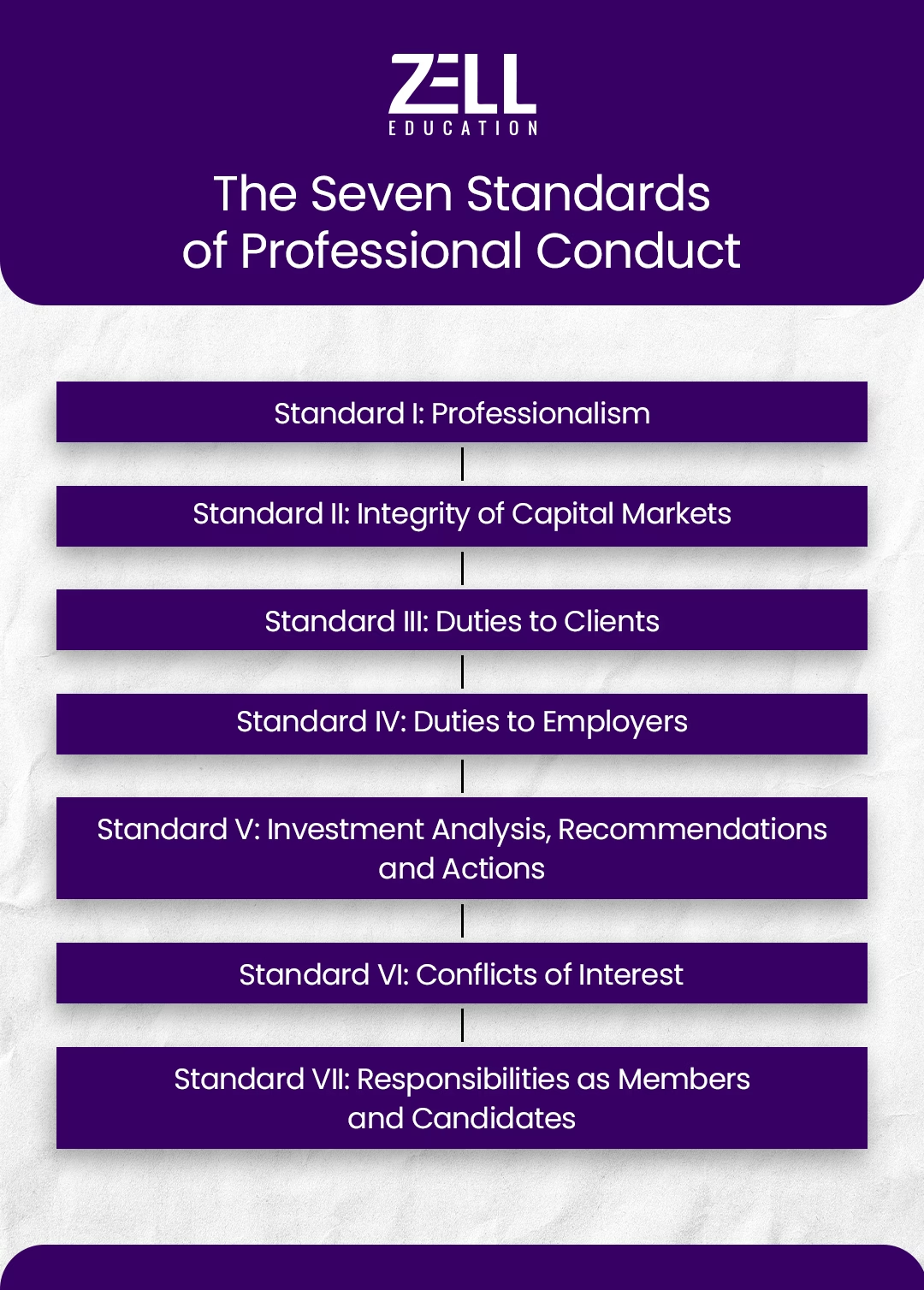
The CFA Ethics framework is built on the Seven Professional Conduct Standards and will inform how you, as a candidate or practitioner, should act in authentic financial situations.
Standard I: Professionalism
You must at all times act lawfully, truthfully, and diligently in your role.
Example: Your employer forces you to manipulate your company’s accounts to impress potential investors. You must reject all unethical requests regardless of the possible consequences of being terminated.
Key point: The best solution is always to act in accordance with your morals instead of succumbing to temptation or easy solutions; therefore,
Standard II: Integrity of Capital Markets
You must not engage or assist in insider trading or market manipulation
Example: You should never trade or disclose any knowledge about any advanced merger outside of the information on the stock exchanges to anyone other than the company involved in the merger.
Key Point: In order to assure a fair and efficient market, investors must have equal access to all pertinent information.
Standard III: Duties to Clients
Always act with the best interest of your clients in mind and treat all clients fairly.
Example: You should not recommend a specific investment to your client because it would pay you a greater commission than would another similar investment that would be better suited for the objectives as stated by your client.
Key point: In the end, the client’s interest is the number one priority.
Standard IV: Duties to Employers
As a member of the CFA Institute, you are expected to always be loyal to your employer and to support ethical practices in your work.
Example: It would be unethical to share company confidential information with a competitor after leaving your job.
Important point: Just because your company will not gain from your loyalty doesn’t mean your loyalty ends.
Standard V: Investment Analysis and Recommendations
You must have researched and/or provided complete, accurate, objective data when making stock recommendations.
Consider the example of publishing a stock recommendation based solely on hearsay and without proper research is an admission that you are guilty.
Important point: your stock recommendations should always be made on the basis of fact and logical reasoning.
Standard VI: Conflicts of Interest
It is important to be transparent with any personal relationships that may impact your decision-making in the workplace. For example, if you are recommending a publicly traded company to a client and own shares in that company, you should provide that information.
The key idea behind transparency is that it creates trust.
Standard VII: Outlines the responsibility of CFA members and Candidates
Members and candidates must be honest when taking the CFA Exam and shall not engage in conduct that violates public trust when engaged in CFA-related activities.
Examples of conduct that are prohibited include sharing CFA exam questions and using any other forms of unfair means in connection with the CFA Exam.
The key idea is to have integrity throughout the entire process, as well as to have integrity in the result.
Real-Life Examples of CFA Ethics Violations
These illustrations of CFA Ethical Issues make it easier to understand what is happening in the real world of finance today:
- Insider Trading: Using non-publicly available information to make a profit.
- Misrepresentation: Providing clients with false returns.
- Plagiarism: Using someone else’s research without giving them credit.
- Front Running: Executing orders on behalf of other clients before executing your own order.
All of the aforementioned issues illustrate why ethics is so important in the field of finance.
Common Ethical Mistakes CFA Candidates Must Avoid
The following are examples of the most frequently made ethical mistakes by candidates and future professionals.
1. Misrepresentation
Information that is not accurately reported is considered misrepresentation. You must always communicate factually accurate information in regard to CFA ethics.
2. Plagiarism & Improper Conduct
You should not represent another person’s efforts or conduct yourself in an inappropriate manner. Be original and accountable; this is the overall principle.
3. Selective Disclosure & Material Non-Public Information
It is improper to share key details of significance with only certain people; it is contrary to CFA ethics to be fair and to protect sensitive information and use it fairly.
Why CFA Ethics Is the Most Important Section of All 3 Levels
CFA ethics provides a framework for ethical decision-making by CFA charterholders. Learning the CFA ethics curriculum equips you with the knowledge and skills to act ethically, build relationships of trust between you and your colleagues, employers, clients, and other stakeholders, and apply those values to real-world situations.
1. CFA Ethics and Exam Performance
You probably believe ethics questions have no great impact on the result, but they do in your total score of the CFA exam, as ethics are evaluated, and you are being examined and assessed.
2. Real-World Impact on Career & Reputation
The way you apply CFA ethics daily matters much more than answering many of the questions correctly on the CFA exam. If you apply CFA ethics to your work daily, people will be able to rely on you to do the right thing, so your career develops.
3. Building Trust in the Investment Profession through Ethics
The ethical principles of CFA ethics provide the foundation for trust between members of the investment profession. Individuals build trust with clients, colleagues, and the financial markets by following a few simple ethical principles.
Consequences of Violating CFA Ethics
Failing to follow CFA Ethics will result in serious consequences, including:
- Exam disqualification
- Suspension from the CFA program
- Revocation of the CFA charter
- Career damage and legal action
The damages from violations of CFA Ethics extend beyond the examination to your entire career.
How CFA Ethics Will Affect Your Career in Finance
Without the application of ethics, the successful buildout of a finance career cannot be done.
- Builds trust with clients
- Develops your professional reputation
- Assures compliance with regulations
- Increases your potential for continued career growth over time
Employers do value those candidates who understand not only the technical aspects of CFA Ethics but also the ethical behaviours associated with clf and bwb on a continued basis.
How to Prepare for the CFA Ethics Section
To prepare for the CFA Ethics Section, candidates need to follow the pointers below:
- Mastering Judgement Questions for Various Scenarios: Concentrate on understanding the situation instead of rote learning the guidelines.
- Practice Case-Study-Based Questions: Complete several case studies to improve the ability to make decisions.
- Learn the language of the CFA institution: Be aware of keywords that have the same meaning: ‘must’, ‘should’, and ‘recommend’.
Recommended Study Resources for CFA Ethics
The study resources for CFA Ethics are:
- The official curriculum of the CFA Institution
- Practice Test Banks
- Sample Exams and Revision Notes.
- Repetitive practice is critical to mastering CFA Ethics.
Tips to Score High in CFA Ethics Section
The following tips that candidates need to follow to score high in CFA Ethics are:
- Concentrating on clearly defining concepts, rather than simply memorizing them;
- Reading the question with care because the specific details of any question will have a significant impact on the answer given and working through challenging examples.
Conclusion: Why Ethics Shapes Your CFA Journey & Career
CFA course is not simply an education in financial knowledge; it is also your journey toward becoming a responsible financial professional. CFA Ethics will ensure you have the highest level of integrity so that others see you as someone they can trust in the global finance community.
So if you understand what CFA is and what its purpose is, you will see that ethics has a much greater meaning than a single subject; it will be the basis for your whole career.
FAQs on CFA Ethics
Is the CFA Ethics section difficult?
It’s incredibly challenging to test your ability to show good judgment while being able to interpret what’s happening in the scenario.
How much of the CFA exam covers Ethics?
The Ethics portion of each of the Levels of the CFA program can make up anywhere from 10% to 20%, depending on the specific Exam.
How does the Ethics Adjustment work?
It’s a mechanism for determining that a person’s performance in Ethics will affect their Final results based on the individual’s performance in Ethics.
What’s the best way to prepare for CFA Ethics?
Practice Scenario-based Questions, along with understanding the rationale/reasoning behind each of the answers provided.
Does studying CFA Ethics help in actual finance jobs?
It develops the decision-making and integrity needed for various real-world finance careers.

Current Role
Co-Founder & CEO at Zell Education
Education
- ACCA – Association of Chartered Certified Accountants, Finance (2011 – 2014)
- Bachelor of Commerce (BCom), Financial Markets from H.R. College Of Commerce & Economics (2010 – 2013)
Location
Mumbai, India
Expertise
ACCA Certified
Why Zell?
- • Largest Provider for Global F&A Courses
- • 4.6 Google Review Rating
- • 1000+ Global Placement Partners
- • Placement Opportunities at the Big 4
- • 100+ Global & Indian Rank Holders
- • 100+ Faculty Network
- • 10,000+ Students Placed
Speak to A Career Counselor
Zell's 10th Anniversary Offer - Avail a 10% Scholarship