
Key Takeaways
- A properly structured CFA resume can really highlight your finance expertise and professional commitment.
- Knowing how to add CFA on resume sections the right way also helps you avoid compliance issues and keeps your profile credible.
- Understanding how to write CFA in resume formats simply makes it easier to present your achievements clearly to employers.
Comprehensive Guide on ‘CFA resume’
CFA Resume
A CFA resume is a finance-focused CV that highlights your education, CFA progress, skills, and work experience in investment and financial analysis.
CFA on Resume
This refers to how you correctly mention CFA status on your CV, such as ‘Level I, II, or III candidate’ or ‘CFA charterholder’, to build credibility.
CFA Designation
The CFA designation is the official title given to professionals who have completed all CFA levels and met work experience requirements.
CFA Candidate
A CFA candidate is someone who has enrolled in the CFA program and is currently working through Level I, II, or III exams.
CFA Resume Example
A CFA resume example shows a sample format of how finance professionals structure their CV with CFA details, skills, and achievements.
CFA Skills
CFA skills are finance and investment abilities like valuation, equity research, portfolio management, and financial modeling gained through the CFA program.
Build a Finance Career That Stands Out
 Speak to an Expert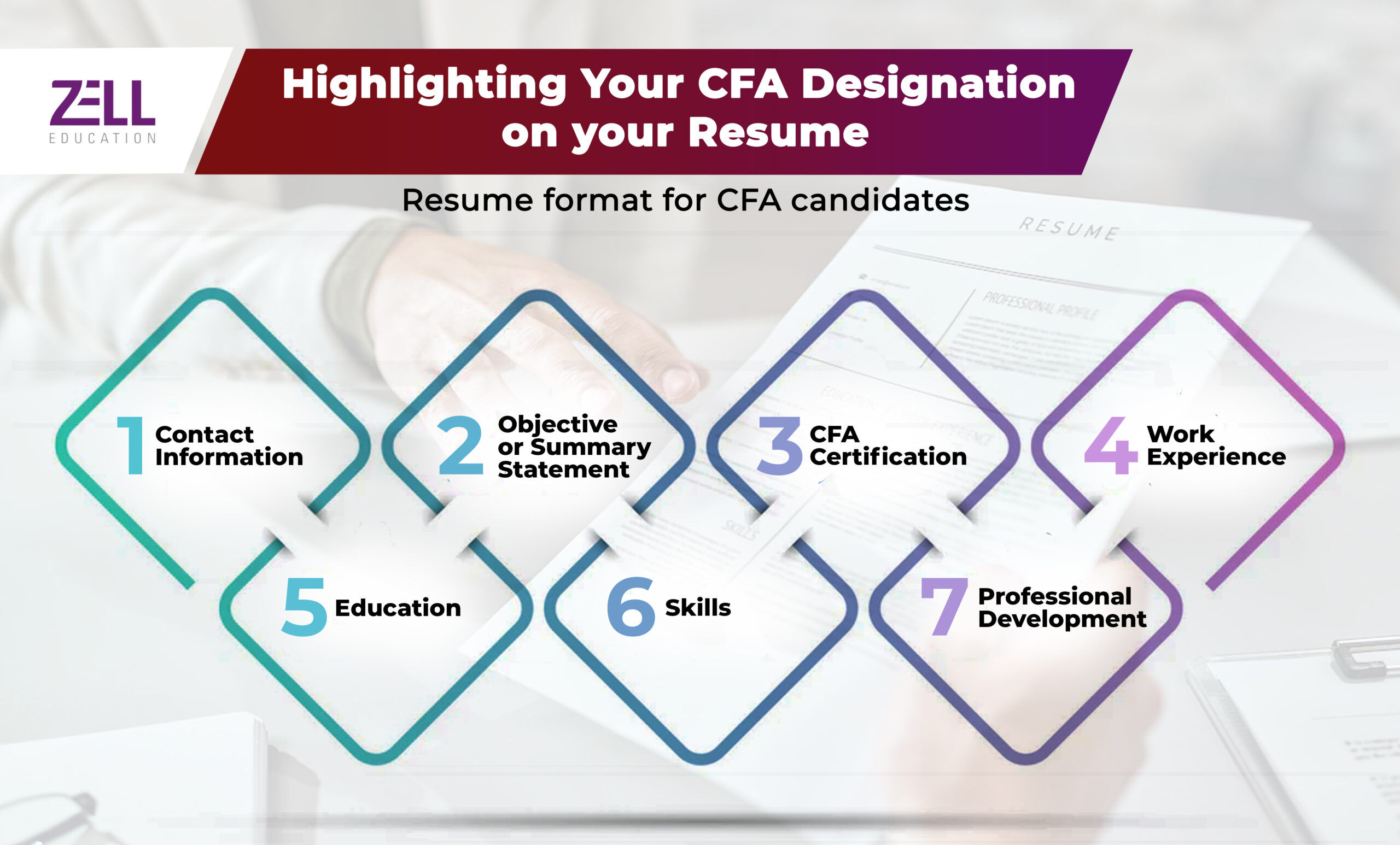
Why the CFA Designation Carries Weight on a Resume
A strong finance resume can open doors, but it’s often the little details that make the biggest difference. One of those things is how you show your CFA status. Whether you’re a charterholder, an active candidate, or preparing for your first exam, using the designation correctly can help build your professional profile and help recruiters quickly scan your qualifications.
The Chartered Financial Analyst (CFA) certification is one of the most respected credentials in the investment and finance world. You only earn it after clearing a series of tough exams and also completing the required work experience, so it really reflects both knowledge and real on the job skill.
Because of this, employers often view the designation as evidence of:
- Strong analytical skills
- Knowledge of investment management
- Ethical decision-making abilities
- Commitment to professional development
- Advanced financial expertise
A well-structured CFA resume immediately signals that a candidate has invested significant effort in developing technical finance skills.
The designation is particularly valued in roles such as:
- Investment Banking
- Equity Research
- Asset Management
- Portfolio Management
- Corporate Finance
- Wealth Management
- Risk Management
Recruiters tend to look for qualifications on resumes that demonstrate specialised knowledge. A proper display of the designation can make your profile stand out in a competitive job market.
CFA Institute Formatting Rules You Must Know
Before adding the designation to your resume, it is important to understand the rules established by the CFA Institute.
These rules are there to keep the CFA charter credible and to make sure candidates describe their status honestly and correctly.
Some key principles include:
- Don’t use CFA like it’s a noun.
- Only call yourself a charterholder if you actually have the charter.
- If you’re still a candidate, be clear about your exam level and where you stand.
- Passing one or two levels doesn’t give you any part of the designation, so don’t imply that.
- And always present CFA exactly the way it’s officially allowed.
Following these guidelines helps maintain professionalism and prevents potential compliance concerns.
CFA vs “Chartered Financial Analyst”: Which to Use
Many professionals wonder whether they should write “CFA” or “chartered financial analyst” on a resume.
In most situations:
- Use CFA after your name if you are an active charterholder.
- Use ‘Chartered Financial Analyst’ when describing the credential in a certifications section.
- Maintain consistency throughout the document.
For example:
Correct:
- Sarah Brown, CFA
- Chartered Financial Analyst (CFA Charterholder)
Less effective:
- Sarah Brown, Chartered Financial Analyst, CFA
Keeping the presentation concise improves readability.
When and How to Use the Symbol
When mentioning the designation, use the letters exactly as approved.
Best practices include:
- Use capital letters: CFA
- Do not add periods between letters
- Do not pluralise the designation
- Do not create variations
Examples:
Correct:
- John Smith, CFA
Incorrect:
- John Smith, C.F.A.
- John Smith, CFAs
- I am a CFA
Consistency helps maintain professional standards and ensures that employers immediately recognise the credential.
Turn Your CFA Knowledge Into Career Opportunities
 Book Your Slot Now
 Where to Place Your CFA Designation on a Resume
Where you put your designation can make a big difference in how quickly recruiters actually notice it.
A clean CFA resume just makes their job easier; they can spot your key qualifications right away without having to hunt through every section.
After Your Name in the Header
For active charterholders, the most common placement is directly after the name.
Example:
Michael Jones, CFA
This way, recruiters notice it right away, and the credential stands out before they even get into the rest of the CFA resume.
Benefits include:
- Quick recognition
- Professional presentation
- Improved recruiter visibility
- Stronger first impression
For many finance professionals, this is the preferred placement strategy.
In the Certifications or Education Section
Another option is to include the designation in a dedicated certifications section.
Example:
Certifications
- Chartered Financial Analyst (CFA)
- Financial Modeling Certification
- ESG Certification
This format works really well when someone has more than one credential to show.
It also gives recruiters a clear spot where they can quickly look through and understand the technical qualifications without digging around.
A strong CFA resume often combines clear header placement with detailed certification information in the body of the resume.
How to List CFA on a Resume Based on Your Status
Your resume should reflect your current CFA status accurately. A charterholder and a candidate don’t describe their CFA status in the same way.
Using the right wording helps employers clearly understand where you are in the CFA journey and also keeps your resume aligned with the standard way it’s supposed to be presented.
Active CFA Charterholder
If you have earned the charter and remain an active charterholder, you can place CFA after your name.
Example:
David Wilson, CFA
You can also include the designation in your certifications section.
Example:
David Wilson, CFA
You can also list it in a certifications section like this:
Certifications
- Chartered Financial Analyst (CFA Charterholder)
A few simple tips:
- Keep the designation easy to spot
- Use the same formatting style throughout your CFA resume
- Avoid repeating the designation unnecessarily.
An active charterholder should make sure every mention of CFA reflects their current status. In a strong CFA resume, the designation is usually shown both in the header and again in the certifications section so it’s easy for recruiters to spot right away.
CFA Candidate (Level I, II, or III)
Candidates can mention their status, but they must avoid suggesting that they already hold the charter.
Examples:
- Passed CFA Level I Exam
- Passed CFA Level II Exam
- CFA Level III Candidate
- Registered for CFA Level I Exam
This information can be included under certifications, education, or a dedicated professional development section.
Example:
Professional Development
- Passed CFA Level II Exam
- Advanced Financial Modeling Certification
Recruiters usually value honesty about where you are in the CFA journey. Clearly mentioning your exam progress shows you’re serious about learning while still keeping things professional.
And for someone applying for their first finance role, showing that progress in a clear way can actually make a CFA resume stronger, even before you’ve earned the charter.
CFA Candidate Resume Example
Name
Emily Carter
Professional Development
- Passed CFA Level II Exam
- Financial Statement Analysis Training
- Equity Valuation Workshop
Skills
- Investment Research
- Financial Modeling
- Portfolio Analysis
This simple CFA candidate resume example gives employers a clear picture of exam progress and relevant skills.
Lapsed or Former CFA Charterholder
Professionals who have let their charter lapse need to be careful about how they present their credentials.
If they no longer have active charterholder status, they should not use CFA after their names.
Where appropriate they may describe their previous achievement accurately.
For example:
- Formerly Chartered Financial Analyst designation
Avoid language that may suggest active charterholder status.
Professional qualifications must also be presented with honesty and clarity.
Linking Your CFA Skills to Resume Bullet Points
Adding a designation definitely helps, but recruiters also look for proof that you can actually apply those skills.
A strong CFA resume usually brings both together, your credentials along with real, measurable achievements and relevant experience.
Key CFA Competencies Worth Calling Out
The CFA syllabus develops several skills that employers actively seek.
Consider highlighting:
- Financial Analysis
- Equity Research
- Fixed Income Analysis
- Portfolio Management
- Risk Assessment
- Corporate Finance
- Financial Reporting
- Quantitative Methods
- Ethics and Professional Standards
- Alternative Investments
Rather than simply listing skills, connect them to outcomes.
Examples:
- Conducted valuation analysis for 25 publicly listed companies
- Built financial models supporting investment decisions
- Evaluated portfolio performance across multiple asset classes
- Performed industry research to support equity recommendations
These examples show how CFA knowledge translates into workplace performance.
Tailoring CFA Skills to Specific Finance Roles
Different finance positions value different competencies.
The table below shows how to align your CFA-related skills with target roles.
| Finance Role | CFA Skills to Highlight |
| Investment Banking | Valuation, Financial Modeling, M&A Analysis |
| Equity Research | Company Analysis, Industry Research, Forecasting |
| Asset Management | Portfolio Construction, Risk Analysis |
| Wealth Management | Investment Planning, Client Advisory |
| Corporate Finance | Budgeting, Financial Analysis, Capital Allocation |
| Risk Management | Quantitative Analysis, Risk Assessment |
A tailored CFA resume usually works better than a generic one sent everywhere.
When you’re applying for a specific role, it helps to actually go through the job description and focus more on the skills and experience that match it best.
How to Add Your CFA Designation on LinkedIn and Beyond
Your resume is not the only place where your CFA status should be displayed professionally.
Consistency across platforms builds a stronger personal brand.
Name Field and Licenses & Certifications Section
Active charterholders can use CFA after their name on LinkedIn.
Example:
Michael Brown, CFA
- You can also add it in the Licenses & Certifications section.
Keep it simple:
- Credential name: Chartered Financial Analyst
- Issuing Organisation: CFA Institute
- Issue Date
- Credential ID (if applicable)
This helps recruiters verify qualifications quickly.
A full profile that lines up with your CFA resume just makes your online presence feel more put together and professional.
Using CFA Digital Badges
Digital badges provide another way to showcase your achievement.
These badges can be displayed on:
- Personal websites
- Online portfolios
- Professional profiles
Benefits include:
- Easy verification
- Enhanced credibility
- Greater visibility
More and more employers check online profiles before interviews, so adding digital badges can actually be a nice way to support your CFA resume.
Business Cards and Email Signatures
Many charterholders also display their credentials on business cards and email signatures.
Examples:
John Smith, CFA
Senior Investment Analyst
or
John Smith, CFA
Portfolio Manager
This simple addition adds professional credibility to daily interactions.
Top CFA Resume Mistakes to Avoid
Even the best qualified professionals make presentation mistakes.
Avoiding these pitfalls can improve your application.
Common mistakes include:
- Claiming charterholder status prior to earning the charter
- CFA as a noun
- Incorrect exam status showing
- Using old information
- Bury the designation deep in the resume
- Not connecting CFA skills to job achievements
- Technical jargon overload in the resume.
- Inconsistent formatting
Another common mistake is building a CFA resume that only talks about the credential and doesn’t really show your work experience.
Remember that employers evaluate the complete candidate, not just certifications.
Conclusion
A properly structured CFA resume can help employers quickly recognise your qualifications and commitment to the finance profession.
- Whether you’re an active charterholder, working through the exams or updating your professional profiles, accurate representation matters.
- Knowing how to write CFA in resume sections correctly will help you to present your achievements professionally and according to industry standards.
- Making an impression with recruiters and hiring managers is all about the details, from your resume headers to your LinkedIn profile.
- You need to clearly and honestly present your CFA status to enhance your credibility and distinguish yourself from the competition in a crowded job market if you are pursuing a career in finance.
- Review your resume often, update your status as you progress, and use a proven CFA resume example to guide your revision.
- Those professionals working towards the charter often ask the question, “What is CFA and is the effort worthwhile?” The answer is the reputation the qualification has across global finance roles. A recognised CFA certification can be a valuable addition to your professional profile, combined with the right experience.
Whether you are creating your first CFA resume or updating an existing one, the goal remains the same: present your qualifications clearly, accurately, and professionally.
FAQs on How to List Your CFA Designation on a Resume
Can I list CFA Level 1 on my resume if I haven’t passed yet?
You can mention that you’re sitting for the exam, but don’t say you’ve cleared it if you haven’t.
Can I still include CFA on my resume if my designation has lapsed?
No, once you’re not an active charterholder, you shouldn’t use CFA after your name.
What happens if I violate CFA Institute resume guidelines?
It can lead to compliance issues and could create professional trouble later.
Should I include CFA in my resume summary?
Yes, just make sure your CFA status is accurate and actually relevant to the role you’re going for.
Does listing CFA on a resume help with ATS screening?
Yes, a lot of finance recruiters do search for CFA-related keywords when filtering resumes.

Current Role
Co-Founder & CEO at Zell Education
Education
- ACCA – Association of Chartered Certified Accountants, Finance (2011 – 2014)
- Bachelor of Commerce (BCom), Financial Markets from H.R. College Of Commerce & Economics (2010 – 2013)
Location
Mumbai, India
Expertise
ACCA Certified
Why Zell?
- • Largest Provider for Global F&A Courses
- • 4.6 Google Review Rating
- • 1000+ Global Placement Partners
- • Placement Opportunities at the Big 4
- • 100+ Global & Indian Rank Holders
- • 100+ Faculty Network
- • 10,000+ Students Placed
Speak to A Career Counselor
Zell's 10th Anniversary Offer - Avail a 10% Scholarship