
Key Takeaways
Can you do Investment Banking after CFA?
- Yes, you can absolutely do investment banking after completing your CFA.
- The CFA provides technical valuation and financial modeling skills for Investment Banking.
- Front-end deal roles usually prefer top-tier MBAs, a CFA is highly respected by banks like Goldman Sachs and JPMorgan.
Comprehensive Guide: Investment Banking After CFA
- What is CFA?
The CFA credential is an elite, globally recognised professional investment management designation.
- What is Investment Banking?
It is a financial sector that assists corporations in raising capital and navigating complex mergers.
- What is Investment Banking after CFA?
Investment banking after a CFA means transitioning into roles focused on raising capital, valuing companies, and executing M&A.
- What are benefits of Investment Banking?
IB provides financial intermediary services that benefit corporations, governments, and individuals.
- What are Investment Banking salaries?
Indian professionals typically earn between 12 to 30 lakhs annually.
Investment banking is a high-stakes, high-reward career that requires sharp analytical skills and a deep understanding of financial markets. The CFA program offers a structured path to break into this competitive field by equipping candidates with the expertise and global recognition needed to thrive.
Find out all about Investment Bank as a field and as a profession through this detailed article for all investment enthusiasts.
Introduction
Saving for the future is something that everyone does. But people have started understanding the difference between savings and investment lately. With rising awareness about investment, the demand for investing services is also soaring. Companies and individuals today invest in markets, bonds, and gold for better returns. While such investments offer great returns, no one is unaware of the risk factors that such investments possess .
So, when the investment market is so volatile, getting expert advice and help becomes important. Investment banking is the service that guides individuals and companies to make the right investment decisions. When the investment market is in demand, more candidates are looking forward to fetching career opportunities in this field. CFA is one such course that trains candidates and enables them to prosper as an Investment Banker.
What is CFA & Investment Banking
The Chartered Financial Analyst (CFA) program is a globally recognized credential that focuses on investment management, financial analysis, and ethical standards. It equips professionals with the skills required for roles in portfolio management, equity research, and investment banking.
Investment banking, on the other hand, is a financial service that assists organizations and governments in raising capital and managing complex financial transactions such as mergers, acquisitions, and IPOs. Together, the CFA designation and investment banking create a powerful combination for individuals looking to make impactful financial decisions on a global scale.
What Exactly is Investment Banking?
To explain Investment Banking in simple terms, we can say that it’s a division of banking that is created with the purpose of generating capital for governments, firms and individuals related to them. Some of the major purposes of the investment banking field are as follows
- Facilitating mergers and acquisitions
- Generating the sale of company stocks
- Management of assets
- Underwriting
- Equity research
- Raising capital debt
- Launching new products
- Insuring bonds
Full-service banks offer all these services as they plan and manage finance projects for larger organizations. Many full-service or investment banks are associated with larger global banks like Goldman Sachs, JP Morgan, Bank of America, Credit Suisse and Deutsche Bank. There are popular investment banks in India as well that are trusted by plenty of people, some of them are JM Financial Institutions and Securities, IDBI Bank, MAPE Capital Advisors, etc.
The Power of CFA and Investment Banking in Your Career
CFA trains the candidates in analyzing and evaluating financial statements and ratios. Also, the course offers in-depth knowledge about the global economy. Moreover, the CFA offers the power to check on the financial health of an organization and offer the right remedies accordingly.
Most candidates pursue the CFA course to become an Investment Banker, which is a reputed position in the financial Industry. A financial banker not only earns a reputation but also pockets a handsome salary package with time.
What is the CFA Program and Why is it Important for Investment Banking?
The CFA program lasts 2 to 3 years and has 3 levels to complete. The candidate will have to complete all the three levels and pass the exams to complete the course. Also, the candidate must complete a practical session or work experience of minimum 4000 hours within 36 months in a relevant field to get the certificate finally.
Candidates learn topics like investment management, banking, risk management, and consulting in the CFA course. These topics help in boosting the major skills of an investment banker. So, CFA is important for investment banking.
What Do Investment Banks Do?
As the name suggests, investment banks assist corporations in large and complicated financial transactions. These monetary transactions could include IPOs, M&A, liquidation or even a takeover. Investment banks hire Investment Bankers to help governments, organizations and individuals to make these big-ticket investments.
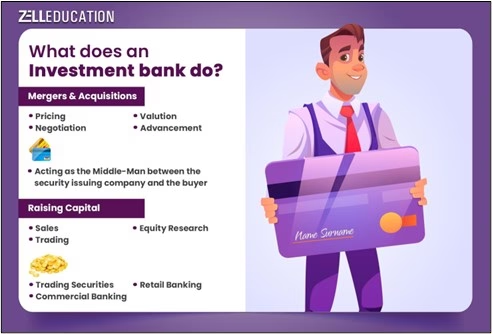
They plan large projects by identifying the risks involved. Since Investment Bankers are well aware of the latest products in the market and can easily predict their growth or downfall, they are sure to direct their clients accordingly. Here are some of the major tasks that investment banks carry out.
- They serve as the mediators between the company and investors
- Offer consultation based on the company or individual’s net worth
- Identifying future risks on the suggesting products accordingly
- Facilitates broker trades for institutions as well as investors
- Raising capital for companies with potential
How To Become An Investment Banker
Becoming an Investment Banker isn’t as it may seem. Since this exciting job also comes with an immense risk factor, the profession must ensure that you possess the necessary skills to invest and raise capital for different public and private organisations. Here’s what you need to have to become an Investment Banker.
- Pass your 10+2: Before you get into any professional course, you need to complete your basic education which falls under the eligibility criteria for almost every professional course.
- Earn a Bachelor’s degree: To master the complexities of the Investment Banking industry you need to understand the finance and banking industry first. And for that, you’ll need a graduation degree in either B.Com or BAF.
- Get a professional degree in CFA: CFA or Chartered Financial Analyst is a prestigious professional qualification with four cut-throat levels that not only equip you with the workings of the investment industry but also the skills you’ll need to invest right.
- Work experience: Apart from a strong passion for researching the market and investing, you’ll also require some level of training to become a true expert. If you’ve cleared all your CFA levels then the mandatory work experience you’ll require would be about 36 months.
A Career In Investment Banking
A career in investment banking is extremely exciting and at the same time extremely rewarding. When working for an Indian or International investment bank, apart from your regular income, you’d be making a handsome amount only through investments. However, you’ll need certain skills to be successful in your career as an Investment Banker. Here are some of the essential skills required –
Key Skills and Competencies
An investment banker should posses a number of skills and some of them are:
- Deep knowledge about the investment market
- Impressive convincing power
- Adaptability and problem-solving power
- Time management skills
- Analytical skills
- Networking and relationship-building
Responsibilities and Career Progression

The investment banking sector takes care of these responsibilities:
- Serves as a mediator between the investors and the clients
- Consultation to companies or individuals about their investments
- Analyzing and discussing risk while suggesting any investment options
- Facilitating broker trades
- Offering capital help for the organizations
Structure, Format, and Tips for Success
The CFA course has three levels. Each level has two exams of 135 minutes each. The Level 1 exam has all objective questions. Level 2 also has objective questions based on case studies. Level 3 is also based on case studies and combines objective and essay-type questions.
Candidates should achieve at least 70% in each exam to pass. The passing rate in CFA is 40%, but you can succeed with some of these tips:
- Invest at least 6 months in preparation before taking the exams of a level
- Make a schedule to complete all the topics
- Enroll in Zell coaching classes for better learning and understanding
- Practice a lot of mock test papers
- Register for the exam only when you are confident
Allocation of resources for a business’s future is one of the major responsibilities of an Investment Banker. But economic uncertainties are one of the biggest challenges in their way. Professionals who use tactics and analysis skills to offer great results even during challenging period grow high and pocket great packages in the long run.
Why CFA and Investment Banking are Worth the Effort?
Investment banking jobs are hot cakes now because more companies and individuals are investing today. Pursuing a CFA course and getting an investment banker job will offer you global exposure and a lucrative career opportunity.
What is the Salary of Investment Banker after CFA?
After completing the CFA program, especially by Level 2 or 3, candidates are eligible for well-paying roles in investment banking. On average, Investment Bankers with CFA qualifications earn between INR 14 to 22 LPA in India, depending on experience, location, and the employer.
| Experience Level | Typical Role | Average Annual Salary (India) |
| Entry Level (0–2 Years) | Investment Banking Analyst | ₹8–15 LPA |
| Early Career (2–5 Years) | Associate | ₹15–30 LPA |
| Mid-Level (5–8 Years) | Senior Associate / Vice President | ₹30–60 LPA |
| Senior Level (8–12 Years) | Director | ₹60 LPA–₹1.2 Crore |
| Executive Level (12+ Years) | Managing Director | ₹1.2–3+ Crore |
Source for Investment Banking salary: Naukri
International opportunities, particularly in countries like the USA, Canada, and the UAE, can offer even higher compensation. Zell Education not only prepares students to crack all levels of CFA but also supports them with job placements in top-tier investment firms.
Countries You Can Work In After Completing CFA
Chartered Financial Analyst is a globally recognised course that enables you to work in several countries. Want to know which are the top hiring countries for CFA professionals? Here’s a glimpse.
- UAE
- Hong Kong
- China
- Canada
- USA
- Australia
- South Africa
If you wish to become a successful Investment Banker the best pathway to becoming one is through completing your professional degree in CFA. To pursue your Chartered Financial Analyst degree from a prestigious learning provider click on the WhatsApp Icon on this blog and get in touch with our experts directly.
Conclusion
Becoming an Investment Banker is a prestigious and rewarding journey, and earning the CFA charter is one of the most effective ways to reach that goal. With global opportunities, impressive salary packages, and the chance to work with top investment firms, the CFA program gives you both the knowledge and credibility to succeed. At Zell Education, our expert-led CFA coaching, personalized study plans, and career support services ensure that you’re not just exam-ready—but career-ready too.
FAQs on CFA Career Path to Investment Banking
What is the role of CFA in investment banking?
The CFA program establishes strong technical credibility by teaching core valuation, financial reporting, and capital market analysis.
Does the CFA charter guarantee an investment banking job?
No, you must pair the credential with active networking, financial modeling skills, and interview preparation.
Which CFA level is most relevant for investment banking?
Clearing Level Two is the most job-relevant stage because it covers in-depth asset valuation and corporate finance.
What are the primary investment banking roles for CFA candidates?
Candidates typically break into the career path as mergers and acquisitions analysts or equity research associates.
Should I choose a CFA or an MBA for investment banking?
An elite MBA offers stronger campus deal-making recruitment, whereas the CFA is far more cost-effective for pure technical depth.

Current Role
Co-Founder & CEO at Zell Education
Education
- ACCA – Association of Chartered Certified Accountants, Finance (2011 – 2014)
- Bachelor of Commerce (BCom), Financial Markets from H.R. College Of Commerce & Economics (2010 – 2013)
Location
Mumbai, India
Expertise
ACCA Certified
Why Zell?
- • Largest Provider for Global F&A Courses
- • 4.6 Google Review Rating
- • 1000+ Students placed Annually
- • 500+ Active Hiring Partners
- • Placement Opportunities at the Big 4
- • 100+ Global & Indian Rank Holders
- • 100+ Faculty Network
Speak to A Career Counselor
Zell's 10th Anniversary Offer - Avail a 10% Scholarship