
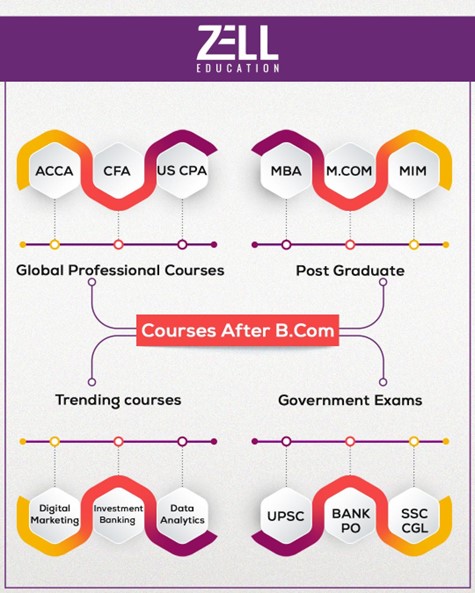
Graduates can choose from career options after B.Com, ranging from Government jobs to Professional courses, Banking, and Finance. There are several career growth possibilities after a B.Com., as well as some very competitive pay for jobs with a B.Com. through various industries, as long as the person holds any required licensing and/or certification for his or her chosen profession.
Comprehensive Summary of Career Options after B.Com:
- Diverse Career Opportunities: The field of business offers many employment opportunities, allowing you multiple choices when it comes to career options in commerce. With a B.Com degree, individuals can pursue careers in areas such as finance, banking, marketing, human resources, analytics, education and government.
- High-income Job Opportunities: Graduates of a B.Com degree program can choose from many job opportunities in these same areas (finance, data analysis and management). These positions often have a high income potential, as individuals grow in their experience and knowledge.
- Professional Certificates Improve Your Job Prospects Globally: Completing a professional certification, such as CA, ACCA, CFA, CPA, or CMA increases your chances for successful employment globally upon graduating with a B.Com degree.
- Advancement Opportunities After Graduation: B.Com graduates with a master’s degree in business/commerce or finance will have increased access to job opportunities after B.Com and a path toward career advancement.
- Short-Term Courses/Skills Development Programs: After graduating with a B.Com degree, short-term courses introduce individuals to career fields with numerous job openings (i.e. investment banking, digital marketing and risk management) and allow for quicker entry into those career fields.
- Stability Through Government/Hourly Employment: Employment within government organisations/hourly pay in India is typically a very stable career option for individuals who pursue a B.Com degree.
After four years of studying subjects such as Accounting, Marketing, Economics, and Management, many graduates face uncertainty about their job prospects. Today, the demand for new-age roles has expanded career options after B.Com beyond just Banking and Accounting.
Graduated with a B.Com. degree, have career options after B.Com. Employment opportunities often aim for high-salaried positions. Many also consider pursuing professional certifications in various fields.
Here is a summary of the opportunities available to those who complete an undergraduate degree in Commerce (B.Com) in India, along with many other occupations and advancement opportunities offered to graduates with a B.Com, and the many kinds of professional training and part-time employment that are provided.
What is B.Com?
B.Com is one of the most sought-after undergraduate degrees for individuals pursuing careers in finance, accounting, business, economics and/or management in India. This degree provides students with a solid foundation of knowledge in the commerce industry, which includes Taxation, Finance, Auditing, Economics, Business Law, and Management.
- Most individuals who complete a B.Com degree are interested in finding ways to transition to a broader range of careers after they have graduated from college.
- The B.Com will provide an excellent foundation for many different kinds of career options after B.Com and opportunities for further education.
- The B.Com will open up many professional opportunities for students who are looking for careers in various fields, such as information technology and government sector,s and for those who will pursue advanced degrees.
What to Do After a B.Com Degree?
Upon obtaining a Bachelor of Commerce (B.Com), many graduates are uncertain regarding the next step in their professional lives. Fortunately, there are many viable options available to B.Com holders, and students can pursue careers based on personal preferences, abilities, and ultimate aspirations.
Career Options After a B.Com Degree:
- Direct private-sector employment and salaried positions
- Assessment and certification
- Postgraduate education (M.Com and MBA)
- Short-term experiential training opportunities
- Entrepreneurship and freelancing activities
- Government employment and salaried positions in comparison to private-sector roles
Top Career Options After B.Com in 2026
After completing their Bachelor of Commerce (B.Com), students from the commerce stream have numerous options for careers. There are many finance, management, analytics, and creative business-related options to be pursued after a B.Com, and there will be many job opportunities after B.Com immediately after graduating with a B.Com, as well as long-term career advancement opportunities in these areas.
1. Finance
Finance has always been one of the top choices for students studying commerce. There is great demand for people in finance, and they earn very good salaries, and there are also global career opportunities. Graduates with a B.Com degree may find jobs in corporate finance, investment banking, financial planning and analysis, auditing, and risk management.
| Responsibilities and Duties | Managing the financial performance of companies via operating and capital budgets; preparation of financial statements; investment analysis and portfolio management; revenue forecasting and control; and financial risk management. |
| Education Qualifications | A graduate degree, such as a B.Com or MBA (finance), CA (chartered accountant), CFA (chartered financial analyst), CPA (certified public accountant), or ACCA (Association of Chartered Certified Accountants). |
| Skills Needed | Financial analysis, accounting, Excel, data interpretation, and analytical skills. |
| Potential Career Exposure | Highest potential in corporations, banks, investment firms, and consulting firms. |
| Companies Hiring | Deloitte, Ernst & Young (EY)
KPMG PricewaterhouseCoopers (PwC) HDFC Bank ICICI Bank J.P. Morgan Chase |
2. Fashion
Fashion is an innovative and creative career path for graduates of B.Com interested in the branding and retail business area. The roles of commerce graduates are primarily back-office support within the fashion industry.
| Responsibilities and Duties | Managing merchandising, retail operations, brand strategy, vendor coordination, and sales planning. |
| Education Qualifications | The education required for a career in fashion includes a B.Com degree along with certification in fashion management, retail management, or luxury brand management. |
| Skills Needed | Some key skills required to enter into a fashion merchandising and retail career are creativity, written and verbal communication skills, trend analysis, and inventory management. |
| Potential Career Exposure | The growth of e-commerce, D2C brands, and large global fashion brands is creating many opportunities in the fashion merchandising and retail sector. |
| Companies Hiring | Myntra
Reliance Retail Aditya Birla Fashion and Lifestyle. |
3. Law
The corporate law industry is growing rapidly in demand for qualified lawyers and therefore, has been able to offer a large number of job opportunities after B.Com for those pursuing a career in this area. Companies hiring in this field include Corporate Law Firms and other Multi-national Companies, Consulting Firms, and Corporate Legal Departments.
| Responsibilities and Duties | Handling corporate law matters, taxation law, contracts, compliance, and legal advisory services. |
| Education Qualifications | Education requirements for corporate law include obtaining an LLB degree three years after completing a B.Com. |
| Skills Needed | Some key skills needed to become successful in corporate law include researching and drafting documents for legal solutions and being able to communicate effectively. |
| Potential Career Exposure | Strong demand in corporate law firms and multinational companies. |
| Companies Hiring | Law firms, corporate legal departments, consulting firms |
4. Banking
Banking is another solid, stable career path for a B.Com graduate. Banking provides individuals with a steady income and typically a salary-based job; however, some individuals may choose to begin their career in banking by taking on more specialized positions. Typical job roles in the banking sector include Customer Account Management, Loan/Investment Opportunity Provision, Risk Assessment, and Banking Operations Management.
| Responsibilities and Duties | Managing customer accounts, loans, investments, risk assessment, and banking operations. |
| Education Qualifications | To be successful in this field, a B.Com degree, coupled with a Master of Business Administration (MBA) degree with an emphasis in Banking and Finance, and various banking certifications, is required. |
| Skills Needed | To succeed in this career, an individual must have a combination of numerical aptitude, customer service experience, and financial knowledge. |
| Potential Career Exposure | Career opportunities in both public and private banks continue to grow steadily, thereby providing job stability to professionals in this field. |
| Companies Hiring | SBI
HDFC Bank ICICI Bank Axis Bank Yes Bank. |
5. Insurance
There are plenty of opportunities available to a B.Com graduate in the insurance sector. Due to the number of available careers within the insurance field, B.Com graduates can find employment in an area that fits their individual career preferences. Individuals who fit a “risk taker” career profile tend to have the best chance of finding rewarding employment in the insurance industry, as insurance professionals work with the following types of areas: Policy Management, Underwriting, Claims Processing, and Risk Assessment.
| Responsibilities and Duties | Policy management, underwriting, claims processing, and risk assessment. |
| Education Qualifications | To be successful in this career, one must have a B.Com degree with added insurance or actuarial certifications. |
| Skills Needed | Successful individuals will possess the ability to analyse risk, communicate effectively, and sell products. |
| Potential Career Exposure | As financial literacy increases, the insurance industry will continue to experience steady job growth. |
| Companies Hiring | LIC
HDFC Life ICICI Prudential Max Life. |
6. Education
An undergraduate degree in commerce (specifically B.Com) is the most common way of becoming a professional educator (most commonly through a B.Ed) that many teachers (be they K-12 school teachers, lecturers in college/university, or educational consultants) take. Most people with degrees in Commerce wanting to enter the teaching profession complete their degree in Commerce and then pursue a B.Ed.
| Responsibilities and Duties | Teaching commerce courses, creating course materials, and mentoring students |
| Education Qualifications | Required Qualifications: MCom, BEd, NET/SET |
| Skills Needed | Subject knowledge, Communication Skills, Presentation Skills |
| Potential Career Exposure | Long-term stability and regard as a respected profession |
| Companies Hiring | Schools, Colleges, Universities, Coaching Institutions |
7. Marketing and Sales
Whether you are working for a large multinational company, a new startup, or a digital-only brand, those who work in Marketing and Sales help brands market their products and services, cultivate strong relationships with customers, and grow their company’s revenue.
| Responsibilities and Duties | Promoting the brand, conducting market research, developing digital campaigns, and acquiring customers. |
| Education Qualifications | B.Com, MBA Marketing, Digital Marketing Certifications |
| Skills Needed | Communication Skills, Creativity, Data Analysis, Persuasiveness |
| Potential Career Exposure | High demand and growth opportunities exist for graduates in areas such as FMCG, IT, e-commerce, and startups. |
| Companies Hiring | HUL
Amazon Flipkart Startups IT Firms |
8. Human Resources (HR)
Human Resources is another promising avenue after B.Com, especially for those who are interested in people management and organisational development. A background in commerce helps students grasp the fundamentals of business operations, labour laws, and employee engagement strategies.
HR professionals are crucial in recruiting talent, training employees, managing workplace culture, and ensuring compliance with corporate policies.
| Responsibilities and Duties | Recruiting staff and ensuring they have training, payroll and monitoring employee performance, ensuring compliance. |
| Education Qualifications | MBA in HR or PG Diploma in HR |
| Skills Needed | Communication skills; Effective people management; Organisational skills |
| Potential Career Exposure | Job opportunities exist in all industries consistently. |
| Companies Hiring | IT Firms
Corporates Consulting Firms |
9. Entrepreneurship Opportunities
For B.Com graduates with a passion for innovation and leadership, entrepreneurship presents an inspiring career path. The course equips students with knowledge of finance, marketing, management, and business law, all of which are essential for running a successful venture.
| Responsibilities and Duties | Starting and managing businesses, financial planning, operations, and marketing. |
| Education Qualifications | The Educational Qualification required for Entrepreneurship is a B.Com plus either formal Entrepreneur Training or Startup Training. |
| Skills Needed | The Skills and Abilities required for Entrepreneurship are Leadership, decision-making and Risk Management. |
| Potential Career Exposure | Career Growth Potential in Entrepreneurship is Unlimited, and may be expanded through the growth and innovation of a small-to-medium business into an enterprise. |
| Companies Hiring | Companies that May Hire Entrepreneurs after completing a B.Com include Self-Employment, Startups and Family Owned Businesses. |
10. Career Opportunities in Data Analytics & Business Analytics
In the age of big data, B.Com graduates are increasingly finding lucrative careers in data analytics and business analytics. Their understanding of financial principles and business operations gives them an edge in interpreting complex data and providing actionable insights to organisations.
Business analysts and data analysts are vital in helping companies make informed decisions, optimise operations, and stay ahead of market trends.
| Responsibilities and Duties | Analysing business data, preparing dashboards, and supporting strategic decisions. |
| Education Qualifications | The Educational Requirement for Data Analysts is a B.Com plus Certification in Data Analytics or Business Analytics. |
| Skills Needed | The Skills and Abilities required to be a successful Data Analyst are Excel, SQL, Power BI and Data Visualisation, plus Analytical Thinking. |
| Potential Career Exposure | Career Growth Potential in Data Analytics is a Future Ready Career with Global Demand. |
| Companies Hiring | Amazon
Accenture TCS Infosys Deloitte. |
Launch your ACCA journey today before the next batch closes forever?
Avg Salary – Career Options After B.Com
| Career Option | Average Salary (INR per annum) |
| Finance | INR 2.4 LPA and 6 LPA |
| Banking | INR 3–6 LPA |
| Marketing | INR 2 LPA-5 lakh LPA |
| HR | INR 3–6 LPA |
| Data Analytics | INR 3.5 LPA – 8 LPA |
Source for Salary: Ambition Box
Professional Courses After B.Com in 2026
Professional education after completing a Bachelor of Commerce (B.Com) offers students an opportunity to gain specialised expertise, increase their earning potential, and receive an internationally recognized credential. Professional courses impart practical knowledge while teaching students the skills necessary for success in their chosen field through industry engagement and best practices.
1. Chartered Accountant (CA)
The programme of Chartered Accountancy for B.Com students is considered one of the top professional courses and has numerous career opportunities that result in lucrative salaries.
Responsibilities of CAs include providing their clients with accounting, auditing, tax, and financial report preparation for financial statements and corporate compliance through their work as CAs.
The Chartered Accountancy programme is offered through three stages: CA Foundation, CA Intermediate and CA Final. Each stage of the programme is conducted by the Institute of Chartered Accountants in India (ICAI).
The key competencies required for success in the Chartered Accountancy programme are accounting skills, analytical skills, attention to detail and problem-solving skills.
Career opportunities for CAs include the corporate sector, audit companies and independent practitioners. An estimated 4,000 large accounting firms, thousands of large companies, thousands of banks and many consultancies want to hire CAs for their practice.
2. Association of Chartered and Certified Accountants (ACCA)
ACCA is a globally recognised and accepted professional course for B.Com graduates and has global opportunities for employment for its graduates.
Responsibilities of ACCA participants include financial reporting, auditing, tax compliance, advisory and preparation of financial reports for clients.
ACCA certification is awarded by the United Kingdom (UK).
ACCA graduates possess the following competencies: Compliance knowledge, financial reporting skills and analytical thinking.
Career opportunities for ACCA include global employers looking to hire qualified ACCA accountants, particularly multinational and shared services firms.
3. Chartered Financial Analyst (CFA)
The CFA (Chartered Financial Analyst) is a highly regarded and respected qualification in the finance industry, specifically for those who are pursuing careers in investment and finance-related fields.
Responsibilities for the CFA include areas such as investment analysis, portfolio management, equity research, and financial modelling.
Requirements for pursuing the CFA include Levels I, II, and III.
Skills needed to pursue a CFA certification include investment analysis, financial modelling, and critical thinking.
Career opportunities for those holding a CFA are typically higher-paying positions, such as in Investment Banking and Asset Management.
Companies such as Investment Banks, Hedge Funds, and Asset Management Companies frequently hire CFS.
4. Company Secretary (CS)
Company Secretary (CS) refers to a professional qualification that is focused on compliance and corporate governance.
Responsibilities for CS include ensuring that a company complies with applicable laws, maintains proper records, and provides proper governance (through board meetings) and filings.
The qualifications that must be completed to become a CS are the CS Executive and Professional levels offered by the Institute of Company Secretaries of India (ICSI).
Skills required to pursue the CS are business law, compliance, and communication skills.
The career scope of a CS is large, as many companies seek compliance and corporate governance assistance.
The types of companies that seek to hire those with a CS are Corporations (companies), Legal Firms, and Consulting Firms.
5. Certified Public Accountant (CPA)
The CPA is a highly regarded accounting credential throughout the world, especially for people who wish to work in the accounting profession in the United States.
US-based accounting, auditing, taxation, and financial advisory services.
Required Educational Qualifications is CPA – USA-based certification.
Knowledge of US GAAP, auditing skills, and financial reporting skills.
Very high demand for CPAs within multinational corporations and global accounting firms.
The four largest accounting firms (Big 4) and multinational firms.
6. Cost and Management Accountant (CMA)
The sixth most popular option within the profession is the Cost and Management Accountant (CMA). CMA’s focus is on cost control and developing a strategic financial plan to achieve business objectives.
Analysing costs, budgeting, evaluating performance, and maintaining a management accounting system.
Completion of the Intermediate and Final CMA exams in the USA.
Cost control, analytical ability, and management of a business’s financial resources.
Demand for CMA professionals is growing, particularly in manufacturing and corporate finance.
Companies that hire CMAs are Manufacturing firms, Corporations, and consulting firms.
7. Actuarial Science
The seventh most popular option within the profession is actuarial science. Actuarial science is a very specialised and well-paying career option within the commerce field.
Conducting risk assessments and creating insurance models, and performing statistical analysis.
Completion of the Actuarial Exams and Certification.
Advanced proficiency in Mathematics, Statistics, and Analytical Thinking.
Very limited availability of actuarial professionals, yet there is high demand and salaries to be made. Hiring firms for actuaries: Insurers and Consulting Firms.
Avg Salary After Professional Courses After B.Com
| Course | Average Salary (INR) |
| CA | INR 8–9 lakh per annum |
| ACCA | INR 4 lakhs to 10 lakhs per annum |
| CFA | INR 6 lakh to 12 lakh per annum |
| CPA | INR 7–12 lakhs per annum |
| CMA | INR 6–10 lakhs per annum |
Postgraduate Courses After B.Com
For students planning on pursuing postgraduate studies after completing their undergraduate degree in commerce, master’s degree programmes provide an opportunity for students to deepen their knowledge about an area of interest while developing their leadership abilities.
Graduates of these programmes typically gain an understanding of their chosen fields as they continue to work towards building successful careers. Selecting the appropriate programme based on interests and career ambitions can greatly enhance employment prospects after graduation as well as increase earning potential following completion of the B.Com degree.
1. Master of Commerce (M.Com)
Postgraduate students who wish to continue their education in commerce can pursue an M.Com, which is a well-respected and traditional degree in commerce. The role of an M.Com graduate includes advanced study of all aspects of accounting, finance, tax, economics, and research.
To pursue your M.Com, you must have a B.Com or equivalent degree from a university.
In addition to your educational qualifications, you will also need to possess strong analytical skills, a good grasp of accounting concepts, and excellent research abilities.
The career scope for M.Com graduates is in teaching and research, accounting roles, and corporate management positions.
Educational institutions, corporations and research organisations are all potential employers for an M.Com graduate.
2. Master of Business Administration (MBA)
By taking an MBA, you will develop the skills to perform well in key positions such as business manager, Chief Executive Officer (CEO) or Chief Operating Officer (COO), as well as to provide strategic input for companies.
MBA graduates can expect to rise rapidly through the ranks of their employer and thus have the opportunity to earn a substantial salary soon after completing their education.
To enter into an MBA programme, you will need to have completed a B.Com degree and have passed an entrance exam, such as the CAT, MAT, XAT or GMAT.
As an MBA graduate, your employer will be either a Multinational Corporation (MNC), a consulting firm, a bank, or a start-up.
3. MSc Finance / Accounting
There are many B.Com colleges in India that also offer accounting. This programme is designed for those who want to pursue analytical/technical roles in finance.
Financial analysis, financial reporting, investment analysis, and financial risk assessment.
B.Com or any degree with a focus on Finance.
Financial modelling, analytical skills, and numerical proficiency.
The Demand for this profession is High in Corporate Finance and Investment.
Companies that Hire for this Profession: Banks, Investment Firms, Corporations, and Consulting Firms.
4. MSc Data Analytics/Business Analytics
This is one of the most complementary and Expanding Professions After the B.Com programme, as well as the highest-paying option for a postgraduate degree.
Data Analysis, Producing Business Intelligence, Creating Dashboards, and Supporting Decision-Making.
B.Com with a background in basic mathematics/statistics.
Data Analysis, Excel/SQL/Power BI, and Critical Thinking.
This is an excellent career path for the future, with companies in almost all areas around the world showing a need for this career path.
Companies that Hire for these Careers: Amazon, Accenture, Deloitte, TCS, Infosys.
Avg Salary After Postgraduate Courses After B.Com
| PG Course | Average Salary |
| M.Com | INR 4 LPA to 12 LPA |
| MBA | INR 7 LPA to 20 LPA |
| MSc Finance | INR 10 LPA |
| MSc Analytics | INR 8 LPA to 15 LPA |
Short-Term Courses After B.Com
B.Com graduates who want to apply for jobs right away or want to gain industry-relevant skills without having to take long-term study programmes will greatly benefit from taking these short-term courses. Short-term courses range in length between three months and one year and emphasise hands-on skill-based learning to enhance a student’s chances of finding work and effectively enhancing earnings over time.
1. Digital Marketing Course
A digital marketing course allows students to prepare for online marketing-related jobs, including SEO specialists, social media managers, performance marketers, and content strategists. This field is one of the fastest-growing career sectors, especially for those completing their B.Com.
Prerequisites: Graduate with a degree in commerce or a related field.
Skills: SEO, Social Media Marketing, Google Ads, Content Marketing, Analytics.
Opportunities: Digital Marketing Manager, SEO Executive, PPC Specialist, Content Strategist.
Employers: Google Partnerships, Digital Agencies, Start-Ups, E-Commerce, and Multi-National Corporations.
2. Data Analytics Course
The Data Analytics course provides focused training on business data assessment and analysis to yield useful information. Students pursuing a Commerce degree may find this to be a very solid alternative to current labour options in Commerce, as more and more organisations demand solutions using data for informed business decisions.
Prerequisites: B.Com Degree or Equivalent.
Skills: Excel, SQL, Python, Data Visualisation, Analytical Thinking.
Opportunities: Data Analyst, Business Analyst, Reporting Analyst.
Employers: IT Firms, Consulting Firms, Banks, and Analytic Start-ups.
3. Financial Modeling Course
A Financial Modeling Certification will teach busy professionals how to analyse their Financials using different methods as they relate to Investment Banking, Corporate Finance, and Valuation. A Certificate in Financial Modeling will allow you to apply all these areas of expertise in your day-to-day work.
Educational Requirements: B.Com Degree or Similar to B.Com
Skills Necessary: Excel, Financial Modelling, Technical Accounting, Economic Reporting, Report Generation, Accounting Basics
Career Opportunities: Financial Models, Business Development Analyst, Corporate Finance Manager
Companies that Hire for Financial Models: Major Investment Banks, Consulting Firms, and Financial Departments of Corporations.
4. Course in Tally with GST
This Course is the Best Option for New Graduates Looking for Entry-level Accounting Positions. This course will help you develop Practical Practical Accounting Skills and Knowledge of the GST.
Educational Requirements: B.Com Degree with Basic Accounting Skills
Skills Necessary: Practical Accounting, GST Preparation and Filing Skills, Experience and Understanding of Tally Software, Accounting Techniques
Career Opportunities: Accountant/accounting Assistant, Accounts4000 Assistant, GST Accountant/Assistant
Companies that Hire for Tally with GST Courses: Many Small/Medium-Sized Accounting Firms, Corporate Accounting Firms, Medium- to Large-Sized Corporate Businesses, and Corporate Accounting Firms.
5. Banking and Finance Certification
These short-duration qualifications offer the necessary education in Banking and Finance. Additionally, they provide a basic understanding of how banks function and what types of financial products are available, as well as what regulations affect those products and banks alike.
Minimum Qualification: Graduation in Commerce (B.Com)
Essential Qualifications: Communication Skills, Analytical Skills, and Financial Knowledge.
Potential job prospects: Bank Executives, Relationship Managers or Associates working within Financial Services.
Organisations may include: Private Sector Banks, Non-Banking Finance Companies (NBFCs), Financial Institutions and Fintech companies.
Why Take Short Term Courses after the Completion of your B.Com?
Short Term Courses after completing your B.Com can assist students to:
Develop employable skills in a shorter time frame, increasing their chance of obtaining employment at an optimal starting salary.
Investigate various career paths in Banking/Finance prior to making a long-term decision.
Transition into the areas of growing demand with the least amount of time spent, allowing for quicker career advancement.
Students who wish to gain immediate results from further study, enhanced skills and practical experience are ideal candidates for Short Term Courses.
Avg Salary After Short-Term Courses After B.Com
| Short-Term Course After B.Com | Average Salary (INR per year) |
| Financial Modeling Course | INR 4–8 LPA |
| Digital Marketing Course | INR 3 Lakhs to 8 LPA |
| Business Analytics Course | INR 6–12 LPA |
| Tally & GST Certification | INR 3 LPA to 5 LPA |
| Data Analytics Course | INR 3.5–6.5 LPA |
These short-term courses after B.Com help students enter the job market quickly. Salaries increase with skills, certifications, and experience.
Government Jobs After B.Com
Many government job opportunities after B.Com are there for graduates. Government positions typically have high levels of job security and fixed salaries and promote career advancement.
Bank Probationary Officers (POs) and Clerks: POs and Clerks are selected from candidates who complete SBI and IBPS examinations. POs complete financial transactions and interact with bank customers.
SSC CGL Officer: The SSC CGL examination is the avenue through which candidates might obtain employment with the Income Tax department and the Customs and Excise departments.
Union Public Service Commission Civil Services: The Union Public Service Commission (UPSC) Civil Services examination leads to IAS, IPS and IRS positions, which are ideally suited for employment in Leadership and Administrative positions.
Railway Jobs (RRB examinations): Railway jobs provide a way for accounting and clerical professionals to be employed.
State Government Jobs: State PSC examinations lead to such job opportunities as auditors, tax assistants and finance officers.
Avg Salary After Government Jobs After B.Com
| Government Job Role | Average Salary (INR per month) |
| Bank PO | INR 74,000 to 78,000 |
| SSC CGL Officer | INR 65,000 to 80,000+ |
| UPSC Officer | INR 75,000 to 85,000+ |
| Railway Accounts Officer | INR 70,000–80,000+ |
| State Government Officer | INR 35,000 to 60,000 (varies) |
Government jobs after B.Com and salary also provide pensions, allowances, and long-term benefits.
Part-Time Jobs & Internships for B.Com Students
Part-time employment for BCom graduates is an excellent source of exposure while generating income for students. Internships will help graduates increase their employability and gain experience through their academic courses.
Common Part-Time B.Com Career Options for Graduates are:
Accounting Interns
Finance Analyst Intern
Digital Marketing Executive Intern
Data Entry and Management Information Systems (MIS) Executive Intern
Online Tutoring & Freelancing
These types of part-time jobs will provide BCom graduates with valuable finance, accounting, and business-related experience.
Tips to Maximise Your Career Success After B.Com
Select your appropriate career path after obtaining your B.Com.
Develop your practical skills by obtaining certifications.
Gain work experience through internships.
Keep abreast of current developments within your chosen industry.
Elevate your current level of communication and analytical ability.
You can use the above steps to help boost your earning potential and advance your career after completing your degree program.
Don’t miss your ACCA breakthrough; seats are filling fast in premium batches!
Conclusion
There are various opportunities available for making a successful career in various fields, including finance, accounting, management, and the public service sector. Post-B.Com students may consider various forms of training programs or courses, as well as government employment after graduation. The future B.Com career options in the country appears to be bright due to the persistence of demand for B.Com professionals with appropriate training and skill sets.
FAQs on Career Options After B.com
What are the career options after B.Com?
The following are some of the career options in commerce available to students graduating with a Bachelor of Commerce (B.Com): Financial roles (such as an investment banker, financial analyst, and chartered accountant) offer the highest salaries for graduates of B.Com programs.
Which B.Com job has the highest salary?
The future for B.Com graduates is strong, as the number of jobs after B.com available continues to grow not only in finance, but also in other fields such as analytics and other types of business roles.
Does B.Com have a future?
In 2026, demand will continue to rise for B.Com graduates in finance, banking, and corporate jobs; therefore, B.Com graduates should have good opportunities for further specialisation and advancement within their respective fields.
Is B.Com worth it in 2026?
Yes, B.Com is worth it in 2026 due to the rising demand for commerce graduates in finance, banking, and corporate jobs. Career opportunities after B.Com continue to grow with specialisation.
Which is better, B.Com or M.Com?
B.Com is ideal for entry-level roles after B.Com, while M.Com offers deeper specialisation and higher B.Com salary potential. The better choice depends on your career goals.
Is B.Com in demand in India?
Yes, B.Com is in high demand in India due to career opportunities after B.Com needs in banking, finance, accounting, and government jobs after B.Com. Commerce graduates are widely hired across industries.
What can I do after B.Com?
After B.Com, you can pursue jobs, professional courses like CA or ACCA, postgraduate degrees, or short-term certifications. These options improve b com salary and long-term career growth.

Current Role
Co-Founder & CEO at Zell Education
Education
- ACCA – Association of Chartered Certified Accountants, Finance (2011 – 2014)
- Bachelor of Commerce (BCom), Financial Markets from H.R. College Of Commerce & Economics (2010 – 2013)
Location
Mumbai, India
Expertise
ACCA Certified
Why Zell?
- • Largest Provider for Global F&A Courses
- • 4.6 Google Review Rating
- • 1000+ Students placed Annually
- • 500+ Active Hiring Partners
- • Placement Opportunities at the Big 4
- • 100+ Global & Indian Rank Holders
- • 100+ Faculty Network
Speak to A Career Counselor
Zell's 10th Anniversary Offer - Avail a 10% Scholarship