
Key Takeaways:
- By developing an organised CFA Level 1 exam schedule, if that is what you’re considering pursuing, it can increase your odds of earning your CFA charter.
- The more practice questions and mock exams that candidates review, coupled with the use of official CFA Institute study material, will assist the candidates with their general CFA exam prep.
- To stay motivated, students must recognise what a CFA actually is and familiarise themselves with the complete CFA exam certification procedure.
Comprehensive Summary on CFA Level 1 Study Plan:
- What is the CFA Level 1 Study Plan?
This will tell you how much time to allocate for your CFA exam preparation for a six-month study duration (estimated 300-350 hours). It is an essential part of adequately preparing for the exam and absorbing the CFA exam material.
- What is the CFA Level 1 Exam Format?
This section will equip you with knowledge of what the CFA Level 1 exam looks like. There are a total of 180 multiple-choice questions divided into two exam sessions to test your basics in the finance and analytics field.
- What is the CFA Level 1 Pass Rate?
Knowing how many candidates clear their CFA Level 1 examination, you will be able to set a realistic expectation for your CFA examination and thus prepare efficiently.
- What are the CFA Topics?
Identify the key CFA topics that carry the heaviest weights in terms of mark allocation, such as Ethics and Financial Statement Analysis, Equity Investments and Fixed Income, among others.
- How to Approach Your CFA Preparation?
Successfully prepare for the CFA exam by always following a study schedule, consistently revisiting previous topics, conducting mock examinations regularly, and utilising reference materials from the CFA Institute.
- Why Pursue a CFA Designation?
Familiarise yourself with what exactly a CFA designation represents and its importance in globally accrediting your knowledge to stay motivated during your preparation.
It can be difficult to know where to begin your preparations for the CFA Level 1 exam once you open up the study materials and see that they look overwhelming. You may open the curriculum, see thousands of pages of information and look at the pass rates and think that you will never make it. You are not alone.
Every year, thousands of people all over the world start the journey to obtain a CFA rating; however, only those with a structured CFA Level 1 preparation plan can stick with their study plan and actually pass the test.
This blog will help you create an efficient roadmap for studying, gain an understanding of the CFA Level 1 Examination format, be able to prioritise your weightage of CFA topics to study and have the greatest chance to pass the CFA Level 1 Examination.
Start Your CFA Preparation the Right Way
 Connect With Us
What is CFA Level 1?
It is essential that you know what is CFA Program is and where Level I fits into that journey before beginning to create your study plan.
The Chartered Financial Analyst designation offered through the CFA Institute is an internationally acknowledged designation for individuals working in investment banking, asset management, equity research, portfolio management, wealth management, and financial analysis.
The CFA Program has three sequential phases:
- CFA Level I
- CFA Level II
- CFA Level III
CFA Level I is about developing your basic level of knowledge through the use of prompts and asset classes, reporting standards and ethics related to creating a portfolio. The examination is based on your ability to recall information and understand the concepts, rather than applying or utilising those concepts.
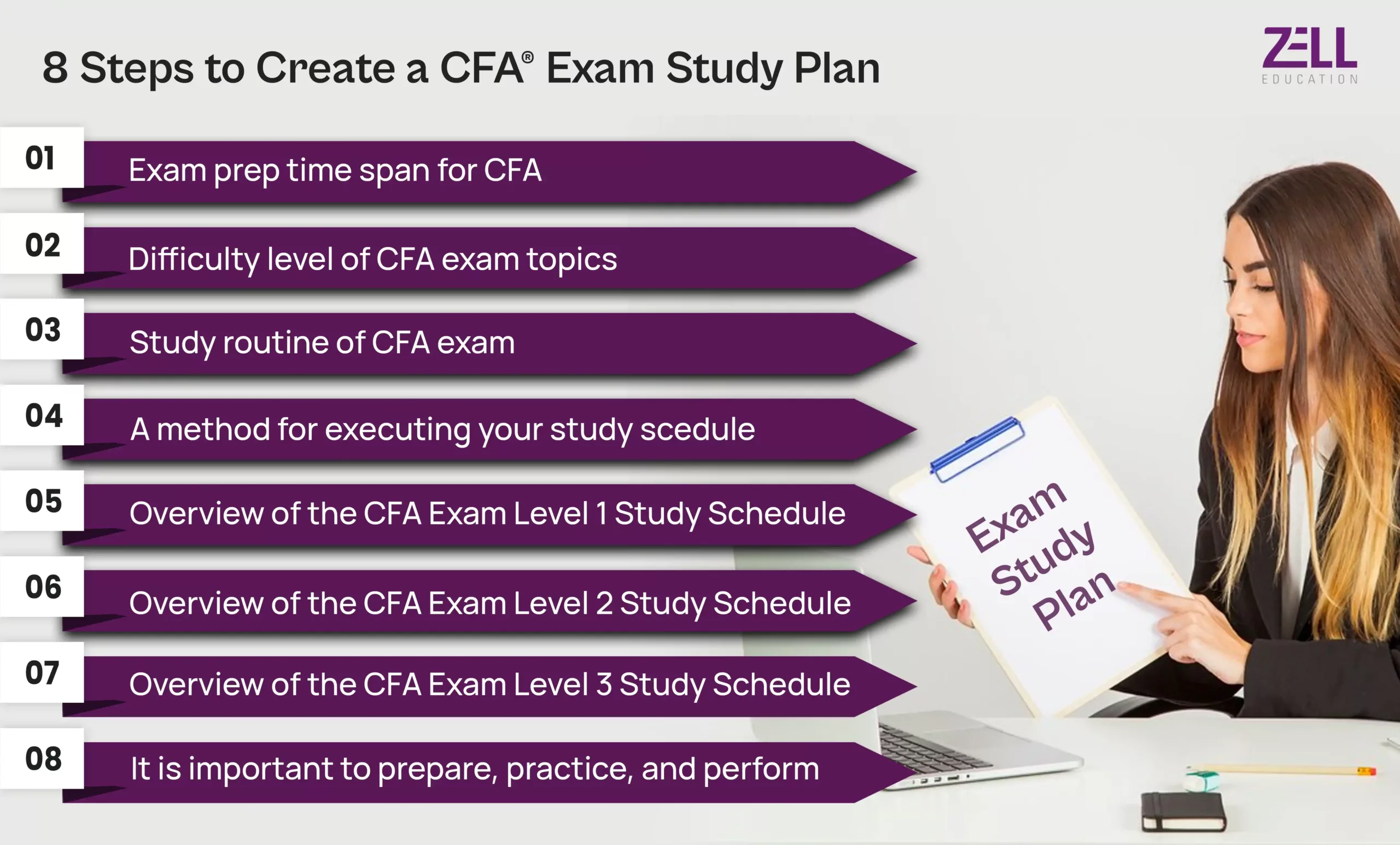
CFA Level 1 Exam Format & Structure
Understanding the CFA Level 1 exam format is the first step in effective CFA preparation.
| Component | Details |
| Exam Mode | Computer-based testing |
| Total Questions | 180 multiple-choice questions |
| Sessions | Two sessions of 90 questions each |
| Question Style | Independent multiple-choice questions |
| Duration | 2 hours and 15 minutes per session |
| Total Exam Time | 4 hours and 30 minutes |
| Number of Answer Choices | Three options per question |
The exam covers ten subject areas and tests both conceptual understanding and problem-solving skills.
CFA Level 1 Pass Rate
Historically, the pass rate for CFA Level 1 ranges from 35% to 45%, therefore requiring good study discipline. According to the most recent statistics from the CFA Institute, the CFA Level 1 pass rate for February 2026 is 45%.
For many, the CFA Level 1 pass rate seems extremely intimidating; nevertheless, with a well-thought-out study program for CFA Level 1, multiple mock tests, and regular revision of valuation principles, the CFA Level 1 exam is surely passable.
Ready to Earn Your CFA Certification?
 Connect With Us
How Many Hours to Study for CFA Level 1?
One of the first things people ask after registering for the CFA Level 1 exam is, “How much time do I need to study?” The CFA Institute suggests you need roughly 300 hours of study time for this level.
Depending on your previous experience and how comfortable you are with financial terms, however, this number will certainly vary. On average, successful CFA Level 1 candidates typically report study times of 300 to 400 hours (based on feedback on forums by people taking the CFA in recent years), while one specific survey of pass candidates indicates an average of 350 hours over six months before their exam date.
Study Hours by Preparation Timeline
| Preparation Timeline | Total Hours | Weekly Hours |
| 4 Months | 320–360 hours | 20–22 hours |
| 5 Months | 320–360 hours | 15–18 hours |
| 6 Months | 300–350 hours | 12–15 hours |
| 8 Months | 300–350 hours | 9–11 hours |
Working Professionals vs. Full-Time Students
Create a weekly schedule based on your lifestyle:
Work Professionals studying
- 1.5-2 hours of study on weekdays
- 4-5 hours during weekends
- Be consistent, not long sessions
Full-time Students
- 3-4 hours studying each day.
- Gradually increase study sessions.
- Finish curriculum early to give yourself more time for revision.
How to Prepare for CFA Level 1
More than just reading the curriculum will create a successful CFA study approach.
Familiarise Yourself With The Exam Preparation Time Frame
You must begin your study efforts at least six months prior to the exam date to have adequate time to plan for unexpected work responsibilities and avoid being overwhelmed as a result of having too few days to study.
Your study efforts should be broken down into three phases:
- Learning the material
- Answering the questions on the test
- Reviewing and completing the exam simulation
Evaluate the Difficulty of CFA Topics
CFA topics vary significantly in effort needed.
For many candidates, the following areas will be considered the most difficult:
- Analysis of Financial Statements
- Fixed Income
- Quantitative Analysis
- Options
Evaluate your strengths and weaknesses early in your studies so you can spend additional time on difficult topics.
Plan a Consistent Study Schedule
Consistency is better for succeeding than intensity.
Instead of studying 10 hours every weekend only, try smaller study sessions spread over the week. Two hours of study each day frequently yield superior results compared to erratic periods of study.
Regularly scheduled review periods will assist with retention and improve your understanding of the material.
Utilize the Proper Study Tools and Resources
A well-rounded CFA study plan should include numerous types of materials, such as:
- CFA Institute official curriculum
- Questions on the Learning Ecosystem
- Formula sheets
- Video presentations
- Practice tests
- Flashcards
- Study groups
Select materials that appeal to your learning style while avoiding too many overwhelming information options.
CFA Level 1 Topics & Weightage
Understanding the relative importance of each subject can help you prioritise your study efforts.
| CFA Topics | Approximate Weightage |
| Ethical and Professional Standards | 15–20% |
| Quantitative Methods | 6–9% |
| Economics | 6–9% |
| Financial Statement Analysis | 11–14% |
| Corporate Issuers | 6–9% |
| Alternative Investments | 7–10% |
| Equity Investments | 11–14% |
| Fixed Income | 11–14% |
| Derivatives | 5–8% |
| Portfolio Management | 8–12% |
High-Weightage Topics to Prioritize
Put particular focus on:
- Ethics
- Financial Statement Analysis
- Equities
- Fixed Income
- Portfolio Management
These topics together have a major contribution to the total number of questions on this exam.
Most Effective Order of Study for CFA Level 1 Topics
The best way to learn any subject area is to follow a logical sequence of developing knowledge. Much of the subject matter builds upon itself, so the order of the topics is important.
Appropriate Study Sequence:
- Quantitative Methods
- Economics
- Financial Statement Analysis
- Issuers of Common Stock
- Equity Securities
- Fixed Income
- Derivative Securities
- Alternative Investment
- Portfolio Management
- Ethics
Although you will study Ethics continuously during your entire exam preparation, use part of the last month before the exam to review it.
How Do I Prepare for Ethics for CFA Level 1?
Ethics has the largest group of total exam questions and therefore has the largest impact on those who are on the borderline for passing.
You can be prepared for Ethics by doing the following:
- Read all the statements from beginning to end
- Understand the rationale for each rule
- Practice the ethical dilemmas as you would if you were an actual court case
- Review Ethics multiple times before the CFA exam.
CFA Level 1 Study Plan: 6-Month Schedule
A 6-month approach to CFA Level II study offers enough time to comprehend, review, and perform practice examinations of all types of material.
Month 1 and Month 2 will focus on quantitative analysis and economic theory for 50-60 hours while emphasising:
- Time value of money
- Probability
- Hypothesis testing
- Macroeconomics
- Microeconomics
After reading all Quantitative and Economic material, complete as many practice problems as possible for the respective chapters.
Month 2 and Month 3 will focus on Fundamental Analysis for 45-55 hours while emphasising the following:
- Financial statements
- Revenue recognition
- Inventory methods
- Ratio analysis
This is one of the most complex areas, and you should spend the majority of your time learning this section.
Month 3 and Month 4 will focus on Corporate Issuers and Equity Securities for 45-50 hours while emphasising the following:
- Corporate governance
- Capital budgeting
- Equity markets
- Industry analysis
Month 4 will focus on Fixed Income, Derivatives, and Alternative Investments for 45-50 hours while emphasising the following:
- Bond pricing
- Duration
- Derivatives
- Alternative Assets
Month 5 will focus on Ethics, Portfolio Management, and First Full-length Mock Exam for 45-50 hours while emphasising the following:
- Portfolio risk/return
- Diversification
- Ethics (review all ethical terms and concepts).
At the end of month 5, you will take your first full-length mock exam.
Month 6 will focus on Final Review and Full-length Mock exams for 50-60 hours, while focusing on:
- Review all the formulas.
- Identify your weak areas
- Complete practice problems related to ethics
Do not attempt to learn any new material during month 6.
Weekly CFA Level 1 Study Timetable
A weekly schedule helps transform your study plan into daily action.
Sample Weekly Study Schedule
| Day | Study Hours | Activity |
| Monday | 2 hours | New concepts |
| Tuesday | 2 hours | Practice questions |
| Wednesday | 2 hours | New concepts |
| Thursday | 2 hours | Topic review |
| Friday | 1.5 hours | Formula revision |
| Saturday | 4 hours | Intensive study |
| Sunday | 4 hours | Practice questions and review |
How Many Hours Per Day for CFA Level 1?
The majority of candidates should be trying to do the following:
- On Weekdays: 1.5 to 2 hours
- On Weekends: 4 to 5 hours
This will allow you to achieve the desired total study hours of 300-350 over a period of 6 months.
How To Execute Your CFA Study Plan: Three-Process Approach
A well-designed study plan for CFA Level One will follow a well-structured process.
Process Step One: Preparation—First Read And Notes
Your focus should be on achieving a high level of understanding of concepts, as opposed to simply memorising them.
- Read through the curriculum
- Create Concisely Written Notes
- Create Formula Sheets
Process Step Two: Practice—Chapter-end Questions And Problem Function
After you have completed one complete topic:
- Complete end-of-chapter questions.
- Review Your Mistakes.
- Track Weaknesses In Each Topic.
- Process Step Three: Performance—Mock Exams And Simulation
Complete mock exams with timed conditions.
Focus on:
- Managing Time Effectively
- Testing Your Accuracy
- Testing Your Exam Stamina
Mock Exam Strategy For The CFA Level One Exam
Mock examinations are one of the best predictors of your success.
How Many Mock Exams Should You Complete?
Complete at least four to six full mock exams prior to exam day.
Many successful candidates report scoring above 65-70% on mock exams and successfully passing their actual exam.
How to Analyse Mock Exam Results
After every mock exam:
- Identify weak areas of content
- Review incorrect questions
- Identify repetition of mistakes
- Revisit readings that relate to the identified topic(s) above
End Result: Focus on improving those areas where you did poorly and do not repeatedly work on trying to master things you already know.
Revision Plan for Last Month
Complete the following over the last four weeks (final month):
- Complete 1 – 2 Mock Exams per week
- Daily Review of Formulas
- Thoroughly Revise Ethics
Review High-Weightage Content
The last week should be used for light revision with a good amount of rest.
How To Stick To Your CFA Study Plan
Creating a plan is easy – The difficulty lies in consistently following the established plan!
Never Skip Subjects Regardless of Weightage
Do not skip low-weight materials. The exam format for CFA Level I tests all material in the entire curriculum, regardless of weightage.
Common Mistakes to Avoid While Preparing
During your preparation for the CFA exam, there are typically a few common mistakes you will want to avoid. These form the foundation of successful preparation and have the potential of being detrimental to your overall performance on the exam.
- Late preparation.
- Not complying with professional ethical standards.
- Insufficient practice testing.
- Memorising without fully understanding the content.
- Not reviewing previously learned concepts.
How to Stay Motivated During CFA Prep
Here are a few tips that may keep you on track to pass the CFA exam, with more encouragement on the way, so keep up the motivation for your CFA study journey:
- Follow your weekly CFA exam preparation progress.
- Celebrate each week that brings a small win.
- Create or join study groups with classmates for additional support.
- Frequently consider your goals and ultimate purpose of obtaining your CFA designation.
CFA Exam Study Schedule Overview: All 3 Levels
This document provides a CFA L1 study guide based on the time commitment necessary to be prepared for the CFA exam, including the length of time needed to prepare and how much total time that should take.
CFA L1 Study Schedule Summary
- 300-350 hours of study required
- 6 months to complete the CFA L1 study schedule.
CFA L2 Study Schedule Summary
- 350-400 hours of study required
- 6-8 months to complete the CFA L2 study schedule.
- CFA L2 includes an application and includes setting questions for item sets.
CFA L3 Study Schedule Summary
- 350-400 hours of study required.
- 6-8 months to complete the CFA L3 study schedule.
- CFA L3 focuses on Portfolio Management, and includes essay-style responses.
Conclusion
Your road to obtaining your CFA certification begins with a structured CFA L1 study plan. Plan ahead by starting early with a target of at least 300 hours of dedicated study, focus on high-weight topics, practise on a regular basis, and perform multiple mock examinations. Success for candidates is not necessarily due to intelligence but by maintaining a continuous pattern of effort.
Your plan must be built on trust and an adequate number of small steps in order to reach your destination of CFA charterholder.
FAQs on CFA Level 1 Study Plan
What does it take to prepare properly for the CFA Level I exam?
Most people spend between 300 and 350 hours studying over a period of 5 – 6 months.
How long will I need to prepare for CFA L1?
Most people who pass CFA L1 do so within 6 months if they adhere to a structured study schedule (12 – 15 hours per week).
Which level of the CFA exam will be the most difficult to pass?
For a majority of candidates, CFA Level II is the most difficult – because there is more emphasis on the application and analysis of concepts – but the best pass rates for any level of the CFA exams reflect that passing the CFA Level I exam may still be quite difficult.
What are the best materials to review for the CFA Level I exam?
The books you will be reading on CFA Level 1, of course, will be the CFA Institute text. The CFA Level 1 materials are broken down into the following areas: quantitative methods, economics, financial analysis, corporate issuers, and equity investments.
How long does it take to study for the CFA exam?
1.5 to 2 hrs. The week of it: you usually study for four or five hours at the weekend or a 1.5- or two-hour duration on weekdays.
Do I need a tutor for CFA Level I?
No, not necessarily: At first sight, it is possible for somebody to study for and for somebody to pass the CFA Level One exam all on their own without any need to take supplemental lessons for their study course.

Current Role
Co-Founder & CEO at Zell Education
Education
- ACCA – Association of Chartered Certified Accountants, Finance (2011 – 2014)
- Bachelor of Commerce (BCom), Financial Markets from H.R. College Of Commerce & Economics (2010 – 2013)
Location
Mumbai, India
Expertise
ACCA Certified
Why Zell?
- • Largest Provider for Global F&A Courses
- • 4.6 Google Review Rating
- • 1000+ Students placed Annually
- • 500+ Active Hiring Partners
- • Placement Opportunities at the Big 4
- • 100+ Global & Indian Rank Holders
- • 100+ Faculty Network
Speak to A Career Counselor
Zell's 10th Anniversary Offer - Avail a 10% Scholarship