
What does it actually take to prepare for the CFA exam without wasting months on the wrong approach? CFA preparation succeeds or fails on a handful of decisions made early, checking eligibility correctly, understanding the exact exam format at your level, building a realistic study schedule, and choosing materials that match how the exam is actually structured. This guide walks through all eight of those decisions in order, from registration through exam day, so nothing gets left to guesswork.
Key Takeaways
- What is the single most important factor in successful CFA preparation? Matching your study plan and materials to the exact exam format at your level, since Level 1, Level 2, and Level 3 test very differently from each other.
- How many hours does CFA preparation actually require? CFA Institute recommends around 300 hours per level, though most candidates who study part-time need closer to 350-400 hours to feel genuinely ready.
- Can CFA preparation work alongside a full-time job? Yes, with a structured 5-6 month schedule built around consistent weekly study blocks rather than occasional long sessions.
Comprehensive Summary on CFA Preparation
CFA Preparation
CFA preparation is the structured process of meeting eligibility requirements, studying the curriculum, and practising exam-style questions across the three levels of the CFA Program.
How to Study and Prepare for CFA
Confirm eligibility, know your exam format, build a realistic study schedule, and back it with active reading and mock exams well before test day.
CFA Guide
This CFA guide covers all eight steps of preparation, from registration and exam format through study planning, materials, revision, and exam day itself.
How to Take CFA
How to take the CFA exam involves registering through CFA Institute, scheduling a computer-based testing slot, and arriving prepared with valid ID and an approved calculator.
Get a quick check on whether your degree and experience qualify you for Level 1.
 Check Your Eligibility
What Is the CFA Exam and Why Does It Matter?
The CFA (Chartered Financial Analyst) exam is a three-level, globally recognised qualification administered by CFA Institute, covering investment analysis, portfolio management, and ethics in progressively greater depth at each level. Passing all three levels, alongside meeting the work experience requirement, earns the CFA charter, one of the most respected credentials in investment management, equity research, and portfolio management roles worldwide. Anyone still working out what is CFA at a foundational level should settle that first, since the answer shapes how seriously to approach the preparation timeline ahead.
Step 1: Check Your Eligibility Before You Register
Confirming eligibility before registering avoids the frustration of preparing for months only to discover a technicality blocks your registration.
Educational Qualifications Required for CFA Level 1
Candidates need a bachelor’s degree, or to be in the final year of a bachelor’s programme, to register for Level 1. Those without a completed degree can also qualify through a combination of work experience and education totalling four years, calculated using CFA Institute’s own criteria.
Someone who left college early to start working, or who studied through a non-traditional route, isn’t automatically shut out here. The four-year combined path exists specifically for that situation.
Work Experience Requirement for CFA Charterholders (4,000 Hours)
Passing all three exams doesn’t hand you the charter on its own. You still need 4,000 hours of relevant work experience, spread across a minimum of three years, before CFA Institute will actually award it.
- The hours can come before, during, or after the exams, there’s no fixed order
- CFA Institute defines “relevant” broadly, investment decision-making counts, but so does supervising people who make investment decisions, or teaching investment-related subjects
- Plenty of candidates start racking up these hours while still stuck on Level 1 or Level 2
- That often means the three-year clock is already ticking well before the final exam is even attempted
How to Register for the CFA Exam: A Quick Walkthrough
Registration happens through the CFA Institute website directly. It’s mostly paperwork, not anything genuinely complicated:
- Create a CFA Institute candidate account and confirm you’re actually eligible for the level you’re targeting
- Pick your exam window from whatever dates are open for that level
- Pay the registration fee, note that CFA Institute dropped the separate one-time enrolment fee starting with the February 2026 cycle, so this got a bit cheaper
- Once registration clears, lock in your specific test date and centre
- Get identity verification sorted well before the window closes, not the night before
Step 2: Understand the CFA Exam Format for Each Level
Level 1, Level 2, and Level 3 don’t test you the same way. Prepare for one format while expecting another, and you’ll waste real study time finding that out too late.
CFA Level 1: Exam Format, Topics, and Weightings
Level 1 runs 180 multiple-choice questions across two sessions of 135 minutes each. No negative marking, so a guess never costs you anything.
Topic weights have stayed the same for a while now. Ethics sits at 15-20%, the biggest single chunk. Financial Statement Analysis, Equity, and Fixed Income each run 11-14%. Portfolio Management takes 8-12%, and the rest spreads across Quantitative Methods, Economics, Corporate Issuers, and Derivatives.
One thing worth planning around: you now have to finish a Practical Skills Module, Python, Data Science, or Analyst Skills, your choice, before CFA Institute will even release your Level 1 result. It’s not part of the timed exam, but skip it and you’re stuck not knowing if you passed.
CFA Level 2: Item Sets and What Changes at This Stage
Level 2 drops the standalone-question format entirely. Instead you get 88 questions built into 22 item sets, each one a short case or dataset followed by four questions tied directly to it.
This changes how you actually need to study. Recalling a concept in isolation, the way Level 1 tests it, isn’t enough anymore. You need to apply it inside a scenario, which is a different skill and takes different practice. Total time on the clock runs 4 hours 24 minutes, split into two 2-hour-12-minute sessions.
CFA Level 3: Essay Questions, Portfolio Focus, and Key Differences
Level 3 introduces constructed-response, essay-style questions in one session, alongside item sets in the other, testing portfolio construction, wealth planning, and performance measurement. Since 2025, candidates also select one of three Specialised Pathways, Portfolio Management, Private Wealth, or Private Markets, at registration, and pathway-specific content is tested across both sessions. Because essay responses are graded manually by CFA charterholders, Level 3 results typically take longer to release than Level 1 or Level 2.
Approved Calculators: BA II Plus vs HP 12C
CFA Institute permits only two calculator models inside the exam room, the Texas Instruments BA II Plus (including the Professional version) and the HP 12C (including the Platinum edition). The BA II Plus uses standard algebraic entry and tends to suit candidates newer to financial calculators, while the HP 12C runs on Reverse Polish Notation, which some experienced finance professionals already know from prior roles. Either is acceptable, but switching calculators mid-preparation wastes valuable practice time relearning keystrokes, so it’s worth choosing early and sticking with it.
Step 3: Build a Realistic CFA Study Plan
A study plan that doesn’t match real available hours falls apart within the first month, which is why this step deserves more care than most candidates give it.
How Many Hours Do You Actually Need to Study?
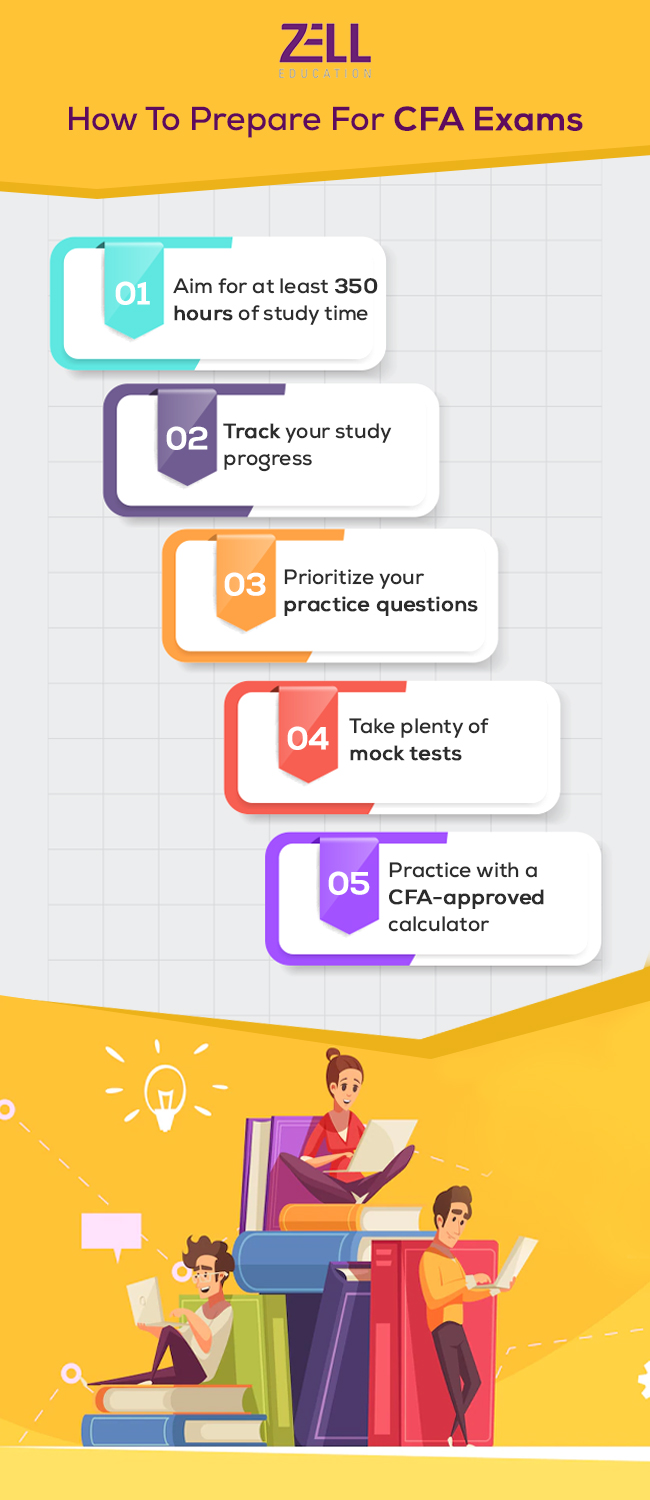
CFA Institute’s own candidate surveys put the average around 300 hours per level, though this figure assumes reasonably efficient study. Most working professionals report needing closer to 350-400 hours to feel genuinely exam-ready, particularly at Level 2, where the item-set format demands more practice repetitions to build speed and accuracy.
How to Create a 6-Month Study Schedule for CFA Level 1
A 6-month runway gives enough room to cover the full curriculum without cramming, and it typically breaks down like this:
- Months 1-3: work through the curriculum topic by topic, completing end-of-reading questions immediately after each section
- Month 4: begin timed practice on individual topics, focusing extra hours on Ethics, FSA, and Portfolio Management given their weight
- Month 5: shift into full-length mock exams, at least one per week, reviewing every wrong answer in detail
- Month 6: focus entirely on weak areas identified from mocks, along with the Practical Skills Module requirement
Adjusting Your Study Plan for Level 2 and Level 3
CFA Level 2 preparation should shift earlier toward item-set practice, since the format itself takes adjustment separate from content mastery. Level 3 preparation needs dedicated time for essay-writing practice, since structuring a clear, gradeable written answer is a skill most candidates haven’t needed since Level 1 and Level 2’s multiple-choice formats.
How to Balance CFA Preparation With a Full-Time Job
Working candidates generally do better with shorter, consistent daily sessions, 1 to 1.5 hours on weekdays, with longer weekend blocks of 3 to 4 hours, rather than trying to cram everything into weekends alone. Protecting at least one full rest day per week also matters more than it seems; burnout by month four is a common reason candidates underperform on exam day despite putting in the hours earlier.
Get a study schedule specifically around your actual weekly hours.
 Book a 1:1 Call
Step 4: Choose the Right CFA Study Materials
Material choice affects both what gets learned and how efficiently it gets learned, making this a genuinely consequential decision.
CFA Institute Official Curriculum vs Third-Party Providers
The official curriculum is the authoritative source and the only material guaranteed to match exam content exactly, but its length and academic tone make it slow going for many candidates. Third-party providers condense the same content, add practice questions, and often explain concepts more directly, which is why most successful candidates use both rather than choosing one exclusively.
Best Study Resources for CFA Preparation
- Official CFA Institute curriculum and end-of-reading questions
- A structured CFA certification prep programme with video lessons and topic-wise practice
- A dedicated question bank for timed, exam-style practice
- CFA Institute’s own mock exams, which most closely match actual exam difficulty and format
How to Use Flashcards, Notes, and Formula Sheets Effectively
Flashcards work best for formulas and Ethics standards that need quick recall rather than deep conceptual understanding. Personal notes, written in your own words rather than copied from the curriculum, force active processing of the material and tend to stick better than passive rereading. A single consolidated formula sheet, built gradually through the study period, becomes genuinely useful for rapid review in the final weeks before the exam.
Step 5: Prioritise High-Weightage Topics Strategically
Treating every topic the same wastes your best study hours on subjects that barely move the score. Effort should follow weight, not personal preference.
Top Topics to Focus on for CFA Level 1
Financial Statement Analysis, Equity, and Fixed Income together make up close to a third of the exam. Get these three solid early and the rest of your prep gets noticeably easier.
Ethics needs real attention too, and not just because it’s worth 15-20%. It’s one of the few topics that shows up consistently across all three levels, so time spent here pays off well beyond Level 1.
High-Priority Areas for CFA Level 2
All topics carry similar individual weight at Level 2 (5-15% each), which means broad coverage matters more than picking favourites, though Financial Reporting and Analysis, Equity Valuation, and Fixed Income still tend to appear across the most item sets.
What to Focus on for CFA Level 3
The Core curriculum carries 65-70% of Level 3, with the remaining 30-35% coming from the Specialised Pathway chosen at registration, which means mastering the Core material thoroughly should come before deep-diving into pathway-specific content.
Step 6: Practice With Mock Exams and Question Banks
Reading the CFA curriculum tells you what you know in theory. Mock exams tell you what actually happens under a clock, and those two things are rarely the same.
When to Start Taking Mock Exams in Your Study Timeline
Six to eight weeks out is the right point to start, once you’ve genuinely covered most of the curriculum. Start any earlier and you’re just testing gaps you already know exist. Start any later and there’s no time left to fix what the mocks reveal.
How to Analyse Your Mock Exam Performance
Reviewing a mock exam properly means going beyond the overall score to look at performance by topic area, since a candidate can pass overall while carrying a serious gap in one high-weight subject. Wrong answers deserve more attention than right ones, specifically understanding why the wrong option seemed correct in the moment.
The Role of End-of-Reading Questions and LOS-Based Practice
Studying against specific Learning Outcome Statements beats generic question practice, plain and simple, it keeps your effort pointed exactly at what the exam tests instead of what feels relevant.
Do the end-of-reading questions right after you finish that section, not three weeks later when you’re “reviewing.” The material is still fresh, and that’s when it actually sticks.
Step 7: Revise Smartly in the Final 4 Weeks
The final month rewards consolidation far more than new learning, and most candidates who struggle at this stage are still trying to cover fresh material too close to the exam.
The Last-Month Revision Strategy That Works
- Weeks 1-2: complete final mock exams and identify remaining weak topics
- Week 3: focused review of weak topics only, using formula sheets and condensed notes
- Week 4: light review, formula recall, and rest, avoiding new content entirely
What Not to Do in the Final Week Before the Exam
Starting a new topic, pulling all-nighters, or taking a fifth or sixth mock exam in the final week all tend to hurt more than help, since fatigue and last-minute doubt affect performance more than any marginal content gain at this point.
Step 8: Prepare for Exam Day
Logistics mistakes on exam day cost candidates who were otherwise well prepared, which makes this final step worth taking seriously.
What to Carry to the CFA Exam Centre
- A valid, unexpired passport for identity verification, CFA Institute’s required ID document
- Your approved calculator, BA II Plus or HP 12C, pre-cleared of memory
- Exam admission ticket or confirmation, printed or accessible digitally as required
Exam Day Rules, Timings, and What to Expect
Arrive well before your scheduled slot, since late arrival policies at test centres are generally strict. Each level runs across two timed sessions with an optional, unscheduled break in between that doesn’t count against total testing time. Personal items, notes, and phones are not permitted in the testing room itself.
How to Manage Time During the Actual Exam
At Level 1, roughly 90 seconds per question is the rough benchmark, which means moving past a genuinely stuck question and returning later usually beats losing five minutes on one item. At Levels 2 and 3, pacing by item set or question set matters more than pacing by individual question, since each set carries roughly equal weight regardless of how many sub-questions it contains.
Common CFA Preparation Mistakes to Avoid
- Starting preparation too close to the exam date without accounting for the Practical Skills Module or registration deadlines
- Spending too much time on the official curriculum’s dense reading without practising questions early enough
- Ignoring Ethics until the final weeks, despite its consistent weight across all three levels
- Switching study materials or calculators midway through preparation
- Taking too few mock exams, or taking them too late to actually act on the results
What Happens After You Pass Each CFA Level?
After CFA Level 1: Next Steps and Timeline for Level 2
Most candidates register for Level 2 within the next one or two available exam windows, since Level 2 builds directly on Level 1 concepts and momentum matters. Continuing to accumulate the 4,000 hours of relevant work experience during this gap is worth prioritising if it hasn’t started already.
After CFA Level 2: Preparing for the Final Push
Level 3’s shift toward essay questions and portfolio-level thinking means candidates should start practising written responses earlier than they might expect, ideally building this into study plans from day one of Level 3 preparation rather than treating it as a late-stage adjustment.
After CFA Level 3: How to Earn the CFA Charter
Passing Level 3 doesn’t automatically confer the charter; candidates still need to complete the 4,000-hour work experience requirement, submit professional references, and apply for membership through CFA Institute before the charter is formally awarded.
Conclusion
CFA preparation rewards candidates who treat it as a structured process rather than an open-ended amount of reading. Confirming eligibility early, understanding exactly how each level is tested, building a study schedule around real available hours, and taking mock exams seriously enough to act on the results all compound into a meaningfully better outcome than studying hard without structure. The charter itself takes years to complete in full, but each level, approached this way, becomes a manageable project rather than an overwhelming one.
FAQs on CFA Preparation
How many hours should I study for the CFA exam?
CFA Institute’s own data suggests around 300 hours per level, though most working candidates find 350-400 hours gives a more comfortable margin of readiness.
Is CFA preparation possible while working full-time?
Yes, a structured 5-6 month schedule with consistent daily study blocks and longer weekend sessions works well for most full-time professionals.
What is the best time to start preparing for the CFA exam?
Starting 5-6 months before your registered exam window gives enough time to cover the curriculum, practice extensively, and revise without last-minute cramming.
Which CFA level is the hardest?
Level 2 is generally considered the most conceptually demanding due to its breadth and the item-set format, while Level 3 is often called the hardest in terms of the essay-writing skill it requires.
How many attempts are allowed for the CFA exam?
CFA Institute currently allows candidates a limited number of attempts per level within their candidacy; checking the exact current policy directly on the CFA Institute website before registering is worth doing, since attempt limits have changed in past years.
Can I clear CFA Level 1 in 3 months?
It’s possible for candidates who can dedicate 25-30 hours a week consistently, though most people find 5-6 months allows for stronger retention and less exam-day stress.

Current Role
Co-Founder & CEO at Zell Education
Education
- ACCA – Association of Chartered Certified Accountants, Finance (2011 – 2014)
- Bachelor of Commerce (BCom), Financial Markets from H.R. College Of Commerce & Economics (2010 – 2013)
Location
Mumbai, India
Expertise
ACCA Certified
Why Zell?
- • Largest Provider for Global F&A Courses
- • 4.6 Google Review Rating
- • 1000+ Students placed Annually
- • 500+ Active Hiring Partners
- • Placement Opportunities at the Big 4
- • 100+ Global & Indian Rank Holders
- • 100+ Faculty Network
Speak to A Career Counselor
Zell's 10th Anniversary Offer - Avail a 10% Scholarship