
Have you considered how an MBA with ACCA’s focus on finance? The combination will give you a distinctive edge as you are developing your skill set and experience when compared with other candidates for employment.
Comprehensive Summary of ACCA with MBA:
- ACCA-MBA Program: An ACCA-MBA program offers students the opportunity to gain both technical abilities to do accounting work and the leadership qualities needed to succeed in a firm related to making decisions on finance globally.
- ACCA Described: ACCA (the Association of Chartered Certified Accountants) is an international association committed to providing level-1 (international) qualifications for all accountants around the globe.
- Career Development: Professionals who complete both the ACCA and the MBA will have a greater likelihood of being able to move up in multinational corporations (both in terms of finance, consulting and/or management).
- ACCA Salary Benefits: If you hold both the ACCA and the MBA, chances are your salary will significantly increase, as you will have access to high-paying positions in India and other countries.
- ACCA Entry Requirements and Timeframe: An understanding of the entry requirements for the ACCA, as well as the exemption process, will help ACCA aspirants achieve their objectives in a shorter period of time when combining their studies with an MBA.
- Global Acceptance and Value: Holding both the ACCA qualification and the MBA designation will provide you with a solid foundation for future career development opportunities at worldwide organisations, as well as improving your ability to relocate internationally throughout your career.
If you are pursuing a career in Finance or Management, then obtaining your ACCA and MBA will probably be one of your best career decisions. The combination of ACCA and an MBA is powerful because it provides both technical Accounting knowledge and banking and management skills, thereby helping you compete and find employment in today’s global market.
Before we look further at our discussion regarding how to do both at once, let’s take a moment to look at what ACCA is. The ACCA is an internationally recognised professional accountancy association, the Association of Chartered Certified Accountants, which provides the ACCA Qualification for Financial and Accounting Professionals through ACCA Global.
Build a Powerful Finance & Management Career
 Apply for ACCA Today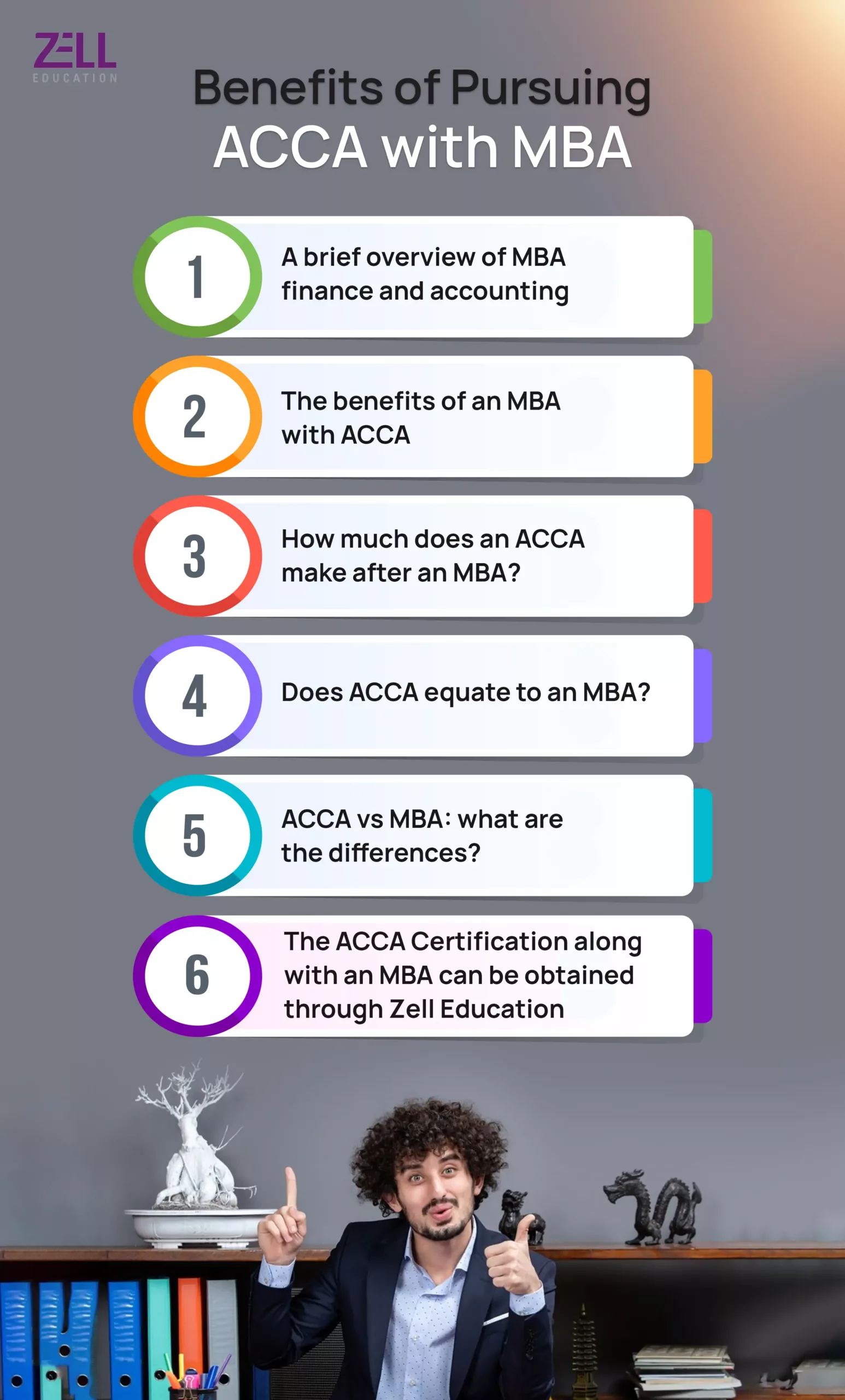
Benefits of an ACCA with MBA
Below are the benefits of an ACCA with an MBA for candidates who are thinking of applying for the same.
1. Enhanced Career Opportunities
The dual expertise gained from an ACCA qualification that gives deep technical knowledge in the areas of accounting and financial management and an MBA that gives business management skills helps the professional to move into a much wider range of leadership roles.
You can be a Chief Financial Officer, Finance Director, or Strategic Consultant. This combination would make a person very attractive for top management positions where both leadership at a strategic level and financial acumen are required.
2. Broader Skill Set
The ACCA focuses on areas requiring accounting principles, financial reporting, and auditing, whereas an MBA looks forward to integrating management strategies, organisational behaviour, and leadership. This would make you fully endowed with the skill set necessary for effective decision-making and business running.
3. Increase in Earning Potential
This additional skill base, because of dual qualifications, can increase the chances of better remuneration packages. Higher salaries are, at times, presented by employers who value the combination of technical knowledge of finances and strategic business acumen that may warrant a higher salary.
4. Global Recognition
Both are globally recognised. With that amount of international recognition, it gives excellent prospects of working in other countries or other multinational organisations. It also builds on their credibility across the finance and management circuit, making them more competitive in the global job market.
5. Strategic and Financial Insight
An MBA with an ACCA enables a professional to provide both the strategic and the financial perspectives when dealing with any professional situation in business. By enhancing their ability to analyse financial data, the student understands business consequences, which guide them in making better, more rational decisions.
6. Networking and Professional Growth
Typically, acquiring either or both credentials exposes you to diverse professional networks of alumni, industry practitioners, and academic professionals. Such a broadened network is often helpful in cultivating relationships and sourcing out job placements.
Turn Your Finance Goals into Reality
 Connect with Us
 Who Should Pursue ACCA with an MBA?
An ACCA & MBA combination may suit your profile if you want the following:
- To work in international finance/consultancy
- To hold positions like CFO or finance manager
- Both accounting & business strategy interest you
- More career progression in the ACCA salary package
How Long Does It Take to Complete ACCA with an MBA?
How long it will take you to develop a study plan depends on the following:
- ACCA – 2 – 3 years (based on whether or not you can receive an exemption for some of the exams & how many exams you take per year)
- MBA – 1–2 years;
- Combined option – a total of 3 – 4 years.
If you hold a degree, you may receive exemptions from the ACCA Eligibility criteria, therefore reducing the total number of papers to complete.
ACCA with MBA: Salary in India and Abroad
The ACCA salary combined with an MBA can vary based on experience, location, and job role.
| Location | Entry-Level Salary | Mid-Level Salary | Senior-Level Salary |
| India | INR 6 LPA to 10+ LPA | INR 10 lakhs to over 25 LPA | INR 20–30+ LPA |
| UK | £30,000 to £45,000+ per year | £45,000 and £70,000+ per year. | £65,000 to over £100,000+ per year |
| UAE | AED 120,000 to AED 150,000 per year | AED 180,000 and AED 240,000 per year | AED 300,000 – AED 540,000+ per year |
This shows how ACCA Global recognition, combined with an MBA, can significantly boost earning potential.
Is ACCA Worth it?
Definitely, ACCA will provide you with an international Accounting qualification that equips you with an extensive skill set & experience in Financial Management, Auditing & Taxation. It creates career opportunities in specialised areas of accounting; additionally, it will also provide you with opportunities to enter employment within more general Financial Management roles. ACCA also has an impressive earning propensity and ample potential for career development.
How much does an ACCA with an MBA make?
Both ACCA and MBA are elite qualifications, capable of yielding strong earning potential when placed individually. Professionals with ACCA on their CVs command high salaries because of the niche skill set that gives them competitive expertise in accounting and financial management.
- On the other hand, an MBA graduate would be valued for their all-round business sense and skills in leadership.
- Combine the two, and you get the best of both worlds to significantly raise your earning potential.
- This combination can start at ₹12 LPA or above in India for professionals holding dual qualifications of ACCA and an MBA, and go higher as one goes up the hierarchy.
- This combination sets you up for lucrative opportunities in senior management and finance roles.
Does ACCA Equate to an MBA?
There are significant distinctions between ACCA and MBA programs, particularly with regard to credentials and career objectives.
ACCA – This is an internationally recognized professional credential that certifies expertise in Accounting, Finance, Auditing, and Accounting Theory at a high technical level. It is regarded as a highly respected professional credential for finance professionals.
MBA – This degree program has multiple areas of business management (Finance, Marketing, Operations, Strategy, etc.) that allow graduates to gain the necessary knowledge to take on leadership roles in a company from both an operational and strategic perspective.
Ultimately, despite both ACCA and MBA programmes being undergraduate programmes, there are too many substantive differences in content areas to equate either one with the other.
Difference Between ACCA vs MBA
The following table showcases ACCA vs MBA, highlighting the major differences for you to make a better decision:
| Criteria | ACCA | MBA |
| Full Form | Association of Chartered Certified Accountants | Master of Business Administration |
| Focus | Focused on accounting, financial management, taxation, and auditing. | Covers broad areas of business management like finance, marketing, operations, and strategy |
| Duration | 2-4 years, depending on prior qualifications and exemptions | Typically 1-2 years based on the program (full-time, part-time, executive) |
| Professional Recognition | Globally recognised in the accounting and finance industries | Broadly recognised across industries for management and leadership roles |
| Career Path | Accountant, Auditor, Financial Analyst, Tax Advisor, Compliance Officer | Management Consultant, Business Development Manager, Marketing Director, Operations Manager, General Manager |
| Career Focus | Specialised financial roles that require technical expertise | Broader management and leadership roles with comparatively more focus on strategic and business operations. |
| Cost | Country- and Institution-specific, but usually lower than an MBA | Often higher, depending on the institution or program |
| Credential type | Professional Certification | Academic (Master’s Degree) |
ACCA Exemptions for MBA
The Association of Chartered Certified Accountants, or ACCA, allows for exemptions from some of its exams in case one has any of the recognised qualifications at the time of registration for the examination. For people holding an MBA, there could be exemptions, especially if such an MBA contains some subjects that are assessed under the ACCA syllabus. Exemptions are only awarded based on the content of the MBA in question and how it aligns with ACCA’s papers.
You can avail of 9 paper exemptions if you have done an MBA in finance, which means you can get your ACCA qualification just by giving 5 more papers. These ACCA exemptions for MBA graduates allow them to fast-track their ACCA journey, making it an appealing qualification.
If you want to know the precise exemptions that you would get, then you should contact ACCA Institute directly or via an accredited learning provider like Zell Education.
ACCA Certification with an MBA through Zell Education
Zell Education helps you pursue the ACCA along with an MBA on an integrated route, guiding and supporting you at every step. Zell Education will help you get an MBA by partnering up with Chitkara University, while they take care of the ACCA course so that maximum benefits from the above two qualifications are derived.
Zell will help you understand how many exemptions you can qualify for and in what way to study most effectively for passing your ACCA exams so that the two mighty qualifications can fit seamlessly into your career development plan.
Conclusion
Combining ACCA with an MBA offers a unique advantage by blending specialised accounting expertise with broad business management skills. Such a powerful combination enables better career opportunities, setting one in leadership careers where financial acumen and strategic insight are required. Whether you are looking to progress your career into senior management or further increase your career prospects, pursuing ACCA with an MBA will arm you with the necessary knowledge and qualifications for success in the fiercely competitive global market today.
FAQs on ACCA with MBA
Which MBA specialisation is best for me after completing my ACCA qualification?
Finance, Investment Banking and Business Analytics are all official ACCA-approved MBA specialisations to finish after your qualification with ACCA.
Is doing an MBA worth it?
An MBA gives you additional management and leadership capabilities to complement your technical skills.
How challenging is ACCA in comparison to an MBA?
ACCA has much higher levels of technical difficulty, while the emphasis of an MBA is on practical working techniques and general management skills.
What is the average duration of an ACCA & MBA combined programme?
A combined ACCA/MBA usually lasts between 3 and 4 years altogether.
What is better: ACCA or MBA?
ACCA and MBA each serve separate purposes, but together they will provide you with the strongest career options available to you.
Can I pursue ACCA certification after completing my MBA?
You can pursue ACCA certification once you have completed your MBA. Depending on your MBA completion merits, you may also receive an exemption from previously identified ACCA coursework.
How many ACCA papers will be exempt after I complete my MBA with finance?
It is based entirely upon your university’s academic and curricular requirements and Council rules, but you may receive certain ACCA coursework exemptions based on the financial component of your MBA.

Current Role
Co-Founder & CEO at Zell Education
Education
- ACCA – Association of Chartered Certified Accountants, Finance (2011 – 2014)
- Bachelor of Commerce (BCom), Financial Markets from H.R. College Of Commerce & Economics (2010 – 2013)
Location
Mumbai, India
Expertise
ACCA Certified
Why Zell?
- • Largest Provider for Global F&A Courses
- • 4.6 Google Review Rating
- • 1000+ Students placed Annually
- • 500+ Active Hiring Partners
- • Placement Opportunities at the Big 4
- • 100+ Global & Indian Rank Holders
- • 100+ Faculty Network
Speak to A Career Counselor

Professionally reviewed by Harshit Morparia, ACCA & Executive at Ernst & Young
Zell's 10th Anniversary Offer - Avail a 10% Scholarship