
Key Takeaways:
- In CFA vs CIMA, both are qualifications which are specialised, but they focus on two particular routes/careers.
- The CIMA is a qualification with objective tests and case studies, whilst the CFA qualification involves an examination which consists of 3 levels with a fairly low pass rate.
- With CFA salary vs CIMA salary, professional qualifications for both careers do have good salaries, and the salary might be higher for various regions, positions, industries and experiences.
Comprehensive Summary on CIMA vs CFA:
- What is CIMA: The CIMA course is a professional qualification in management accounting and business strategy offered.
- What is CFA: CFA stands for Chartered Financial Analyst, a globally respected professional certification for investment and financial management.
- CIMA Career Scope: Powerful global career scope focused on strategic finance, business management, and financial planning & analysis (FP&A)
- CFA Career Scope: Vast career scope in global investment management, asset management, equity research, and corporate finance.
- CIMA Salary: In India, the starting salary for a fresh CIMA professional or entry-level analyst ranges from ₹5,00,000 to ₹8,00,000 per year.
- CFA Salary: In India, a CFA salary ranges from ₹6 to ₹12 LPA for freshers with Level 1, scaling to ₹20 to ₹40+ LPA for full charterholders.
There can be an overwhelming feeling when deciding whether to choose CIMA vs CFA. Both qualifications guarantee outstanding career progression, international recognition, and fantastic salaries; however, the pathways themselves and opportunities available after completion of these professional qualifications are vastly different.
Think about two finance graduates who started working in the finance profession on the same day. One dreams of the idea of portfolio management and researching financial markets, whilst the other’s ambition is to shape the strategic decision-making of organisations and positively impact business performance.
This is where the differentiation between CIMA vs CFA comes in; the path that one chooses is entirely dependent on one’s career goals and interests, as well as ambitions long into the future. This guide covers CFA eligibility, CIMA eligibility, CFA syllabus, CIMA syllabus, CFA exam structure, career prospects, salaries, and more.
Want to Choose a Qualification Based on Your Career Goals?
 Connect With Us
Who Should Consider CIMA vs CFA
While looking for finance and accounting courses you must have often come across two most popular courses that may have caught your eye – CIMA for accounting and CFA for finance. When you read up about these courses, you must have felt that they have some similarities.
For example, they both are globally accepted and can be pursued along with graduation.
They both have a 3-year duration and offer exciting opportunities. However, both of these courses are actually quite different from each other. While one focuses more on the accounting management side, the other is an intensive finance course that trains a candidate on financial markets and investments.
While the future prospects of CIMA and CFA are incredibly bright, if you have to make the right choice, you need to consider the difficulty, duration, future scope and eligibility of each course.
CFA vs CIMA: Quick Comparison
Before we get into the details, here’s the side-by-side view, governing body, fees, duration and pay, all in one place.
| Parameter | CFA | CIMA |
| Governing Body | CFA Institute, USA | Chartered Institute of Management Accountants, UK (with AICPA) |
| Focus Area | Investment management, equity research, portfolio management | Management accounting, corporate finance, business strategy |
| Levels | 3 (Level I, II, III) | 4 (Certificate, Operational, Management, Strategic) |
| Duration | 2–4 years | 2.5–3.5 years |
| Total Fees (approx.) | $3,520–$4,520 (~₹3.3–4 lakh) | ₹1.5–3.5 lakh |
| Work Experience Needed | 4,000 hours over 36 months | 3 years relevant practical experience |
| Pass Rate | 40–51% per level | Varies by paper; P2 fails ~60% of first attempts |
| Typical Roles | Equity Analyst, Portfolio Manager, IB Associate | Management Accountant, FP&A Analyst, Finance Director |
What is CFA?
The CFA (Chartered Financial Analyst) is a globally recognised charter for investment professionals, awarded by the CFA Institute after candidates clear three exam levels and log qualifying work experience. If you want the full breakdown, our detailed guide on what CFA is and how it works covers eligibility and syllabus in depth.
- Covers ethics, quantitative methods, economics, financial statement analysis, equity, fixed income, derivatives and portfolio management.
- Three levels, each roughly 300 hours of study, sat up to twice a year.
- Aimed at people who want to work directly with markets, money and investment decisions.
(Source: CFA Institute)
Still Unsure Between CIMA and CFA? Which One Fits Your Career?
 Explore Finance Certification
What is CIMA?
If you’re wondering what is CIMA? In simple terms, it’s a management accounting qualification from the UK that blends accounting skills with strategic business thinking, and it now carries the CGMA (Chartered Global Management Accountant) designation alongside it.
- Four levels: Certificate in Business Accounting, Operational, Management and Strategic.
- Each level combines objective tests with a live case-study exam.
- Built for people who want to sit inside a business, not just analyse it from outside, think FP&A, budgeting, and eventually the CFO’s chair.
CFA vs CIMA: Key Differences
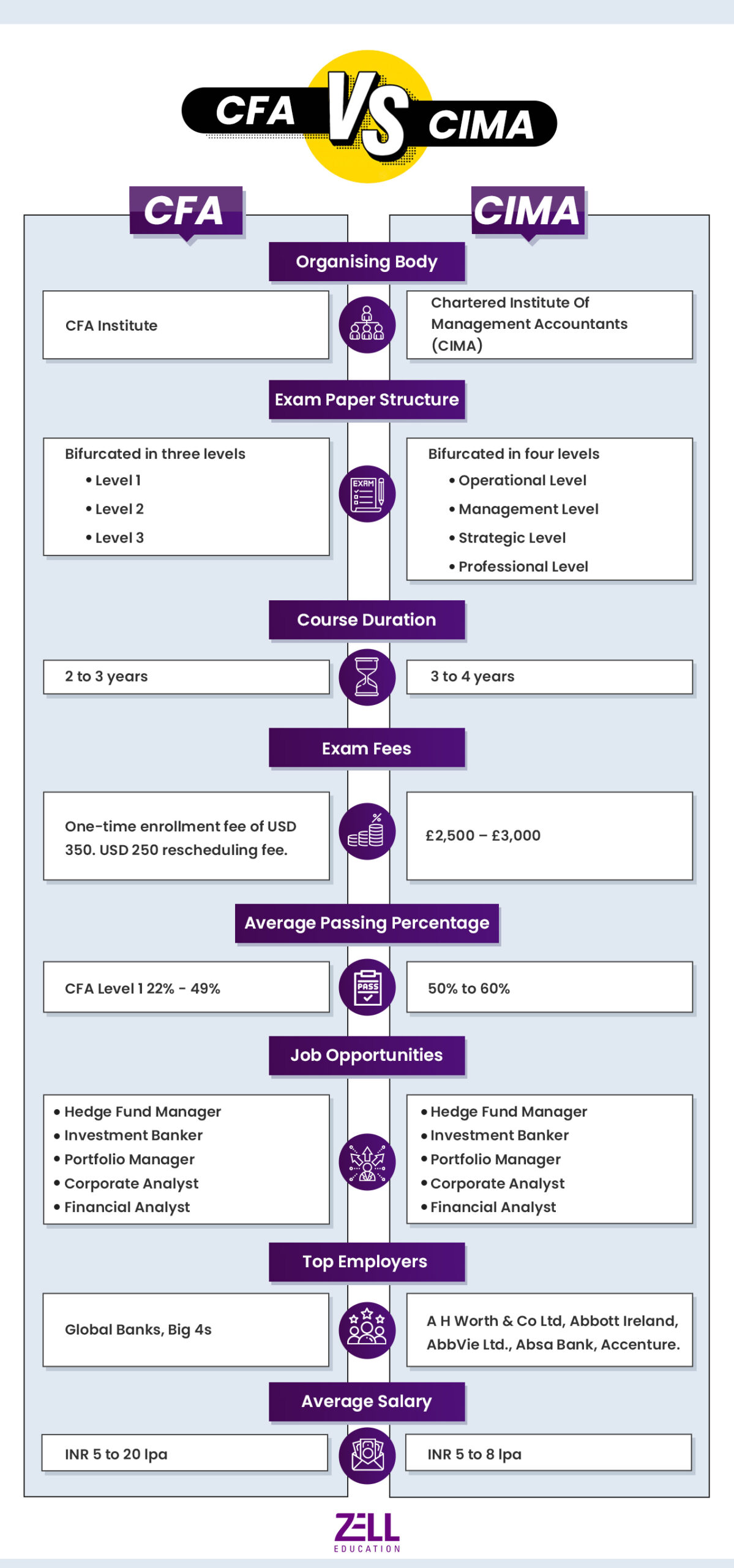
Once you get past the headline stats, CFA vs CIMA really splits along nine practical lines: who’s eligible, how the exams are structured, how long it takes, what it costs, how hard it is, where it leads, what it pays, who hires you, and how far your certificate travels.
| CIMA | Chartered Financial Analyst |
| Learn and apply transformative technology | A career in the exciting field of investments |
| Gives you analytical and problem-solving ability | Gives you cutting edge research skills |
| High compensation with recognition | High compensation with incentives |
| Prestigious career choice | Demanding career choice |
| Managing human capital | Global career options |
CFA vs CIMA: Eligibility
CFA needs a bachelor’s degree (or final-year status) or four years of relevant work experience, and a valid passport for exam-day identification. CIMA is more open at the entry point.
- CFA: bachelor’s degree, or final year of a degree, or 4,000 hours of work experience.
- CIMA: can be started after Class 12, though a graduate background or MBA speeds up the journey through exemptions.
CFA vs CIMA: Exam Structure & Syllabus
CFA is a three-level, computer-based exam covering ten core investment topics, while CIMA runs on a tiered mix of objective tests and case studies.
- CFA Level I–III: multiple-choice, item sets and constructed-response questions on ethics, equity, fixed income, and portfolio management.
- CIMA Certificate through Strategic level: objective tests per subject, capped off with a case-study exam at each professional level.
CFA vs CIMA: Duration
CFA generally takes 2–4 years since candidates can only sit each level twice a year and must space attempts at least six months apart. CIMA typically takes 2.5–3.5 years, though exemptions for commerce graduates, CAs or CMAs can shorten this noticeably.
CFA vs CIMA: Course Fees
All-in, CFA runs about $3,520–$4,520 for three levels with early registration, since the one-time enrolment fee was scrapped from February 2026 onward. CIMA in India (Tier 2 pricing) usually totals ₹1.5–3.5 lakh including registration, annual subscription and exam fees.
| Cost Component | CFA | CIMA |
| Registration/Enrolment | None (scrapped 2026) | £99 one-time |
| Per-Level/Subject Fees | $1,140–$1,590 per level | £104–£303 per paper, tiered |
| Annual Subscription | $299/year post-charter | £150/year |
| Approx. Total | ₹3.3–4 lakh | ₹1.5–3.5 lakh |
CFA vs CIMA: Difficulty & Pass Rate
CFA’s 10-year average pass rates sit at roughly 40% (Level I), 45% (Level II) and 51% (Level III), and only about 20% of everyone who registers eventually earns the charter, per CFA Institute pass rate data. CIMA’s difficulty is more paper-specific, its Management-level P2 paper alone fails close to 60% of first-time candidates, making it the toughest single hurdle in the CIMA journey.
(Source: CFA Institute pass rate data)
CFA vs CIMA: Career Scope & Job Roles
CFA opens doors on the investment side of finance; CIMA opens doors on the corporate side.
- CFA roles: Equity Research Analyst, Portfolio Manager, Investment Banking Associate, Credit Analyst, Risk Analyst.
- CIMA roles: Management Accountant, FP&A Analyst, Business Analyst, Financial Controller, Finance Director, CFO.
CFA vs CIMA: Salary in India
CFA charterholders tend to out-earn CIMA professionals at entry and mid-level, largely because investment roles are tied directly to fund performance and deal value. The gap narrows sharply at the top, where CIMA-qualified CFOs and Finance Directors can match or exceed CFA pay.
| Career Stage | CFA (India) | CIMA (India) |
| Entry-level | ₹6–10 LPA | ₹5–9 LPA |
| Mid-career (3–8 yrs) | ₹15–30 LPA | ₹10–20 LPA |
| Senior/Leadership | ₹30–50+ LPA | ₹20–40+ LPA |
CFA vs CIMA: Top Recruiters
- CFA recruiters: JP Morgan, Goldman Sachs, Morgan Stanley, HDFC AMC, ICICI Prudential AMC, SBI Mutual Fund, Kotak AMC, Blackstone, KKR, CRISIL, ICRA.
- CIMA recruiters: Big 4 firms (Deloitte, EY, KPMG, PwC), FMCG and manufacturing MNCs, shared-services and GCC finance hubs like Accenture and Genpact, and corporates hiring for FP&A or controllership tracks.
CFA vs CIMA: Global Recognition
CFA is recognised worldwide as the benchmark credential for investment management, with the CFA Institute having awarded roughly 200,000 charters globally. CIMA, through its partnership with AICPA and the CGMA designation, is recognised across 180+ countries and holds a specific MOU-based exemption pathway with India’s Institute of Cost Accountants (ICMAI), which makes it well recognised for Indian corporate finance roles too.
Which is Better, CFA or CIMA?
There’s no single winner here. It depends on which side of finance you actually want to sit on. If markets, valuation and portfolio decisions excite you, CFA is the more direct route, and the payoff shows up fastest in investment banking and asset management pay scales. If you’d rather be inside a business shaping budgets, cost strategy and eventually reporting to the board as CFO, CIMA lines up better with that trajectory, and its practical, case-study format suits people who learn by doing rather than by pure theory.
A reasonable way to decide: map out where you want to be in ten years. Fund manager or CIO, go CFA. Finance Director or CFO of a corporate, go CIMA. If you genuinely can’t choose between the two paths, that’s usually a sign you’d benefit from both.
Can You Pursue CFA and CIMA Together?
Doing both at the same time is tough, the study load for CFA alone runs into the hundreds of hours per level, but plenty of professionals complete both sequentially over several years.
- Some CFA charterholders add CIMA later to move from pure analysis into general management and CFO-track roles.
- Some CIMA members pick up CFA to sharpen their investment and valuation skills, especially if they move into treasury or corporate finance.
- Doing both signals unusually broad finance capability, but it’s a multi-year commitment best planned around your actual career goal rather than added just for the resume.
Why Zell?
- Largest provider for global finance and accounting courses
- 4.6 Google review rating
- 1000+ global placement partners
- Placement opportunities at the Big 4
- 100+ global and Indian rank holders
- 100+ faculty network
- 10,000+ students placed
Zell Education’s counsellors can map out a CFA certification plan or a CIMA study plan based on your background, exemptions and target roles.
FAQs on CFA vs CIMA
What is the salary difference between CFA and CIMA in India?
CFA professionals generally earn more at entry and mid-career levels (₹6–30 LPA versus CIMA’s ₹5–20 LPA), though the gap narrows at senior CFO-track roles where CIMA holders can earn ₹20–40+ LPA.
Which is easier, CFA or CIMA?
Neither is “easy,” but CFA is considered more quantitatively demanding with lower pass rates per level, while CIMA’s difficulty is concentrated in specific papers like the Management Case Study.
Is CIMA recognised in India?
Yes, CIMA is recognised in India and holds a formal exemption arrangement with the Institute of Cost Accountants of India (ICMAI), plus strong demand from MNCs and Big 4 firms.
How long does it take to complete CFA vs CIMA?
CFA typically takes 2–4 years due to twice-yearly exam sittings per level, while CIMA usually takes 2.5–3.5 years, shorter with relevant exemptions.

Current Role
Co-Founder & CEO at Zell Education
Education
- ACCA – Association of Chartered Certified Accountants, Finance (2011 – 2014)
- Bachelor of Commerce (BCom), Financial Markets from H.R. College Of Commerce & Economics (2010 – 2013)
Location
Mumbai, India
Expertise
ACCA Certified
Why Zell?
- • Largest Provider for Global F&A Courses
- • 4.6 Google Review Rating
- • 1000+ Students placed Annually
- • 500+ Active Hiring Partners
- • Placement Opportunities at the Big 4
- • 100+ Global & Indian Rank Holders
- • 100+ Faculty Network
Speak to A Career Counselor
Zell's 10th Anniversary Offer - Avail a 10% Scholarship