
This blog discusses why choose a self-finance course, its differences from traditional education, the best benefits of a self finance course, appropriate candidates, and tips to choose the relevant course for enhancing one’s career.
Why Is Self-Financed Education Becoming So Popular?
In the previous decade, there has been a rise in the trend of self-financed education in India. However, one may question why choose a self-finance course, given that government-funded schemes are also available.
A self finance course is a course where the entire fee is paid by the students, not relying on any government funding. By becoming financially independent, colleges gain the liberty to develop advanced curriculum systems. They can immediately update the course and appoint guest faculties, as well as include specialisations such as artificial intelligence, accounting, data analytics, or business strategy that comply with international standards.
In today’s competitive environment, most students are faced with difficulties in getting admission to government-sponsored seats. This is where knowing what is self financing course becomes a necessity. This course gives a new scope to the students, increasing the chances of getting quality education.
Why choose a self-finance course, then? Because you get to control what happens next in your education and ultimately in your career!
Curious About Why Choose a Self-Finance Course?
What Makes Self-Finance Courses Different from Regular Programs?
So, if students are asking what is self financing course, the answer is in appreciating what makes it differ from a conventional course.
As opposed to government-supported schemes where the funding comes from the government, in self-financed schemes, completely separate funding comes from student fees. This enables institutions to invest in the sector’s infrastructure as well as in partnerships with various sector bodies.
In conventional institutions, the curriculum remains static for years together. By contrast, in self-financing colleges, there is a possibility of redesigning modules to keep pace with new age requirements, including the inclusion of practical modules like internships, workshops, and case studies.
How Self-Finance Differs from Regular Courses
| Feature | Self-Finance Course | Regular Course |
| Funding | Student-funded (no government aid) | Partially funded by government |
| Curriculum | Flexible, industry-updated | Static and university-controlled |
| Admission | Easier, fewer restrictions | Limited and highly competitive |
| Fees | Higher | Lower or subsidized |
| Focus | Employability and skills | Academics and theory |
| Examples | BBA (Self-Finance), BCA, ACCA, CPA | B.Com, BA, B.Sc. |
Source for Information on Difference Between Self-Finance and Regular Courses – Careers360
As a result, the self finance course meaning is not only financial; rather, it is a host of things, including innovation, liberty, and future readiness. When it comes to students looking to gain exposure as well as job-related learning, the decision to self-finance a course is often the best.
What Are the Key Benefits of Self-Finance Courses?
Why choose a self-finance course? This question can be answered by considering the many advantages that come with this type of course.
No Dependence on Government Quotas
India has a fixed number of seats in colleges that are government-funded, leading to a great deal of competition. This is not the case in self-financing courses.
Key advantages:
- Higher admission intake without strict quotas.
- Transparent merit or direct-entry systems.
- Multiple intakes or rolling admissions in many institutions.
- Greater access for students from different boards or states.
Students do not have to wait for counselling anymore or lose a year of studies. A self finance course allows one to immediately avail of academic as well as professional development.
Access to Modern Curriculum & Infrastructure
A third important reason to choose a self finance course is that of technology-driven education. Self-financing colleges may possess the following:
- Smart classrooms, simulation labs, and digital libraries.
- International collaborations with professional bodies.
- Updated curricula aligned with corporate and global standards.
For instance, Zell Education incorporates globally accepted certifications such as CPA, ACCA, and CFA in their self-financing programmes to ensure that the student acquires technical expertise as well as international exposure.
Therefore, the self finance course meaning is that the course involves world-class resources as well as teaching methods that ensure students can compete in the international world.
Higher Chances of Admission
Thousands of capable students are left out of government colleges due to high cut-offs every year. This issue is addressed by self-financing colleges.
Why choose a self-finance course in such cases?
- More seats in in-demand disciplines such as finance, IT, and management.
- The liberty to apply to various universities.
- Often reliant on personal interviews rather than test results.
- Flexible study options that target working professionals or students leaning towards weekend studies.
This makes education both inclusive and personalised.
Practical and Career-Oriented Training
Maybe the most significant factor that makes choosing a self finance course a better option is that the course is career-focused. Self-financing colleges emphasise employment skills in addition to academic achievements. Students are introduced to:
- Internships and on-site projects.
- Guest lectures from industry professionals.
- Real-world simulations, case studies, and problem-solving tasks.
- Integrated certifications and soft-skill training.
Source for Information on The Benefits Of Self Finance Courses – Hindustantimes/Education
Institutes such as Zell Education make sure that practical applications in every self-financing course help students ease into a corporate setting. These programmes help bridge the divide between academia and industry, something that conventional graduate programmes fail to achieve.
Who Should Consider a Self-Finance Course?
Deciding what are self finance courses, one needs to understand who is best suited for such courses. A self-financing course is ideal for:
- Students who missed out on government college seats but don’t want to lose a year.
- Working professionals seeking upskilling or career transitions.
- Learners who prefer modern learning tools and small, interactive batches.
- Those aiming for global certifications or international placements.
- Individuals who value flexibility and practical exposure over rigid academic systems.
Essentially, the choice of a self finance course is a matter of what is most important to you: flexibility, speed, or employment prospects. As either an undergraduate searching the self finance course list or a professional looking to upgrade his skills, the benefit is in acquiring education relevant to today’s needs.
How Can You Choose the Right Self-Finance Course?
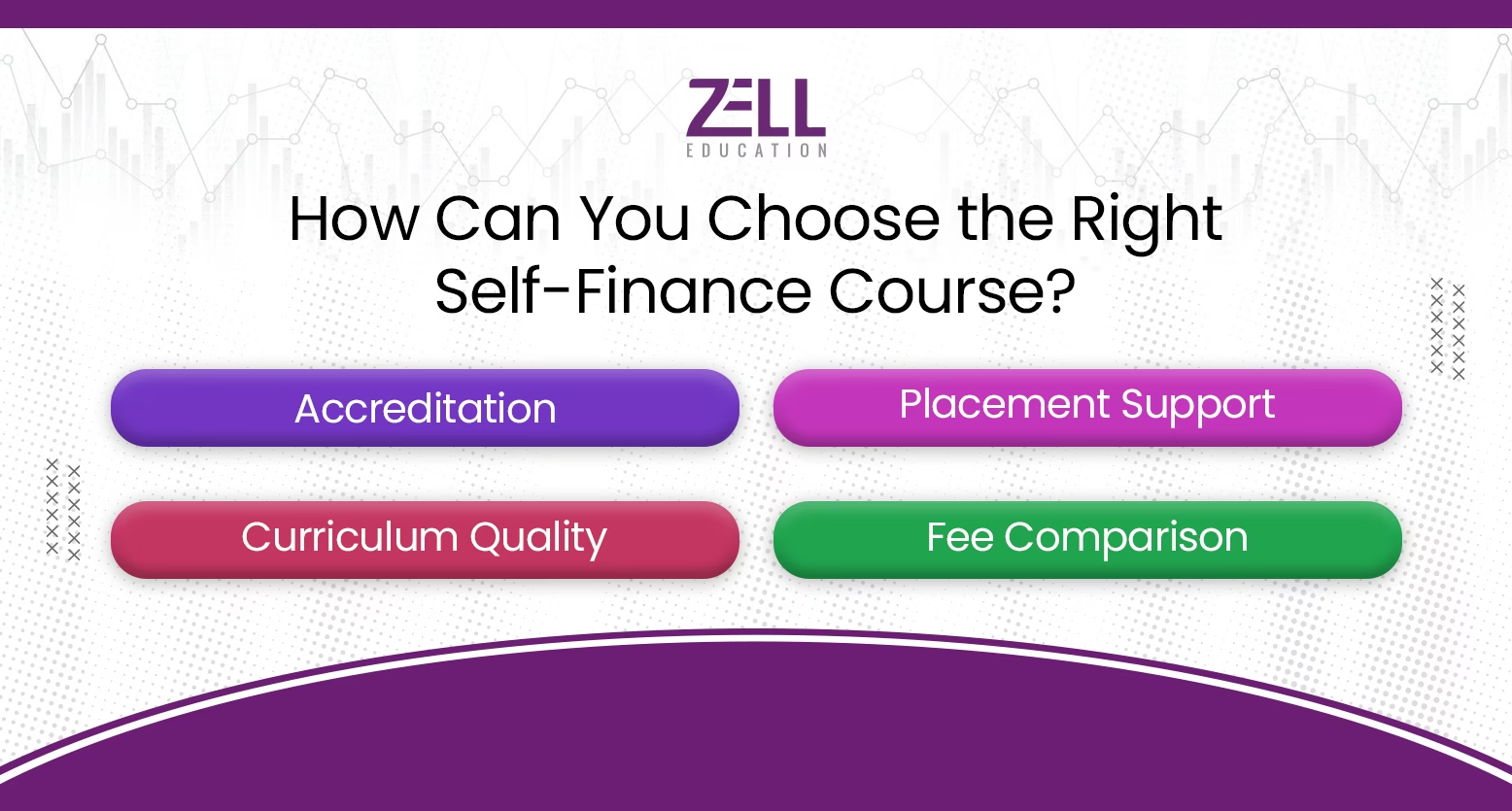
There are numerous options available, making course selection a difficult task. This is how you can make a confident choice.
Check Accreditation, Placement & Fee Structure
- Accreditation:
It is important to verify the recognition of the degree from a reputable university or international body. Accreditation is imperative in ensuring that your degree is accepted worldwide. - Placement Support:
Look into the placement records, recruitment partners, and alumni networks offered by a school. A school with a robust placement record is what indicates a school is relevant in the industry. Zell Education, for instance, has recruitment ties with leading firms in the field of finance & accounting. - Curriculum Quality:
Investigate if projects, internships, or certifications are involved in this course. Self-financed education with certifications approved in the respective industry is more valuable in the job sector. - Fee Comparison:
Various institutes’ fee structures can be compared in terms of cost, and they can be judged in relation to the amenities offered, the quality of education, and placement support. It is important to keep in mind that a self-financing course is a means of overall development, not an expense. - Explore the Self Finance Course List:
Popular options include:
- BBA (Self-Finance)
- B.Sc. IT or Data Science
- MBA (Self-Finance)
- ACCA, CPA, CMA
- Digital Marketing, Business Analytics
By taking into consideration these factors, you will be in a position to decide on the most beneficial self-financing course for you.
How Does Investing in a Self-Finance Course Shape Your Future?
A self finance course is much more than a simple academic course; rather, it is a long-term investment in one’s future. These courses will help you in:
- Gain early career exposure and relevant skillsets.
- Learn through real-time industry engagement and digital tools.
- Build confidence through hands-on experience and international collaborations.
- Become eligible for high-paying roles in both India and abroad.
So, if anyone asks what is self financing course, one can easily say that this is where education meets opportunity, with institutions such as Zell Education making sure that the student is armed with international qualifications that give him a great start in his corporate life.
Therefore, why choose a self-finance course at this university? Because a self finance course will ensure independence, topicality, and a relevant skill set that is imperative in today’s employment market.
Want to Pursue CPA Accounting Career?
Book Your Free Counselling Session Today
Conclusion: Why Self-Finance Education Is a Smart Investment
In conclusion, the rationale of a self finance course is best summarised in one word: opportunity.
These initiatives imbue students with the power of control over their education, including flexibility and internationalisation, as well as job readiness. Self finance course meaning” is much more pronounced than simple financial independence, as it is a product of innovation in education as well as the liberty to pursue education that counts in today’s time.
At Zell Education, we offer self-financing courses that cater to international standards in order to offer globally accepted qualifications. No matter what type of self finance course list you are looking into, in finance, business, technology, or any other field, a self-financed education is essentially an investment in your future.
Essentially, a self finance course is not a cost – it is your path to a successful career.
FAQs on Why Choose a Self-Finance Course
Are self-finance courses worth the higher fees?
Yes, as they offer flexibility, new ways of learning, and career prospects that are better than conventional programmes. Also, paying a higher fee means getting higher returns in one’s career.
Which are the best self-finance courses in India?
Some of the most sought-after courses are BBA, BCA, MBA (self-finance), Data Analytics, Digital Marketing, ACCA, CPA, and CFA, which provide excellent placement options.
Do self-finance colleges provide good placements?
Yes. Top institutions such as Zell Education are well-connected in the industry with MNCs as well as the Big 4, offering immense exposure to students
How do I apply for self-finance admission?
Applications are usually accepted directly from the school’s website. Online forms are available in most colleges, and the process is either merit-based or conducted through interviews.

Current Role
Co-Founder & CEO at Zell Education
Education
- ACCA – Association of Chartered Certified Accountants, Finance (2011 – 2014)
- Bachelor of Commerce (BCom), Financial Markets from H.R. College Of Commerce & Economics (2010 – 2013)
Location
Mumbai, India
Expertise
ACCA Certified
Why Zell?
- • Largest Provider for Global F&A Courses
- • 4.6 Google Review Rating
- • 1000+ Global Placement Partners
- • Placement Opportunities at the Big 4
- • 100+ Global & Indian Rank Holders
- • 100+ Faculty Network
- • 10,000+ Students Placed
Speak to A Career Counselor
Zell's 10th Anniversary Offer - Avail a 10% Scholarship