
An MBA in International Finance equips students for careers in international banking or finance departments of multinational companies and financial consulting. The syllabus, eligibility criteria, fees, career prospects, and international job prospects for 2026 are discussed in this article.
Are you curious to know the details of international finance, its difference from a regular finance MBA, and everything related to the field? This article is a one-stop solution for all your queries related to the MBA in International Finance programme.
Comprehensive Guide on ‘What is MBA in International Finance?’
- MBA in International Finance: It teaches students how to manage finances during international banking operations and multinational corporation functions.
- International Finance: This is a part of the financial system that deals with cross-border financial systems, investments in foreign countries, foreign exchange markets, etc.
- International Business and Finance: The field of international business and finance combines management strategies with global financial decision-making.
- Scope of International Finance: This is a growing field due to globalisation, trade between countries, and investments by companies in different countries.
- Global Financial Management: This course equips students for careers in managing finances in different countries.
- What is MBA: The understanding of an MBA through its definition helps students to recognise how international finance programmes develop business leaders for worldwide operations.
Imagine analysing financial markets that span multiple countries, each with its own currency and regulatory system. Global businesses constantly deal with changing foreign exchange rates, international investments, and the risks that come with cross-border transactions. Managing such complex international financial systems requires specialised knowledge and expertise.
For students aiming to build a career in this field, an MBA in International Finance offers the right path. The programme equips learners with core management skills along with a deep understanding of global financial markets, including foreign investments and forex dynamics.
This course not only builds strong financial knowledge but also opens doors to career opportunities in global financial institutions, helping students step into the world of international finance with confidence.
Talk to an Expert About MBA in International Finance Today!
 Call Now!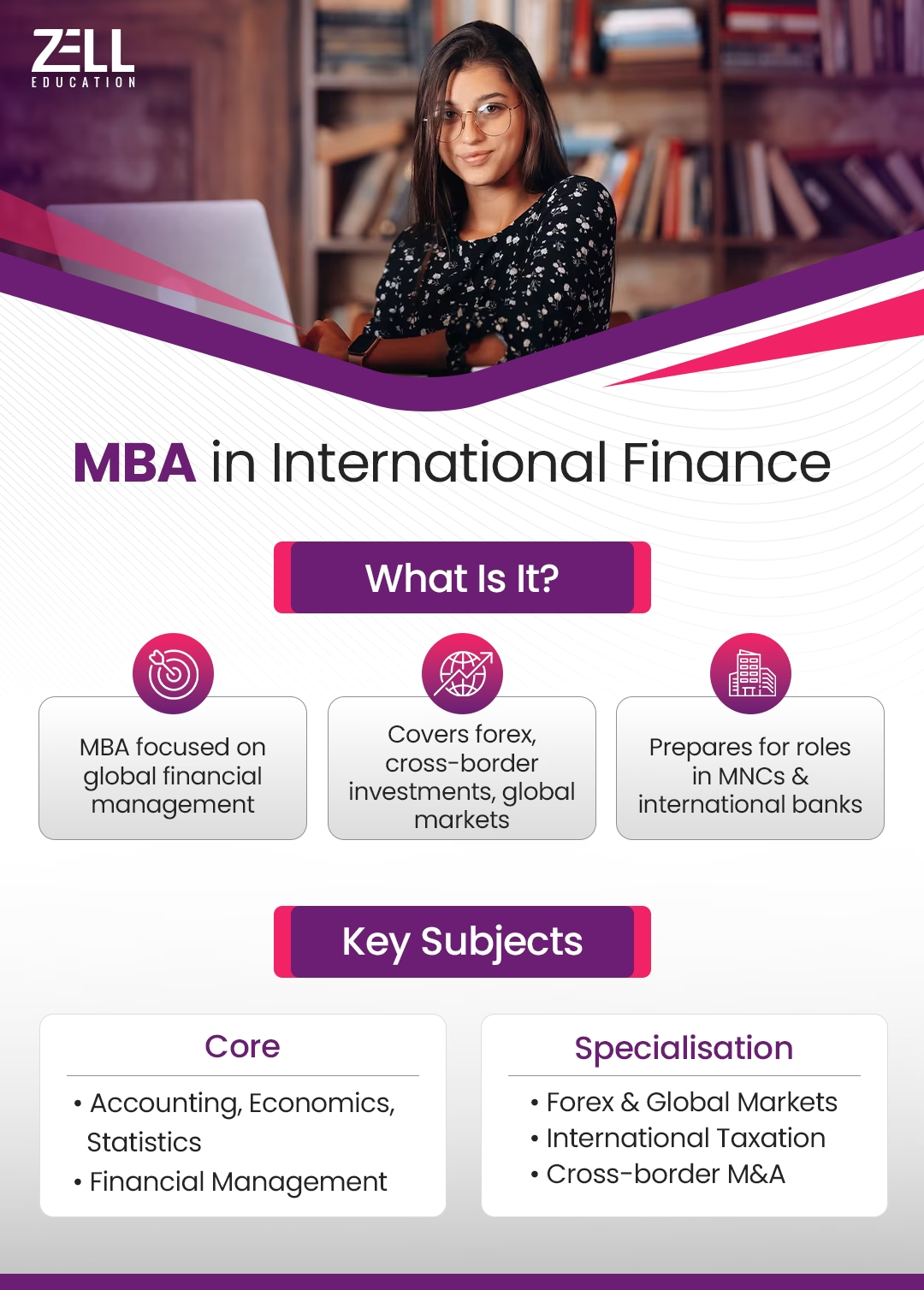
What is an MBA in International Finance? Core Overview
An MBA in International Finance is a postgraduate management programme (PGDIAF) that deals with financial decisions in the international market. It is a combination of a regular MBA programme with additional courses on international finance and international business. The main areas of the programme are:
- Study of global financial markets
- Analysis of foreign exchange (Forex) systems
- Understanding international investment strategies
- Managing financial risks across borders
What Will You Learn in the MBA in International Finance Syllabus?
The MBA in International Finance syllabus focuses on management fundamentals and specialised international finance topics. Students develop analytical, strategic, and financial skills required for global business environments.
Core Management Subjects (Semester 1 & 2)
First-year subjects of an MBA in International Finance are general management subjects, which are:
- Financial Accounting
- Marketing Management
- Organisational Behaviour
- Business Economics
- Business Statistics
Specialised International Finance Modules
In the second year, the International Finance syllabus delves deeper into international finance topics, which are explained in the context of the international financial system and international business environment.
Global Financial Markets & Foreign Exchange (Forex)
One of the major subjects in this course is global financial markets. Some of the major subjects include:
- Foreign exchange markets
- Currency valuation
- Global investment strategies
- International monetary systems
International Taxation and Transfer Pricing
Cross-border financial operations require knowledge of international tax systems. Important topics include:
- Tax treaties between countries
- Transfer pricing strategies
- Corporate tax planning
- Regulatory compliance
Cross-Border Mergers & Acquisitions (M&A)
Cross-border mergers and acquisitions are a major component of international finance. Key areas of study include:
- Global M&A strategies
- Financial valuation techniques
- Legal frameworks for cross-border deals
- Post-merger integration strategies
Integration of Professional Certifications (ACCA/CFA/CMA)
There are many programmes that offer professional certifications. Some of the certifications that can be obtained include:
- ACCA
- CFA
- CMA
This can help in acquiring greater expertise in international finance and can increase the chances for a good career in international finance. Some programmes offer a combination of finance and international business.
What Are the Eligibility Criteria and Admission Process for 2026?
To get admitted to an institution offering an MBA in International Finance course, one needs to fulfil certain requirements. The requirements include academic qualifications and entrance examinations. The process is similar for all institutions.
Academic Requirements & Entrance Exams (CAT, GMAT, GRE)
To apply for an MBA in International Finance, students must meet basic eligibility criteria. These tests are designed to check your analytical skills, logical reasoning, and mathematical abilities, which are essential for international finance programmes. The basic requirements for the tests are:
- Bachelor’s degree from a recognised university
- Minimum academic percentage requirement
- Entrance exam scores such as CAT, GMAT, or GRE
How Important Is Professional Work Experience in Admissions?
Having a good amount of work experience can help in getting admitted to an institution offering an MBA in International Finance course. Most institutions require students who have experience in international business and finance. This is because such students:
- Practical exposure to business operations
- Understanding of corporate finance processes
- Stronger leadership and management skills
Chat with Us on WhatsApp for MBA in International Finance Details
 Claim Your Discount
Which Are the Top MBA International Finance Colleges and Their Fee Structure?
There are a number of institutes that offer a specialised MBA in international finance. The choice depends upon the reputation and opportunities available in the institution for placements.
Premier Government Institutes
Government institutes are known for high-quality management education. Top institutes include:
- Indian Institutes of Management (IIMs)
- Faculty of Management Studies (FMS)
- Indian Institute of Foreign Trade (IIFT)
Top Private B-Schools
Apart from the top institutes, many private business schools are offering good-quality MBA International Finance programmes. The top private business schools are:
- SPJIMR
- NMIMS
- XLRI
ROI Analysis: Fees vs. Average Placement Package
Before making a final decision, the students can do an ROI analysis for the programme. The international finance sector is a growing industry, which can give good financial benefits to the students. The factors that can be considered for the ROI analysis are:
- Tuition fees
- Average placement salary
- Internship opportunities
- Global exposure
Are There Online and Distance MBA Options Available?
Online programmes are becoming increasingly popular for MBA in International Finance. Examples include:
- Amity Online MBA
- Jain Online MBA
What Career Opportunities Exist After an MBA in International Finance?
One can find a career in global banks, multinational companies, and consulting firms. The scope of international finance will also create a requirement for finance professionals.
High-Demand Profiles: Investment Banking & Global Analyst
Some of the high-demand careers for an MBA in International Finance are as follows:
- Investment Banker
- Global Financial Analyst
- Portfolio Manager
- International Finance Consultant
Corporate Finance Roles in Multinational Corporations (MNCs)
Some of the corporate finance roles that can be found after an MBA in International Finance are as follows:
- Corporate Finance Manager
- Financial Planning Analyst
- International Treasury Analyst
Risk Management and Treasury Operations
Risk management is another major career path in international finance. Responsibilities include:
- Managing currency risks
- Monitoring global investments
- Managing liquidity across countries
Average Salary Packages in India (Entry to Senior Level)
Salary is based on experience and industry. As the industry for international finance grows, so does the salary. Salary levels are as follows:
- Entry-level: ₹6–10 LPA
- Mid-level: ₹12–25 LPA
- Senior-level: ₹30 LPA or more
Source: Payscale
What Global Opportunities Exist After an MBA in International Finance?
The MBA in International Finance opens the gates to global career opportunities in the top financial hubs of the world.
Key Markets: USA, UK, Singapore, and UAE (Dubai)
Global financial centres offer strong career prospects in international finance. Popular destinations include:
- USA
- UK
- Singapore
- UAE (Dubai)
How Do Global Financial Regulations Impact International Mobility?
Professionals working in international finance must understand global regulations. Important factors include:
- International accounting standards
- Financial compliance regulations
- Banking supervision frameworks
Conclusion: Is an MBA in International Finance Worth It in 2026?
An MBA in International Finance is one of the most valuable management specialisations for students interested in global markets. The programme develops expertise in international finance, global investment strategies, and multinational financial operations.
As businesses expand internationally, the scope of international finance continues to grow, creating demand for professionals skilled in international business and finance. For students seeking careers in investment banking, global consulting, or multinational corporations, this specialisation offers excellent opportunities.
If you are interested in global markets, cross-border investments, and global financial management, pursuing an MBA in International Finance along with an ACCA Certification can be a strong step toward a successful international career.
FAQs on What is MBA in International Finance
What is the difference between an MBA in Finance and an MBA in International Finance?
International finance deals with the global market and investments. It is a part of finance. An MBA in Finance is a general course.
What is the average starting salary for an MBA in International Finance in India?
The average starting salary for freshers is between ₹6 and 10 LPA, depending on the college or institution and the position applied for.
Do I need to learn a foreign language for global finance roles?
The companies that hire most are those that are into international business or finance.
Which companies are the top recruiters for international finance graduates?
Top recruiters include global banks, consulting firms, and multinational corporations operating in international business and finance.
Can I work in the USA after completing an MBA in International Finance from India?
Yes, professionals with an MBA in International Finance can work abroad if they meet visa and professional qualification requirements.

Current Role
Co-Founder & CEO at Zell Education
Education
- ACCA – Association of Chartered Certified Accountants, Finance (2011 – 2014)
- Bachelor of Commerce (BCom), Financial Markets from H.R. College Of Commerce & Economics (2010 – 2013)
Location
Mumbai, India
Expertise
ACCA Certified
Why Zell?
- • Largest Provider for Global F&A Courses
- • 4.6 Google Review Rating
- • 1000+ Global Placement Partners
- • Placement Opportunities at the Big 4
- • 100+ Global & Indian Rank Holders
- • 100+ Faculty Network
- • 10,000+ Students Placed
Speak to A Career Counselor
Zell's 10th Anniversary Offer - Avail a 10% Scholarship