
Key Takeaways
- What is accounting? It records, classifies, and summarises a business’s financial transactions.
- Why is accounting important? It helps track income, expenses, profits, and overall financial performance.
- What does accounting do? It provides financial information for planning, reporting, compliance, and business decisions.
Comprehensive Summary: What Is Accounting
- Accounting Definition: Accounting records, classifies, summarises, and reports financial transactions systematically.
- Accounting Principles: Accounting principles provide consistent rules for preparing accurate financial statements.
- Accounting Standards: Accounting standards promote consistency, transparency, and comparability in financial reporting.
- Importance of Accounting: Accounting helps businesses measure performance, control finances, and make decisions.
- Types of Accounting: The core types are financial, managerial, tax, cost, forensic, and auditing accounting.
- Future of Accounting: AI and automation will handle routine tasks, elevating accountants to strategic advisors.
Accounting is basically a process that involves recording, summarising, and analysing financial information for useful purposes. This guide will help you understand what is accounting, all about accounting, including the accounting definition, the accounting process, accounting principles, and reasons why accounting is important.
Thinking About Accounting as a Career? What Should You Do Next?
 Speak to Expert
What Is Accounting?
Accounting is known as the language of business because it communicates information about a business’s financial position to both internal and external users. Generally speaking, what is accounting is actually the process or technique used to record, classify, and interpret financial information.
Accountancy in terms of accounting transcends mere figures. It allows for all this with perfect clarity and is one of the most critical activities that any enterprise undertakes.
In essence, the accounting definition is:
“Accounting is the process of identifying, measuring, and communicating financial information to help stakeholders make informed decisions.”
How Can Accounting Be Defined: The Process Explained
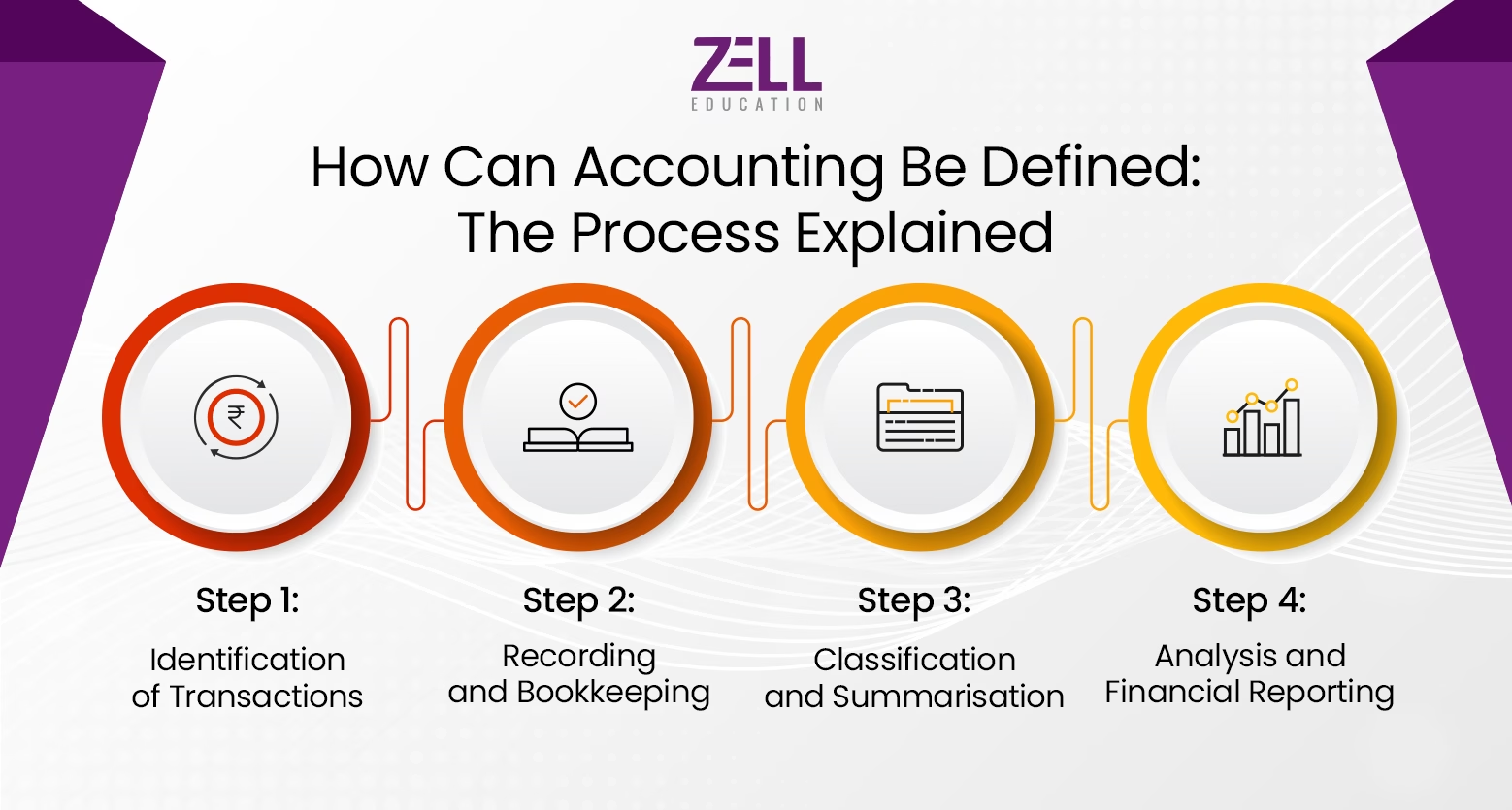
Accounting is not a singular process but comprises several levels because it is a process that ensures financial information is constantly correct and useful.
Step 1: Identification of Transactions
It all begins with the identification of economic events or transactions that require recordation. These can be sales, purchases, payments, investments, or any other economic event that influences the financial situation of businesses.
Step 2: Recording and Bookkeeping
Once transactions have been identified, they are entered in journals in time-order fashion. Again, this is part of bookkeeping. This ensures all transactions have been recorded for subsequent financial statement adjustments.
Step 3: Classification and Summarisation
After that, data is sorted under various categories called ledgers. These could be cash accounts, assets, and liabilities. Summarised data includes trial balances and financial statements. This ensures all entries made meet basic accounting principles.
Step 4: Analysis and Financial Reporting
The last step includes analysing financial information and reporting it in terms of statements such as balance sheets, income statements, and cash flow statements. Similarly, it is evident that this step is importance of financial reporting.
Curious About What Is Accounting?
What Are the Main Branches of Accounting?
Accounting branches are for various business purposes. They all deal with particular areas related to finances, compliance or management.
Financial Accounting:
This branch focuses on the importance of financial reporting and record-keeping that affects people who are not part of the company itself. The accounting process is governed by the rules of GAAP and IFRS.
Managerial Accounting:
Managerial accounting supports internal decision-making. It provides management with insights into budgeting, forecasting, and performance evaluation. This branch focuses on strategy rather than compliance.
Tax Accounting:
Tax accounting ensures all financial practices align with national tax laws and helps minimise liabilities legally. It involves preparing returns, planning tax strategies, and ensuring compliance with changing regulations.
Every branch highlights that accounting is an important function in achieving efficiency and profitability.
Source of Information for What Are the Main Branches of Accounting – Indeed/Career Development.
Could a Professional Accounting Qualification Improve Your Career?
 Consult Career Specialist
Why Is Accounting So Important for Businesses and Individuals?
Accounting is more than mere calculation. Accounting is all about informed decision-making, planning, and financial security. One must understand the importance of accounting to different people.
For Internal Stakeholders
- Aids management in making profitability and performance assessments.
- Aids with budgeting and planning.
- Aids in making decisions consciously and managing expenses.
- Notifies about errors, fraud, and inefficient activities.
For External Stakeholders
- Stockholders and debtors are able to assess the performance of businesses through financial statements.
- The government uses GAAP reporting for purposes of complying.
- Clients and suppliers feel confident about dealing with financially transparent businesses.
Finally, it can be noted that accounting is all about providing information that is used for growth.
What Are the Key Concepts and Principles of Accounting (GAAP/IFRS)?
Accounting is done in accordance with universally accepted norms called Generally Accepted Accounting Principles (GAAP) or International Financial Reporting Standards (IFRS). These frameworks promote standardisation, consistency, and comparability with respect to financial reporting across firms and across nations.
Core Accounting Principles Include:
- Accrual Principle: Revenues and expenses are reported when earned or incurred, regardless of when funds change hands.
- Consistency Principle: Use consistent accounting treatment in each reporting period.
- Prudence Principle: The accounts must prioritise the reporting of expenses and liabilities. The revenues are recognised only if they can be verified.
- Going Concern Principle: An entity is presumed to continue operations in the future.
- Matching Principle: Match expenses with revenues which they help generate.
Source of Reference for Key Concepts and Principles of Accounting (GAAP/IFRS) – Indeed/Career Advice/Accounting Principles.
Knowledge about these basic accounting principles is critical to financial managers since these principles form the backbone of basic accounting principles that are followed universally.
How Does Accounting Differ from Bookkeeping?
Despite these terms often being used alternatively, there is a difference between bookkeeping and accounting.
Bookkeeping:
Bookkeeping involves recording all business transactions on a regular basis. It focuses on accuracy and organisation, creating the foundation for financial reports.
Accounting:
Accounting is associated with analysing, summarising, and interpreting data reported by bookkeepers. Data is converted from raw information to useful information.
Briefly stated: bookkeeping reveals what has occurred. Accounting tells why it occurred and what should happen next.
Recognition of this difference helps to reaffirm the accounting concept and value and the role of accounting in business.
Want to Pursue Finance and Accounting Career?
Book Your Free Counselling Session Today
Conclusion
Accounting is not only record-keeping but is actually a critical component of every financial decision made in any business. Accounting makes it feasible for organisations to see how everything is going financially.
From transaction identification to reporting on GAAP, all accounting activities are done to ensure financial information is comparable and reputable.
Whether you’re a school-going student studying what is accounting or a business owner looking for financial clarity, it’s imperative to have a firm grasp on accounting principles. Speaking of which, it’s inconceivable to overstate the value that accounting plays. Accounting pushes for informed decision-making, facilitates integrity, and promotes business sustainability.
FAQs on What is Accounting
What is the simplest definition of accounting?
Accounting refers to the process by which economic activities are recorded, summarised, and analysed to produce useful information for decision-making.
What are the four main steps in the accounting process?
These four steps comprise identifying transactions, recording these transactions, classifying and summarising information, and finally making financial reports.
What is the difference between financial accounting and managerial accounting?
Financial accounting is concerned with reporting information to parties outside the business on a standard, GAAP-compliant basis. The goal is to facilitate informed decision-making by management.
Why are GAAP or IFRS important in accounting?
GAAP and IFRS promote standardisation by offering clear instructions that guarantee accuracy, consistency, and comparability.
Who are the primary users of accounting information?
Accounting data is utilised by management, investors, creditors, regulatory bodies, and employees, among others.
Is accounting the same as bookkeeping?
No. Bookkeeping is the process that entails recording transactions. Accounting is the subsequent process that involves the interpretation of such data.

Current Role
Co-Founder & CEO at Zell Education
Education
- ACCA – Association of Chartered Certified Accountants, Finance (2011 – 2014)
- Bachelor of Commerce (BCom), Financial Markets from H.R. College Of Commerce & Economics (2010 – 2013)
Location
Mumbai, India
Expertise
ACCA Certified
Why Zell?
- • Largest Provider for Global F&A Courses
- • 4.6 Google Review Rating
- • 1000+ Students placed Annually
- • 500+ Active Hiring Partners
- • Placement Opportunities at the Big 4
- • 100+ Global & Indian Rank Holders
- • 100+ Faculty Network
Speak to A Career Counselor
Zell's 10th Anniversary Offer - Avail a 10% Scholarship