
IAS 37 is designed to address issues relating to recognising and measuring provisions, contingent liabilities, and contingent assets. Its objective is to present accurate obligations in the financial statement and avoid the distortion of profits. The following discussion will explore these issues in more depth in line with the ACCA guidelines.
Comprehensive Summary on ‘IAS 37’
IAS 37 Overview: IAS 37 is an IFRS standard that governs provisions, contingent liabilities, and contingent assets in financial reporting.
IAS 37 Purpose: The main goal of IAS 37 is to ensure accurate recognition of liabilities and prevent profit manipulation.
IAS 37 ACCA Importance: IAS 37 ACCA is a core topic in IFRS learning and professional accounting exams.
Recognition Principles: IAS 37 defines strict conditions for recognising provisions in financial statements.
Measurement Rules: IAS 37 provides guidance on estimating obligations using present value and expected outcomes.
IFRS Context: Understanding IAS 37 ACCA requires a strong foundation in what IFRS principles and financial reporting standards are.
It is important to keep in mind that in financial reporting, timing and the nature of transactions can greatly affect the accounting for liabilities. Companies often face such issues as lawsuits, guarantees, or even obligations to clean up contaminated lands.
For ACCA students learning IAS 37, it is vital since they will be able to report accurately about how a company makes profits, maintain an accurate balance sheet, and be transparent about any financial reporting. Additionally, the study of this subject matter contributes greatly to advanced IFRS study and is often included in the ACCA Diploma in IFRS.
Build Strong IFRS Foundations for ACCA
 Talk to our career advisor
History & Background of IAS 37
IAS 37 was developed to standardise the treatment of provisions and contingent liabilities, ensuring transparency and consistency in IFRS reporting.
| Year | Development | Impact |
| 1998 | IAS 37 issued | Introduced rules for provisions and contingencies |
| 1999 | IAS 37 effective | Standard applied in financial reporting |
| 2000s | Interpretations (IFRIC) added | Clarified complex provision scenarios |
| 2010–2014 | Annual improvements | Enhanced consistency and disclosures |
| Ongoing | IFRS updates | Improved comparability and transparency |
What Is the Core Objective of IAS 37?
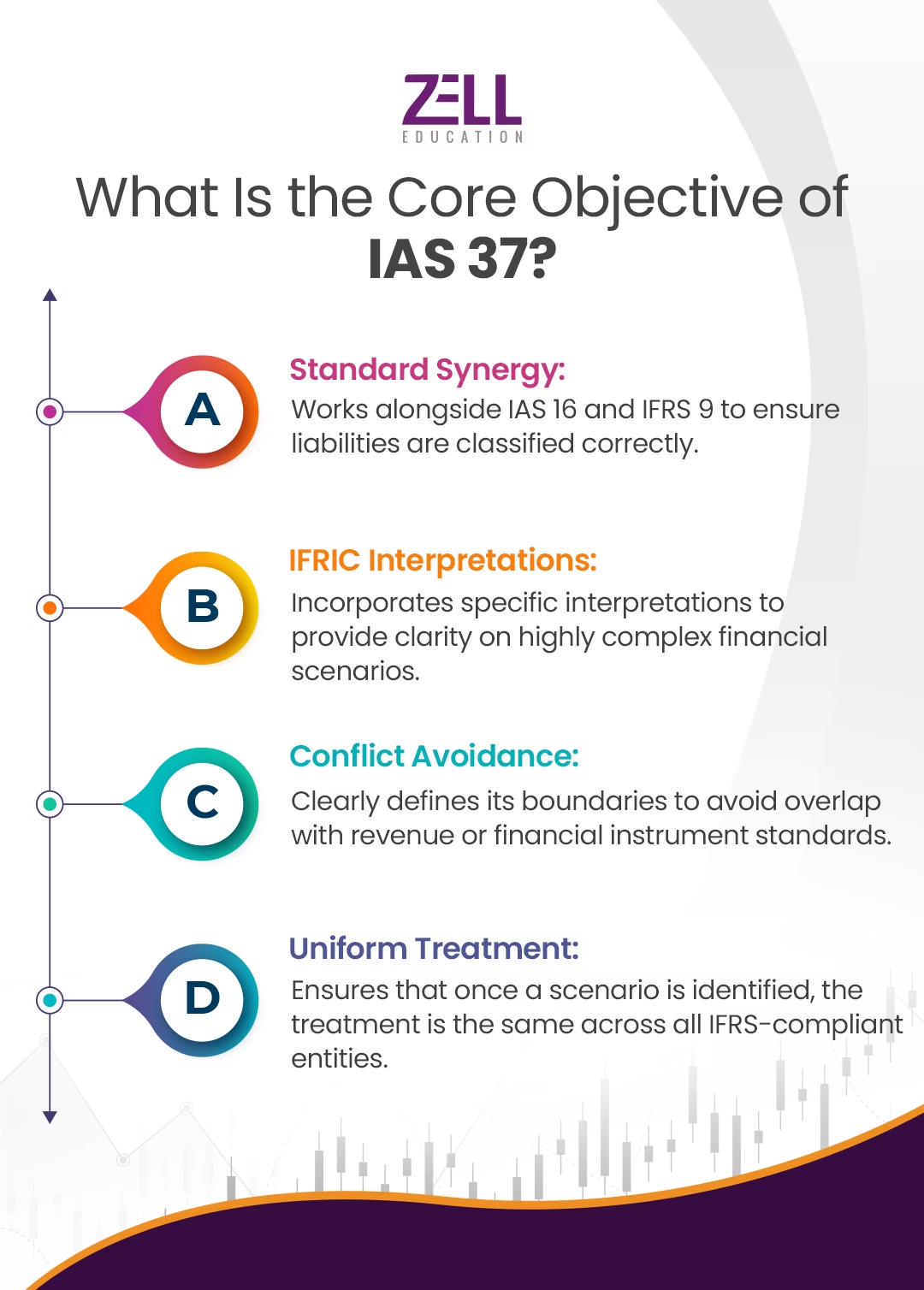
IAS 37 seeks to make sure that liabilities are recorded in a business’ books only when they are realistic, quantifiable, and probable. This way, liabilities will not be over- or underestimated.
Preventing “Big Bath” Accounting
One of the key purposes of IAS 37 is to prevent companies from deliberately making profits look low by creating provisions in a year that happens to have very low profits.
- Stops profit smoothing abuse
- Ensures realistic financial reporting
- Improves investor trust
These points are vital in understanding IAS 37 ACCA.
Ensuring Consistency in Financial Reporting
IAS 37 attempts to create uniformity among transactions of a similar nature in different companies.
- Standardised recognition rules
- Comparability between companies
- IFRS compliance enforcement
Defining the Scope: What IAS 37 Does and Doesn’t Cover
IAS 37 applies only to uncertain liabilities and excludes certain financial instruments.
- Covers provisions and contingencies
- Excludes financial instruments
- Does not apply to revenue recognition
Understanding what IFRS is helps clarify this scope better.
Get Career-Ready with ACCA & IFRS
 Connect with us
 When Should Provisions Be Recorded Under IAS 37?
A provision shall be made in the accounts only when all conditions are fulfilled according to IAS 37.
The Three Criteria for Recognition
IAS 37 requires all three conditions to be satisfied before recording a provision.
Present Obligation (Legal or Constructive)
There shall be a current obligation to provide something to someone else.
- Legal obligation from contracts or law
- Constructive obligation from business practices
- Past event must exist
This is heavily tested in IAS 37 ACCA exams.
Probable Outflow of Resources (>50% Likelihood)
An obligation should be fulfilled, and an outflow of economic resources is probably going to happen.
- More likely than not (>50%)
- Based on available evidence
- Requires professional judgment
Reliable Estimate of the Amount
The liability must be measurable with reasonable accuracy.
- Based on best available data
- Requires estimation techniques
- Updated regularly
Legal vs. Constructive Obligations: Knowing the Difference
IAS 37 defines two types of obligations to be fulfilled:
- Legal obligation: enforceable by law
- Constructive obligation: based on company behavior
- Both are valid under IAS 37
Provisions vs. Contingent Liabilities
There are a few differences between provisions and contingent liabilities. This table is essential for IAS 37 ACCA understanding.
| Feature | Provisions | Contingent Liabilities |
| Recognition | Recognised in accounts | Not recognised |
| Probability | Probable | Possible or remote |
| Measurement | Reliable estimate | Uncertain |
| Disclosure | Yes | Yes (if material) |
How Are Provisions Measured Under IAS 37?
When making a provision, there are several steps to take into consideration.
Best Estimate and Expected Value Method
When accounting for a provision under IAS 37, an entity should make its best efforts to estimate its value.
- Weighted average method
- Most likely outcome approach
- Historical data analysis
Risk and Uncertainties: Adjusting for the Unknown
While making provisions, companies usually take into account risks and uncertainties related to making provisions.
- Uncertainty adjustments
- Conservative estimation
- Professional judgment
The Impact of Time Value of Money (Discounting)
If an effect is material, an obligation should be discounted, taking into account its present value.
- Present value calculation
- Long-term liabilities adjustment
- Financial accuracy improvement
Future Operating Losses: Why They Are Excluded
Under IAS 37, provisions for future loss cannot be recognised for expected operations.
- No provisions for future operations
- Only past obligations allowed
- Prevents earnings manipulation
What Are Specific Applications and Examples Under IAS 37?
IAS 37 applies to several real-world accounting scenarios.
Onerous Contracts: When Costs Exceed Benefits
An onerous contract occurs when costs exceed expected benefits.
- Immediate provision required
- Loss must be recognised
- Common in lease agreements
Restructuring Provisions: The Strict Recognition Rules
Restructuring provisions have strict recognition conditions.
- Formal plan required
- Communication to stakeholders
- No general future planning allowed
Environmental and Decommissioning Liabilities
Companies must account for environmental obligations under IAS 37.
- Pollution cleanup costs
- Asset dismantling obligations
- Long-term environmental risks
Example: A Factory Cleanup Requirement
If a factory must be cleaned after operations:
- Provision must be recorded
- Estimated cleanup cost included
- Discounted if long-term
What Are Contingent Assets and How Are They Treated?
Contingent assets are possible gains arising from uncertain future events.
Why Contingent Assets are Rarely Recognised
IAS 37 is conservative regarding gains.
- No recognition until certainty increases
- Avoids overstatement of income
- Ensures prudence principle
Threshold for Disclosure vs Recognition
Contingent assets are disclosed only when probable.
- Possible gains → disclosure only
- Certain gains → recognition
- Requires judgment
Example: A Pending Legal Claim for Damages
If a company expects compensation from a lawsuit:
- Not recognised initially
- Disclosed in notes
- Recognised when certain
Quick Summary of Accounting Treatments
The following table summarizes the key accounting treatments under IAS 37.
| Item | Treatment under IAS 37 |
| Provision | Recognised |
| Contingent Liability | Disclosed only |
| Contingent Asset | Disclosed (if probable) |
| Future Losses | Not recognised |
Conclusion: Best Practices for IAS 37 Compliance in 2026
The IAS 37 standard plays an extremely important role in ensuring that financial statements contain realistic obligations and related risks. It does so by giving precise definitions as to what should be recognised as a provision, contingent liability, and contingent asset.
For students studying IAS 37 as part of the ACCA syllabus, it is very important to have a good command of the criteria of recognition, ways of measurement, and practical examples. The study of these aspects not only develops knowledge about the IAS 37 standard but will also contribute to acquiring general knowledge regarding accounting in accordance with IFRS and prepare students for receiving a diploma in IFRS.
In conclusion, it should be emphasised that the IAS 37 standard allows us to achieve financial reporting that is conservative, consistent, and uniform all around the world.
FAQs on IAS 37 Guide
What is the difference between an accrual and a provision?
An accrual is a certain liability, while a provision under IAS 37 is uncertain in timing or amount.
Does IAS 37 apply to financial instruments?
No, financial instruments are governed by other IFRS standards, not IAS 37.
When should a provision be discounted?
A provision is discounted when the time value of money is material under IAS 37.
What is a constructive obligation?
It arises when a company creates an expectation through past practices.
Can future repairs be recognised as provisions?
No, future operating costs cannot be recognised under IAS 37.
How often should provisions be reviewed?
Provisions must be reviewed at each reporting date under IAS 37 requirements.

Current Role
Co-Founder & CEO at Zell Education
Education
- ACCA – Association of Chartered Certified Accountants, Finance (2011 – 2014)
- Bachelor of Commerce (BCom), Financial Markets from H.R. College Of Commerce & Economics (2010 – 2013)
Location
Mumbai, India
Expertise
ACCA Certified
Why Zell?
- • Largest Provider for Global F&A Courses
- • 4.6 Google Review Rating
- • 1000+ Global Placement Partners
- • Placement Opportunities at the Big 4
- • 100+ Global & Indian Rank Holders
- • 100+ Faculty Network
- • 10,000+ Students Placed
Speak to A Career Counselor
Zell's 10th Anniversary Offer - Avail a 10% Scholarship