
Key Takeaways
- Students studying the FRM part 2 syllabus will work through six major FRM subjects that focus on practical risk management concepts.
- Under the FRM exam pattern, candidates are required to answer 80 multiple-choice questions within a 4-hour exam session.
- The highest weightage in the FRM part 2 syllabus comes from market risk, credit risk, and operational risk.
Comprehensive Guide on FRM Part 2 Syllabus
What is the FRM Part 2 syllabus?
If you’re moving on to Part 2, you’ll notice it’s less about learning definitions and more about using risk management concepts in practical situations.
What does the FRM Part 2 curriculum consist of?
You will explore market risk, credit risk, operational risk, liquidity risk, investment management and current issues affecting the world of finance.
What is the structure of the FRM Part 2 exam?
You will be given four hours to complete the paper, which has eighty multiple choice questions to be answered.
What are the most important topics in FRM Part 2?
Some subjects are worth more marks than others, so many students spend more time on those when they are planning their revision.
Is FRM Part 2 harder than Part 1?
Many students find it harder because the questions require you to use what you know, not just remember it.
How should I prepare for the FRM Part 2 syllabus?
Most students start with one topic at a time, keep revising along the way, solve plenty of questions, and leave enough time for mock exams before the actual paper.
Planning to complete your FRM Certification?
 Speak To A Mentor
 FRM Part 2 Syllabus 2026-27 at a Glance
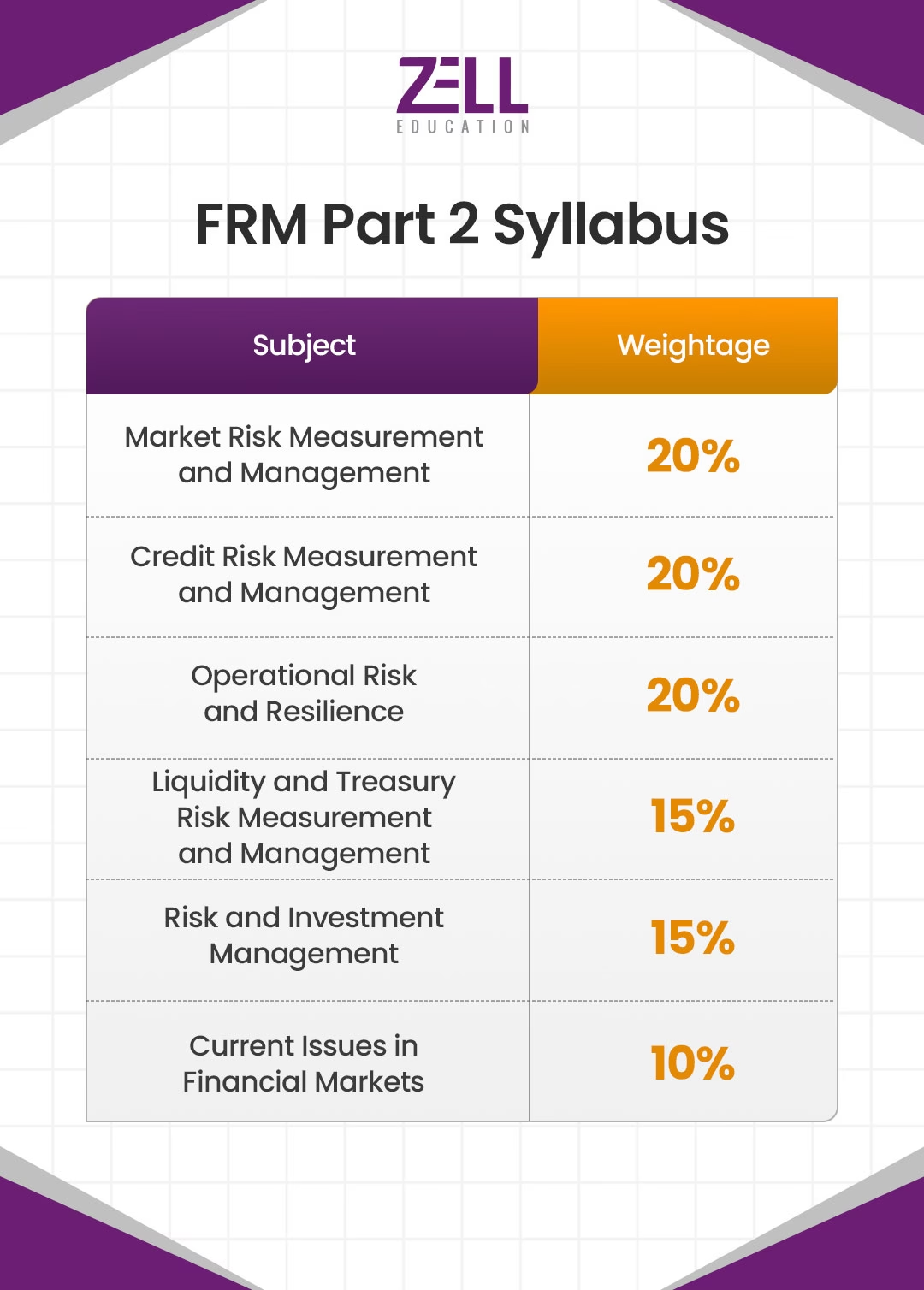
The risk management concepts are taken from theory to practice in the FRM part 2 syllabus. part 1 is all about laying down the foundations, while part 2 is about testing how risk professionals identify, measure and manage financial risks across banks, investment firms, insurance companies and financial institutions.
If you are planning to appear for the exam in 2026 or 2027, knowing the syllabus, subject weightage and exam pattern beforehand can ease the preparation.
GARP develops the syllabus for the FRM part 2 course. It covers risk management topics that banks and other financial institutions deal with in their day to day work.
The curriculum consists of six subject areas that test practical application skills.
| Subject | Weightage |
| Market Risk Measurement and Management | 20% |
| Credit Risk Measurement and Management | 20% |
| Operational Risk and Resilience | 20% |
| Liquidity and Treasury Risk Measurement and Management | 15% |
| Risk and Investment Management | 15% |
| Current Issues in Financial Markets | 10% |
What Is FRM Part 2?
FRM level 2 is the second and final examination in the Financial Risk Manager program.
While part 1 is about the foundational concepts, FRM level 2 is more about using risk management techniques in practical financial situations.
The exam tests a candidate’s ability to:
- Measure market and credit risks
- Evaluate operational and liquidity risks
- Analyse investment risks
- Understand emerging issues affecting financial markets
- Apply risk frameworks used by global institutions
Candidates who pass both parts and meet the work experience requirement can earn the FRM certification.
FRM Part 2 Syllabus 2026-27 – Subject-Wise Weightage
The FRM Part 2 syllabus follows a fixed weightage structure across exam windows.
- Market Risk Measurement and Management – 20%
- Credit Risk Measurement and Management – 20%
- Operational Risk and Resilience – 20%
- Liquidity and Treasury Risk Measurement and Management – 15%
- Risk and Investment Management – 15%
- Current Issues in Financial Markets – 10%
Together, the first three FRM subjects account for 60% of the examination, making them the most important areas to focus on.
FRM Part 2 Syllabus 2026-27 – Subjects in Detail
The FRM exam syllabus covers six core areas.
Market Risk Measurement and Management
This section is about how people measure and handle market risk in practice.
Key topics include:
- Value at Risk (VaR)
- Expected Shortfall
- Backtesting
- Stress Testing
- Extreme Value Theory
- Basel market risk regulations
- FRTB framework
- Options risk management
Weightage: 20%
Credit Risk Measurement and Management
This section deals with evaluating borrower risk and managing credit exposures.
Important topics include:
- Credit risk models
- Credit scoring
- Default probability estimation
- Credit derivatives
- Counterparty risk
- Credit Value Adjustment (CVA)
- Portfolio credit risk
- Structured credit products
Weightage: 20%
Operational Risk and Resilience
This area focuses on risks arising from systems, people, processes, and external events.
Major topics include:
- Operational risk frameworks
- Risk governance
- Risk identification
- Key Risk Indicators (KRIs)
- Scenario analysis
- Model risk
- Cybersecurity risk
- Business continuity planning
Weightage: 20%
Liquidity and Treasury Risk Measurement and Management
This section focuses on funding and liquidity management.
Key concepts include:
- Liquidity Coverage Ratio (LCR)
- Net Stable Funding Ratio (NSFR)
- Asset Liability Management (ALM)
- Treasury management
- Liquidity stress testing
- Intraday liquidity risk
Weightage: 15%
Risk and Investment Management
This subject looks at how risk management is used in real investment portfolios.
Topics include:
- Factor models
- Portfolio construction
- Risk budgeting
- Checking how a portfolio is performing
- Hedge fund strategies
- Alternative investments
- Private market investing
- Doing investment due diligence
Weightage: 15%
Current Issues in Financial Markets
This section changes regularly to reflect developments in global finance.
Topics for 2026 include:
- Artificial Intelligence in risk management
- Climate risk and ESG
- Digital assets
- Advanced stress testing
- Systemic risk
- Cyber risk
- Regulatory developments
Weightage: 10%
Want expert guidance for the FRM Part 2 syllabus?
 Book Your Slot Today
What’s New in the FRM Part 2 Syllabus 2026-27
There are a few updates in the latest FRM Part 2 syllabus.
Major changes include:
- Additional readings on private markets
- More focus on hedge fund risk
- New content on model validation
- AI and machine learning used in risk management
- Advanced scenario generation techniques
- Digital asset and crypto related risks
Most of these updates are mainly in risk and investment management and current issues in financial markets.
FRM Part 2 Exam Pattern 2026-27
It’s good to understand the FRM exam pattern before you start preparing.
The latest FRM exam pattern includes:
- Exam Mode: Computer Based Test
- Number of Questions: 80
- Question Type: Multiple Choice Questions
- Duration: 4 Hours
- Negative Marking: No
- Exam Level: Advanced
The FRM exam pattern stays the same across all exam windows.
Important Points About the FRM Exam Pattern
- The FRM exam pattern has more application-based questions.
- It checks how well you understand concepts and use calculations.
- It also needs good time management.
FRM Part 2 Eligibility, Fees and Exam Dates 2026-27
Before you register, it’s important to know the eligibility requirements.
Eligibility
- No minimum educational qualification is required for registration.
- Candidates generally attempt Part 2 after passing Part 1.
- Work experience is required later to obtain the FRM certification.
Fees
The examination fee depends on the registration period selected by the candidate.
Since fees can change from one exam cycle to another, candidates should verify the latest amount directly from GARP before registering.
Exam Dates
GARP administers the FRM exams in multiple windows during the year, such as May, August, and November. Candidates should refer to the official exam calendar for updated deadlines and schedules.
FRM Part 2 vs FRM Part 1: Key Differences
Understanding the difference between Part 1 and FRM level 2 can assist candidates to prepare better.
| Feature | FRM Part 1 | FRM Level 2 |
| Focus | Fundamentals | Practical Application |
| Difficulty | Concept Building | Advanced Analysis |
| Questions | 100 MCQs | 80 MCQs |
| Duration | 4 Hours | 4 Hours |
| Coverage | Basic Risk Concepts | Advanced Risk Management |
While Part 1 builds the foundation, FRM level 2 tests real-world decision-making and risk management skills.
Best Books and Study Material for FRM Part 2
Picking the right study material really helps when you’re going through the FRM course syllabus.
Recommended resources include:
- Official GARP Curriculum Books
- GARP Learning Objectives
- Kaplan Schweser Notes
- Practice Question Banks
- Mock Exams
- Formula Sheets and Revision Notes
The official curriculum is still the most reliable source for the latest FRM subjects and syllabus updates.
How to Prepare for FRM Part 2: Study Plan
A structured plan can help to make the FRM part 2 syllabus more manageable.
Month 1
- Complete Market Risk
- Complete Credit Risk
Month 2
- Finish Operational Risk
- Finish Liquidity Risk
Month 3
- Cover Risk and Investment Management
- Cover Current Issues
Final 6 Weeks
- Revision
- Question practice
- Formula review
- Mock examinations
Most successful candidates spend around 200 to 250 hours preparing for FRM level 2.
Conclusion
The FRM part 2 syllabus focuses on practical risk management skills that financial institutions use every day. The FRM exam pattern is well defined and has six major FRM course subjects. The FRM exam content is updated as per AI, private markets and emerging financial risks. The exam prepares the candidates for modern risk management roles.
Good preparation strategy, consistent practice & regular revision can help to make it much easier to manage the syllabus. GARP always suggests candidates refer to the latest curriculum issued by them for any changes.
FAQs on FRM Part 2 Syllabus
Is FRM part 2 harder than part 1?
Yes, FRM Part 2 is generally considered more difficult because it focuses on application-based questions.
What are the six subjects in FRM part 2?
Across the FRM part 2 curriculum, the six subjects are market risk, credit risk, operational risk, liquidity risk, risk and investment management, and current issues.
What is the weightage of each subject in FRM part 2 2026-27?
The weightage ranges from 10% to 20% depending on the subject area.
Can I take FRM part 2 without clearing part 1?
You may register, but Part 2 results are recognised only after passing Part 1.
How many hours are needed to prepare for FRM part 2?
Most candidates prepare for approximately 200 to 250 hours.
Is there negative marking in the FRM part 2 exam?
No, there is no negative marking.
What is the pass rate for FRM part 2?
It’s usually around 50% to 60% over the years.
What changed in the FRM part 2 syllabus for 2026-27?
The updates include AI, private markets, hedge fund risk, model validation, and digital asset risk topics.

Current Role
Co-Founder & CEO at Zell Education
Education
- ACCA – Association of Chartered Certified Accountants, Finance (2011 – 2014)
- Bachelor of Commerce (BCom), Financial Markets from H.R. College Of Commerce & Economics (2010 – 2013)
Location
Mumbai, India
Expertise
ACCA Certified
Why Zell?
- • Largest Provider for Global F&A Courses
- • 4.6 Google Review Rating
- • 1000+ Students placed Annually
- • 500+ Active Hiring Partners
- • Placement Opportunities at the Big 4
- • 100+ Global & Indian Rank Holders
- • 100+ Faculty Network
Speak to A Career Counselor
Zell's 10th Anniversary Offer - Avail a 10% Scholarship