
Finance and accounting are two of the sectors which have been around for a long time and have withstood numerous catastrophes and are growing steadily. Each year there are so many new options now available in the field of accountancy and finance; it can be difficult for students to choose what they want to study.
Through the Chartered Financial Analyst (CFA), students can work in investment, financial markets (equities, derivatives, debts) and portfolio management. ACCA allows working in the fields of accounting, auditing, preparation of financial reports, financial management, taxation, etc.
To find out in detail about the differences between ACCA vs. CFA and ACCA vs. CA, continue to read more.
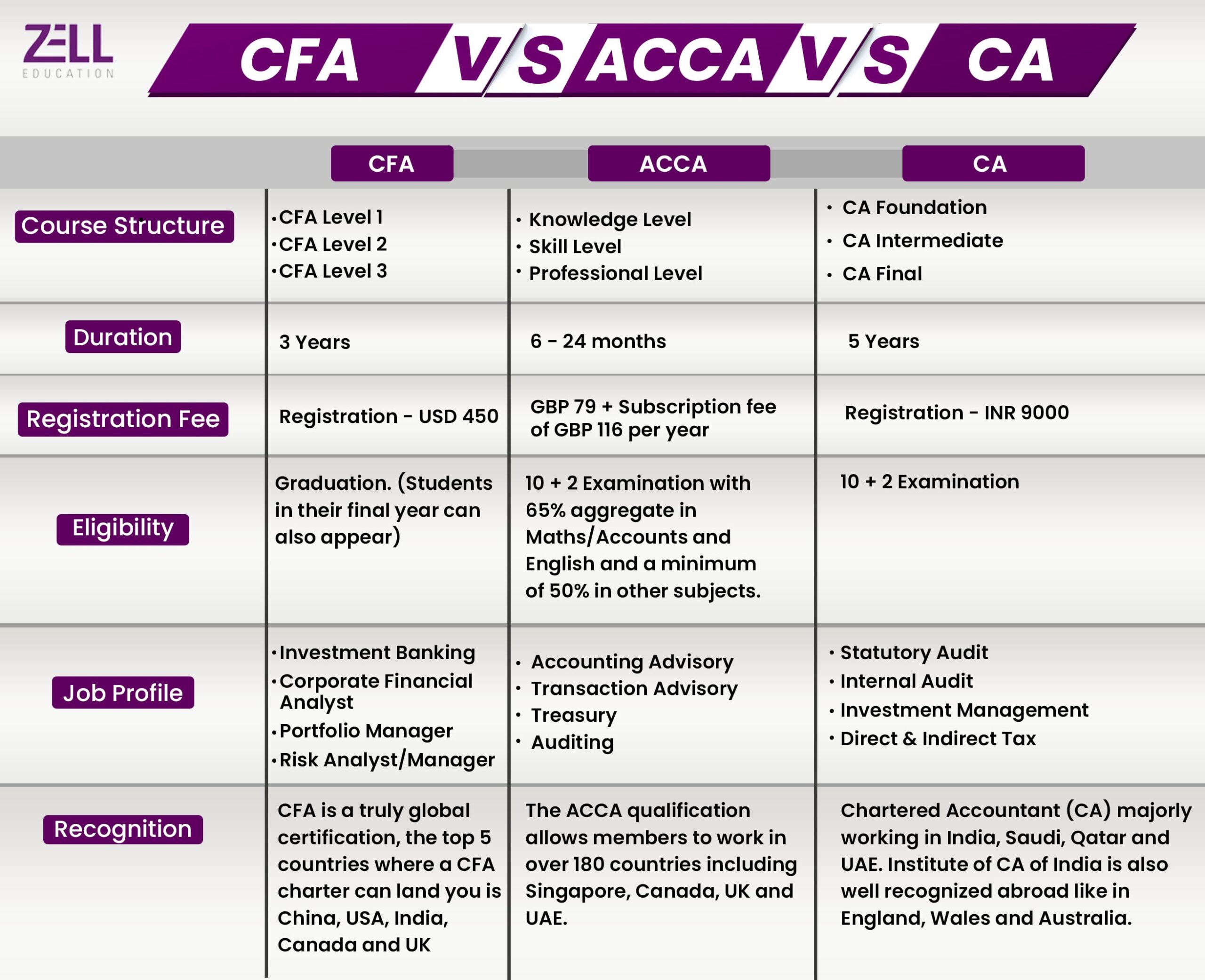
1. ACCA: What is it?
ACCA (Association of Chartered Certified Accountants) is a globally recognised professional accounting qualification. It equips individuals with expertise in finance, accounting, taxation, audit, and business management. ACCA members are in demand across multinational companies, financial firms, and consulting firms worldwide.
2. CFA: What is it?
CFA (Chartered Financial Analyst) is a prestigious qualification focused on investment management, financial analysis, portfolio management, and risk assessment. It is awarded by the CFA Institute and is highly valued in the banking, asset management, and investment sectors globally.
3. CA: What is it?
CA (Chartered Accountant) is a professional accounting designation that focuses on taxation, auditing, financial reporting, and corporate laws. In India, the CA qualification is regulated by the Institute of Chartered Accountants of India (ICAI), and CAs are highly sought after in both corporate and public accounting sectors.
ACCA Vs. CFA: Which Course Is the Right One For You
To clear up the confusion and make an informed decision, one has to look into the differences and similarities between ACCA vs CFA. While they are both excellent courses recognised internationally, they differ in scope and work profiles. ACCA is the internationally recognisable alternative to completing CA in India. Both ACCA and CFA have similar course lengths, i.e., 24 to 36 months, and similar fresher salaries, i.e., 4 to 6 lakhs per annum.
After completing the ACCA Program, one can work in the future in sectors such as Risk Advisory, Accounting Advisory (IFRS), Valuations, Internal Audit, Mergers & Acquisitions, International Taxation, Transfer Pricing, Assurance, Forensic Auditing, Financial Reporting, etc. Completing the ACCA course means one learns about accounting, taxation, costing, auditing, and financial management. The majority of candidates take ACCA courses due to their flexibility in duration, the high exposure, and the value addition in India.
If one completes a course similar to CFA, they are equipped to work in the finance sector in profiles such as financial portfolio management, investments, equity, debt, wealth management, derivatives, etc. As a CFA, one can make a comfortable living for themselves as a Portfolio Manager, Wealth Manager, Hedge Fund Manager, Trader or Dealer in Derivatives, Investment Banker, Equity Research Analyst, and through the currency Markets, etc.
To know more about ACCA Vs. CFA, read our detailed article on ACCA vs CFA: Which Should You Study?
ACCA Vs. CA: Which Course Is the Right One For You
Completing an ACCA course in Delhi or Mumbai will give you a huge advantage over CA. After the inclusion of a very strong business paper, the students completing ACCA have a huge benefit. The great thing about this course is that you can join the course right after high school. You can start preparing for the papers right after the 11th standard. Even if you feel confused about which track you want to pursue, you can start with the ACCA during your bachelor’s, and after completing it, if you change your mind, you can start working on your CFA papers.
Companies such as the Big 4, namely KPMG, Deloitte, PwC, and EY, and other MNCs such as Grant Thornton, BDO, etc., are all hiring workers with successful ACCA certificate holders. Most of these companies consider ACCA as equivalent to CA in terms of profile, salary, designation, work format, etc. Recognised worldwide and highly sought after, the CFA candidates are recruited by the time they complete the Level 1 examination. Big international companies such as JP Morgan, Goldman Sachs, Morgan Stanley, Citibank, and Indian firms such as Motilal Oswal, Anand Rathi, etc., hire CFAs of all profiles and all levels.
The ACCA qualification is recognised in over 180 countries, including Canada, Singapore, and Australia. If you’ve made the decision to become a global CA and are contemplating your next move, we can help you take a step forward. Check out our Association of Chartered Certified Accountants (ACCA) course to learn more.
To know more about ACCA Vs. CA, read our detailed article on CA vs ACCA – Which Course is Better? Detailed Comparison
Planning to Pursue ACCA Accounting Career?
To Book Your Free Counselling Session
FAQs on ACCA vs CFA vs CA
Which qualification is better, ACCA, CFA, or CA?
The “best” credential depends entirely on your career goals. ACCA is ideal for global accounting roles, CFA for investment management, and CA for auditing and taxation in India.
How do the salaries of ACCA, CFA, and CA compare?
Salaries vary by role and location. Generally, CFA professionals often earn higher salaries in global finance roles, while a CA typically commands a good salary in India due to their specialisation in Indian laws.
Are the job opportunities different for ACCA, CFA, and CA?
Yes. ACCA opens doors in corporate finance globally. CA is the gold standard for auditing in India. CFA is best for investment analysis and portfolio management.
How long does it take to complete the ACCA, CFA, or CA?
CFA is the fastest at 1–2 years, while ACCA and CIMA are more extensive, usually taking 2–3 years to complete all exams and requirements.
Which of these is the most difficult to clear: ACCA, CFA, or CA?
The CA is often considered the most difficult due to its low pass rates and lengthy articleship. The CFA and ACCA are generally considered less difficult.
Are there any exam exemptions available for any of these qualifications?
Yes, you can get significant exemptions. For example, a qualified CA can get up to nine exemptions in ACCA, which drastically reduces the number of exams they need to take.

Current Role
Co-Founder & CEO at Zell Education
Education
- ACCA – Association of Chartered Certified Accountants, Finance (2011 – 2014)
- Bachelor of Commerce (BCom), Financial Markets from H.R. College Of Commerce & Economics (2010 – 2013)
Location
Mumbai, India
Expertise
ACCA Certified
Why Zell?
- • Largest Provider for Global F&A Courses
- • 4.6 Google Review Rating
- • 1000+ Students placed Annually
- • 500+ Active Hiring Partners
- • Placement Opportunities at the Big 4
- • 100+ Global & Indian Rank Holders
- • 100+ Faculty Network
Speak to A Career Counselor

Professionally reviewed by Harshit Morparia, ACCA & Executive at Ernst & Young
Zell's 10th Anniversary Offer - Avail a 10% Scholarship