
This comprehensive guide gives in-depth information on various aspects concerning investment banking, such as its role, salaries, needed skills and qualifications, possible career options, and current trends, as well as upcoming prospects.
Be it a fresher aspiring to start an investment banking career, a chartered accountant, an MBA student or even someone with no background in commerce, you can get acquainted with all aspects related to banking in this article.
Comprehensive Summary on ‘Investment Banking Career in India’
Investment Banking Career
An investment banking career offers high salaries, strong career mobility, and opportunities to work on large financial transactions.
Investment Banking Salary
Investment banking salaries in India depend on the role, employer type, technical expertise, and experience level, with compensation typically ranging from ₹8 LPA to ₹15 LPA for analysts, ₹15 LPA to ₹35 LPA for associates, and ₹40 LPA+ for senior investment banking professionals.
Investment Banking Career Paths
Investment banking career paths are divided into front-office, middle-office, and back-office functions.
Investment Banking Skills
Investment banking skill requirements include financial modelling, valuation, communication, and analytical thinking.
Investment Banking Companies
Top investment banking companies in India include global banks, Indian private banks, boutique firms, and Big 4 advisory divisions.
Investment Banking Trends
Investment banking trends in India are being shaped by AI, fintech, ESG finance, IPO growth, and GCC expansion.
Night owls, hectic financial transactions, billion-dollar merger deals, and intense boardroom negotiations – being an investment banker is considered among the most challenging but extremely lucrative professions in finance. In India, there are thousands of people who aspire to have an investment banking career owing to its good salary packages, international exposure, and numerous chances of career growth.
What is Investment Banking?
Investment banking refers to financial services rendered to corporates, government entities, and institutions in raising funds, managing mergers and acquisitions, and undertaking huge financial transactions. In simpler terms, investment banks act as the financial advisors and facilitators when it comes to handling complex operations by the corporations.
There has been an increase in the number of people interested in becoming investment bankers in India because of its thriving economy, startup culture, active initial public offering market, and constant foreign investments. All these factors ensure that there are plenty of prospects for individuals to be part of important business dealings.
Build Investment Banking Skills That Top Financial Firms Look For
 Connect with us now
Core Functions of an Investment Bank
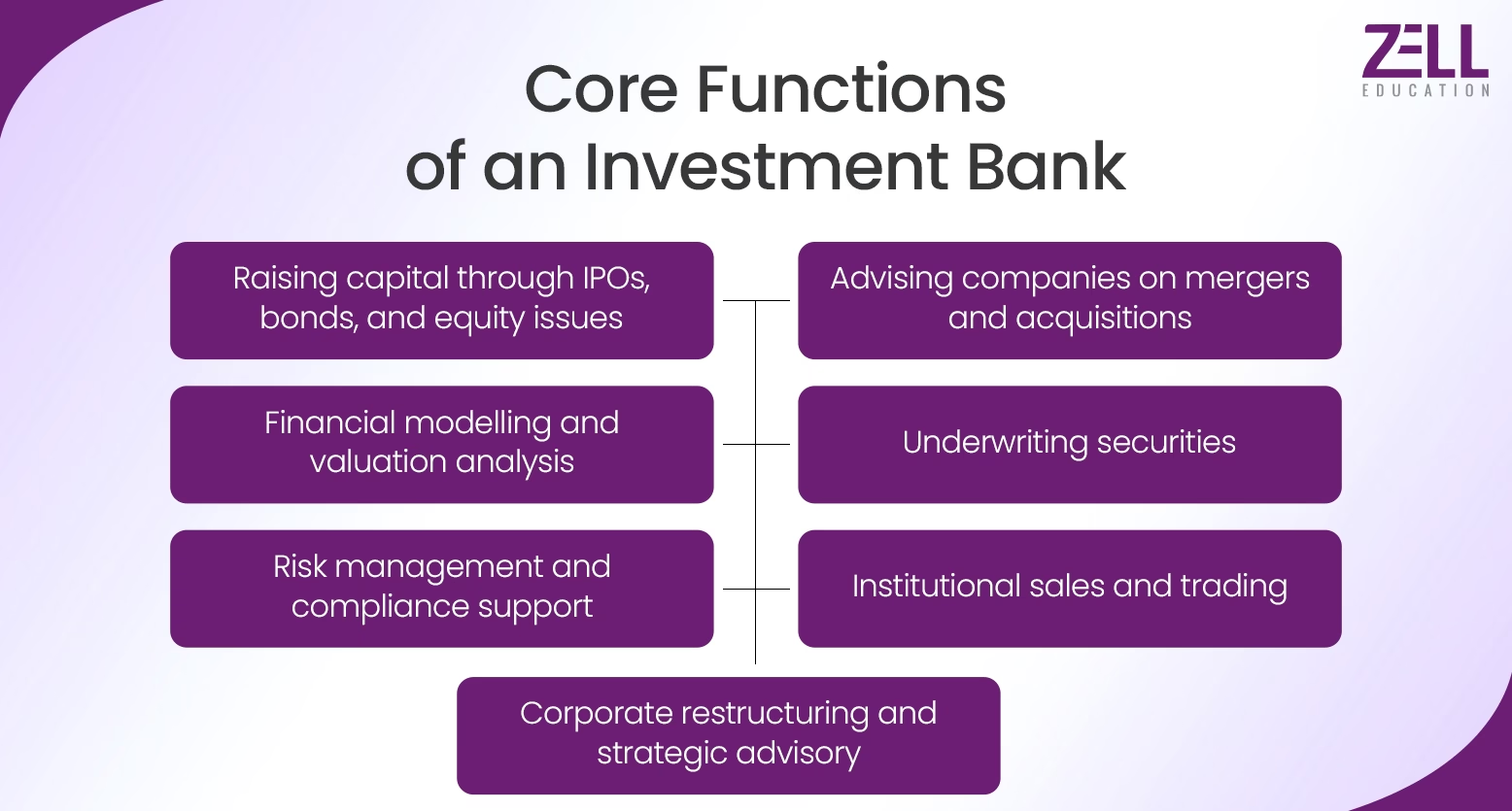
There is a list of core functions performed by investment banks, which make up the heart of the industry. They include:
- Raising capital through IPOs, bonds, and equity issues
- Advising companies on mergers and acquisitions
- Financial modelling and valuation analysis
- Underwriting securities
- Risk management and compliance support
- Institutional sales and trading
- Corporate restructuring and strategic advisory
Investment Banking in India – The Opportunity Landscape
The Indian market has seen considerable development over the last 10 years, thanks largely to the rise in corporate activity and foreign investments into the market. Among the factors contributing to the market growth are the following:
- India’s booming startup ecosystem
- Increased IPO and capital market activity
- Expansion of Global Capability Centers (GCCs)
- Rising cross-border transactions
- Growth in fintech and digital banking
- Demand for financial advisory services
Cities with the largest recruitment and activity are:
- Mumbai
- Bengaluru
- Hyderabad
- Pune
- Gurugram
- Chennai
Explore Career Options That Can Help You Enter Investment Banking Faster
 Connect with our Experts today
What Are the Different Investment Banking Career Paths?
An investment banking career can be generally categorised into three different streams, namely the front office, the middle office, and the back office. Each of these career tracks comes with unique sets of responsibilities, remunerations, and work-life balance.
| Function | Revenue Role? | Typical Pay | Work Hours | Entry Difficulty | Growth Ceiling |
| Front Office | Yes | Very High | Extremely Long | Very High | Excellent |
| Middle Office | Partial | Moderate to High | Moderate | Medium | Strong |
| Back Office | No | Moderate | Stable | Easier | Moderate |
Front Office – Revenue-Generating Roles
The front office consists of all jobs where people are involved in driving revenues and winning new clients. The typical job titles in investment banking from this part include:
- M&A Analyst
- Equity Capital Markets Analyst
- Sales & Trading Associate
- Corporate Finance Analyst
Key responsibilities:
- Pitchbook preparation
- Financial modelling
- Client interaction
- Deal execution
- Market analysis
Middle Office – Risk, Compliance & Control
Individuals working within this area should be concerned about controlling risks, enforcing compliance, and improving performance. The popular titles for employees here include:
- Risk Analyst
- Treasury Analyst
- Compliance Officer
- Financial Control Analyst
Key tasks:
- Regulatory reporting
- Risk assessment
- Trade validation
- Monitoring internal controls
Back Office – Operations & Infrastructure
This is the area which supports all activities involved in transaction handling and their flawless execution. Back-office jobs include the following:
- Operations Analyst
- Settlement Specialist
- Data Management Analyst
- Trade Support Associate
Responsibilities include:
- Transaction processing
- Reporting
- Documentation
- Operational workflow management
What is the investment banking hierarchy in India?
The hierarchy in India follows the conventional hierarchy that most multinational investment banks follow around the world. Here’s what you should expect:
- Analyst
- Associate
- Vice President (VP)
- Director
- Managing Director (MD)
Key Takeaway
Global multinational investment banks based in India generally maintain the same hierarchical levels. Local Indian banks may have different designations, like AGM (Assistant General Manager) and Deputy GM, but otherwise their levels of hierarchy are equivalent to each other’s.
Analyst
- Entry-level role
- Heavy focus on Excel, valuation, and research
- Long working hours
Associate
- Manages analysts
- Handles client coordination
- Reviews financial models
Vice President
- Leads transactions
- Manages teams
- Handles strategic client communication
Director
- Focuses on relationship management
- Generates business opportunities
- Oversees major deals
Managing Director
- Senior-most leadership role
- Drives revenue and client acquisition
- Leads strategic expansion
What Are the Major Investment Banking Job Roles and Responsibilities?
Upon exploring investment banking jobs, one should note that although job responsibilities vary significantly between departments, they all rest upon certain common features. Specifically, an ability to think analytically, knowledge of finance, and accuracy in work become crucial for any employee within the field.
Investment Banking Analyst – Daily Work
An investment banking analyst supports senior bankers during transactions and financial advisory projects. Daily responsibilities include:
- Building financial models
- Preparing pitch decks
- Conducting market research
- Company valuation analysis
- Assisting in M&A execution
Equity Research Analyst – Daily Work
As for equity research analysts, their job consists of analysing companies and sectors. Thus, they usually have to do the following on a daily basis:
- Studying company financials
- Preparing research reports
- Tracking stock market trends
- Building earnings forecasts
Risk & Compliance Analyst – Daily Work
The role of risk and compliance specialists consists of monitoring an organisation in accordance with relevant laws and guidelines. Therefore, their main daily responsibilities may be described as follows:
- Monitoring risk exposure
- Regulatory reporting
- Internal audits
- Compliance documentation
Operations Analyst – Daily Work
In addition to investment and corporate banking, a bank operates a number of other departments. Among them are operations that provide transactional support to other business units and deal with trades. In particular, operations analysts usually perform the following duties on a daily basis:
- Trade settlement
- Reconciliation processes
- Workflow monitoring
- Process optimization
What is the investment banking salary in India?
Various factors play into the compensation for an investment banking career in India, which include the experience level of the candidate, employer type, location of the job, and area of focus or specialisation of interest. On average, salaries for roles in the front office would be the highest, as such positions are revenue-generating roles.
Salary by Role and Seniority Level (India-Specific)
Investment banking compensation in India follows a steep growth curve, with bonuses often forming a significant portion of total earnings. The figures below are based on compensation data from leading platforms such as Glassdoor India, AmbitionBox, and industry recruitment reports published by investment banking and financial services recruiters.
| Role | Experience | Base Salary (₹ LPA) | Bonus Range | Total CTC Range | Notes |
| Analyst | 0–3 Years | 10–20 | 20–80% | 12–35 | Entry-level front office |
| Associate | 3–6 Years | 20–40 | 30–100% | 30–70 | MBA/CFA preferred |
| VP | 6–10 Years | 40–80 | 50–150% | 60–150 | Deal leadership |
| Director | 10–15 Years | 80–150 | High | 1–3 Cr | Client management |
| MD | 15+ Years | 1.5 Cr+ | Very High | 3 Cr+ | Revenue generation |
Salary by Employer Type in India
Compensation in investment banking varies significantly by employer type, with global investment banks generally offering the highest pay packages and bonuses, while domestic banks, advisory firms, and boutiques provide competitive opportunities based on deal flow, specialisation, and career progression.
| Employer Type | Typical Salary Range | Hiring Focus |
| Bulge Bracket MNC Banks | Highest | Premium talent |
| Indian Private Banks | Moderate to High | Domestic deals |
| Boutique IB Firms | Variable | Specialized advisory |
| Big 4 Advisory Arms | Stable | Transaction advisory |
Examples of top investment banking companies include:
- Goldman Sachs
- JP Morgan
- Barclays
- Kotak Mahindra
- HDFC Bank
- EY
- Deloitte
- KPMG
- PwC
Factors That Influence IB Salary in India
Key factors include:
- Technical expertise
- MBA or CFA qualification
- Employer brand
- Deal exposure
- Networking ability
- Financial modelling expertise
- City and location
What Skills Are Required for Investment Banking in India?
The domain of investment banking careers in India is very competitive from the perspective of skills needed. Employers are keen on a blend of technical expertise and effective soft skills.
Core Technical Skills
Some of the core technical investment banking skills that must be cultivated by candidates include the following:
- Financial modelling
- Valuation techniques
- Excel proficiency
- Accounting fundamentals
- PowerPoint presentation skills
- Financial statement analysis
- Market research
Soft Skills That Actually Matter in Indian IB
Soft skills will be essential in maintaining one’s performance and ensuring long-term career success. These include:
- Communication
- Attention to detail
- Time management
- Problem-solving
- Client handling
- Team collaboration
Emerging Skills for 2026 and Beyond
With technology changing the landscape, some of the upcoming skills are the following:
- AI-driven analytics
- ESG finance understanding
- Data visualization
- Fintech knowledge
- Automation tools
- Python and SQL basics
What Qualifications and Certifications Are Needed for Investment Banking in India?
Educational qualifications matter a great deal when one wants to make it into a career in investment banking, despite the growing significance of technical know-how in the profession.
Academic Degrees – What’s Actually Needed?
Mostly, individuals holding various degrees are found working in IB positions, namely:
- B.Com
- BBA
- Economics
- Engineering
- MBA Finance
- Chartered Accountancy
It makes a lot of difference to be educated at an excellent university.
CFA vs MBA vs CA vs FRM – Which is the Best for IB in India?
Each qualification can lead to a career in investment banking, but they differ significantly in terms of time commitment, cost, industry recognition, and the types of roles they best prepare you for. The right choice depends on whether you aim for front-office deal-making, equity research, advisory, or risk-focused roles.
| Certification | Duration | Cost (India) | Recognition | Best For | IB Role Fit |
| CFA | 2–4 Years | Moderate | Global | Equity research | Strong |
| MBA Finance | 2 Years | High | Very High | Front office | Excellent |
| CA | 4–5 Years | Moderate | High | Financial advisory | Strong |
| FRM | 1–2 Years | Moderate | Global | Risk management | Moderate |
Can You Enter IB Without an MBA or CFA?
Yes. It is definitely possible for one to join the investment banking world in India without an MBA or CFA certification. However, this requires that one be well equipped with certain qualities. These include:
- Strong financial modelling skills
- Internship experience
- Networking capability
- Market understanding
- Excellent communication skills
Most employers today look out for more than just education qualifications and degrees, and hence this is another way to make a point.
How Can You Enter Investment Banking in India?
There are multiple entry routes into an investment banking career in India depending on educational background and experience.
Campus Placement Route (Freshers)
Freshers often enter through:
- MBA campus placements
- Commerce colleges
- Engineering colleges
- Internship conversion programs
Most of the leading MBA colleges still remain the best places for recruitment.
Lateral Entry Route
Experienced professionals switch into investment banking from:
- Big 4 firms
- Consulting firms
- Corporate finance
- Equity research
- Chartered accountancy
Non-Commerce Students – Is Investment Banking Possible?
Yes. Non-commerce students can establish a promising career in the field of investment banking through getting themselves proper technical knowledge as well as suitable internship opportunities. In most cases, engineering graduates are hired since they have great analysis abilities and problem-solving skills.
What Do Recruiters Look For in India?
Recruiters usually evaluate the following:
- Financial modelling capability
- Excel proficiency
- Communication skills
- Internship experience
- Market awareness
- Certifications
- Problem-solving ability
Key Takeaway
The best way for Indian students to gain admission into the front office of investment banking in India is by gaining proper financial modelling skills along with some internships as well as an MBA degree or CFA Level 1.
Which Companies Hire Investment Bankers in India?
A diverse array of institutions engages investment bankers in the Indian market, such as multination banks, Indian banks, boutique advisory companies, and independent advisory firms.
Global Bulge Bracket Banks in India (GCCs)
Major international investment banks with operations in India consist of several prominent names. Examples of such banks include:
- Goldman Sachs
- JP Morgan
- Morgan Stanley
- Barclays
- Bank of America
- Citi
Such banks have large operations in the area of global capital markets and investment banking with large GCCs based out of Indian cities like Bengaluru, Hyderabad, and Mumbai.
Indian Banks with IB Divisions
Indian banks with investment banking operations include:
- Kotak Mahindra Capital
- ICICI Securities
- Axis Capital
- SBI Capital Markets
- HDFC Bank
Boutique Investment Banks in India
Boutique firms specialise in niche transactions and advisory services. Examples include:
- Avendus Capital
- O3 Capital
- Allegro Capital
Big 4 Transaction Advisory (IB Adjacent)
Big 4 firms also offer IB-adjacent careers. Major firms include:
- Deloitte
- EY
- PwC
- KPMG
What Are the Exit Opportunities After Investment Banking in India?
Further investigation into the subject matter will provide insights into how one’s career in investment banking could become the foundation of a long-term and promising professional life.
Private Equity (PE)
PE firms hire bankers for:
- Deal execution
- Financial analysis
- Portfolio management
Venture Capital (VC)
VC firms prefer candidates with startup and market evaluation expertise.
Corporate Finance / CFO Track
Many professionals transition into leadership finance roles within corporations.
Hedge Funds & Asset Management
Investment bankers often move into:
- Portfolio management
- Public market investing
- Institutional asset management
Entrepreneurship / Fintech
Many professionals launch the following:
- Financial consulting firms
- Fintech startups
- Wealth management platforms
Global Mobility
Investment banking in India can also create international opportunities in:
- Singapore
- Dubai
- London
- Hong Kong
- New York
What Are the Latest Investment Banking Industry Trends in India?
The investment banking trends affecting India’s industry include technological advancements, regulatory changes, and expansion of capital markets.
GCCs as India’s IB Talent Powerhouse
India is one of the global leaders when it comes to operations and analytics services, which makes the country a powerhouse of talent for the investment banking industry.
India’s IPO & Capital Markets Boom
Due to the increased number of IPOs, there is growing expansion of India’s capital markets, hence increasing demand for professionals working in this area.
SEBI Reforms and Regulatory Landscape
Some recent regulatory changes are likely to shape how firms operate in terms of compliance and corporate governance.
ESG and Green Finance in India
ESG (environmental, social, and governance) and sustainable investing are becoming a popular trend of advisory activities in India.
AI and Automation in Indian IB
AI tools are improving:
- Financial forecasting
- Data analysis
- Compliance monitoring
- Automation workflows
Fintech × Investment Banking Convergence
Traditional investment banking job companies are increasingly collaborating with fintech platforms.
Is Investment Banking a Good Career in India?
While being in investment banking in India may lead to huge earning capacity and some global prestige, it is also quite demanding and associated with hard work.
| Pros | Cons |
| High salary potential | Long working hours |
| Global exposure | High pressure |
| Strong exit opportunities | Competitive hiring |
| Fast career growth | Work-life imbalance |
| Premium networking | Stressful deadlines |
Who Should Choose Investment Banking in India?
Investment banking may be the right choice for those who:
- Enjoy finance and markets
- Can handle pressure
- Prefer fast-paced work
- Have strong analytical skills
- Want high-income potential
Who Should Consider Alternatives?
Alternative careers may suit people seeking:
- Better work-life balance
- Lower-stress environments
- Creative work profiles
- Stable working hours
Conclusion
An investment banking career in India has emerged to be an extremely wide-ranging profession which provides ample scope to any individual who wishes to gain mastery in technology, work under pressure, and learn all the time. There are a large number of different kinds of job profiles available for any recent graduate, charted accountant, MBA, engineer, or experienced professional who wishes to pursue a career in this domain.
However, there are many things required other than having relevant credentials in order to succeed in investment banking jobs in India. These include acquiring necessary skills through experience, internships, good communication skills, and advanced financial modelling skills. Although such a career path can prove to be demanding at times, it also comes with lucrative remuneration packages and several other perks.
Students and professionals who are interested in exploring a career in the investment banking profession will find that this is an especially lucrative option for people with a liking towards analysis, fast-paced environments, and career-orientated jobs. Taking wise decisions regarding investment banking certification, gaining practical exposure, and developing technical skills are some of the ways to benefit from such a career choice.
FAQs on Investment Banking Career in India
What is the starting salary in investment banking in India?
Investment banking starting salaries in India typically lie within the range of ₹10-20 LPA for analyst-level front-office roles.
Which qualification is best for investment banking in India – CFA, MBA, or CA?
An MBA in finance is preferred for a front-office profile, whereas a CFA/CA is extremely valued for a research and advisory role.
Can a non-commerce student enter investment banking in India?
Non-commerce students may join investment banking in India through certifications, internships, and proficiency in finances.
What is the difference between front office, middle office, and back office in investment banking?
Revenue generation by the front office, risk management by the middle office and operations by the back office make their differentiation.
How many hours do investment bankers work in India?
Typically front office investment bankers work 70-100 hours per week based upon ongoing deal activities.
Which cities have the most investment banking jobs in India?
Investment banking job opportunities are abundant in Mumbai, Bengaluru, Hyderabad, Gurugram & Pune.
What are the exit opportunities after investment banking in India?
Private equity, venture capital, corporate finance, hedge funds, fintech and entrepreneurship are popular exit options.
Is investment banking stressful?
Investment banking is definitely a stressful career owing to the demanding work schedule and stringent deadlines.
How do I switch to investment banking from a CA background?
A CA professional can change his/her career to investment banking through valuation, transaction advisory, and corporate finance.
What does an investment banking analyst do in India on a daily basis?
Work on modelling, research, valuation, presentation and transaction-related activities makes up the day’s routine.

Current Role
Co-Founder & CEO at Zell Education
Education
- ACCA – Association of Chartered Certified Accountants, Finance (2011 – 2014)
- Bachelor of Commerce (BCom), Financial Markets from H.R. College Of Commerce & Economics (2010 – 2013)
Location
Mumbai, India
Expertise
ACCA Certified
Why Zell?
- • Largest Provider for Global F&A Courses
- • 4.6 Google Review Rating
- • 1000+ Students placed Annually
- • 500+ Active Hiring Partners
- • Placement Opportunities at the Big 4
- • 100+ Global & Indian Rank Holders
- • 100+ Faculty Network
Speak to A Career Counselor
Zell's 10th Anniversary Offer - Avail a 10% Scholarship