
The CFA Level 2 exam is a milestone on the path to gaining the CFA charter. Below is a month-by-month CFA Level 2 study plan, active learning techniques, tips on mock tests, and how to prepare to pass.
Key Takeaways
The CFA Level II exam is a 4-hour, 24-minute computer-based test.
The CFA Institute reports study time of 328 hours for the Level II exam.
In 2026, the CFA Level II exam is offered in May, August, and November.
Comprehensive Summary: CFA Level 2 Study Plan Guide
- CFA Timeline: A CFA Level 2 study plan should span four to six months.
- Level 2 Hours: Most candidates need three hundred focused hours for Level 2 preparation.
- CFA Order: Study Ethics, FSA, Equity, and Fixed Income first strategically.
- Level 2 Practice: Practise vignette questions regularly to improve speed and accuracy.
- CFA Revision: Reserve final weeks for mocks, formulas, and weak-topic revision.
- Level 2 Discipline: Consistent daily study habits greatly improve CFA Level 2 success chances.
Need a CFA Level 2 Study Plan? Get Expert Help Today
 Talk to Advisor
Understanding the CFA Level 2 Exam Structure
Many view the CFA Level 2 exam to be the toughest part of the CFA program. While Level I tests general knowledge and understanding, Level II focuses on the application and analysis of tools and concepts of investing.
It is composed of item sets (vignette-style questions), to each of which multiple-choice questions are attached. There are 4–6 questions in each vignette, and the test is divided into two sessions of 44 questions each, amounting to 88 questions.
It’s because of that switch in question type that a formal CFA Level 2 study plan is necessary. Without a methodology and time frame, test takers are generally overwhelmed by the nature of the CFA Level 2 notes.
CFA Level 2 Topic Weightage & Study Priority
Use CFA Level 2 topic weightage to prioritise study hours, difficult subjects, and high-scoring areas for better preparation.
| Topic | Weightage | Difficulty | Priority |
| Ethical and Professional Standards | 10–15% | Medium | Very High |
| Financial Statement Analysis | 10–15% | High | Very High |
| Equity Investments | 10–15% | High | Very High |
| Fixed Income | 10–15% | High | Very High |
| Portfolio Management | 10–15% | Medium | High |
| Quantitative Methods | 5–10% | High | High |
| Derivatives | 5–10% | High | High |
| Economics | 5–10% | Medium | Medium |
| Corporate Issuers | 5–10% | Medium | Medium |
| Alternative Investments | 5–10% | Low-Medium | Medium |
Source for CFA Level 2 topic weightage: CFA Institute/Candidate Resources
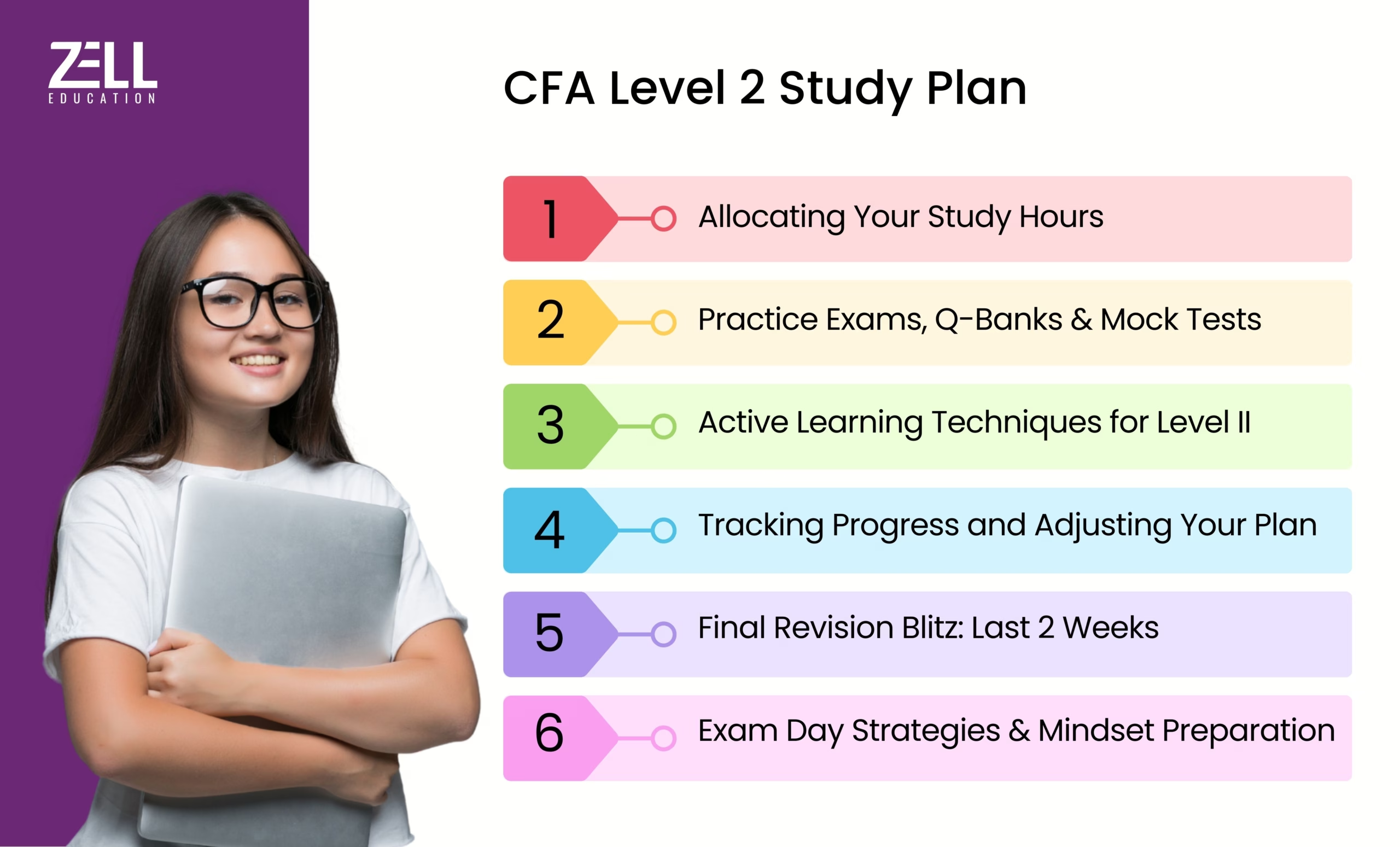
Allocating Your Study Hours: A Timeline Approach
Applicants are supposed to spend 300–350 study hours to prepare for the CFA Level 2 exam. It’s not the number of hours that counts but how they are distributed. A strategic four-month study plan will allocate time according to topically weighted material, difficulty of material, and your relative strengths.
Let’s look at a sample breakdown:
Month 1: Ethics, Quantitative Methods, and Economics
Ethical and Professional Standards is a required part of the CFA program, and it’s particularly crucial in Level II because it has a bearing on borderline pass/fail determinations.
Focus Areas:
-
- Code of Ethics & Standards
- Soft dollar standards
- Research objectivity standards
- Time-weighted return vs. money-weighted return (Quant)
Study Tips:
- Start each week with an ethics reading to reinforce the ideas over time.
- Use CFA Level 2 notes to summarise long chapters.
- Use ethics-based vignettes to practice from CFA Level 2 mock exams.
The Level II Quantitative Methods and Economics certainly has a strong emphasis on statistical modelling and economics. You should be able to read regression results and understand macroeconomic data.
Month 2: Financial Statement Analysis and Corporate Issuers
At Level II, Financial Reporting and Analysis (FSA) gets more rigorous with increased emphasis on analysing financial statements based on multi-period models and valuation methods.
Key Concepts:
- Intercorporate investments
- Employee compensation
- Multinational operations
Corporate issuers have crossover with FSA but extends further into capital structure, dividend policy, and corporate governance.
How to Approach:
- Distinguish differences in accounting standards utilising CFA Level 2 study notes.
- Utilise practice sets and end-of-chapter problems.
- Break down lengthy FSA readings by watching videos or webinars.
Utilise this month to intensively study these core CFA Level 2 syllabus.
Month 3: Equity Valuation, Fixed Income, and Derivatives
One of the most theory-based months of your CFA study plan.
Equity Valuation covers:
- Dividend Discount Models (DDM)
- Free Cash Flow to Equity (FCFE)
- Residual Income and Market-Based Valuations
Fixed Income shifts focus toward:
- Credit analysis
- Term structure models
- Securitisation
Derivatives introduce:
- Forward contracts, swaps, and options
- Pricing and valuation of derivatives
- Risk management strategies
Tips:
- Examine them collectively to see how they are connected within the CFA program.
- Apply a concept map to link valuation techniques.
- Solve challenging examples using your own spreadsheet modeling.
It’s usually the month that determines if the CFA Level 2 exam will feel manageable or overwhelming. Lock down concepts now to not panic later.
Month 4: Alternative Investments, Portfolio Management, and Review
Alternative Investments and Portfolio Management are lesser-weighted topics but are often tested in complex vignettes. It’s also your month to start an overall review and start doing CFA Level 2 mock tests.
Topics to Focus On:
- Hedge funds, private equity, real estate valuation
- Portfolio concepts like CAPM, active/passive strategies, and risk management
Action Plan:
- Conduct topic-based timed tests.
- Carefully review errors and refer back to corresponding CFA Level 2 notes.
- Begin doing full CFA Level 2 mock examinations each weekend.
Your study notes from the previous months of CFA Level 2 will assist you in revising effectively now.
Build a 4 Month CFA Level 2 Plan Before Exams Begin
 Speak to Mentor
Practice Exams, Q-Banks & Mock Tests
Theory is reinforced by practice. During your last month, a minimum of 25–30% of your time must go into doing mock CFA Level 2 exam topics and Question Bank questions.
Best Practices:
- Use CFA Institute’s official mock exams first.
- Supplement with third-party vendors (Kaplan, Wiley
- Mimic actual testing environments.
- Check over all responses, including those that you correctly answered.
Qbanks are convenient, but actual mocks simulate actual stress.
Active Learning Techniques for Level II
To understand challenging CFA Level 2 subjects, active learning methods are more effective than passive reading.
Techniques to Use:
- Spaced Repetition: Use Anki or review logs to revisit formulas.
- Active Recall: Quiz yourself daily.
- Teach-Back Method: Explain tough concepts aloud to a friend or mentor.
- Mind Mapping: Visualise interlinked topics like valuation models.
These methods are to be included in your CFA Level 2 study plan from day one.
Tracking Progress and Adjusting Your Plan
It is acceptable to make changes to the plan. Certain subject matters take longer than anticipated. Use a dashboard or spreadsheet to monitor:
- Study hours per topic
- Weekly goals
- Mock exam scores
- Topic mastery (e.g., confidence rating 1–5)
If you fall behind, reduce the amount of passive reading and switch to CFA Level 2 mock questions or summary sheets of your CFA Level 2 study notes.
Final Revision Blitz: Last 2 Weeks
During the last 14 days, the entire focus must be on application and review. There must not be any new concepts introduced.
Final Phase Strategy:
- Take 2 full CFA Level 2 mock exams within strict time constraints.
- Review each error using your CFA Level 2 notes.
- Emphasise ethics daily; it’s heavily weighted and frequently dictates borderline passes.
You must also concentrate on formulaic areas and weak subjects uncovered by mock analysis.
Exam Day Strategies & Mindset Preparation
Mental preparation is crucial on exam day. Even with the best possible CFA Level 2 study plan, weaker mental preparation can impair performance.
Tips for Exam Day:
- Come early, and bring everything that is needed (passport, calculator, etc.).
- Carefully read each vignette before trying the questions.
- Use scratch paper to summarise facts from the case.
- Don’t get stuck on a single question and move on later.
Remain relaxed, have faith in your readiness, and recall that you have done the hard part.
Post-Exam: From Candidate to CFA Charterholder
After completing the CFA Level 2 exam, results are expected within 6–8 weeks. Assuming you pass, you can then prepare to pursue Level III and ultimately achieve the CFA certification status. Whether you pass on your first try or retake the test, view this process as a transformative learning process.
Conclusion
A disciplined what is CFA and CFA Level 2 study plan can significantly improve your chances of success. Focus on high-weight topics, practise vignette-style questions regularly, and revise formulas consistently. Use mock exams to build speed and accuracy. With structured preparation, smart strategy, and expert guidance from Zell Education, clearing Level 2 becomes achievable.
FAQs on CFA Level 2 Study Plan
How long should a CFA Level 2 study plan be?
A CFA Level 2 study plan should ideally span four to six months.
How many hours are needed for CFA Level 2 preparation?
Most candidates need around three hundred focused hours for proper preparation.
Which topic should I study first for CFA Level 2?
Begin with Ethics and Financial Statement Analysis for stronger foundations.
Can I clear CFA Level 2 in three months?
Yes, disciplined daily study can help clear it within three months.
How should I revise during a CFA Level 2 study plan?
Reserve final weeks for mocks, formulas, and weak-topic revision.

Current Role
Co-Founder & CEO at Zell Education
Education
- ACCA – Association of Chartered Certified Accountants, Finance (2011 – 2014)
- Bachelor of Commerce (BCom), Financial Markets from H.R. College Of Commerce & Economics (2010 – 2013)
Location
Mumbai, India
Expertise
ACCA Certified
Why Zell?
- • Largest Provider for Global F&A Courses
- • 4.6 Google Review Rating
- • 1000+ Students placed Annually
- • 500+ Active Hiring Partners
- • Placement Opportunities at the Big 4
- • 100+ Global & Indian Rank Holders
- • 100+ Faculty Network
Speak to A Career Counselor
Zell's 10th Anniversary Offer - Avail a 10% Scholarship