
Comprehensive Summary of the CIMA Exemptions
- Purpose of CIMA Exemptions: CIMA course exemptions recognise your prior learning and qualifications to significantly reduce the number of exams required for certification.
- CIMA Exemptions Eligibility: Exemptions are granted based on existing academic degrees (like Accounting or an MBA) or professional certifications (such as ACCA, CA, or CMA).
- CIMA Exemptions Benefits: Applying for exemptions allows you to finish the qualification earlier, saving you substantial time, effort, and money on unnecessary exams.
- CIMA Exemptions for MBA Fast-Track: An MBA qualification is highly valued, potentially exempting you from up to 11 exam papers and allowing you to directly attempt the CIMA Gateway Exam.
- CIMA Exemptions for Professional Recognition: Completing certifications like ACCA can earn you up to 11 exemptions, acknowledging the mutual overlap between the accounting qualifications.
- CIMA Exemption Fees: CIMA has a beneficial policy where no exemption fees are charged for exams that you are qualified to bypass based on your prior learning.
Are you currently in the process of preparing for the esteemed CIMA examinations? Is it possible to bypass a few CIMA exams if you possess specified degrees or qualifications? That sounds too wonderful to be true, right? If you possess the necessary qualifications, you may be eligible for exemptions from certain exams under the CIMA.
You will get a concession from taking specific CIMA examinations when you apply for and qualify for an exemption. This is a relief for most applicants, considering the demanding nature of the CIMA certification exams. Read on to learn more about CIMA exemptions, including why you need an exemption and CIMA exemption fees and regulations.
What is CIMA?
CIMA (Chartered Institute of Management Accountants) is a UK-based professional body that offers the CIMA qualification, a globally recognised certification in management accounting. It focuses on business strategy, financial management, performance analysis and risk management. CIMA-certified professionals often work in corporate finance, FP&A, business consulting and strategic roles within organisations.
Understanding CIMA Course Exemptions
The course exemptions of CIMA are specially formulated to help reduce the time that is taken to achieve a qualification when candidates hold other academic or professional qualifications in accountancy, finance, or management. Exemptions offer the chance to forego sitting for specific exams based on qualifications such as a Bachelor’s degree in relevant fields or professional qualifications like ACCA or CMA.
Through these exemptions, one can save time by reducing the number of exams to be taken and enabling people to make headway toward obtaining the CGMA designation quickly. Knowing what exemptions apply to your qualification will also help you progress easily toward becoming a member of CIMA.
Which Exams Could I Be Exempt From in CIMA?
CIMA offers exemptions based on your previous qualifications, allowing you to skip certain exams in the CIMA Professional Qualification pathway. The exemptions typically apply to the Certificate in Business Accounting and Operational-level exams.
You may be exempt from exams if you have:
- A Commerce or Accounting Degree: May earn exemptions from the Certificate level and possibly some Operational level exams.
- MBA or Master’s in Finance: Could receive exemptions up to the Management level.
- ACCA, CA, CPA, or CMA (USA): May qualify for multiple exemptions across all levels depending on your certification.
- ICAI or ICMAI (India): Often granted several exemptions, especially in the foundation and operational stages.
To check your exact exemptions, use CIMA’s official Exemption Calculator, where you can enter your qualification and institution details for accurate results.
Why Should You Apply for an Exemption?
If you are eligible for CIMA exemptions, you should opt for them for the following reasons:
- Exemptions will help you finish your course earlier than usual. This way, you can give a jump-start to your career and have the edge over your peers.
- As a student preparing for CIMA, you will have a tight schedule. Getting a few exams out of your way will save time, effort, and money.
- CIMA values all your hard work to achieve a degree. Exemptions are a token of recognition, which can boost your overall morale.
CIMA Exemptions for Graduation
A candidate can be exempt from taking a few CIMA exams if they have a Bachelor’s degree in Accounting, Finance, Management, Economics or other relevant fields.
The following table summarises the exemptions corresponding to the graduation degrees:
| Degree | Exemptions |
| Accounting | All certificate-level exams |
| Business General | BA1 Fundamentals of Business Economics
BA4 Fundamentals of Ethics, Corporate Governance and Business Law |
| Finance | BA1 Fundamentals of Business Economics
BA2 Fundamentals of Management Accounting BA3 Fundamentals of Finance Accounting |
| Economics | BA1 Fundamentals of Business Economics |
| Management | BA1 Fundamentals of Business Economics |
| Commerce | All certificate-level exams |
| Business Studies/Administration | All certificate-level exams |
CIMA Exemptions after MBA
The CMA certification attests to a candidate’s proficiency in financial accounting and strategic management, which CIMA acknowledges and exempts candidates from passing certain tests.
Though CIMA exemptions after the MBA appear appealing because you can avoid taking 11 exam papers, the pass rate is only 18%. To take the CIMA Gateway Exam, you must have a solid understanding of the concepts up to the Management Case Study Level.
CIMA Exemptions for ACCA
In particular, anyone who has passed all 14 ACCA exams enjoys exemption from four Certificate Level exams, three Management Level exams, and three Operational Level exams, which indeed includes the one called the Operational Level Integrated Case Study Exam. This mutual recognition underlines the overlap in content between both qualifications and allows professionals from ACCA to further their careers in management accounting effectively.
CIMA exemptions for CA
CIMA exemptions for CA mainly depend on two factors: the kind of CA qualification a candidate has and the number of years of work experience they possess.
Take this example for a better understanding. A candidate with a level 5 certificate in Accounting from SAICA and a SAICA member with more than three years of experience will qualify for different CIMA exemptions.
CIMA exemptions for CMA
The CMA certification attests to a candidate’s proficiency in financial accounting and strategic management, which CIMA acknowledges and exempts candidates from passing certain tests.
To avail of the exemptions, you must check the CIMA database, which states the year of qualification and the modules required for exemptions. However, CIMA exemptions for US CMA and CMA India may vary, as one has global recognition while the other is only recognised in India.
Planning to pursue CMA Course?
To Book Your Free Counseling Session
CIMA exemptions for AAT
Many candidates go for the AAT certification to hone their accounting skills. Some even pursue the CIMA certification after AAT for better job prospects. Though it may seem like a long route, it is worth a try.
You can get exemptions from a few CIMA Certificate Level exams if you already have a Level 2 or Level 3 diploma in AAT. However, a candidate with an AAT Level 4: Technician/Diploma can bypass all the exams under the CIMA Certificate Level.
CIMA Exemptions for CFO
If you are a senior management professional like a CFO or CEO with ten years of business and finance experience, you can directly take the Strategic Case Study Exam to achieve the CIMA certification. This exemption falls under CIMA’s CFO program.
CIMA Exemption Fees
CIMA charges no exemption fees for CIMA-registered students. If you have relevant prior qualifications, then you need not sit for those particular exams and incur extra costs. It is such a beneficial policy, making the qualification process more accessible and encouraging professional minds to explore CIMA membership.
Checking CIMA Eligibility for Exemption
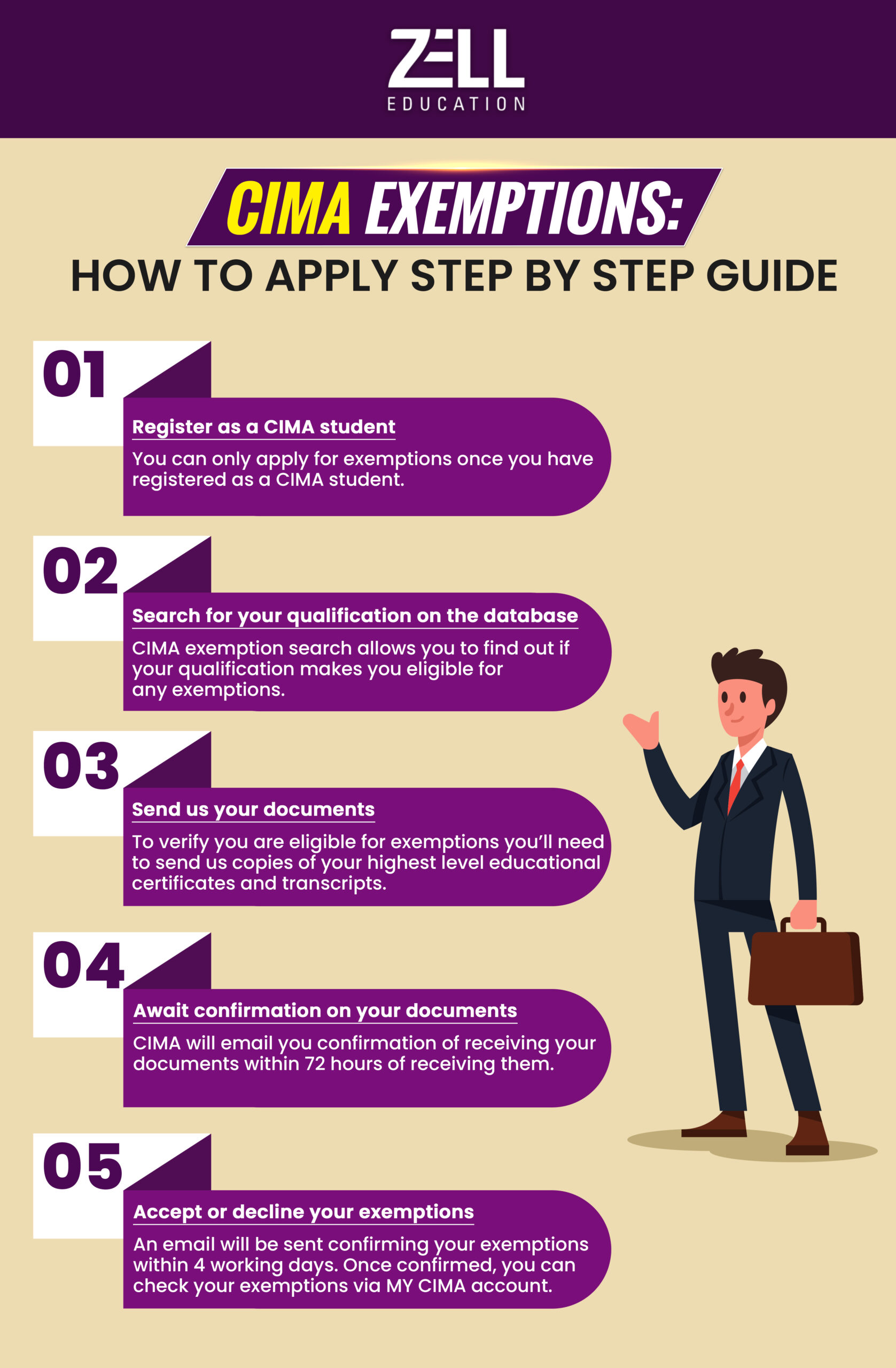
To confirm eligibility for CIMA exemptions, one has to register as a CIMA student since only registered candidates can apply. Access the CIMA database to see how your qualifications align with exemption criteria. You will need documentation, such as transcripts and confirmation, which normally takes 10-20 working days.
CIMA Exemptions: A Big Deal
CIMA exemptions simplify the route to achieving the Chartered Global Management Accountant (CGMA) designation. Time is saved, energy is conserved and financial expenditure on exams is avoided. This flexibility encourages professionals with the background to pursue CIMA and improve prospects.
What Exams Might I Be Exempt From?
Exemptions are awarded based on prior qualifications. Graduates in accounting, finance, or business may be exempt from certificate-level tests, while those with an MBA can directly sit for the strategic level. ACCA, CA, and CMA professionals have their exemptions based on CIMA rules.
Want To Know About CIMA Exemption?
Book Your Free Counselling Session Today!
Conclusion
In a nutshell, CIMA exemptions provide excellent opportunities for candidates to tailor the route they need to take to acquire the CGMA qualification. CIMA simply saves time and costs by recognising prior learning and qualifications but provokes professionals towards developing their skills in management accounting.
Whether holding an MBA, ACCA, or any other applicable qualification, checking on the exemptions can make a difference in your progress within your career.
FAQs on CIMA Exemptions
How do I get exemptions in CIMA based on my current qualification?
To get CIMA exemptions, first register as a CIMA student. Then, use their online exemption calculator, submitting your academic transcripts or professional qualification certificates. CIMA will review these and grant you exemptions for exams that match your prior learning.
How many exemptions does CIMA offer if I’ve completed ACCA?
Completing all 14 ACCA exams can earn you up to 11 exemptions from CIMA, including the four certificate-level and seven professional-level exams, allowing you to start at the strategic level. It’s an optimal way to fast-track your CIMA qualification.
Is CIMA considered equivalent to a degree in the UK or globally?
Yes, CIMA is highly respected. The full qualification is considered equivalent to a master’s degree in the UK and is valued by employers globally.
Can CIMA lead to exemptions or fast-tracking into other courses like CPA or CFA?
While CIMA doesn’t grant exemptions for the CFA or CPA exams, your CIMA knowledge will give you a big advantage in your studies.
Which is better: CIMA or ACCA for a global finance career?
Both CIMA and ACCA are fantastic for a global finance career. ACCA is broader, covering audit and tax, which is beneficial for public practice. CIMA is more specialised in management accounting and business strategy, making it ideal for industry leadership roles. Choose based on your passion.
Is CIMA still worth pursuing in today’s finance job market?
Yes, CIMA is definitely worth pursuing. It’s a globally recognised qualification that’s highly valued by employers for its focus on management accounting and business strategy skills. It will give you a big advantage.
What’s the average salary of a CIMA-qualified professional in India?
The average salary for a CIMA-qualified professional in India is quite high. While a fresher might start at around ₹4-6 lakhs, an experienced professional can earn over ₹25 lakhs per year, depending on their role and the company.

Why Zell?
- • Largest Provider for Global F&A Courses
- • 4.6 Google Review Rating
- • 1000+ Global Placement Partners
- • Placement Opportunities at the Big 4
- • 100+ Global & Indian Rank Holders
- • 100+ Faculty Network
- • 10,000+ Students Placed
Speak to A Career Counselor
Zell's 10th Anniversary Offer - Avail a 10% Scholarship