
Understanding the Impact of ACCA Exemptions on Your Global Career
Gaining credit for previous studies allows students to accelerate their professional journey and complete the prestigious international qualification faster while maintaining the high standards required by global accounting firms.
- Eligibility for ACCA Exemptions: Graduates from recognised universities and professional bodies can claim credit for up to 9 papers based on their previous academic curriculum and relevant financial qualifications.
- Benefits of ACCA Exemptions: Claiming these credits helps students save significant study time and reduces the total number of examinations they must pass to earn their professional global accounting charter.
- Applying for ACCA Exemptions: Candidates must submit their official degree certificates and detailed mark sheets to the professional body to receive a formal evaluation of their previous educational background and credits.
- Fees for ACCA Exemptions: Students are required to pay a specific fee for every single paper they skip to maintain their active status and progress towards the professional strategic level exams.
- Knowledge and ACCA Exemptions: While skipping papers is faster, you must ensure your foundational knowledge is strong enough to handle the advanced technical subjects that appear in the final professional-level tests.
- Value of ACCA Exemptions: Top multinational corporations recognise the full value of your certification regardless of the number of papers skipped as long as you demonstrate high technical expertise during interviews.
ACCA is one of the most sought-after accounting certifications in the world. A study by the Business Research Company forecasts that the accounting services market will achieve a growth of 4.2% CAGR in 2027, making this a profitable opportunity for accounting aspirants. ACCA awards exemptions to qualified candidates based on rigorous assessments.
However, candidates are often faced with the dilemma of whether applying for ACCA exemptions will lower the value of the certification. This blog will guide you through ACCA exemptions, the criteria for ACCA exemptions and the benefits and downsides of exemptions. Read on and evaluate if you want to apply for the exemptions or take all the exams.
What is ACCA?
The ACCA full form is Association of Chartered Certified Accountants (ACCA) which confers the Chartered Certified Accountant certification. The cutting-edge skill sets of an ACCA make them valuable assets in the industry.
The exam is split into three parts – Knowledge, Skill and Professional. Aspirants can give the Skill and Professional exams in March, June, September and December, while they can take the CBE (computer-based exam) Knowledge exam throughout the year.
ACCA candidates get lucrative salary packages with an average base salary of Rs. 6 LPA. Cracking the ACCA exam is not easy, but your accounting career will have almost no hurdles once you do.
Take a look at our blog, Top 5 Benefits of Getting an ACCA Certification, to learn more about the utility of the ACCA certification.
ACCA Exemptions
ACCA exemptions imply that aspirants might not have to sit for all the exams if they already possess some qualifications. In other words, they can skip some levels and start at a level aligned with their current skills and knowledge. The ACCA is very rigorous regarding the exemptions to ensure that an applicant’s prior learning matches the skills required for the ACCA certification.
Exemptions Information for ACCA Students
ACCA offers exam exemptions to students depending on the different qualifications of the candidates. With the ACCA exemptions, aspiring candidates will be able to complete the course within a lesser duration and with lower fees. Candidates who have joined the ACCA course just after passing Class 12th will have to attempt and pass all 13 exams. But B.Com and M.Com degree holders can enjoy up to 5 exam exemptions depending upon the subjects they have studied.
Inter-CA candidates or someone who has cleared IPCC can get an exemption from 5 exams. If the candidate has cleared the final CA exam, then ACCA offers an exemption of 9 exams.
Apart from the major degrees, ACCA exemptions are also for candidates with various other qualifications. For example, a US CPA certificate holder will enjoy an exemption from 8 exams.
Similarly, candidates who have completed CMA in India and also have experience of 5 years in relevant fields will get an exemption of 9 exams. Candidates who have a US CMA certificate get exempted from 3 exams. An Association of Chartered Certified Accountants Exemptions Calculator helps in understanding the exemptions that a candidate can enjoy.
Types of Exemptions
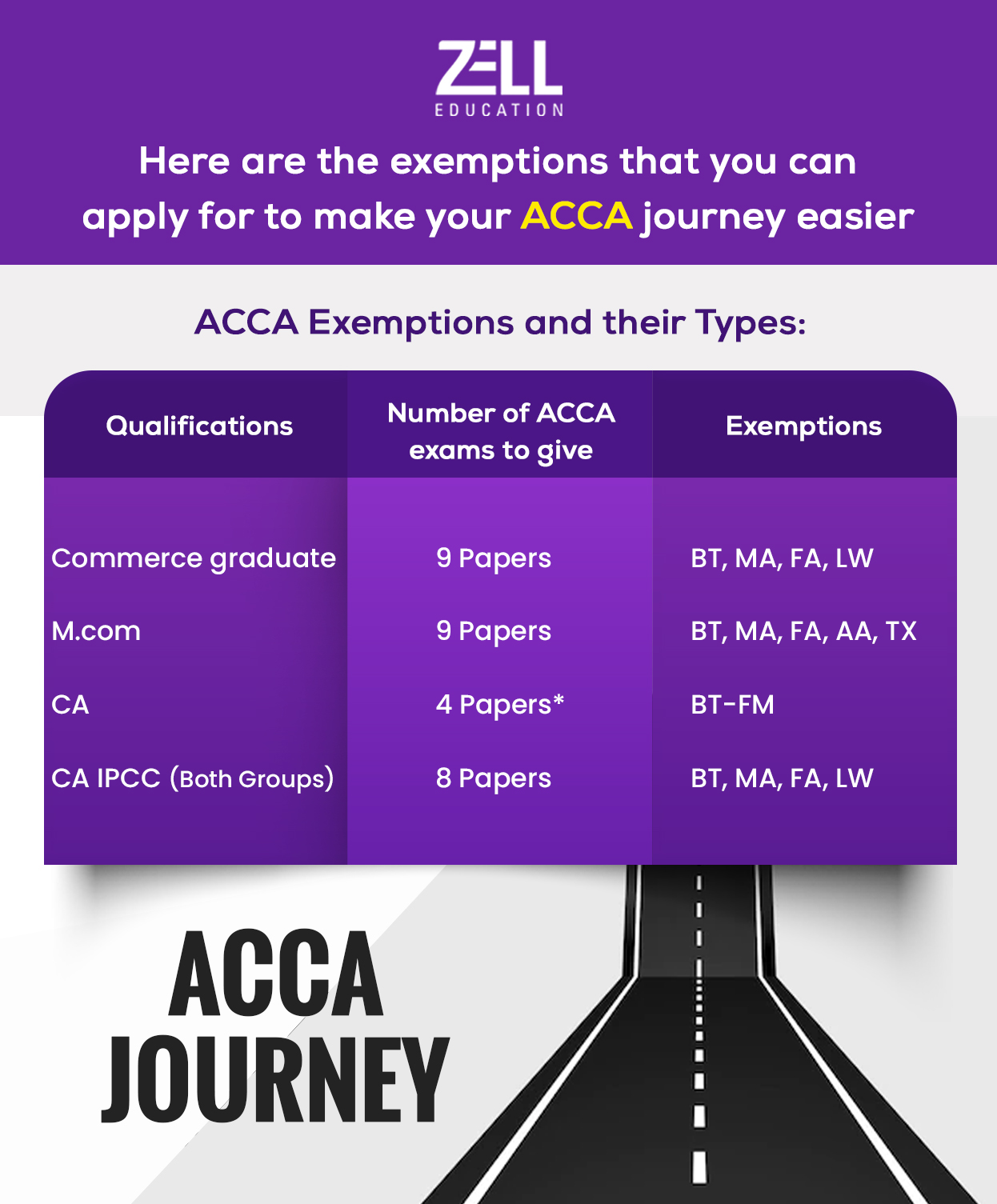
Candidates who can apply for the exemptions must be CA-qualified candidates, commerce graduates and M.Com Inter CA graduates. If candidates have cleared their grade 12 exams, they can register for the ACCA exam using the FIA (Foundation in Accountancy) path but cannot apply for exemptions.
The table below summarises the exemptions:
| Prior Qualification | Exemptions Granted | Papers to Give | Entry Point |
| CA (Fully Qualified) | 9 Papers (F1–F9) | 4 Papers | Strategic Professional |
| CA Inter (Both Groups) | 6 Papers (F1–F3, F4, F6, F8) | 7 Papers | Applied Skills |
| B.Com / M.Com (Major) | 4 Papers (F1–F4) | 9 Papers | Applied Skills |
| B.Com (ACCA Integrated) | 6 to 9 Papers | 4 to 7 Papers | Applied Skills / Prof |
| MBA Finance (Reputed Univ.) | 3 to 9 Papers* | 4 to 10 Papers | Applied Skills |
| ICMAI CMA (Qualified) | 7 to 9 Papers | 4 to 6 Papers | Strategic Professional |
| US CPA (Qualified) | 8 Papers (F1–F6, F8–F9) | 5 Papers | Applied Skills / Prof |
| US CMA (Qualified) | 3 Papers (F1–F3) | 10 Papers | Applied Skills |
| CS (Fully Qualified) | 5 Papers (F1–F4, F6) | 8 Papers | Applied Skills |
| CIMA (Qualified/Adv Dip) | 3 to 6 Papers | 7 to 10 Papers | Applied Skills |
| AIA (Qualified) | Up to 12 Papers | 1 Paper | Strategic Professional |
| Bachelor of Management (BMS) | 3 Papers (F1–F3) | 10 Papers | Applied Skills |
| CFA (Chartered Fin. Analyst) | 0 Papers (Direct Entry) | 13 Papers | Knowledge Level |
ACCA exemptions for CA aspirants can include more papers if they have attained a score of 40 and above for relevant topics in their examination. If you want more information about the ACCA paper pattern, check out the blog, What are the 13 ACCA Papers? and Exemption
Become a global finance leader by joining our latest ACCA batch!
 Enrol in ACCA Today
What is the Importance of ACCA Exemptions?
ACCA exemptions are a great help to candidates who wish to reach the ACCA membership in a shorter time. The exemptions help the candidates to continue their training of skills and knowledge on what they have already achieved in their previous courses or programs. ACCA offers exemptions based on different factors, such as the candidate’s qualifications and, at times, work experience.
Hence, while a class 12th student may complete the ACCA course in 3 to 5 years, a CA final candidate will be able to complete the course in 2 years. Also, ACCA charges fees based on levels and steps. All candidates have to pay for the initial registration and then the subscription. After this, ACCA will charge according to the Exam Level that you are appearing for. So, when there are fewer exams to appear for, the fees will also be reduced. Thus, one of the best ideas is to make use of an ACCA Exemptions Calculator before enrolling for the course.
How to Apply for Exemptions
You can claim exemptions for ACCA in two ways:
- Submit your claim on the ACCA website when you register as a student.
- Submit your claim by emailing the required educational documents to ACCA.
The documents must be in English. It must be officially translated if you have documentation in a different language. You must send a copy of both the translated and the original documents. Remember to send only scanned copies of the documents. You can use the ACCA exemptions calculator to find out if you are eligible for ACCA exemptions.
Charges for ACCA Exemptions
Candidates must pay an exemption fee for individual exams rewarded. The ACCA exemption fees help the ACCA accredit its worldwide network of academic bodies and professionals. As of the 2025-2026 session, ACCA exemption fees are approximately GBP 123 per paper for Applied Skills and GBP 98 per paper for Applied Knowledge. Note that these fees are subject to annual revisions by ACCA Global and are typically equivalent to the exam fee for that specific paper.
Find out more about the prospect of ACCA in the international field in our blog, ACCA Career Scope and Job Opportunities in India and Abroad. ACCA exemptions: Are they worth it? If you’re wondering if ACCA exemptions will affect the credibility of your degree, then compare the pros and cons of the exemptions to decide whether you want to avail these perks:
ACCA Exemption Benefits:
- Getting ACCA exemptions means you need not waste time preparing for topics you already have expertise in from your previous qualifications.
- Completing all ACCA papers requires a lot of time. If you apply for exemptions, you can use the time for the remaining papers and study more thoroughly. This is most useful for graduate students juggling their graduate studies and ACCA.
- You will have a financial advantage since you can save the money you would have otherwise invested on tuition fees and study materials for the exempted papers.
Advantages for Graduate and Undergraduate Students
- Pursuing ACCA with a graduation degree is a great idea because of the benefits that ACCA offers.
- ACCA offers flexible timing for classes and exams so that students can pursue other degrees and courses too.
- The ACCA module often matches the syllabus of B.Com and M.Com which is a helping hand for the students.
- Students can save time when they pursue ACCA after completing their B.Com and M.Com.
- ACCA is globally recognized and it will offer you better career opportunities than your graduation peers.
- The ACCA module and support team also work as a counselling session that helps you in selecting the career path.
ACCA Exemption Disadvantages:
- You must pay exemption fees for the papers you apply for.
- A major disadvantage of exemptions is that candidates who get exemptions might not have enough insights about the basic level topics. It could be a problem when you sit for Professional papers since these require applying basic-level knowledge. But this might not apply to all, especially candidates with a good grasp of the Professional level topics.
If you are wondering how an MBA can benefit you in the exemptions, go through our blog, How Can MBA in Finance Help in ACCA Exemptions.
ACCA Exemptions Process Steps
The ACCA (Association of Chartered Certified Accountants) exemption process allows students to claim exemptions from certain exams based on their previous qualifications. Here’s a step-by-step guide to the process:
Step 1: Check Eligibility for Exemptions
Visit the ACCA Exemptions Calculator on the ACCA website: https://www.accaglobal.com.
Enter details of your qualification(s) to see which papers you may be exempt from.
Step 2: Register as an ACCA Student
If you’re not already registered, create an account and register as an ACCA student on the ACCA website.
During registration, you will be asked to declare any previous qualifications.
Step 3: Submit Supporting Documents
Provide copies of relevant academic certificates, transcripts, and other required documents.
Documents should be officially translated if not in English.
Upload the documents through your myACCA portal.
Step 4: Wait for the Assessment
ACCA will review your documents and confirm the exemptions you are eligible for.
This process can take a few weeks, depending on the volume of applications.
Step 5: Pay Exemption Fees
Once exemptions are confirmed, you will receive an invoice for the exemption fees.
Fees must be paid before the exemptions are officially granted.
Payments can be made via the myACCA portal.
Step 6: Confirmation of Exemptions
After payment, ACCA will update your account with the exempted papers.
You can check your myACCA account to verify.
Step 7: Plan Your ACCA Studies
With exemptions granted, you can start preparing for the next applicable exam papers.
Use ACCA resources, study materials, and approved learning providers.
Best Tips for a Streamlined ACCA Exemptions Application Process
Applying for ACCA exemptions can save you time and effort, but the process must be handled carefully to ensure a smooth application. Here are some top tips for a streamlined ACCA exemption application process:
1. Understand ACCA Exemptions Policy
- ACCA grants exemptions based on prior qualifications.
- Use the ACCA Exemptions Calculator on the official website to check your eligibility.
- Exemptions apply to the Applied Knowledge and Applied Skills levels but not to the Strategic Professional exams.
2. Check Your Institution’s Accreditation
- ACCA recognises many universities and professional qualifications.
- If your institution and course are listed in the ACCA database, exemptions are usually granted automatically.
- If not, you may need to provide additional documentation.
3. Gather Required Documents Early
- Official academic transcripts (certified copies).
- Degree/professional qualification certificates.
- Syllabus details (if required for verification).
- Official translations (if documents are not in English).
4. Apply for Exemptions When Registering
- You can apply for exemptions while registering for ACCA.
- Upload scanned copies of your documents directly to the MyACCA portal.
5. Pay the Exemption Fees Promptly
- Exemptions are subject to a fee, equivalent to the exam fee for the exempted paper.
- Pay these fees on time to avoid delays in approval.
6. Follow Up on Your Application
- Check the status of your exemptions in your MyACCA account.
- ACCA may take several weeks to process applications. If there’s a delay, contact ACCA directly.
7. Confirm Exemptions Before Booking Exams
- Ensure your exemptions are approved before scheduling exams to avoid unnecessary payments or misunderstandings.
8. Keep Copies of Everything
- Maintain records of all submissions and approvals for reference.
- How Exemptions Affect the Duration of ACCA Qualification
How Exemptions Affect the Duration of ACCA Qualification
Exemptions in the ACCA (Association of Chartered Certified Accountants) qualification can significantly impact the duration of completing the qualification. Here’s how:
1. Reducing the Number of Exams
The ACCA qualification consists of 13 exams divided into three levels:
- Applied Knowledge (3 papers)
- Applied Skills (6 papers)
- Strategic Professional (4 papers: 2 compulsory + 2 optional)
If you receive exemptions for some or all of the Applied Knowledge and Applied Skills papers based on your prior qualifications (such as a degree in accounting or finance), you can skip those exams, reducing the total number of exams you need to take.
2. Faster Completion Time
- Without exemptions, completing ACCA can take around 3 to 4 years (depending on exam sittings and work experience).
- If you have maximum exemptions, you may only need to sit for the Strategic Professional exams, reducing the completion time to 1 to 2 years (including practical experience requirements).
3. No Exemptions for Strategic Professional Level
ACCA does not grant exemptions for Strategic Professional exams, so regardless of previous qualifications, you must complete these four papers.
4. Impact on Practical Experience Requirement (PER)
Even if you have exemptions, you still need to complete 36 months (3 years) of relevant work experience and demonstrate achievement of performance objectives. If you already have relevant work experience, it can count towards this requirement, potentially reducing the overall duration.
Hurry! Check your CPA exam eligibility and download the syllabus!
 Get Free Eligibility Check
Conclusion
The demand for ACCA courses is high in the global market. Though the actual ACCA course is tedious and lengthy, it offers exemptions to candidates with certain qualifications and work experience. The ACCA exemptions help save time and money while achieving the goal of becoming a successful ACCA member.
Getting exemptions can be beneficial if you already have the skills and knowledge for the exempted papers. However, your ACCA degree will not lose value due to any exemptions you apply for. It will save much of your time, which you can utilise in preparing for your other papers.
Zell Education offers a comprehensive ACCA course to train finance professionals in the skills required to make their mark in the accounting industry. You get to learn from ACCA-qualified faculty with personalised doubt-solving classes.
FAQs on ACCA Exemptions Hinder the Value of Your Degree
Do ACCA exemptions hinder the value of your degree for future employers?
Not at all. Employers value the efficiency of skipping redundant exams. However, you must ensure you truly mastered the foundational topics during your degree.
Will skipping early exams make it harder to get hired at Big 4?
Big 4 firms care most about your performance in Strategic Professional papers. Zell Education helps you bridge any knowledge gaps from skipped exams.
Is it tougher to pass professional levels if I take many exemptions?
Yes, it can be. Strategic papers build directly on “Knowledge” and “Skills” levels. If you skip too much, you might struggle with advanced application.
How can I avoid knowledge gaps when claiming credits for previous studies?
Active revision is key. Even if you don’t sit the exam, skimming through current ACCA study texts for those subjects ensures your terminology and standards are up to date.
Are the exemption fees worth the time saved on early exams?
Usually, yes. While you pay a fee per paper, you save months of study time and tuition costs.
Does the ACCA Institute rigorously check my university degree before granting credits?
Absolutely. ACCA only awards exemptions if your degree curriculum closely matches their specific learning outcomes.
Can I still become a top-tier accountant if I skip foundational papers?
Success depends on your final professional exam scores and work experience. Once you are a member, no one asks how many exemptions you took.

Current Role
Co-Founder & CEO at Zell Education
Education
- ACCA – Association of Chartered Certified Accountants, Finance (2011 – 2014)
- Bachelor of Commerce (BCom), Financial Markets from H.R. College Of Commerce & Economics (2010 – 2013)
Location
Mumbai, India
Expertise
ACCA Certified
Why Zell?
- • Largest Provider for Global F&A Courses
- • 4.6 Google Review Rating
- • 1000+ Students placed Annually
- • 500+ Active Hiring Partners
- • Placement Opportunities at the Big 4
- • 100+ Global & Indian Rank Holders
- • 100+ Faculty Network
Speak to A Career Counselor

Professionally reviewed by Harshit Morparia, ACCA & Executive at Ernst & Young
Zell's 10th Anniversary Offer - Avail a 10% Scholarship