
Key Takeaways
Is the CFA course worth it?
- The CFA Program is worth it if you want a career in investment management, equity research, or portfolio analysis.
- Total CFA exam and registration costs run about $3,520–$4,600 (roughly ₹3.3–4.3 lakh) plus 900+ hours of self-study.
- CFA offers high global recognition, but it is not a shortcut to a quick job or instant high salary.
Comprehensive Guide: Benefits of CFA
- What is CFA: The Chartered Financial Analyst is a premier globally recognised professional investment credential.
- CFA Syllabus: Level I (foundational tools), Level II (asset valuation), and Level III (portfolio management and specialised pathways)
- Global Career: CFA certification is respected by employers across investment and financial services worldwide.
- CFA Career Opportunities: The CFA Program opens pathways into diverse investment and finance career roles.
- Average CFA Salary: In India, the average salary for a Chartered Financial Analyst (CFA) ranges from ₹6 lakh to ₹25+ LPA
- Exclusive Network: CFA Institute community of over 200,000 professionals for networking and mentoring.
The benefits of the CFA designation are numerous, including global recognition, salary potential and overall career opportunities in the finance industry. In addition, discover if the CFA is worth it for your career growth (2026) and whether it provides long-term returns on investment.
Can CFA Give You Better Career Opportunities Than Your Current Qualification?
 Talk to CFA Expert
Introduction
Given your level of investment in your career, it can seem like an unbeatable challenge to find the perfect job. One question that many students and professionals are asking themselves today is, “Is it worth it to become a CFA?”
The CFA program has built an outstanding reputation worldwide and continues to be one of the most respected finance programmes in existence. There are many people who have suggested that the CFA will provide excellent salary increases and ample career opportunities. The majority of students pursuing the CFA want those two benefits to come from their education.
This blog will explain not only the benefits of the CFA but will also demonstrate how a CFA will help you reach your professional goals.
What is the CFA Course?
What is CFA? CFA Institute is the world’s largest association of investment professionals. CFA Institute offers the CFA Program, a professional credential that prepares individuals for a career in the areas of investment management, financial analysis, portfolio management and ethics. The CFA program is one of the most prestigious financial certifications in the world and consists of three levels.
The CFA Program will provide you with good analytical skills and knowledge of financial markets, making it a good choice for professionals who want to have a career in investment banking, equity research and asset management.
Who Should Pursue the CFA Course?
If you are someone who is looking to establish yourself in investments or finance, then consider taking the CFA course.
Here are some examples of who may find value in completing the CFA program:
- You are currently studying commerce or finance
- You have an interest in stock market investment opportunities
- You want to work in investment banking or capital markets
- You want to pursue a global career
- You are currently working in finance and want to improve your career in the future.
The Top 7 Benefits of Pursuing CFA in 2026
The top benefits of pursuing a CFA career in 2026 are the following:
| Benefit | How It Helps |
| Global Recognition | Valued by employers in 160+ countries |
| Better Career Opportunities | Opens roles in investment banking, equity research, and asset management |
| Higher Salary Potential | Improves long-term earning prospects |
| Industry-Relevant Curriculum | Covers investments, valuation, ethics, and portfolio management |
| Strong Analytical Skills | Enhances financial modelling and decision-making |
| Growing Employer Demand | Preferred by banks, GCCs, and investment firms |
| Flexible Exam Schedule | Multiple exam windows throughout the year |
| Practical Skills Modules | Builds job-ready finance and analytical skills |
| Professional Network | Connects candidates with a global CFA community |
| Long-Term Career Growth | Supports leadership and specialised finance roles |
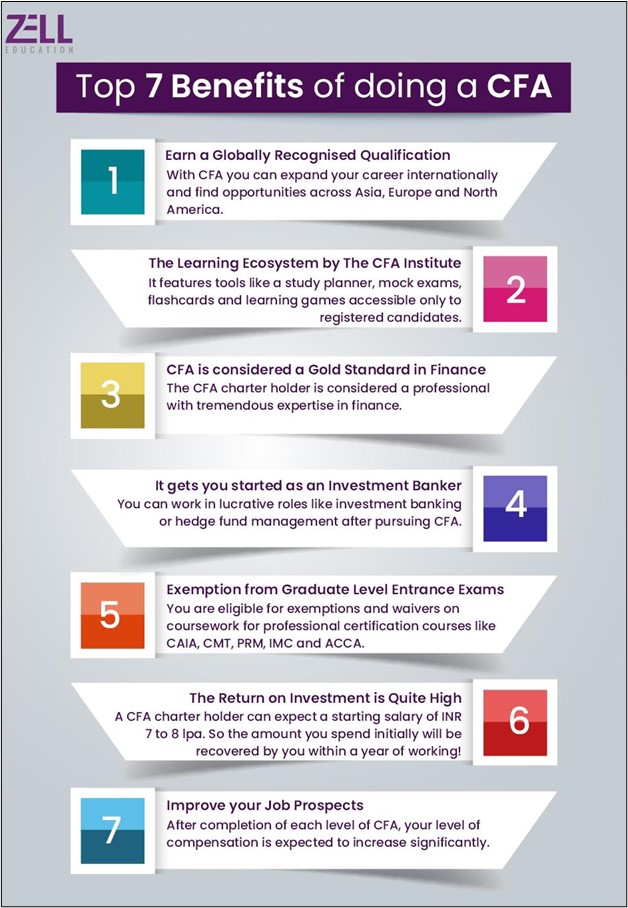
Becoming a CFA charter holder in 2026 offers more than a globally recognised credential. It equips candidates with practical investment knowledge, strong analytical skills, and access to diverse finance careers across investment management, banking, consulting, and fintech.
- Enhanced Career Opportunities
The advantage of obtaining a CFA certification is that you will have access to various career paths, such as investment banking, equity research, and portfolio management.
- Increased Earning Potential
CFA charterholders tend to earn higher salaries than their non-CFA counterparts due to the knowledge and capabilities they gain from holding the CFA credential.
- Internationally Recognised Global Mobility
The CFA charter has global recognition, allowing its holders to work anywhere in the world and in multinational corporations.
- Networking Opportunities
If you’re a CFA holder, you’ll have access to a network of other CFA professionals who can help you grow your future career and find job opportunities.
- Practical Financial Skills & Acquiring Sustainable Learning
The CFA frequently updates its curriculum to include real-world financial skills that prepare you for the job market.
- Flexibility of Graduate School or Career
You can be accredited with your CFA while working or while going to graduate school (MBA) – giving you maximum options in how you choose to pursue your career.
- High Return on Investment
CFA has very high long-term returns compared to other finance degree programmes for both growth in salary and advancement at work.
Curious About Benefits of Pursuing CFA?
Additional CFA Benefits: Starting Your Own Service & Licensing Waivers
The additional benefits of starting your own service & licensing waivers are the following:
| Additional CFA Benefits | Description |
| Start Your Own Advisory | CFA charterholders can start their own financial advisory or investment firm |
| Credibility Boost | Clients trust CFA professionals due to strong ethical standards |
| Entrepreneurial Opportunities | Enables you to work independently in finance consulting |
| Licensing Waivers | In some countries, CFA helps in getting exemptions from regulatory exams |
Waivers
Many professionals see the CFA designation as the first step in starting a new business. By applying what you’ve learnt from earning your CFA charter, you may decide to start a financial services company or other type of consulting firm, and you’ll create clients using the trust and respect associated with your CFA designation.
| Waiver Type | Who Can Apply? | Key Benefit |
| Practical Skills Module Waiver | Eligible university students through affiliated institutions | Exemption from the Practical Skills Module (where applicable) |
| Professional Experience Recognition | Experienced finance professionals | Supports learning but does not waive exams |
| University Affiliation Benefits | Students at CFA Institute-affiliated universities | Curriculum aligned with the CFA Program |
| Access Scholarship | Students and professionals with financial need | Reduced registration fee |
| Student Scholarship | Eligible university students | Discounted exam registration fee |
| Professor Scholarship | Full-time university faculty | Reduced registration fee |
| Regulator Scholarship | Employees of financial regulators | Discounted registration fee |
| No Exam Waivers | All candidates | Every candidate must pass Levels I, II, and III |
| Charter Requirements | Candidates passing all three levels | Work experience and membership are still required for the CFA Charter |
CFA holders can take advantage of different licensing exemptions through their CFA charter, leading to lower barriers to entry for other financial services certifications such as CAIA (Chartered Alternative Investment Analyst) and CMT (Chartered Market Technician), increasing professional credibility and the scope of the services delivered to clients.
Work Experience Requirements
One of the conditions to receive your CFA charter is the completion of four years’ work experience. This work experience must be related to investment decision-making and must have demonstrated your ability to apply the knowledge and skills that you have acquired from your CFA Program and be a necessary part of having both theoretical and practical knowledge to achieve professional success in the investment decision-making process.
Work experience can be obtained from any combination of asset management, financial analysis, investment banking or risk management.
Job Profiles after CFA
If you have completed one or more levels of CFA or have completed all three levels and are officially a CFA charter holder, there are numerous job profiles that you can start working in. Moreover, you may also get the opportunity to work as a finance professional outside India if your skills and resume are strong enough.
1. Investment Banker
For many students, the main reason behind pursuing CFA is to get into the field of investment banking. The primary job role of an Investment Banker is to manage the investments of a company and raise money for them. They look after the investment portfolio of their organisation and, based on their valuation results, offer recommendations for private equity transactions, mergers and acquisitions, and product offerings.
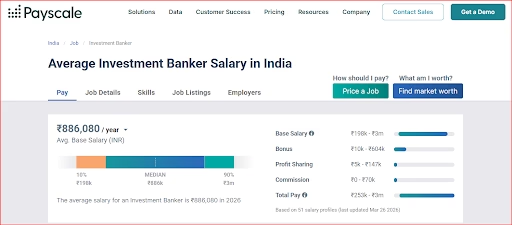
Source for Investment Banker Salary: Payscale
2. Portfolio Manager
A Portfolio Manager is someone who manages the existing assets and investment strategies of a company. Such professionals are required to manage their clients’ portfolios based on how much risk their clients are able and willing to take and how much they can invest for the short term or long term.
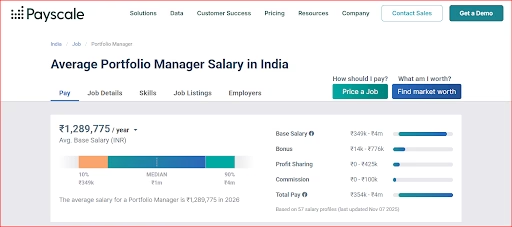
Source for Portfolio Manager Salary: Payscale
3. Financial Advisory
Working as a Financial Advisor mainly involves gathering data from the financial statements of an organisation and analysing this data to help them make better financial decisions in the future. They offer forecasts and suggestions regarding the next steps that an organisation should take when it comes to managing its finances.
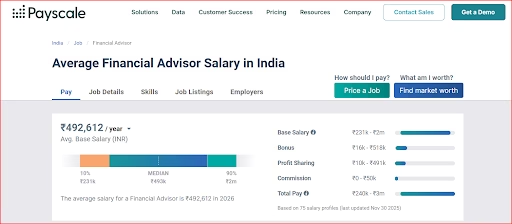
Source for Financial Advisor Salary: Payscale
4. Risk Manager
A risk manager is a professional who analyses the amount of risk faced by an organisation and suggests ways to reduce that risk. They also help determine the potential loss that may be incurred by the organisation as a result of that risk. A risk manager also manages the liability programmes and directly operates the risk management program of a company. You can also pursue risk management after completing FRM, but the salary to be expected will increase drastically after CFA.
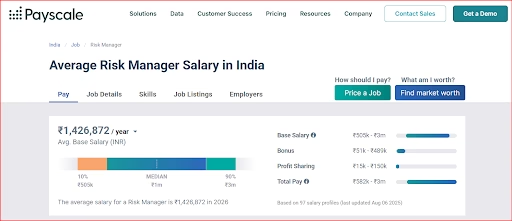
Source for Risk Manager Salary: Payscale
5. Hedge Fund Manager
Hedge funds are investment partnerships where funds are pooled and managed using aggressive investment strategies in order to earn higher returns. A professional who manages these funds is known as a Hedge Fund Manager. Such professionals make investment decisions on behalf of High-Net-Worth Individuals (HNWIs) and attempt to improve the performance of their existing investments.
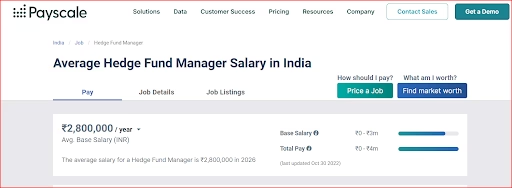
Source for Hedge Fund Manager Salary: Payscale
When evaluating CFA benefits, ROI is one of the most important factors. The CFA, or Chartered Financial Analyst, is a certification that holds a great reputation around the world in the area of finance and investment. If you are considering getting into a finance-related career, then obtaining a CFA will for sure be a great help in the process.
| Investment Factor | Details |
| Total Program Cost | USD 3,500–5,500 (all three levels, depending on registration window) |
| Average Completion Time | 2.5–4 Years |
| Recommended Study Time | 900–1,200 hours (300–400 per level) |
| Average Starting Salary | ₹8–15 LPA (India) |
| Mid-Career Salary | ₹20–40 LPA |
| Senior-Level Salary | ₹50 LPA–₹1 Crore+ |
| Global Recognition | Accepted in 160+ Countries |
| Top Employers | JPMorgan Chase, Goldman Sachs, BlackRock, HSBC, Morgan Stanley |
| Career Opportunities | Investment Banking, Equity Research, Portfolio Management, Risk Management |
| Return on Investment | High for long-term careers in investment and finance |
| Best For | Students and professionals targeting global finance roles |
| Overall Verdict | High ROI for candidates committed to finance careers |
If you have recently completed your graduation or are appearing for your final semester, you may be eligible to become a CFA. Interested? We highly recommend checking out our Chartered Financial Analyst (CFA) Program.
Conclusion
The CFA will be of tremendous value for 2026 if you have a genuine interest in pursuing a career in finance. The advantages of earning a CFA include global recognition of your abilities, the potential for earning a considerable income, the likelihood that you will experience rapid advancement in your career, and an excellent return on investment.
While you will need to devote a significant amount of time and effort to earn the CFA, if you are truly passionate about finance and/or investing, the CFA could significantly impact your career.
FAQs on Benefits of CFA
Are CFAs being sought after in India?
Absolutely, CFAs are very much in demand in India within the fields of investment banking, asset management and fintech.
Can AI replace CFA?
No, artificial intelligence cannot replace a CFA, as it lacks human judgment, ethics, and strategic decision-making.
Will earning a CFA increase your income?
Yes, earning a CFA charter generally increases income and career advancement in finance.
Is it better to pursue CFA than CA?
CA is more focused on accounting/auditing, while CFA is tailored to prepare the person pursuing it for their career in investment/finance.
Is the CFA worth it?
Yes, the CFA is worth it if you want a career in investment analysis or portfolio management
Is the CFA losing its value?
No, the CFA continues to have an incredibly high global value because of its extremely rigorous curriculum and how good it is at staying relevant to the industry.

Current Role
Co-Founder & CEO at Zell Education
Education
- ACCA – Association of Chartered Certified Accountants, Finance (2011 – 2014)
- Bachelor of Commerce (BCom), Financial Markets from H.R. College Of Commerce & Economics (2010 – 2013)
Location
Mumbai, India
Expertise
ACCA Certified
Why Zell?
- • Largest Provider for Global F&A Courses
- • 4.6 Google Review Rating
- • 1000+ Students placed Annually
- • 500+ Active Hiring Partners
- • Placement Opportunities at the Big 4
- • 100+ Global & Indian Rank Holders
- • 100+ Faculty Network
Speak to A Career Counselor
Zell's 10th Anniversary Offer - Avail a 10% Scholarship