
If you are interested in accounting and want to pursue a course in the same field, you must have heard about ACCA or CPA. The CPA and ACCA courses are growing in popularity, and despite their differences, both provide excellent employment prospects.
ACCA or CPA: Quick Career Comparison Guide
- ACCA Global Reach: The ACCA program gives students global recognition from many different countries and opens up various finance and accounting careers around the world.
- CPA US Focus: CPA is very respected in the United States and caters to audit, tax, and regulation positions.
- ACCA Flexibility: Students can take ACCA exams flexibly, and at their own speed.
- CPA State Licensing: CPA involves state-based licensing that students must obtain before becoming a licensed CPA.
- ACCA Career Roles: ACCA professionals work in consulting, finance, audit, and management roles across multinational companies globally.
- CPA Salary Potential: CPA professionals earn strong salaries, especially in US markets, depending on experience and specialisation.
Anyone interested in taking one of these courses hopes to succeed in the field of accounting. If you’re confused between ACCA or CPA, we are here to help you solve your dilemma. Let us compare both the courses so that you can decide wisely which course to pursue.
What Are ACCA and CPA Courses? Complete Overview
Both ACCA (Association of Chartered Certified Accountants) and CPA (Certified Public Accountant) provide highly certified credentials for anyone interested in pursuing a career in accounting. The fundamental distinction between the two courses is that CPA is US-based, focusing on the accounting standards known as US GAAP and ACCA is UK-based, focusing on accounting standards known as IFRS. Both focus on all aspects of accounting
- The Association of Chartered Certified Accountants degree is a wise way to start a career in accounting and finance since it is an internationally recognised course with updated/industry-relevant information.
- Certified Public Accountants monitor a company’s financial planning, examine financial data, audit financial reports, and offer strategic, data-driven suggestions about strategic planning, budgeting, and fraud protection depending on the company’s financial situation.
A Certified Public Accountant might work for a company as an individual or as part of a public accounting firm. The ACCA or CPA are highly qualified accounting courses created for individuals who want to work in accounting, taxation, auditing, or finance.
ACCA vs CPA: Key Differences and Comparison
Choosing between ACCA or CPA depends on career goals, geography, and role preference. This comparison highlights key differences in structure, scope, eligibility, and opportunities to help make an informed decision.
| Factor | ACCA (Association of Chartered Certified Accountants) | CPA (Certified Public Accountant) |
| Global Recognition | Recognised in 180+ countries worldwide | Primarily recognised in the USA |
| Focus Area | Accounting, finance, management, strategy | Audit, taxation, and compliance |
| Exam Structure | 13 papers across 3 levels | 4 papers (Uniform CPA Exam) |
| Flexibility | High flexibility with multiple exam attempts yearly | Fixed exam structure and schedule |
| Eligibility | Open after 12th (with conditions) | Requires graduation + credits |
| Duration | 2–3 years (faster with exemptions) | 1–1.5 years |
| Career Scope | Global roles in MNCs, consulting, finance | Strong US-based accounting roles |
| Licensing | No licence required | Requires state licence |
| Cost | Moderate | Higher due to licensing and exams |
| Job Roles | FP&A, analyst, consultant, auditor | Auditor, tax consultant, CPA firm roles |
Source for ACCA vs CPA: Key Differences and Comparison – ACCA Global and AICPA & CMA
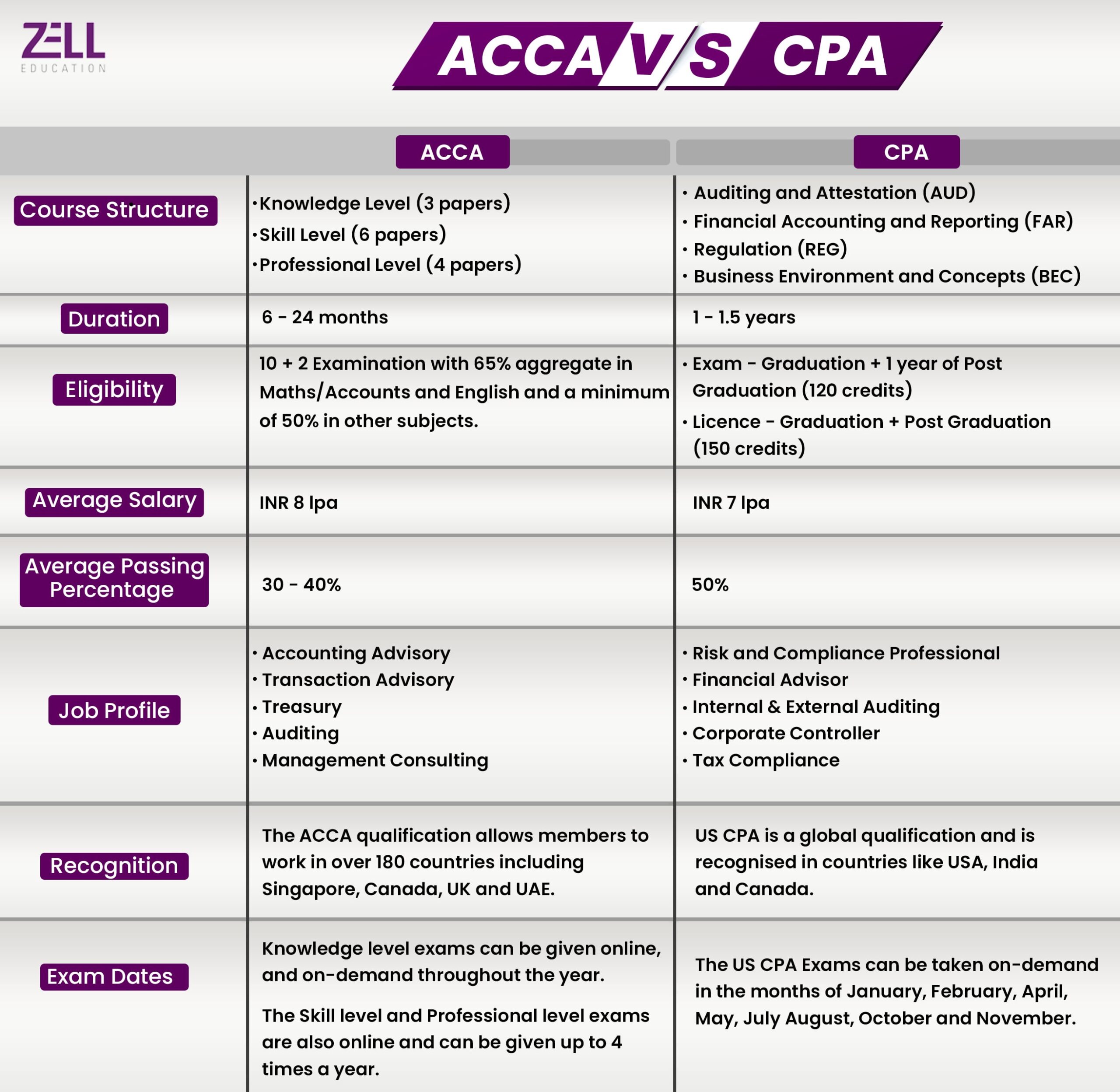
ACCA vs CPA Eligibility Criteria: What You Need to Know
Understanding eligibility for ACCA or CPA depends on education and location. ACCA allows entry after 12th with conditions, while CPA requires graduation and specific credit hours, especially for US licensure. Choosing between ACCA and CPA depends on academic background.
ACCA Eligibility Criteria
To pursue the ACCA course, you need to fulfil any of the below-given requirements:
- Completion of class 10th from a recognised board
- 60% aggregate in English and Mathematics in class 12th
- Graduation from a recognized university
- A CA final-year student is also eligible to pursue the course.
CPA Eligibility Criteria
To become a CPA-certified professional, you must have the necessary education and experience, preferably with accounting credentials. The following are some mandatory requirements:
- Bachelor’s degree or its equivalent from a recognised university
- 150 credit hours
Which Course Offers Better Future Career Scope?
Choosing between ACCA or CPA depends on career goals, location, and role preferences. Both qualifications offer strong opportunities, but their scope differs based on global exposure, industry demand, and long-term career pathways in finance and accounting.
ACCA Future Scope and Career Opportunities
The Association of Chartered Certified Accountants (ACCA) qualification requires a professional work experience of 3 years after which ACCAs can either continue with their previous jobs or pursue corporate careers, private consultancy, and other opportunities. Companies are becoming aware of the ACCA course, its reputation, and its importance as a global standard.
After completing the ACCA course, you can get a job at some of the top MNCs like Tata, Barclay’s, Standard Chartered, Grant Thornton, and many others. With a solid academic background and relevant work experience, you may expect to receive rewarding job offers as soon as you finish the course. Your skills also determine the number of job offers.
CPA Future Scope and Career Opportunities
The future career scope after getting the CPA designation is quite promising. CPAs have no trouble with international and financial accounting and corporate governance. Different subsidiaries of multinational corporations in India are known to engage CPAs. Certified Public Accountants are employed by Indian enterprises that have raised funding from the US financial markets.
CPAs have also been known to work for financial services firms. They are employed for various positions like Financial Analysts, Staff Accountants, and CFOs in finance-based companies and other businesses.
ACCA or CPA Salary Comparison: India and Global Insights
Understanding salary differences is essential when choosing ACCA or CPA as a career path. This comparison highlights earning potential across roles, experience levels, and global markets, helping professionals make informed decisions based on long-term financial growth.
| Experience Level | Role Type | ACCA Salary (India) | CPA Salary (India) | Global Salary Range (ACCA/CPA) |
| Entry Level | Analyst / Associate | ₹5–9 LPA | ₹6–10 LPA | $50,000–$70,000 |
| Mid-Level | Senior Analyst / Manager | ₹10–18 LPA | ₹12–20 LPA | $70,000–$100,000 |
| Senior Level | Finance Manager / Lead | ₹18–35+ LPA | ₹20–40+ LPA | $100,000–$150,000+ |
| Leadership Roles | Director / CFO | ₹30–60+ LPA | ₹35–70+ LPA | $120,000–$200,000+ |
| Specialised Roles | FP&A / Tax / Audit | ₹12–25+ LPA | ₹15–30+ LPA | $80,000–$140,000 |
Source for ACCA or CPA Salary Comparison – Naukri
Field of Work: ACCA vs CPA Career Scope
Learn more about your career options if you choose to become an ACCA or CPA and learn about the job duties and responsibilities in different industries.
CPA Roles and Responsibilities
The field of work for CPAs is licensing to provide Public Accounting Services. These specialist degree holders assist people, small and mid-size businesses, and multinational corporations to preserve the law and manage the finances of the company. A CPA can pursue additional fields of finance, such as financial control, accounting, and financial analysis, in addition to auditing and taxes.
ACCA Roles and Global Opportunities
Job responsibilities of an ACCA include inspection and accounting services for the public and commercial sectors, among other things. Before the inspection, they must pass the certifications, apart from auditing, taxation, and so forth. ACCA may establish a global footprint in financial control, accounting, and financial analysis, among others.
Global Recognition and Next Steps
The ACCA qualification is recognised in over 180 countries including Canada, Singapore, and Australia. If you’ve made the decision to become a global CA and are contemplating your next move, we can help you take a step forward. Check out our Association of Chartered Certified Accountants (ACCA) course to learn more. To advance your portfolio and build professional skills, try Zell Education’s interactive courses that offer flexible training timings. Get in touch at +91 7208885600 or email us at [email protected].
Conclusion
Keeping in mind the features mentioned above of the course and the differentiation between them, you need to decide wisely which course suits your skills and interests and can provide you with a great career boost. You can contact industry professionals if you are interested in pursuing any of these courses. Platforms like Zell Education can provide you with the necessary assistance in determining which course is ideal for you.
FAQs on ACCA or CPA
Which is better ACCA or CPA?
The ACCA or CPA choice depends on career goals, location, and preferred finance roles.
Can I pursue ACCA or CPA after graduation?
Graduates can pursue ACCA or CPA depending on eligibility requirements and academic qualifications.
Which has better global scope ACCA or CPA?
ACCA offers wider global recognition, while CPA is more focused on United States markets.
Is ACCA or CPA more difficult to complete?
CPA is shorter but intense, while ACCA is longer with a flexible exam structure.

Current Role
Co-Founder & CEO at Zell Education
Education
- ACCA – Association of Chartered Certified Accountants, Finance (2011 – 2014)
- Bachelor of Commerce (BCom), Financial Markets from H.R. College Of Commerce & Economics (2010 – 2013)
Location
Mumbai, India
Expertise
ACCA Certified
Why Zell?
- • Largest Provider for Global F&A Courses
- • 4.6 Google Review Rating
- • 1000+ Global Placement Partners
- • Placement Opportunities at the Big 4
- • 100+ Global & Indian Rank Holders
- • 100+ Faculty Network
- • 10,000+ Students Placed
Speak to A Career Counselor
Zell's 10th Anniversary Offer - Avail a 10% Scholarship