
Key Takeaways
- What are Investment banking services? Provide assistance to businesses in terms of capital formation, merger activities, and capital market operations.
- The investment banking process is used in the process of organising IPOs, debt financing, underwriting, and corporate restructuring.
- Understanding how investment banking operates will be useful to learn about a career path in finance and obtain the CFA certification.
Comprehensive Summary on ‘Investment Banking Services’
What is investment banking?
Investment banking provides assistance to businesses, governments, and other institutions in the process of raising capital and conducting certain financial transactions.
What are capital markets?
The investment banking services help organise the issuance and trade of securities in primary and secondary markets.
What is the investment banking process?
The investment banking process is used to organise the fundraising, underwriting, mergers and acquisitions, and advisory services.
What are investment banking products?
Some of the common investment banking products that are widely available include equity, bonds, IPOs, M&A advisory, and several structured finance products.
How does investment banking work?
Investment banking operates in corporations through the provision of advice and assistance in various aspects relating to financing and risk management.
Can CFA help in investment banking?
Certainly, getting CFA certification can improve financial analysis abilities and career prospects in the sphere of investment banking.
Thinking About a Career in Investment Banking After Graduation?
 Book Free Career Session
What Are Investment Banking Services?
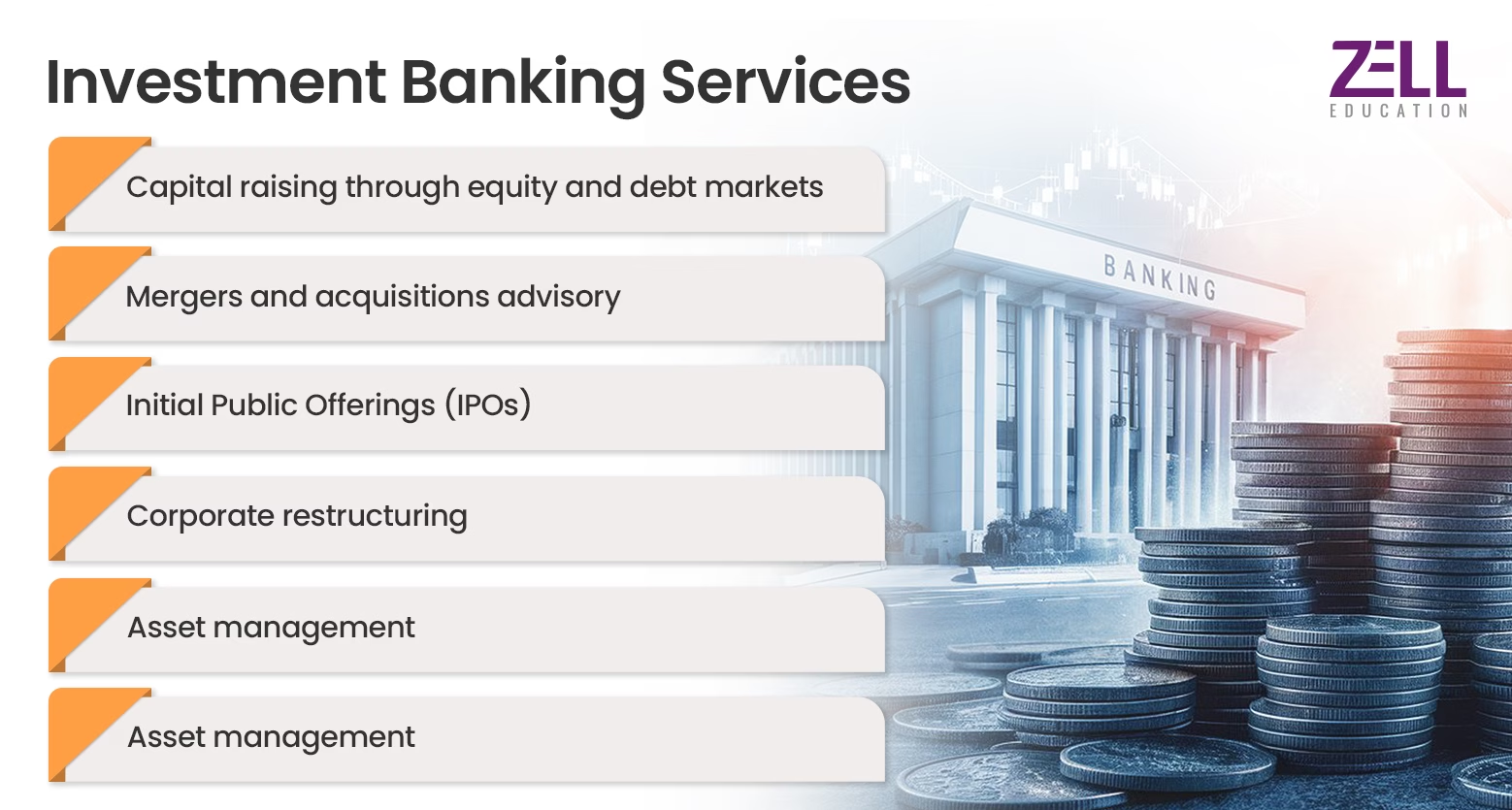
Investment banking services mean special financial services which are aimed at raising money for companies, governments, and institutions, carrying out various transactions and helping to reach certain goals. Understanding what investment banking is is very important because investment banking services occupy an important place in finance. The main functions of investment banking services are:
- Capital raising through equity and debt markets
- Mergers and acquisitions advisory
- Initial Public Offerings (IPOs)
- Corporate restructuring
- Asset management
- Risk management solutions
- Research and market analysis
The investment banking process connects businesses with investors while ensuring efficient capital allocation across markets.
What Is the Brief History of Investment Banking?
The origin of investment banking can be found in merchant banking, which was financing international business and large-scale trade. Investment banking has become a special type of financial industry. The most important moments in the history of investment banking are the following:
- 19th-century industrial expansion funded through investment banks
- Growth of securities markets in the United States and Europe
- Rise of multinational financial institutions
- Development of modern M&A advisory services
- Expansion of global capital markets
- Adoption of technology-driven investment banking work
Investment banking services play a pivotal role in today’s world of corporate finance.
What Are the Different Types of Investment Banks?
It is important to know different investment banks that vary in size, location, and specialisation. This knowledge will help businesses choose an appropriate advisor.
What Are Bulge Bracket Banks?
Bulge bracket banks are the biggest investment banks worldwide that provide their clients with numerous financial services.
Examples include:
- Goldman Sachs
- Morgan Stanley
- JPMorgan
- Bank of America
- Citigroup
Key characteristics:
- Global presence
- Large-scale transactions
- Extensive research capabilities
- Full-service investment banking products
- Strong capital market expertise
What Are Elite Boutique Banks?
Elite boutique banks focus primarily on advisory services while maintaining strong expertise in high-value transactions.
Key advantages:
- Independent advice
- Specialized M&A expertise
- Senior-level client engagement
- Lower conflicts of interest
Popular examples include:
- Evercore
- Lazard
- Centerview Partners
What Are Middle-Market Banks?
Middle-market banks serve medium-sized companies requiring financial advisory and capital-raising services.
Typical services include:
- M&A advisory
- Debt financing
- Equity offerings
- Corporate valuation
Benefits:
- Personalized service
- Industry expertise
- Competitive fees
Build the Skills Needed for M&A, IPOs, and Capital Markets
 Explore IB Course
What Are Regional and Industry-Specific Boutique Banks?
The regional and industry-specific boutique banks serve certain geographical locations or industries.
Common sectors include:
- Healthcare
- Technology
- Energy
- Consumer products
- Real estate
Advantages include:
- Deep industry knowledge
- Strong local relationships
- Tailored investment banking work
How Do Capital Markets Form the Foundation of Investment Banking?
The capital markets help corporations to raise money and at the same time enable investors to put their money to work in an efficient manner. The investment banking activities play the role of intermediaries between the issuers and the investors.
Core functions include the following:
- Capital formation
- Price discovery
- Liquidity creation
- Risk transfer
- Economic growth support
Without capital markets, the investment banking process would be significantly restricted.
What Is the Difference Between Primary Markets and Secondary Markets?
The primary market is the one in which new securities are offered for the first time, while the secondary market is the one in which existing securities are traded amongst the investors.
| Feature | Primary Market | Secondary Market |
| Purpose | Raise Capital | Trading Securities |
| Participants | Issuers and Investors | Investors |
| Examples | IPOs, Bond Issues | Stock Exchanges |
| Capital Flow | Goes to Issuer | Goes to Seller |
| Role in Investment Banking | Direct Advisory | Market Support |
What Are Equity Capital Markets (ECM)?
Equity capital markets help companies raise funds through equity instruments such as shares.
Common ECM activities:
- IPOs
- Follow-on offerings
- Rights issues
- Convertible securities
Benefits:
- Access to growth capital
- Enhanced market visibility
- Improved liquidity
What Are Debt Capital Markets (DCM)?
Debt capital markets refer to the market where organisations will issue debt instruments in order to raise finances as opposed to raising finances through selling equity.
Some common DCM products are:
- Corporate bonds
- Government bonds
- Convertible debt
- Structured products
Benefits include:
- Lower ownership dilution
- Flexible financing structures
- Access to institutional investors
What Are the Core Investment Banking Services Explained?
Investment banking services are quite diverse in nature since they cover all possible ways to help businesses develop and make strategic financial decisions. Let us consider the main services in more detail below:
1. What Are Underwriting Services?
‘Underwriting services’ refer to specific functions aimed at issuing securities by firms with the purpose of minimising fundraising risks.
Key responsibilities:
- Pricing securities
- Assessing risks
- Purchasing securities from issuers
- Selling securities to investors
Benefits:
- Capital raising certainty
- Improved investor confidence
- Efficient market access
In general, underwriting continues being a significant and permanent element of the investment banking process.
2. What Is Mergers & Acquisitions (M&A) Advisory?
The area of mergers and acquisitions (M&A) advisory is associated with assisting the organisation in buying, merging or selling the company to achieve some specific strategic goals.
Core activities:
- Valuation analysis
- Due diligence
- Negotiation support
- Deal structuring
- Integration planning
Benefits:
- Strategic growth
- Market expansion
- Cost synergies
- Competitive advantages
Within the investment banking area, M&A advisory services are considered among the most profitable.
3. What Are Initial Public Offerings (IPOs)?
IPO allows the private company to go public via share issuance to the investors.
The investment banking process for IPOs includes:
- Due diligence
- Regulatory filings
- Valuation
- Roadshows
- Share pricing
- Market listing
Advantages:
- Access to large capital pools
- Brand enhancement
- Liquidity opportunities
4. What Are Private Placements and PIPE Transactions?
Private placements involve selling securities directly to institutional investors without a public offering.
Benefits include:
- Faster fundraising
- Reduced regulatory burden
- Greater flexibility
Then there is PIPE, which stands for Private Investment in Public Equity. In a PIPE transaction private investors put capital into a company that’s already publicly listed, but the investment itself happens privately.
5. What Is Debt Financing and Bond Issuance?
In the case of debt financing, a company raises capital without dilution of the ownership stake.
Common forms include:
- Corporate bonds
- Syndicated loans
- Notes
- Commercial paper
Advantages:
- Ownership retention
- Tax benefits
- Flexible repayment structures
Debt financing is among the most widely used investment banking services.
6. What Is Corporate Restructuring and Distressed Advisory?
Corporate restructuring can be seen as an effort to improve a company’s financial position when faced with some difficulties.
Services include:
- Debt restructuring
- Turnaround planning
- Bankruptcy advisory
- Asset sales
Benefits:
- Improved liquidity
- Reduced financial stress
- Business continuity
7. What Are Sales, Trading, and Market Making Services?
This refers to the buying and selling of financial instruments.
Functions include:
- Executing client orders
- Providing liquidity
- Market making
- Risk management
Such functions are essential for investment banking since they make it possible to participate in financial markets efficiently.
8. What Is Equity Research and Analysis?
This is an activity aimed at assisting investors in making wise decisions through analysis of companies and industries.
Research outputs include:
- Earnings forecasts
- Industry reports
- Valuation models
- Investment recommendations
Equity research forms the core of investment banking products to attract investors.
9. What Are Asset Management and Wealth Services?
Asset management is engaged in managing the investments of both individuals and organisations with the aim to fulfil clients’ financial objectives.
Key offerings:
- Portfolio management
- Retirement planning
- Wealth preservation
- Alternative investments
Benefits:
- Professional expertise
- Diversification
- Long-term wealth creation
10. What Are Risk Management Services?
Risk management services help organisations identify and mitigate financial risks.
Common risks addressed:
- Market risk
- Credit risk
- Liquidity risk
- Operational risk
- Interest rate risk
Risk management results in higher business stability and investor confidence.
Case Study: Alibaba IPO
The IPO carried out by Alibaba back in 2014 remains among the biggest in history, with its total proceeds of almost $25 billion. In this case, there were some leading investment banks that were behind underwriting, pricing, roadshowing, and positioning of the deal. This is just an illustration of how investment banking services facilitate capital market transactions.
How Do Investment Banking Fees Work?
There are various fee structures in investment banking, and depending on the type of transaction you have, your fee structure will vary. Getting an understanding of the fee structure will make it easier for you to determine the total cost involved.
What Is the Difference Between Retainer Fees and Success Fees?
The retainer fee is paid ahead of time for the advisory service. The success fee is payable only in case of a successful transaction.
Retainer Fees
Key characteristics:
- Paid monthly or quarterly
- Covers ongoing advisory support
- Ensures banker commitment
- Common in M&A mandates
Success Fees
Key characteristics:
- Paid only upon transaction completion
- Performance-based compensation
- Aligns advisor and client interests
- Common in acquisitions and fundraising
Businesses often use a combination of both fee structures during the investment banking process.
What Is an Underwriting Spread?
The underwriting spread is the difference between the price paid by underwriters to the issuer in order to buy securities from him and the selling price of the same securities. Thus, underwriting spread is the main tool of compensation for underwriters who make this deal happen.
Components include:
- Management fee
- Underwriting fee
- Selling concession
Benefits of underwriting spreads:
- Compensate banks for risk
- Cover marketing expenses
- Reward distribution efforts
The underwriting spread remains a key revenue source for investment banking services.
How Do M&A Advisory Fee Structures Work (Lehman Formula)?
The Lehman Formula is a traditional method used to calculate advisory fees in M&A transactions.
Traditional structure:
- 5% of the first $1 million
- 4% of the second $1 million
- 3% of the third $1 million
- 2% of the fourth $1 million
- 1% of amounts above $4 million
Currently, however, most of the firms use some modification of this formula. The modern modification depends on the details of the transaction, including its size and complexity. As a result, the fee structure may deviate from the standard formula but still preserves the same idea.
What Drives Fee Negotiations?
There is a list of drivers of investment banking fee negotiations, among which we could name the following:
- Deal size
- Industry complexity
- Market conditions
- Transaction risk
- Required expertise
- Competitive bidding among banks
Larger transactions generally attract lower percentage fees due to economies of scale.
How Is ESG and Sustainable Finance Transforming Investment Banking?
The criteria of environmental, social, and governance have become major principles determining the investment banking services and capital allocation.
Key ESG-related services include:
- Green bond issuance
- Sustainability-linked loans
- ESG advisory
- Climate risk assessment
- Sustainable investment products
Benefits for businesses:
- Improved investor appeal
- Better access to capital
- Enhanced corporate reputation
- Long-term value creation
With the growing importance of sustainability, the ESG-orientated investment banking products are forecast to develop rapidly.
How Are Digital Transformation and AI Changing Investment Banking?
Digital technology and AI continue to bring about changes related to the increased efficiency, precision, and effectiveness in the realm of investment banking activities. The implementation of these two spheres takes place in different areas, including both front-office and back-office tasks, making banks run better and adapt to market changes faster.
Key applications include the following:
- Automated financial modeling
- Predictive analytics
- Algorithmic trading
- Fraud detection
- Client relationship management
- Risk monitoring
Benefits of AI in investment banking:
- Faster deal execution
- Better market insights
- Reduced operational costs
- Enhanced compliance monitoring
Moving forward, the process of investment banking will become increasingly dependent on AI-based solutions to help increase client benefits and improve its performance.
What Are the Key Regulations Governing Investment Banking?
Investment banking services are highly regulated to prevent potential risks related to both clients and investment banking institutions themselves.
What Is the Dodd-Frank Act?
This act was signed after the financial crisis of 2008 in order to prevent similar cases in the future.
Key provisions:
- Enhanced regulatory supervision
- Consumer protection measures
- Stress testing requirements
- Increased transparency
Impact on investment banking:
- Improved risk management
- Stronger compliance obligations
- Greater reporting requirements
What Is the Volcker Rule?
The Volcker Rule restricts proprietary trading by banks and limits investments in certain private funds.
Objectives include:
- Reducing excessive risk-taking
- Protecting depositors
- Enhancing financial stability
Effects on investment banking work:
- Reduced speculative activities
- Greater focus on client-driven transactions
What Are Basel III Capital Requirements?
Basel III establishes international standards for bank capital adequacy and liquidity management.
Key requirements:
- Higher capital reserves
- Improved liquidity ratios
- Stronger risk controls
Benefits:
- Increased resilience during economic downturns
- Better protection against financial shocks
What Is MiFID II in Europe?
Markets in Financial Instruments Directive II is aimed at providing additional transparency and improving investor protection in European financial markets.
Key objectives:
- Increased reporting standards
- Better trade transparency
- Improved investor safeguards
Impact:
- Greater accountability
- More detailed market disclosures
How Do SEC and FINRA Oversee Investment Banking?
The two bodies responsible for monitoring the activities of the investment banking firms in the US are the Securities and Exchange Commission (SEC) and the Financial Industry Regulatory Authority (FINRA). Both of these institutions regulate, monitor and oversee the investment banking practices for the benefit of both sides of the investment process. Their main responsibilities include:
- Market oversight
- Enforcement actions
- Investor protection
- Licensing and compliance
They strive to maintain the integrity of capital markets and the quality of the services provided by the investment banks in particular.
How Should You Choose an Investment Bank for Your Business?
The selection of an appropriate investment bank may have great effect not only on the results of your transaction but also on the future of your company. The main criteria you should consider when choosing an investment bank are listed below.
| Selection Criteria | Why It Matters |
| Industry Expertise | Improves transaction quality |
| Deal Experience | Provides practical knowledge |
| Global Reach | Expands investor access |
| Research Capabilities | Supports informed decisions |
| Client Relationships | Enhances deal opportunities |
| Fee Structure | Impacts transaction costs |
| Reputation | Builds investor confidence |
Questions to ask before hiring:
- Has the bank handled similar transactions?
- What industries does it specialise in?
- What is its track record?
- How experienced is the deal team?
- How competitive are its fees?
Your company’s needs will be the main criterion that should determine the best option for your enterprise.
What Are the Investment Banking Industry Trends in 2026–27?
The environment of investment banking services is constantly changing because of new technologies, new regulations, and growing demands of the clients. Here are some trends expected to take place in 2026–27:
AI-Powered Advisory
- Enhanced financial analysis
- Faster due diligence
- Improved forecasting accuracy
ESG-Driven Capital Raising
- Growth in green bonds
- Sustainable finance expansion
- Increased ESG disclosures
Cross-Border M&A Activity
- Greater international deal-making
- Expansion into emerging markets
- Increased strategic partnerships
Digital Asset Integration
- Tokenized securities
- Blockchain-enabled settlements
- Digital investment platforms
Data-Driven Decision Making
- Advanced analytics adoption
- Real-time market intelligence
- Improved client insights
Increased Regulatory Technology (RegTech)
- Automated compliance monitoring
- Enhanced reporting systems
- Lower compliance costs
These trends are expected to reshape investment banking work and create new opportunities across the industry.
What Are the Top Careers in Investment Banking?
Investment banking is one of the fields which offer a lot of different options for those finance professionals who enjoy analytical work, problem-solving and communication with clients. The major career tracks include:
1. Investment Banking Analyst
Responsibilities:
- Financial modeling
- Valuation analysis
- Industry research
- Pitchbook preparation
Skills required:
- Excel proficiency
- Analytical thinking
- Attention to detail
2. Investment Banking Associate
Responsibilities:
- Managing analysts
- Client interaction
- Deal execution support
- Financial review
Skills required:
- Leadership
- Communication
- Transaction management
3. Mergers & Acquisitions Advisor
Responsibilities:
- Strategic advisory
- Due diligence coordination
- Deal structuring
- Negotiation support
Skills required:
- Valuation expertise
- Relationship management
- Strategic thinking
4. Equity Research Analyst
Responsibilities:
- Company analysis
- Earnings forecasts
- Market research
- Investment recommendations
Skills required:
- Financial analysis
- Industry knowledge
- Report writing
5. Risk Management Specialist
Responsibilities:
- Risk assessment
- Compliance monitoring
- Scenario analysis
- Portfolio evaluation
Skills required:
- Quantitative analysis
- Regulatory knowledge
- Problem-solving
Individuals who would like to venture into the industry can go for the CFA charter, as it is considered an important credential. This will equip them with skills related to investment analysis, portfolio management, ethics and financial reporting. Many employers consider it an indicator of proficiency and commitment to a finance career.
| Role | Average Annual Salary (India) |
| Investment Banking Analyst | ₹10–20 LPA (entry level); median around ₹12.9 LPA |
| Investment Banking Associate | ₹25–50 LPA |
| Mergers & Acquisitions (M&A) Advisor | ₹15–40 LPA (varies by firm and experience) |
| Equity Research Analyst | ₹7–18 LPA |
| Risk Management Specialist | ₹8–20 LPA |
Conclusion
Investment banking services serve an indispensable function by linking enterprises with capital markets and facilitating strategic transactions that affect the future of corporations, among other activities associated with economic growth. The scope of activities that investment banks undertake encompasses underwriting services, IPOs, M&A, business restructuring, risk management, etc. Therefore, an enterprise needs expert guidance in making financial decisions in these areas.
It is necessary for enterprises to know about the investment banking meaning, the process of investment banking, and its products in order to make informed decisions about investments. It helps businesses to choose the right option from various alternatives and thus makes transactions more successful.
In the era of digital transformation, AI deployment, the growing popularity of ESG investments, and evolving regulations, investment banking services will continue to play a crucial role. Professionals with an investment banking certification will be better equipped to navigate these industry changes, while businesses that align their strategies with market trends and partner with experienced advisory firms will be well-positioned for long-term success.
FAQs on Investment Banking Services
What are the main services provided by investment banks?
Investment banks offer capital markets, M&A advisory, restructuring, asset management, underwriting, IPO management, research, and risk management services.
What is the difference between investment banking and commercial banking?
Investment banking deals with capital market activities and corporate transactions, whereas commercial banking is focused on offering deposit facilities, loan facilities, and other banking services to individuals and companies.
How do investment banks make money?
The different sources of earning money for investment banks include advisory fees, underwriting spreads, trading activities, management fees, research, and others.
What is the role of investment banks in capital markets?
Investment banks operate as intermediaries that link issuers with investors and help in raising funds and issuing securities.
What is an underwriting spread in investment banking?
‘Underwriting spread’ refers to the margin that is made through the price differential that underwriters pay in order to buy the securities and the price at which the securities are sold to the investors.

Current Role
Co-Founder & CEO at Zell Education
Education
- ACCA – Association of Chartered Certified Accountants, Finance (2011 – 2014)
- Bachelor of Commerce (BCom), Financial Markets from H.R. College Of Commerce & Economics (2010 – 2013)
Location
Mumbai, India
Expertise
ACCA Certified
Why Zell?
- • Largest Provider for Global F&A Courses
- • 4.6 Google Review Rating
- • 1000+ Students placed Annually
- • 500+ Active Hiring Partners
- • Placement Opportunities at the Big 4
- • 100+ Global & Indian Rank Holders
- • 100+ Faculty Network
Speak to A Career Counselor
Zell's 10th Anniversary Offer - Avail a 10% Scholarship