
The IASB full form (International Accounting Standards Board) is an internationally recognised organisation that develops publicly available, high-quality, consistent accounting standards.
By providing this information on IASB, its objectives, and influence, the information can assist organisations and individuals with a clearer understanding of what it means to report financial performance and the way it is analysed around the world.
Understanding the Role of IASB in Global Accounting
If you’ve searched for the IASB full form, you might expect a straightforward definition, but it actually reflects how global business remains interconnected. Imagine a scenario where companies in different countries report profits and losses under entirely different rules, confusing investors and creating distrust in financial information.
The International Accounting Standards Board (IASB) has established universal accounting standards that promote transparency, consistency, and comparability in financial statements worldwide. This common “financial language” minimises disputes for companies in international trade, boosts foreign investments, and reinforces global finance. Understanding what is IASB fosters trust in the exchange of international financial information.
What Is IASB?
IASB stands for International Accounting Standards Board. It is an independent organisation that produces global accounting standards so that companies around the world will adhere to the same rules regarding financial reporting.
When companies in India, Australia, Europe, or South Africa prepare their financial statements, the IASB is working to ensure that their financial reporting all looks consistent, transparent, and comparable based on these international standards.
Objectives of IASB
The goals set out by the International Accounting Standards Board (IASB) direct and influence its work globally. These goals support the development of a universal, consistent accounting model across the world.
Main Objectives of the IASB:
The following are the objectives of IASB:
- Create high-quality international accounting standards for financial reporting
- Enhance the transparency of financial reporting
- Improve the comparability of reported information across companies and countries
- Enhance the quality of trust in the international financial reporting environment
- Support the needs of investors, analysts and regulators in making effective, informed economic decisions
- Reduce variances between national accounting practices
- Support developing economies in promptly adopting International Financial Reporting Standards (IFRS)
- These noted goals present a perfect indication as to why the IASB is such an important part of the global financial environment.
Curious About What is IASB?
History & Evolution of IASB
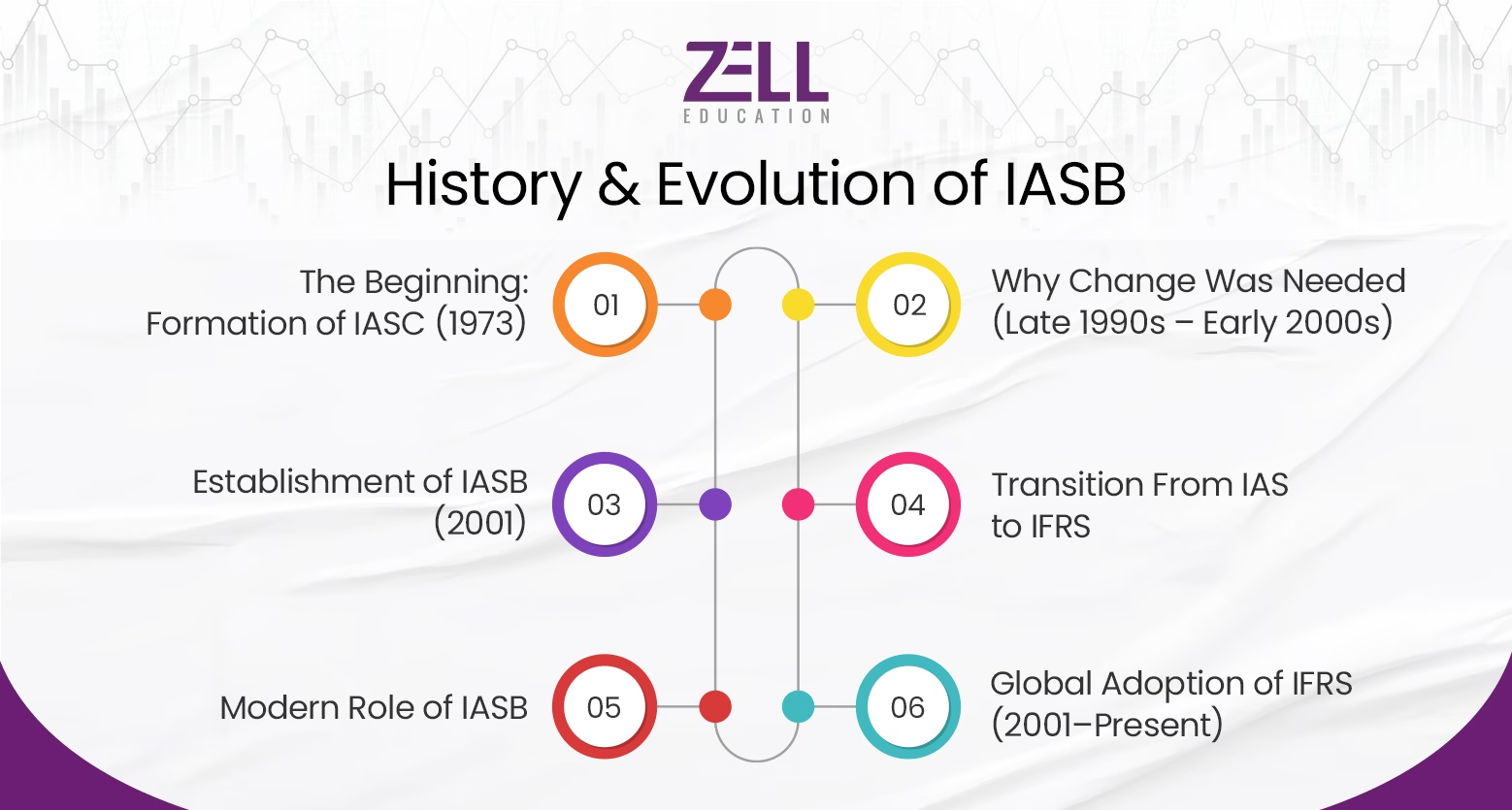
Grasping the history of the IASB will show readers why it was established as well as how it became the most influential accounting body in the world. So, we will use a simple timeline to make this simple to understand.
1. The Beginning: Formation of IASC (1973)
Before the inception of the International Accounting Standards Board (IASB), there existed a predecessor organisation, the International Accounting Standards Committee (IASC). The IASC, which was established in 1973, existed well in advance of globalisation, which ushered in international business.
Reasons for the formation of the IASC:
- Countries had different accounting frameworks.
- Investors (investing globally) struggled to even compare these respective companies.
- There was no global organisation that developed uniform standards.
- The IASC ultimately began the process of developing standard accounting standards (International Accounting Standards – IAS).
2. Why Change Was Needed (Late 1990s – Early 2000s)
With the growth of global business, financial markets became interconnected. This resulted in:
- Companies were establishing an international reach.
- Investors were purchasing equities in multiple countries.
- Multinational enterprises required universal reporting.
- But IASC was limited in several ways:
- IASC had weak governance.
- IASC lacked a formal structure for the decision-making process.
- Global regulators were asking for a more robust standard-setting body.
In the end, it was apparent that the world required a more contemporary, independent, and transparent organisation.
3. Establishment of IASB (2001)
To address these challenges, in 2001, IASC was superseded by the IASB—International Accounting Standards Board.
This was a substantial shift in a global approach.
The IASB provided:
- A stronger governance structure
- Improvements to the proper procedure to adhere to standards
- More global representation
- Direct oversight from the IFRS Foundation
- Higher quality and more detailed standards
The establishment of the IASB initiated a new era of international accounting.
4. Transition From IAS to IFRS
When the IASB was established, the older IAS standards were not simply gone. Rather:
- IAS = Old standards (still in effect)
- IFRS = New standards issued by IASB
- IASB now controls BOTH IAS and IFRS
Consider it this way:
IFRS finally has the newest chapters, but the old chapters still remain:
- IAS = Old chapters of the book;
- IFRS = New chapters added by IASB, and
- IASB controls both IAS and IFRS
Both IAS and IFRS are part of the same book—the accounting “global” book.
5. Global Adoption of IFRS (2001–Present)
Throughout the years, 140+ nations accepted IFRS, which was created by the IASB.
This includes countries in Europe, Asia, and Africa and countries with great economies around the world.
Countries decided to adopt IFRS for the following reasons:
- Improves comparisons of financial statements
- Fosters accountability to investors
- Supports international trading and investment
- Ease of report preparation for multinational firms
As of today, IASB is the recognised global leader in regard to accounting standards.
6. Modern Role of IASB
In the past few years, IASB has broadened its focus by:
- Improving technology-oriented reporting
- Developing sustainability & ESG disclosures
- Revising standards to reflect real-life business practices
- Engaging in conversations with regulators around the globe
And so it evolves with ongoing changes in the global business and economic environment.
Why the Transition Was Needed
The transition from IASC to IASB took place because of the following reasons:
- Financial markets had become global
- There was a need for a more rigorous structure for standard setting
- The world demanded clear and consistent rules
- Companies were expanding internationally
- Investors demanded comparable financial statements
Finally, IASB provided a governance structure, increased transparency, and a rigorous due process for the development of standards.
Relationship Between IAS and IFRS
Before 2001, standards were called IAS (International Accounting Standards).
After the IASB was formed, new standards were named IFRS (International Financial Reporting Standards).
Important points:
- IAS = Older standards
- IFRS = New standards
- Both are still used
- The International Accounting Standards Board governs both
This connection is essential for students preparing for professional exams like ACCA, CPA, CMA, and CFA.
Structure of IASB
The composition of the IASB full form is intended to promote transparent, balanced, and globally representative standard-setting, with expertise from board members, advisory groups, and oversight from the IFRS Foundation in the development of high-quality financial reporting around the world.
Board Team
The IASB full form is composed of:
- Accounting professionals
- Auditors
- Financial analysts
- Academics
- Industry experts
They come from a variety of countries to ensure that all worldwide accounting perspectives are fair.
Advisory groups
The IASB collaborates with advisory groups, such as:
- IFRS Advisory Council
- IFRS Interpretations Committee (IFRIC)
- Other working groups and consultative groups
- These advisory groups provide technical and industry input.
Oversight by IFRS Foundation
Though IASB writes the standards, it is overseen by the IFRS Foundation, which ensures:
- Transparency
- Accountability
- Independence
- Strong governance
This relationship keeps the global standard-setting system balanced.
Key Functions of IASB
The main goals of the IASB are to develop international accounting standards that promote transparency and comparability of financial statements. The IASB is committed to developing, improving, and offering guidance on IFRS to provide companies with a framework for reporting their financial information consistently while adhering to international standards.
Developing and Issuing IFRS Standards
The primary role of the IASB is to develop IFRS standards that serve as the global language of financial reporting.
These standards define:
- How transactions should be recorded
- How assets are valued
- How revenues should be acknowledged
- How companies must disclose information
Updating Existing Standards
As business evolves, IASB constantly updates standards to reflect:
- New technology
- New business models
- Global economic changes
- Stakeholder feedback
This keeps IFRS modern and relevant.
Promoting Global Financial Reporting Consistency
The International Accounting Standards Board makes sure that companies across the world follow the same rules:
- Investors can compare results
- Companies can expand globally
- International trade becomes simpler
- This consistency is essential for a stable global economy.
Enhancing Transparency & Comparability
IASB standards enable readers to clearly understand:
What a company owns,
- What it owes,
- How profitable it is,
- How efficiently it operates.
- Transparency builds trust, and trust fuels investment.
Major Standards & Projects by IASB
This part of the document outlines key IFRS standards and guidance documents issued by the IASB that impact financial reporting around the world.
IFRS Standards Published
Some well-known IFRS Standards are the following:
- IFRS 9 – Financial Instruments
- IFRS 15 – Revenue from Contracts
- IFRS 16 – Leases
- IFRS 17 – Insurance Contracts
These standards are highly utilised around the world.
IFRIC & SIC Interpretations
- IASB releases interpretations via:
- IFRIC – IFRS Interpretations Committee
- SIC – Standing Interpretations Committee (older)
These gain clarity in certain areas of accounting.
Current Work Plan & Projects
IASB is currently looking into:
- Disclosure pertaining to sustainability matters
- Digital reporting
- Improved communication in financial statements
- Updating primary financial statements
- Economic changes globally
Importance of IASB in Global Finance
The IASB is fundamental for financial information to be transparent and uniform internationally. Its standards facilitate trust and comparability of financial statements by investors, companies, and regulators, enhancing the global financial system.
Facilitating Cross-Border Comparability
With the help of the IASB:
- A company in India can be correlated to one in Europe.
- Investors can analyse companies on a worldwide basis.
- Financial statements have become standardised.
- This comparability will increase worldwide investing.
Increasing Investor Confidence
Investors have confidence in IFRS financial statements because:
- They are based on standardised rules.
- They provide a level of transparency.
- Companies cannot easily manipulate the accounting.
- Confidence → Investing → Economic growth.
Assisting Multinational Companies
For multinational companies, having one single standard around the world:
- Reduces compliance costs.
- Eases the reporting process.
- Simplifies cross-border business.
The IASB makes it easier for companies to develop globally.
IASB vs FASB: Key Differences
The IASB vs FASB undertake different roles and issue different standards for financial statement preparation, as well as having different global reach.
Understanding the differences allows students to easily identify how IFRS vs US GAAP are developed in different jurisdictions and follow different systematic approaches to accounting processes.
| Basis of Difference | IASB (International Accounting Standards Board) | FASB (Financial Accounting Standards Board) |
| Full Form | International Accounting Standards Board | Financial Accounting Standards Board |
| Accounting Framework | IFRS (International Financial Reporting Standards) | US GAAP (Generally Accepted Accounting Principles) |
| Jurisdiction | Used in 140+ countries that include Europe, Asia, Africa, and Australia. | Used mainly in the United States |
| Primary Goal | Global consistency and comparability | Detailed compliance within U.S. markets |
| Governance | Overseen by the IFRS Foundation | Overseen by the Financial Accounting Foundation (FAF) |
| Standard Updates | More flexible and regularly updated | More structured and detailed modifications |
| Focus | Ensuring a global reporting framework | Assuring accurate reporting within the U.S. jurisdiction |
Convergence Efforts
IASB and FASB have worked for years to bring IFRS and US GAAP closer, though full overlap has not yet been achieved.
IASB for Students & Accounting Professionals
Students and professionals alike are aware of the importance of IASB and IFRS in today’s accounting and finance careers. It illustrates how IASB standards are integrated into key professional examinations and can open the world for employment.
Why ACCA, CPA, CMA, CFA Students Study IASB
Professional course students need to know the IASB because:
- Accounting standards are in exams
- Getting gainful employment opportunities with knowledge of IFRS
- The IASB is overseeing and laying the foundations for modern, purely financial reporting
- IASB is present in the ACCA and CPA certification.
Career Opportunities Linked to IFRS Knowledge
Individuals with knowledge of IFRS take on an esteemed role in international companies, MNCs, Big 4 firms, and audit/consulting positions. Salary offerings vary based on experience. However, IFRS-skilled candidates typically receive higher compensation due to the technical requirements of the work.
| Job Positions | Average Salary (INR) |
| Financial Reporting Associate | INR 3.2 Lakhs – 15 Lakhs |
| IFRS Consultant | INR 2 Lakhs – 11 Lakhs |
| IFRS Specialist | INR 3.3 Lakhs – 23 Lakhs |
| Senior Financial Analyst (IFRS) | INR 3.2 Lakhs – 20 Lakhs |
| Finance Manager / Controller | INR 4 Lakhs – 34.4 Lakhs |
| Audit & Assurance Manager (IFRS) | INR 7.2 Lakhs – 41 Lakhs |
| Big 4 IFRS Advisory Roles | INR 20 Lakhs to 65 Lakhs |
Source of Reference for Career Opportunities Linked to IFRS Knowledge: Ambition Box
Want to Pursue IFRS Finance Career?
Book Your Free Counselling Session Today
Conclusion: IASB’s Role in Modern Accounting
The International Accounting Standards Board (IASB) is more than just a global organisation; it serves as the backbone of international financial reporting, promoting transparency, consistency, and trust in the business world.
Whether you are a student or a professional or are simply reviewing global accounting systems, by understanding what the IASB is, the IASB’s objectives, and the importance of the IASB, you will have the knowledge necessary to understand the foundation of modern corporate reporting fully.
IAASB continues to shape global finance, and its influence will only become stronger.
FAQs on What is IASB
What is IASB in simple terms?
The full form of ISAB is the International Accounting Standards Board, a global organisation that creates accounting rules used by companies around the world to prepare clear and consistent financial statements.
Are IFRS and IAS the same?
No. IAS are older standards that were issued prior to 2001. IFRS are newer standards that have been issued since 2001 and onwards. IAS and IFRS coexist and are used, but IFRS is slowly replacing IAS.
Who controls IASB?
IASB is controlled and overseen by the IFRS Foundation, an independent non-profit organisation responsible for supervising its activities and ensuring the standards serve the public interest.
What is the number of IFRS Standards published by the IASB?
The IASB is responsible for producing numerous versions of the IFRS, including seventeen primary IFRS specifications, as well as multiple enhancements and clarifying guidance regarding worldwide accountancy.
Why Would a Student Want to Learn About IASB?
Students will benefit from acquiring knowledge about the IASB since its standards with IFRS are in use across the globe, enabling students to develop a wider understanding of accounting principles, enhance their future job potential and understand the way in which financial statements are reported around the world.
What jobs can I do with IFRS knowledge?
You can work as an IFRS Analyst, Financial Reporting Associate, IFRS Consultant, Senior Analyst, or in an audit, and any type of finance management position.

Current Role
Co-Founder & CEO at Zell Education
Education
- ACCA – Association of Chartered Certified Accountants, Finance (2011 – 2014)
- Bachelor of Commerce (BCom), Financial Markets from H.R. College Of Commerce & Economics (2010 – 2013)
Location
Mumbai, India
Expertise
ACCA Certified
Why Zell?
- • Largest Provider for Global F&A Courses
- • 4.6 Google Review Rating
- • 1000+ Students placed Annually
- • 500+ Active Hiring Partners
- • Placement Opportunities at the Big 4
- • 100+ Global & Indian Rank Holders
- • 100+ Faculty Network
Speak to A Career Counselor
Zell's 10th Anniversary Offer - Avail a 10% Scholarship