
A CPA is essentially a Certified Public Accountant, which is administered by the American Institute of Certified Public Accountants. CPA is basically the American version of what we call a Chartered Accountant in India.
The CPA course has now gained tremendous popularity and has a great scope now in India as well as many other countries such as the USA, Canada, Singapore and the Gulf Countries as well.
What is MBA?
An MBA (Master of Business Administration) is a postgraduate degree for candidates who want to kickstart a career in business management. Among the many specialisations offered, you can go for an MBA in Finance if you wish to apply your managerial skills to the finance sector.
An MBA specialising in finance is suitable for people with a vision for a successful career in finance. The programme imparts knowledge of the management of finances and accounts for companies.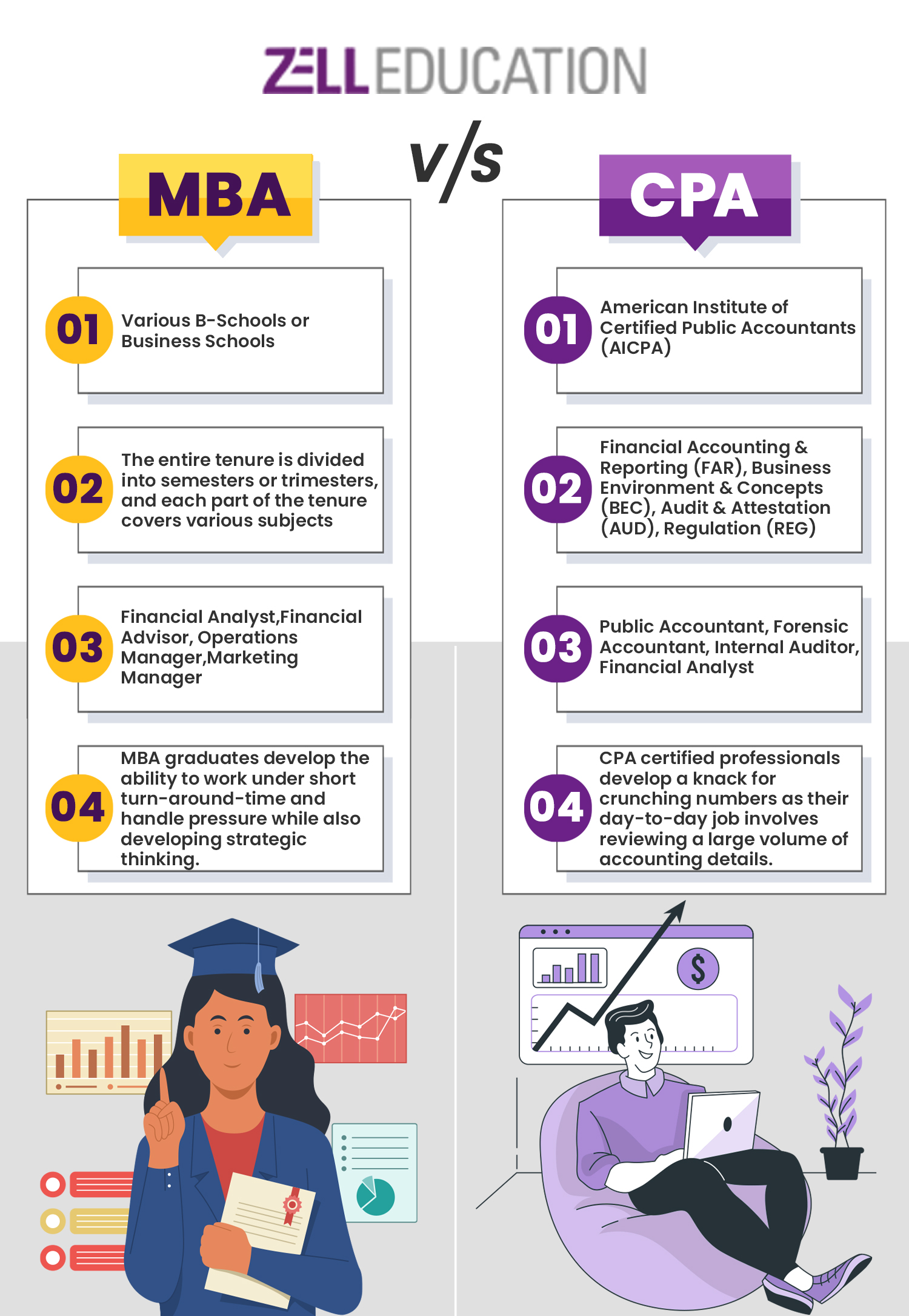
CPA vs MBA: Major Differences
| Point of Difference | US CPA | MBA |
| Organising body | IMA (Institute of Management Accountants) awards the CPA designation to individuals who have successfully completed the course. | Private and public universities and colleges worldwide offer MBA courses to interested candidates. |
| Fees comparison | The CPA course is more affordable than an MBA course.
The standard evaluation fee for checking eligibility is around INR 22000, while the exam fee is USD $900 (may vary). |
Depending on the college, it will cost you between INR 4 and 20 LPA to complete your MBA degree.
MBA fees are much higher than FRM since autonomous authorities provide the course. |
| Course duration | The entire duration of the US CPA course could range from 12 to 18 months. | An MBA program from a reputed university will take two years to complete. |
| Syllabus | The syllabus includes
Financial Accounting and Reporting (FAR) Auditing and Attestation (AUD) (72 questions from each of these subjects are asked.) Business Environment and Concepts (BEC) Regulation (REG) |
The syllabus includes
Business Ethics. Financial and Marketing Management. Operations Research. Accounting. Business Statistics. Human Resource Management. |
| Skills |
A CPA equips you with specialised skills like financial analysis, auditing, regulatory compliance, tax expertise, and forensic accounting. CPAs are expected to have strong analytical thinking, attention to detail, and ethical judgement. These skills are highly valued in audit firms, multinational companies, and government agencies. |
An MBA, particularly in Finance, builds broader business management skills. These include leadership, strategic decision-making, financial planning, marketing, human resource management, and business communication. MBA graduates are trained to think critically, solve complex business problems, and manage cross-functional teams effectively. |
| Job prospect | Common job profiles after US CPA include:
Public Accounting Corporate Controller Tax Examiner Business System Analyst |
An MBA in Finance will land you one of the following job profiles:
Finance Manager Operations Manager Accountant Investment Banker |
| Leadership Opportunities |
While CPA roles traditionally focus on technical expertise, leadership opportunities do exist, especially in roles like Chief Financial Officer (CFO), Financial Controller, and Partner at accounting firms. However, the leadership path usually requires additional years of experience and proven expertise in financial management. |
An MBA is designed to fast-track candidates into leadership roles. MBA graduates are often placed directly into management training programs, leadership development roles, and upper management positions. Specialisations like MBA in Finance, Strategy, or Consulting can lead to roles such as Finance Director, Investment Banker, or even CEO over time. |
| Salary expectations | The mean salary for a Public Accountant in India ranges between INR 3.61 LPA and INR 10 LPA. | The average base salary for a graduate in MBA Finance in India is INR 7.62 LPA. It can go up to INR 20 LPA for an Operations Manager. |
Source of Reference for US CPA Course Details and MBA Course Details – Wikipedia.
Can You Earn Both a CPA and an MBA?
Definitely, and the truth is that possessing a CPA and an MBA together can turn your career around. A lot of people in the accounting and finance field work out their skills so that they could either get an MBA or simply get a CPA. A CPA designation marks you as an authority in accounting and finance, whereas an MBA embodies the qualities of being a manager, a strategic thinker, and a leader in your profession.
By combining both qualifications, you position yourself for senior leadership roles like CFO, Financial Consultant, or VP of Finance, where both deep financial expertise and strong management skills are critical. It’s a powerful combo if you aspire to work in top multinational companies or even start your own business.
Curious About CPA vs MBA?
Which Course is Better, CPA vs MBA?
US CPA is the right course if you are interested in crunching numbers and handling public accounts. This course not only helps you gain Chartered Accountancy opportunities in the US, but in case you wish to work for US-based companies in India, with a CPA degree you can choose to work at the Big 4.
However, if you’re interested in getting into the management side of finance, then an MBA degree in finance is just what you need. There’s one thing about an MBA degree that you need to consider before getting into a course. The college you get into to pursue your MBA degree should be one of the top 10 colleges in India to actually make the degree count.
We hope that with this detailed article on CPA vs MBA, you’ve received some detailed information on which course to choose and what to expect. If you wish to pursue US CPA with us or enquire about the range of professional courses that we offer, then we suggest that you click on the WhatsApp icon at the side of this blog and get in touch with our experts directly.
Planning to Pursue CPA Accounting Career?
To Book Your Free Counselling Session
FAQs on CPA vs MBA
Should I pursue a CPA or MBA for a top finance career?
Choose CPA for public accounting, auditing, and tax leadership. Choose MBA for broad general management, corporate strategy, and non-accounting executive roles.
Generally, who earns more, CPA or MBA graduate?
High-level executives, often holding an MBA, may earn more initially. However, experienced CPAs in specialised financial leadership or consulting roles can match or exceed those salaries.
What should come first: the CPA or MBA qualification?
It is often beneficial to get the CPA first to secure core technical expertise in accounting, then pursue an MBA for strategic advancement later in your career.
Is getting a CPA after MBA still worth the extra effort?
Yes, earning a CPA after MBA creates a powerful profile, combining strategic business acumen with deep financial accounting authority, highly valued for CFO roles.
Which is considered academically harder, CPA or MBA program?
The CPA exam is often considered technically harder due to its focused regulatory and specialised accounting depth, requiring intense preparation and high retention.
Do I need an MBA if I already have a CPA license?
Not always. If your goal is technical accounting leadership, the CPA is enough. An MBA is only necessary if you aim to pivot into general management or operations.
Where can I find coaching for CPA exam success in India?
You can find expert, structured coaching for the highly rigorous CPA exam right here. Zell Education specialises in preparing candidates for this US qualification.

Why Zell?
- • Largest Provider for Global F&A Courses
- • 4.6 Google Review Rating
- • 1000+ Students placed Annually
- • 500+ Active Hiring Partners
- • Placement Opportunities at the Big 4
- • 100+ Global & Indian Rank Holders
- • 100+ Faculty Network
Speak to A Career Counselor
Zell's 10th Anniversary Offer - Avail a 10% Scholarship