
Want to dive into the highly dynamic world of investment banking? Before you take the leap, be sure about what you are getting yourself into in terms of money and time. Knowing what an investment banking course costs and its duration will help you choose the right path, whether you are looking at a short certification or a comprehensive diploma course. Let’s dive into the details so you can make a better decision and be one step closer to that corner office!
The Core of Investment Banking Careers and Functions
- Investment Banking Role: Professionals in Investment Banking advise corporations and governments on raising capital, complex financial transactions, and strategic financial events.
- Investment Banking Functions: Major functions include M&A advisory, facilitating IPOs, debt and equity offerings, conducting due diligence, and company restructuring.
- Investment Banking Skills: Necessary skills include strong financial modelling, advanced Excel proficiency, valuation techniques, and impeccable attention to detail and rigour.
- Investment Banking Career Path: The typical career path progresses from Analyst to Associate, then to Vice President, and finally culminates at the prestigious Managing Director level.
- Investment Banking Salary: Investment Banking offers competitive compensation, comprising a high base salary augmented significantly by substantial, performance-based annual bonuses.
Investment Banking Preparation: A strong foundation requires a finance degree and relevant certifications, like the CFA, alongside crucial deal experience gained through internships.
What is an Investment Banking Course?
An investment banking course is the ideal way of acquiring all the theoretical and practical knowledge needed to carry out the investment banking profession. These courses attract professionals or students aiming for a career in investment banking, where the professionals would work with financial transactions related to mergers, acquisitions, and capital raising and even provide financial advice.
To know more about Investment Banking Course, also read What is Investment Banking?, by Zell Education
Curious About Investment baking course fees?
What are the Core Modules of the Investment Banking Course?
Financial Modeling: Training in constructing and interpreting financial models that assess business performance and investment opportunities.
Valuation Techniques: Learn to estimate enterprise value and asset values like DCF analysis, comparable company analysis, and precedent transactions.
Mergers and Acquisitions (M&A): The processes and strategies involved in M&A transactions, including due diligence, deal structuring, and negotiation.
Capital Markets: Learn how capital markets work, equity and debt offerings, IPO procedures, and market regulations.
Corporate Finance: The course will introduce candidates to the different principles of corporate finance, such as capital budgeting, risk management, and financial statement analysis.
Industry Knowledge: Some courses will give insights into specific sectors, technology, health, energy, or others depending on career goals.
Regulatory and Compliance Issues: Be aware of the legal and regulatory framework within which the investment banking practices are conducted.
Soft Skills: Communication, negotiation, and analytical skills in investment banking.
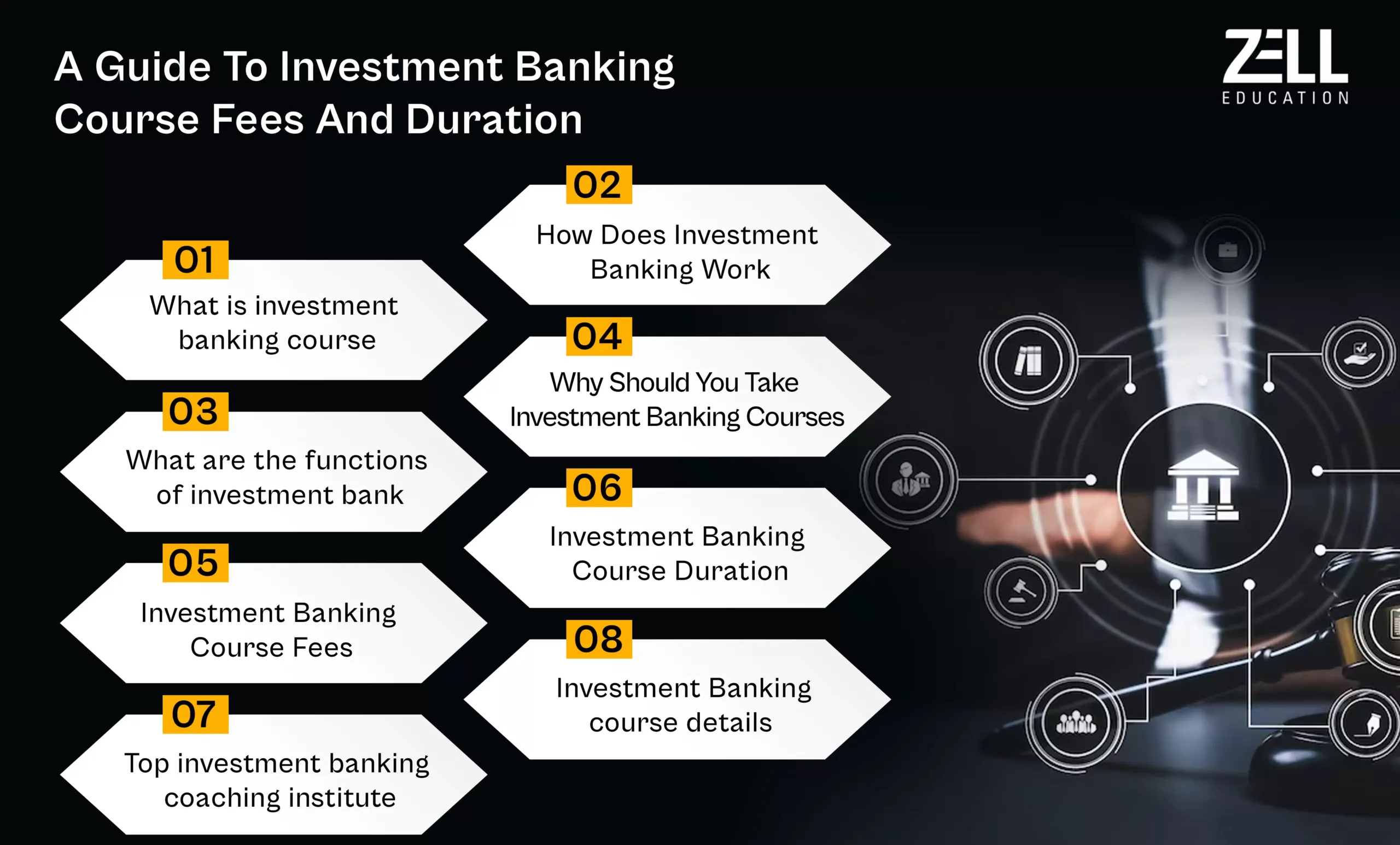
Investment Banking Course Details
Investment Banking course details include syllabus, exams, skills, and career opportunities.
Investment Banking Syllabus
The Investment Banking syllabus varies from institution to institution. At Zell Education, we provide a comprehensive 12-module syllabus covering all the important topics.
Module 1 – Introduction to Financial Systems
The complete introduction to financial systems is provided by the unit with the discussion of concepts, structure, main components, and roles. It points out the financial markets, institutions, and instruments which are established in the global economy and how collective action has made it possible for capital and investment to flow.
Module 2 – Equity Markets
The main focus would be on the equity markets, where you would learn how stocks get issued, traded, and valued. This would include understanding stock exchanges, trading mechanisms, market participants, issues determining stock prices, and factors influencing investors’ behaviour.
Module 3 – Valuation Techniques
Overview of how companies and financial assets are valued. Discussion on some vital methods, such as Discounted Cash Flow analysis, Comparable Companies Analysis, and Precedent Transactions, will be available compared to making informed decisions on investment.
Module 4 – Derivatives Markets and Types
You will learn the markets of derivatives, including the various types of derivatives: options, futures, and swaps, and how these instruments are used for hedging, speculation, and arbitrage. You will be taught their role in the management of financial risk.
Module 5 – Basic to Advanced Excel
In this module, you will be taken through Excel from the basic functions to advanced features used in financial analysis. You will be able to use Excel’s tools to build and manipulate financial models, run complex calculations, and analyse data proficiently.
Module 6 – Financial Modeling
Financial modeling is an activity in which you try to represent the financial performance of a company. You will become competent in building models to project revenues, expenses, and valuations and in how to use models to make decisions in investment banking and corporate finance.
Module 7 – LBO (Leveraged Buyouts)
In this section, you will learn about the mechanics of leveraged buyouts, an acquisition where a business enterprise is acquired using a significant amount of borrowed money to meet the cost of acquisition. This module includes structuring LBO deals, evaluating the deal’s feasibility from a financial perspective, and other associated risks and rewards of such transactions.
Module 8 – Mergers & Acquisitions (M&A)
In this module, the different processes and strategies in mergers and acquisitions are examined. You will learn about deal structuring, valuation techniques, due diligence, integration strategies, and the strategic reasoning for M&A dealings.
Module 9 – The Startup Ecosystem
You will be taken through the dynamics of the startup ecosystem: stages of funding, venture capital, and all the associated challenges a startup faces. This module helps you gain insight into how a startup is appraised, financed, and scaled within the entrepreneurial ecosystem.
Module 10 – Due diligence
Due diligence is an investigative and analytical exercise that goes alongside financial transactions. You will learn of the steps to be performed in the evaluation of the company’s financial health, legal standing, and operational risks, which help in making informed decisions in deals and investments.
Module 11 – Forex & Risk Management
This part lists foreign exchange markets and currency risk management strategies. You will be able to understand how they work, the impact of changes in currencies on financial performance, and how to control associated risks.
Module 12 – Compliance and Regulatory
It is essential to have a comprehensive grasp of compliance and regulations in investment banking. This module will walk you through a thorough examination of the legal and regulatory framework that controls the various financial markets, including the AML and KYC regulations that must be observed in order to maintain the industry’s established standards.
Also read A Guide To Investment Banking Course Syllabus to know more about the Investment Banking Course Details.
Investment Banking Course Duration
These investment banking courses‘ duration ranges from a few weeks to one year, depending on the scope and depth of the program. Courses designed to give basic knowledge about investment banking normally run from 4 weeks to 8 weeks. Certification programs, which are aimed at providing good education and covering all important aspects like financial modeling, valuation, and M&A, take about 3 months to 6 months.
The courses run for 6 months to a year or more in the advanced or professional levels of training. This would involve in-depth modules, practical projects, and extensive industry exposure. Duration often varies from institution to institution and with respect to the particular format of the course, like online or offline classes.
At Zell Education, you can complete your post-graduation program in Investment Banking in 6 months.
Investment Banking Course Fees
The course fees for investment banking would typically lie between ₹50,000 and ₹3 lakhs, depending on certain factors such as the duration, institution, and depth of content. At Zell Education, the fee for the investment banking course is INR 1,20,000 and you receive 100 hours of training in it.
Top Investment Banking Coaching Institute
| Institute Name | Approx. Fees |
| Zell Education | INR 1,20,000 |
| BSE Institute Limited | INR 5,60,000 |
| Amity University (Mumbai) | INR 5,00,000 |
| IEM Kolkata | INR 3,20,000 |
| Imarticus Learning | INR 3,25,000 |
Investment Banking Exams
At the end of each module in this 6-month course on investment banking, a simple test will be carried out to assess the understanding and retention capacity of the learner on the covered material. Investment Banking exams will check the understanding and application in practice of the key concepts covered during each module and that participants grasped the foundation and advanced topics effectively.
Investment Banking Career Opportunities
Explore the diverse investment banking career opportunities available in investment banking with the following list.
1. Investment Banking Analyst
Analysts spend their time doing financial analysis and modeling and, therefore, conducting research. They prepare “pitch books”, financial reports, and deal documentation, such that they tend to do the majority of the work and support senior bankers.
2. Investment Banking Associate
The associate manages the analysts, leads the client contact, and takes care of transaction execution. They handle deal structuring, due diligence, and production of presentation materials and associated financial models.
3. Finance Manager
Finance Managers are responsible for the overall oversight and management of the financial health of a given organisation. They take charge of budgeting, financial planning, and financial reporting. The finance manager is directly linked to other departments in the origination of finance strategies and managing cash flow to sustain business decisions.
4. Relationship Manager
The relationship managers build and maintain strong connections with their clients. They get to know the financial needs of the clients, they present the financial products and services that suit them, and they give continuous support to the clients, which results in client satisfaction. Their duty is to take care of client portfolios, respond to client queries, and devise methods for enhancing client retention and growth.
Source of Reference for Investment Banking Career Opportunities – Naukri
Why Should You Take Investment Banking Courses?
Career Opportunities: The courses will equip one with the knowledge and skills to get involved in a highly remunerative and competitive field, accompanied by diverse career paths.
Skill Development: This course teaches you how to use some essential skills, such as financial modeling, valuation techniques, and market analyses, to succeed in investment banking.
Industry Knowledge: Deep industry knowledge of capital markets and corporate finance, coupled with that of processes involved in M&As, helps one stay ahead in the industry.
Networking: Investment banking courses offer strong networking opportunities and are outstanding ways to meet industry professionals, peers, and potential employers. This factor may be very helpful for advancing in one’s career.
Certification and Credentials: Many investment banking courses are known whose completion may increase a resume’s worth and give credibility to job seekers in the job market.
Practical Experience: Case studies, simulations, and involvement in internships provide practical experience in scenarios of a real-world nature.
Read What are the Advantages of Investment Banking to have more detailed information about Why Should You Take Investment Banking Courses?
Want to Pursue Investment Banking course?
Talk to Our Expert Today
Conclusion
In the end, an investment banking course fills students up with a vivid and dynamic profession, with important tools in financial analysis, modeling, and strategic transaction execution. By knowing the details of the investment banking course through fees and the duration it takes, you’re likely to be in a better position to decide if it’s a good investment in the course that promises good professional growth and opportunity, fitting our fiercely competitive world; that is investment banking.
FAQs on Investment Banking
What qualifications are needed for an Investment Banker role?
A bachelor’s degree in finance or commerce is a start, but specialised investment banking course training in financial modeling and valuation is crucial for entry.
What is the average starting Investment Banking salary in India?
The starting salary for an analyst is very high, often ₹10-15 LPA or more at top firms. Compensation significantly outpaces many other entry-level finance roles.
Is Investment Banking a 9-to-5 job, or are the hours longer?
No, investment banking is famously demanding, requiring extremely long hours (often 70+ per week). It is definitely not a typical 9-to-5 job.
Is Investment Banking a lot of math and complex calculations?
Yes, Investment Banking involves a lot of maths, particularly in financial statement analysis, valuation, and complex financial modeling using Excel.
How long does a practical Investment Banking Course usually last?
A focused investment banking course or financial modeling certification, like those offered by Zell Education, typically takes about 3 to 6 months to complete.
Which institute is best for Investment Banking practical training?
Institutes that offer hands-on, project-based learning and cover advanced financial modeling and valuation, such as Zell Education, are considered the best.
How hard is it to become an Investment Banker after graduation?
It is highly competitive. Success requires excellent networking, a high GPA, and specialised technical knowledge, which a dedicated Investment Banking Course can provide.

Why Zell?
- • Largest Provider for Global F&A Courses
- • 4.6 Google Review Rating
- • 1000+ Global Placement Partners
- • Placement Opportunities at the Big 4
- • 100+ Global & Indian Rank Holders
- • 100+ Faculty Network
- • 10,000+ Students Placed
Speak to A Career Counselor
Zell's 10th Anniversary Offer - Avail a 10% Scholarship